XI-Physics CH-11

Special Theory of Relativity

Topic 11.1

Relative Motion

Why Relativity

At the beginning of the twentieth century, new experiments and theoretical calculations revealed that classical physics, based on Newton’s laws, could not explain phenomena involving extremely small particles or very high velocities. This led to relativistic mechanics.

Einstein

Albert Einstein’s special theory of relativity, introduced in 1905, proposed that the laws of physics are the same for all observers and that the speed of light is constant, regardless of the observer’s motion.

Direction Is Relative

Consider throwing a ball to your right. For someone facing you, this direction appears to be to his left, so direction is a relative concept.

Rest and Motion Are Relative

The walls of a moving train seem stationary to the passengers inside but appear to be moving to someone standing on the ground. We cannot say whether an object is absolutely at rest or in motion; all motions are relative to the observer or to the reference frame being used.

The Experiment

An observer in a closed train compartment uses the compartment as his frame of reference. To determine the train’s motion he drops a ball and measures the horizontal distance travelled by it, the vertical distance being the same in each case and covered in a time $t$.

Case (a) — The Train Is Stationary

The horizontal velocity of the ball is zero, so the horizontal distance travelled is also zero. The observations made inside and outside the train are identical, and the ball falls to a point on the floor directly below the point from which it was dropped.
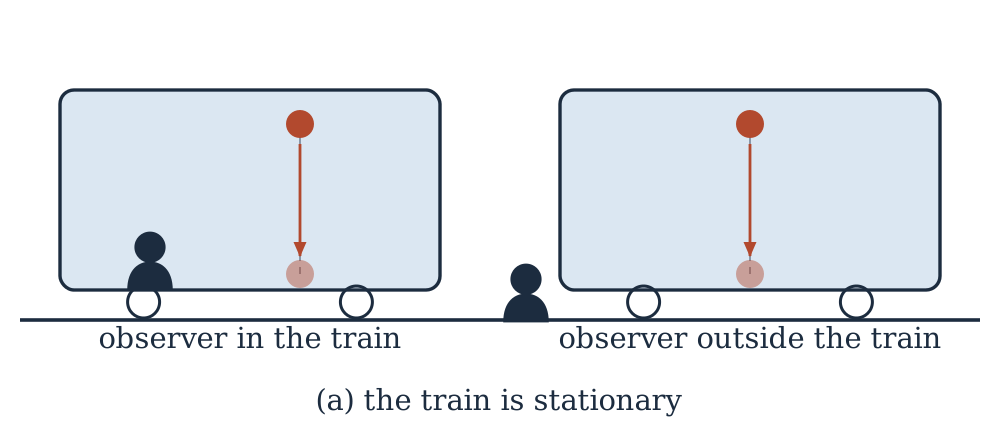
A ball dropped inside a stationary train falls straight down for both observers

Case (b) — The Train Moves With Uniform Velocity

When the ball is released it has an initial horizontal velocity $v_o$ and behaves like a projectile, travelling a horizontal distance $v_ot$ in the time it takes to reach the floor.

The Observer Inside

The train and the observer inside it move the same horizontal distance in the same time, so the observer inside sees the ball fall to a point on the floor directly below where it was dropped.

The Observer Outside

An observer outside the train sees the ball following a projectile path.
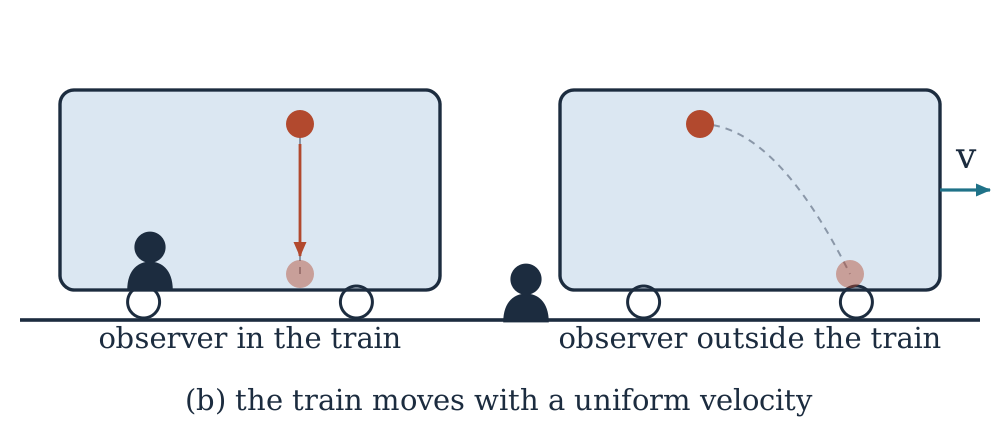
A ball dropped inside a moving train falls straight down for the traveller and follows a projectile path for the observer outside

Conclusion

Observers in different frames of reference, moving with uniform velocity relative to each other, will perceive motion differently.

Short Questions

SQ 11.1.1

Why did classical physics have to be extended at the beginning of the twentieth century?

Two Failures

Newton’s laws could not explain phenomena involving extremely small particles or very high velocities.

The Answer

Relativistic mechanics, and Einstein’s special theory of relativity of 1905, gave a framework that covers both.
SQ 11.1.2

A ball is dropped inside a train moving with uniform velocity. Compare what the two observers see.

Inside the TrainOutside the Train
The ball falls straight down.The ball follows a projectile path.
Its horizontal velocity is zero.Its horizontal velocity is $v_o$.
It lands directly below the release point.It lands a distance $v_ot$ along the track.
SQ 11.1.3

Why can we not say that a body is absolutely at rest?

Reason

Rest and motion are judged against a frame of reference, and every frame is itself moving relative to some other. All motion is therefore relative to the observer.
SQ 11.1.4

Show that direction is a relative concept.

Example

A ball thrown to your right appears to be thrown to the left of someone facing you. The same motion is described differently in the two frames.
MCQ 11.1.1

The special theory of relativity was introduced by Einstein in:

A1915B1919
C1925D1905
Solution:The general theory came ten years later.
MCQ 11.1.2

A ball dropped inside a train moving with uniform velocity is seen by the passenger to:

Afollow a projectile pathBfall straight down
Cmove backwardsDstay in the air
Solution:The passenger and the ball share the same horizontal velocity.
MCQ 11.1.3

Classical mechanics fails for objects moving with:

Aa low velocityBthe velocity of sound
Ca velocity approaching that of lightDa constant velocity
Solution:Relativistic corrections then become large.
MCQ 11.1.4

The direction in which a ball is thrown is:

Aa relative conceptBan absolute concept
Cindependent of the observerDthe same for everyone
Solution:What is to your right is to the left of someone facing you.
Topic 11.2

Frames of Reference

LQ 1starts here — What is meant by the frame of reference? Distinguish between an inertial frame of reference and a non-inertial frame of reference by giving examples.

Frame of Reference

A frame of reference is any coordinate system relative to which measurements are taken.

Examples

The position of a table in a room can be described relative to the walls, making the room the frame of reference.
The laboratory is the reference frame for the measurements taken there.
If the same experiment is performed in a moving train, the train becomes the frame of reference.
The position of a spaceship can be described relative to the distant stars, and a coordinate system based on those stars is then the frame of reference.

Inertial Frame of Reference

An inertial frame of reference is a coordinate system in which the law of inertia is valid. A body at rest remains at rest unless acted upon by an unbalanced force that produces acceleration, and the other laws of nature also apply in such a system.

The Earth

A body placed on the Earth remains at rest unless an unbalanced force acts upon it, so the Earth can be considered an inertial frame of reference.

A Moving Car

A body in a car moving with uniform velocity relative to the Earth also remains at rest, so the car is also an inertial frame.
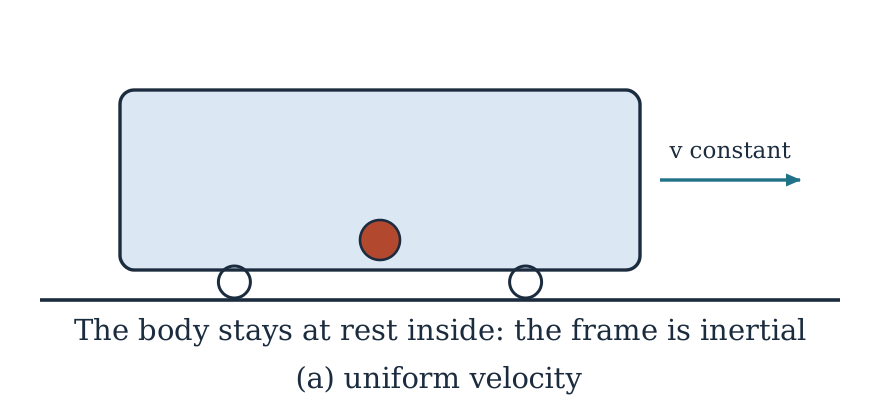
A car moving with a uniform velocity is an inertial frame of reference

General Rule

Any frame of reference moving with uniform velocity relative to an inertial frame is also an inertial frame.

Non-Inertial Frame of Reference

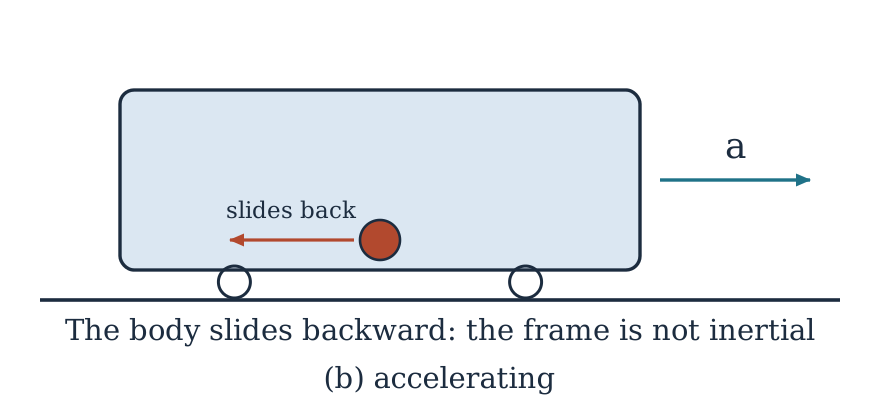
If the moving car is suddenly stopped or accelerated, the body inside no longer remains at rest, so the car is not an inertial frame. An accelerated frame of reference is a non-inertial frame.
An accelerating car is a non-inertial frame of reference

The Earth Again

The Earth is rotating and revolving, so strictly speaking it is a non-inertial frame, but it is often treated as an inertial frame because of its relatively small acceleration.
LQ 1ends here

Short Questions

SQ 11.2.1

Give three examples of a frame of reference.

Examples

The walls of a room, for the position of a table in it.
The laboratory, for measurements taken there.
The distant stars, for the position of a spaceship.
SQ 11.2.2

Why is the Earth treated as an inertial frame even though it is not one?

Strictly Not

The Earth rotates and revolves, so it is accelerating and is a non-inertial frame.

In Practice

Its acceleration is very small, so the error made in treating it as inertial is negligible.
SQ 11.2.3

A car brakes suddenly and a ball on its floor rolls forward. What does this tell you about the car?

It Is Non-Inertial

A body at rest has begun to move with no unbalanced force acting on it, so the law of inertia does not hold in this frame. The braking car is an accelerated, and therefore non-inertial, frame.
SQ 11.2.4

Is a frame moving with uniform velocity relative to an inertial frame also inertial?

Yes

A body at rest in it stays at rest, because no acceleration has been introduced. Any frame moving with uniform velocity relative to an inertial frame is itself inertial.
MCQ 11.2.1

A frame of reference in which the law of inertia holds is called:

Aan inertial frameBa non-inertial frame
Can accelerated frameDa rotating frame
Solution:Any frame moving with uniform velocity relative to it is also inertial.
MCQ 11.2.2

A car that is suddenly braked is:

Aan inertial frameBno frame at all
Can absolute frameDa non-inertial frame
Solution:A body inside it no longer stays at rest of its own accord.
MCQ 11.2.3

Strictly speaking the Earth is:

Aan inertial frameBan absolute frame
Ca non-inertial frameDnot a frame of reference
Solution:It rotates and revolves, but its acceleration is small enough to ignore.
MCQ 11.2.4

A frame of reference is essentially:

Aa rigid bodyBa coordinate system
Ca clockDa measuring rod
Solution:Measurements are taken relative to it.
Topic 11.3

Special Theory of Relativity

What the Theory Deals With

The theory of relativity deals with how observers in different states of relative motion describe physical phenomena. The special theory addresses problems involving inertial, that is non-accelerating, frames of reference.

The General Theory

There is another theory, the general theory of relativity, that deals with problems involving frames of reference that are accelerating relative to one another.

First Postulate

The laws of physics are the same in all inertial frames. This is the principle of relativity.

Second Postulate

The speed of light in free space has the same value for all observers, regardless of the state of motion of the source or of the observer. This is the principle of the constancy of light.
$$c=3\times10^{8}\,\mathrm{m\,s^{-1}}$$

What the First Postulate Means

If the laws of physics differed for observers in relative motion, those observers could determine which was stationary and which was moving. No such distinction exists, so there is no way to detect absolute uniform motion.

What the Second Postulate Means

Since $c$ is constant, space and time become relative. If you are sitting in a train moving at the speed of light and hold up a mirror at arm’s length, you will still see your reflection, because no experiment can detect the constant motion of the train relative to the person inside it.

Consequences

These simple postulates have far-reaching consequences, including the slowing down of clocks and the contraction of lengths in moving reference frames as observed by a stationary observer.

The Relativity of Simultaneity

If two events at different locations are observed by one observer to be simultaneous, they will generally not be observed as simultaneous by another observer in a frame moving relative to the first.

The Train With Light-Operated Doors

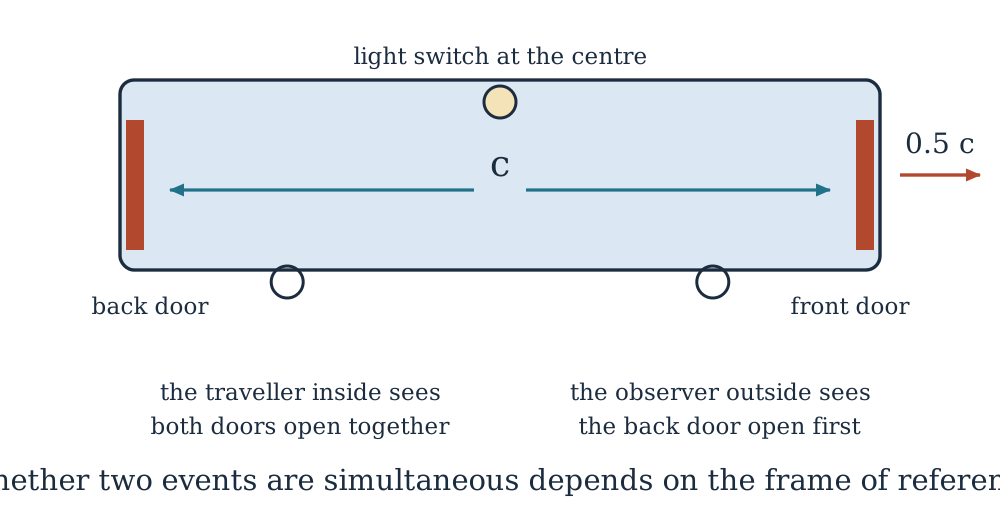
The light switch is at the centre of the roof and is operated by a traveller standing in the middle of the compartment. The train travels at half the speed of light and the traveller turns on the light.
A train with light-operated doors: whether the two doors open together depends on the frame

What the Traveller Sees

The light travels forward and backward at equal speed and reaches both doors at the same time, so the traveller sees both doors opening simultaneously.

What the Outside Observer Sees

The observer outside sees the back door open before the front door, because the back door is moving towards the light waves while the front door is moving away from them.

Time Dilation

According to the special theory of relativity, time is not an absolute quantity; it depends on the motion of the frame of reference.

Proper Time

An observer stationary in an inertial frame measures the time interval between two events in that frame. This interval $t_o$ is known as the proper time.

The Dilated Time

If the observer moves with respect to the frame of the events with a relativistic velocity $v$, or if the frame of the events moves with respect to the observer, the time measured is
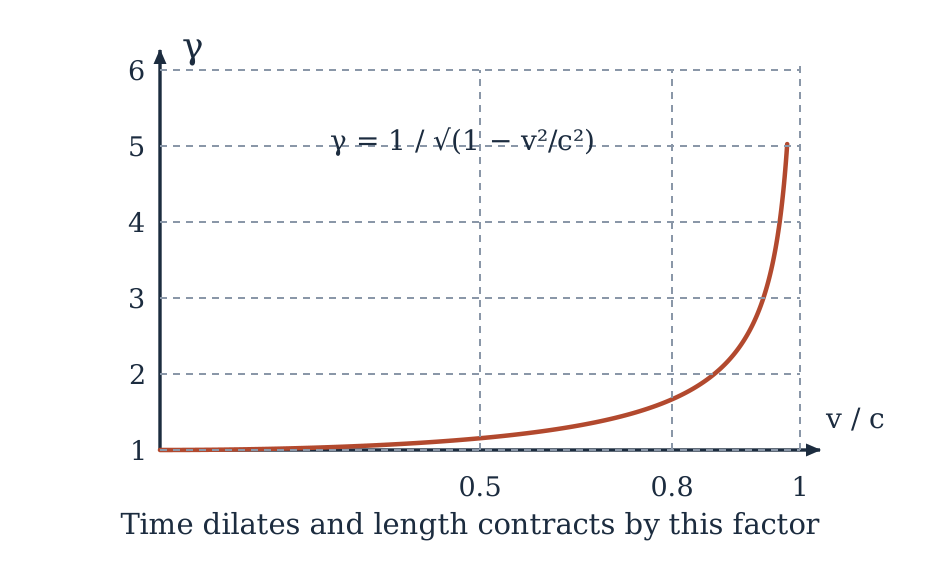
$$t=\frac{t_o}{\sqrt{1-\dfrac{v^2}{c^2}}}$$

Why Time Stretches

The square root is always less than one, so $t$ is greater than $t_o$. Time has dilated, or stretched, because of the relative motion.

The Lorentz Factor

The Lorentz factor plotted against the speed of the frame

What It Applies To

This astonishing result applies to all timing processes — physical, chemical and biological. Even the ageing of the human body is slowed by motion at relativistic speeds.

Example

If a traveller on a plane moving at $0.8c$ picks up and opens a book, the event takes one second as measured by the traveller but 1.7 seconds for a person standing outside the plane.

Length Contraction

The distance from the Earth to a star measured by an observer in a moving spaceship appears smaller than the distance measured by an observer on the Earth.

Statement

If you are in motion relative to two points a fixed distance apart, the distance between them appears shorter than if you were at rest relative to them.

Only Along the Motion

Length contraction occurs only along the direction of motion; no contraction is observed perpendicular to the direction of motion.

Proper Length

The length of an object, or the distance between two points, measured by an observer who is at rest relative to them is called the proper length $\ell_o$.

The Contracted Length

$$\ell=\ell_o\sqrt{1-\frac{v^2}{c^2}}$$

Example

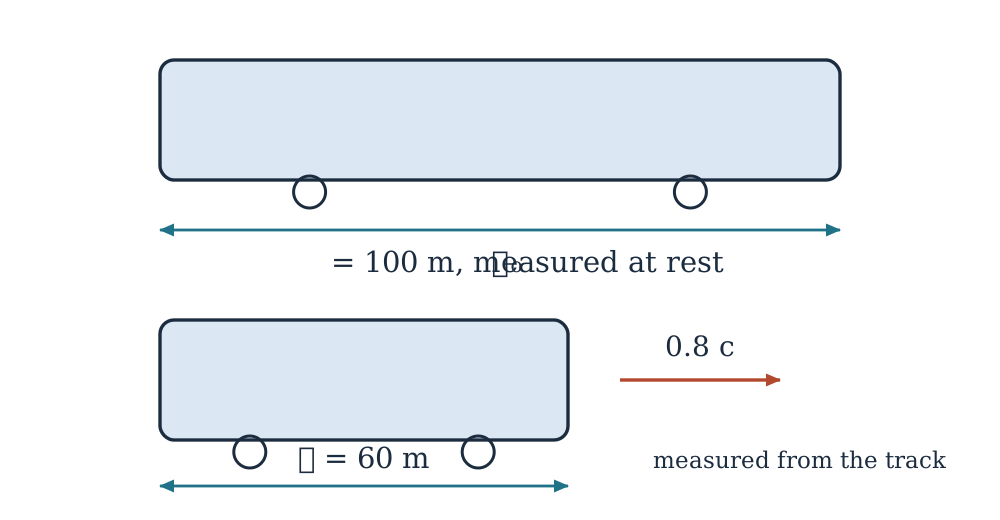
A train measured as 100 metres long at rest travels at $0.8c$. A person inside measures its length as 100 metres, but a person standing beside the track observes it to be only 60 metres long.
A train 100 m long at rest is measured as 60 m from the track when it moves at 0.8 c

Mass Variation

According to the special theory of relativity, the mass of an object is a variable quantity that depends on the object’s speed.

Rest Mass

An object whose mass is measured at rest is said to have the rest mass $m_o$. Observed to be moving at speed $v$, it has an increased mass $m$
$$m=\frac{m_o}{\sqrt{1-\dfrac{v^2}{c^2}}}$$

What the Increase Means

The increase in mass indicates the increase in inertia that an object has at high speeds. As $v$ approaches $c$, a greater force is needed to change the object’s speed.

At the Speed of Light

As the speed approaches that of light, the square root approaches zero.
$$v\to c$$
$$\sqrt{1-\frac{v^2}{c^2}}\to0$$
$$m\to\infty$$

Conclusion

An infinite mass would require an infinite force to accelerate it. Since infinite forces are not available, an object cannot be accelerated to the speed of light in free space.

Why We Do Not Notice

In everyday life we deal with speeds extremely small compared with the speed of light. Even the Earth’s orbital speed is only 30 km s$^{-1}$, while light travels at 300000 km s$^{-1}$. That is why Newton’s laws are valid in everyday situations.

Where They Matter

When dealing with subatomic particles moving at velocities approaching the speed of light, relativistic effects become very prominent, and the experimental results cannot be explained without Einstein’s equations.

Book Examples

Example 11.3.1

The period of a pendulum is measured to be 3.0 s in the inertial reference frame of the pendulum. What is its period measured by an observer moving at a speed of $0.95c$ with respect to the pendulum?

Given Data

$$t_o=3.0\,\mathrm{s}$$
$$v=0.95c$$

To Find

The dilated period $t=?$

Formula

$$t=\frac{t_o}{\sqrt{1-\dfrac{v^2}{c^2}}}$$

Solution

Putting the values
$$t=\frac{3.0}{\sqrt{1-(0.95)^2}}=\frac{3.0}{\sqrt{0.0975}}$$
$$t=\frac{3.0}{0.312}=9.6\,\mathrm{s}$$

Result

$$t=9.6\,\mathrm{s}$$
Example 11.3.2

A bar 1.0 m in length and located along the x-axis moves with a speed of $0.75c$ with respect to a stationary observer. What is the length of the bar as measured by the stationary observer?

Given Data

$$\ell_o=1.0\,\mathrm{m}$$
$$v=0.75c$$

To Find

The contracted length $\ell=?$

Formula

$$\ell=\ell_o\sqrt{1-\frac{v^2}{c^2}}$$

Solution

Putting the values
$$\ell=1.0\times\sqrt{1-(0.75)^2}=1.0\times\sqrt{0.4375}$$
$$\ell=1.0\times0.661=0.66\,\mathrm{m}$$

Result

$$\ell=0.66\,\mathrm{m}$$
Example 11.3.3

Find the mass $m$ of a body moving at a speed of $0.8c$, in terms of its rest mass $m_o$.

Given Data

$$v=0.8c$$

To Find

The relativistic mass $m=?$

Formula

$$m=\frac{m_o}{\sqrt{1-\dfrac{v^2}{c^2}}}$$

Solution

Putting the values
$$m=\frac{m_o}{\sqrt{1-(0.8)^2}}=\frac{m_o}{\sqrt{0.36}}$$
$$m=\frac{m_o}{0.6}=1.67\,m_o$$

Result

$$m=1.67\,m_o$$

Short Questions

SQ 11.3.1

What does the first postulate rule out?

Absolute Motion

If the laws of physics differed between frames in relative motion, an observer could tell which frame was really moving. Since they do not differ, there is no way to detect absolute uniform motion.
SQ 11.3.2

Why does the constancy of the speed of light force space and time to be relative?

Reason

Speed is a distance divided by a time. If every observer must get the same value of $c$ however fast they move, then the lengths and the times they measure cannot all be the same.
SQ 11.3.3

In the train with light-operated doors, why does the outside observer see the back door open first?

Reason

The light travels at $c$ for him too, but the back door is moving towards the light while the front door is moving away from it. The light therefore has less distance to cover to the back door.
SQ 11.3.4

A clock on a fast spaceship is seen from the Earth. Does it run fast or slow, and by what factor?

Slow

$$t=\frac{t_o}{\sqrt{1-\dfrac{v^2}{c^2}}}$$
The square root is less than one, so the measured interval is longer than the proper interval and the moving clock appears to run slow.
SQ 11.3.5

Does a moving rod contract in every direction?

No

Contraction occurs only along the direction of motion. No contraction at all is observed in the directions perpendicular to the motion.
SQ 11.3.6

A rod moves at 0.6c along its own length. What fraction of its rest length is measured?

Working

$$\ell=\ell_o\sqrt{1-(0.6)^2}=\ell_o\sqrt{0.64}$$
$$\ell=0.8\,\ell_o$$
So it measures 80% of its proper length.
SQ 11.3.7

A particle’s lifetime at rest is 2 μs. At 0.6c what lifetime is measured in the laboratory?

Working

$$t=\frac{2}{\sqrt{1-(0.6)^2}}=\frac{2}{0.8}=2.5\,\mu\mathrm{s}$$
SQ 11.3.8

Why are relativistic effects invisible in everyday life but obvious for subatomic particles?

Reason

The effects depend on $v^2/c^2$. Even the Earth’s orbital speed of 30 km s$^{-1}$ makes that ratio about $10^{-8}$, which is unmeasurable, while particles in an accelerator move at a large fraction of $c$ and the corrections are large.
MCQ 11.3.1

The speed of light in free space is:

Agreater for a moving observerBless for a moving observer
Cdifferent for each sourceDthe same for all observers
Solution:This is the second postulate of the special theory.
MCQ 11.3.2

The time interval measured by an observer at rest in the frame of the events is called:

Athe dilated timeBthe proper time
Cthe relativistic timeDthe absolute time
Solution:Every other observer measures a longer interval.
MCQ 11.3.3

Length contraction occurs:

Ain every directionBonly across the direction of motion
Conly along the direction of motionDonly at rest
Solution:No contraction is seen perpendicular to the motion.
MCQ 11.3.4

A rod of proper length 2 m moves at $0.8c$ along its length. Its measured length is:

A1.2 mB1.6 m
C2.5 mD3.3 m
Solution:$\ell=2\sqrt{1-0.64}=2\times0.6$.
MCQ 11.3.5

A clock moving at $0.6c$ measures 1 s. The interval measured on the Earth is:

A0.8 sB1.25 s
C1.0 sD0.6 s
Solution:$t=1/\sqrt{1-0.36}=1/0.8$.
MCQ 11.3.6

As the speed of a body approaches $c$, its mass:

Aapproaches zeroBstays the same
ChalvesDapproaches infinity
Solution:That is why no material body can reach $c$.
MCQ 11.3.7

Whether two events at different places are simultaneous depends on the:

Aframe of reference of the observerBdistance between the events
Cspeed of soundDmass of the observer
Solution:The train with light-operated doors is the standard example.
MCQ 11.3.8

A traveller at $0.8c$ takes 1 s over an action. To an observer at rest it takes about:

A0.6 sB1.0 s
C1.7 sD2.5 s
Solution:$t=1/\sqrt{1-0.64}=1/0.6$.
MCQ 11.3.9

The quantity under the square root in the relativistic equations is always:

Aless than oneBgreater than one
Cequal to oneDnegative
Solution:That is why time dilates and length contracts.
Topic 11.4

The Equivalence Between Mass and Energy

LQ 2starts here — Describe Einstein’s mass-energy equation. Why cannot we observe its effects in everyday life? What are its significant consequences? Give examples.

Statement

According to the special theory of relativity, mass and energy are distinct entities but are interconvertible.

Total Energy

$$E=mc^2$$
Here $m$ depends on the speed of the object.

Rest Mass Energy

At rest, the energy equivalent of an object’s mass $m_o$ is called its rest mass energy.
$$E_o=m_oc^2$$

Kinetic Energy

Since $mc^2$ is greater than $m_oc^2$, the difference of energy is due to the motion, so it represents the kinetic energy of the mass.
$$K.E=(m-m_o)c^2$$

Change of Mass With Energy

$$\Delta m=\frac{\Delta E}{c^2}$$

Why We Do Not See It

Because $c^2$ is a very large quantity, small changes in mass require very large changes in energy. In our everyday world the energy changes are far too small to give measurable mass changes.

Where It Is Seen

The energy and mass changes in nuclear reactions are found to be exactly in accordance with these equations.
LQ 2ends here

Short Questions

SQ 11.4.1

What does the mass-energy equation say about mass and energy?

Interconvertible

Mass and energy are distinct entities but can be converted into each other.
$$E=mc^2$$
SQ 11.4.2

Write the relativistic expression for kinetic energy and say where it comes from.

Expression

$$K.E=(m-m_o)c^2$$

Origin

The total energy $mc^2$ exceeds the rest mass energy $m_oc^2$, and the difference is due entirely to the motion.
SQ 11.4.3

Why are the mass changes in a chemical reaction never noticed?

Reason

$$\Delta m=\frac{\Delta E}{c^2}$$
The square of the speed of light is enormous, so an ordinary energy change gives a mass change far too small to weigh. Only nuclear reactions release enough energy for the change to show.
SQ 11.4.4

How much energy is equivalent to 1 gram of matter?

Working

$$E=mc^2$$
$$E=1\times10^{-3}\times(3\times10^{8})^2=9\times10^{13}\,\mathrm{J}$$
MCQ 11.4.1

Einstein’s mass-energy relation is:

A$E=mc$B$E=m^2c$
C$E=mc^3$D$E=mc^2$
Solution:It gives the total energy of a body of mass $m$.
MCQ 11.4.2

The relativistic kinetic energy of a body is:

A$\frac{1}{2}mv^2$B$(m-m_o)c^2$
C$m_oc^2$D$\frac{1}{2}(m-m_o)c^2$
Solution:It is the excess of the total energy over the rest mass energy.
MCQ 11.4.3

Mass changes are measurable in:

Achemical reactionsBeveryday collisions
Cnuclear reactionsDthe melting of ice
Solution:Only there is the energy change large enough.
MCQ 11.4.4

The rest mass energy of a body of rest mass $m_o$ is:

A$m_oc$B$\frac{1}{2}m_oc^2$
CzeroD$m_oc^2$
Solution:It is the energy the body has when it is at rest.
Topic 11.5

Space-Time in Relativity

LQ 3starts here — State Einstein’s concept about space-time. Describe the view of gravity according to this concept.

Space

Space is a three-dimensional extent in which all objects and events occur. It provides a framework to define the position and motion of objects under the influence of a force.

Time

Time measures the sequence and duration of events. In the theory of relativity time is not absolute; it is considered the fourth dimension.

Examples

Oscillatory motion, such as that of a swinging pendulum, relies on time to determine the frequency of the oscillations.
Time dilation, where time passes more slowly for an observer moving at extremely high speeds than for one at rest.

Space and Time Are Related

The special theory of relativity explains that space and time are related to each other, and describes how they are influenced by gravity and speed, such as the bending of light around massive objects like stars.

Space-Time

Space-time is a mathematical model that unifies space and time into a single continuum. It describes all the points of space and time and their relation to each other.

Curvature

According to Einstein’s theory, space-time is curved, especially near massive bodies and for speeds approaching the speed of light.

The Fabric Sheet

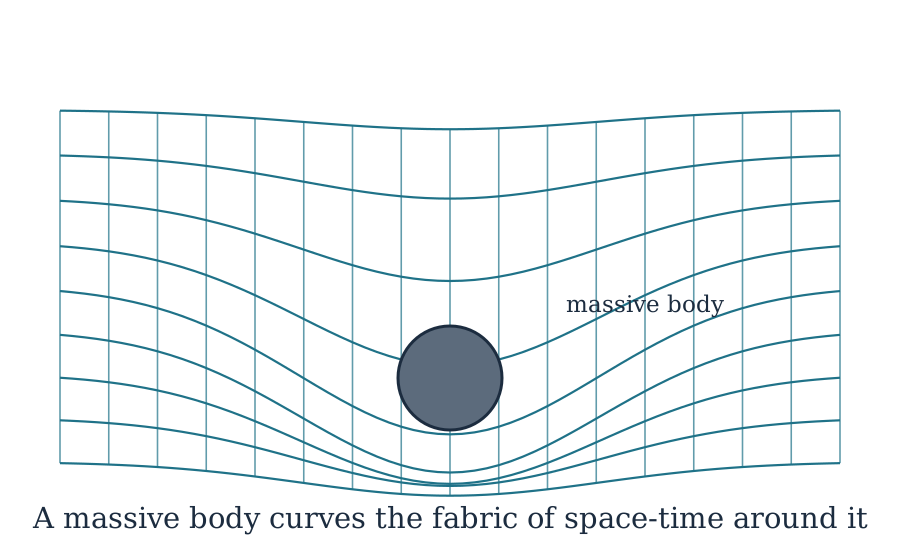
We can visualize this as a fabric sheet: if a heavy ball is placed on the sheet, the sheet curves. Objects such as stars and planets cause space-time to curve around themselves, much as an elastic fabric deforms when holding a ball. The more massive the object, the deeper the curve.

Diagram

A massive body curves the fabric of space-time around it

Geodesics

We therefore do not speak of a force of gravity acting on bodies. Instead we say that bodies and light rays move along geodesics, which are analogous to straight lines in plane geometry, in curved space-time. A body at rest or moving slowly near a massive object follows a geodesic towards that object.

Why Einstein Improved on Newton

Newton discovered the inverse square law of gravity but explicitly stated that he offered no explanation for why gravity should follow this law. Einstein’s theory also gives an inverse square law, except in strong gravitational fields, but it explains why this is so.

Contains Newton’s Theory

Einstein’s theory encompasses Newton’s theory and yields the same results in all but very strong gravitational fields.

The 1919 Eclipse

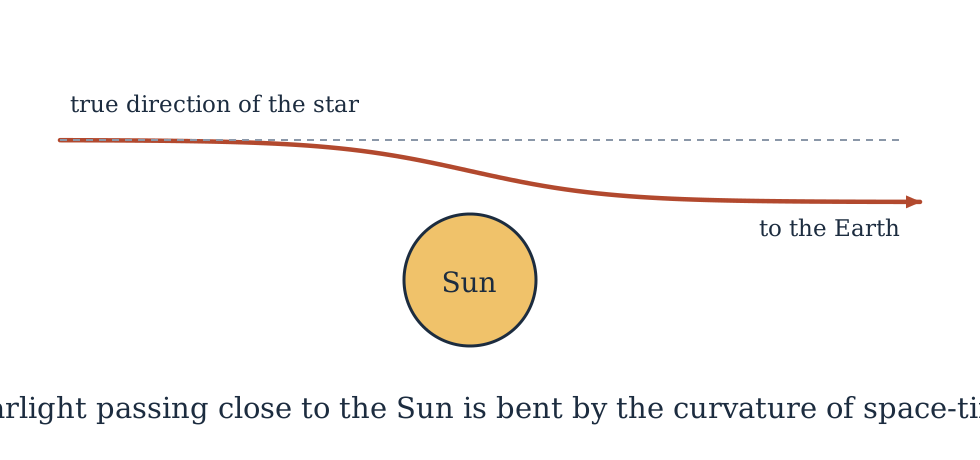
The bending of starlight caused by the Sun’s gravity was measured during a solar eclipse in 1919. The results matched Einstein’s theory rather than Newton’s, and Einstein’s theory was hailed as a scientific triumph.

Diagram

Starlight passing close to the Sun is bent by the curvature of space-time

Gravitational Waves

Another success was the detection of gravitational waves, produced by celestial events that squeeze and stretch the curvature of space-time. These waves were detected in 2015 and announced in 2016.
LQ 3ends here

A Hypothetical Journey

Let a spaceship travel to a star at half the speed of light, taking eight years to reach it from the point of view of an observer on the Earth.

From the Earth

The clocks on the spaceship run slowly, so less time passes on the spaceship than on the Earth.

From the Spaceship

The length of the journey has contracted, so the occupants cover it in less time and record 7 years rather than 8 years.

Short Questions

SQ 11.5.1

In what sense is time the fourth dimension?

Space-Time

Space and time are not separate: relativity joins the three dimensions of space and the one of time into a single four-dimensional continuum, in which every event has three space coordinates and one time coordinate.
SQ 11.5.2

What is a geodesic, and why does relativity use it instead of a force of gravity?

Geodesic

The path in curved space-time that is the analogue of a straight line in plane geometry.

Why

A body near a massive object simply follows a geodesic, so its motion needs no force of gravity to explain it — only the curvature of space-time.
SQ 11.5.3

Why is Einstein’s theory considered an advance on Newton’s?

Newton

He found the inverse square law but explicitly offered no explanation of why gravity should follow it.

Einstein

His theory gives the same inverse square law, except in strong fields, and explains why. It contains Newton’s theory and agrees with it everywhere except in very strong gravitational fields.
SQ 11.5.4

Name two observations that confirmed Einstein’s theory of gravity.

The 1919 Eclipse

The measured bending of starlight passing the Sun matched Einstein’s prediction rather than Newton’s.

Gravitational Waves

They were detected in 2015 and announced in 2016.
MCQ 11.5.1

In relativity, time is regarded as:

Aan absolute quantityBthe fourth dimension
Ca scalar of no consequenceDthe first dimension
Solution:Space and time form one four-dimensional continuum.
MCQ 11.5.2

Bodies and light rays in curved space-time move along:

AcirclesBparabolas
CgeodesicsDstraight lines in space
Solution:A geodesic is the analogue of a straight line in curved geometry.
MCQ 11.5.3

The bending of starlight by the Sun was measured during the solar eclipse of:

A1919B1905
C1915D1929
Solution:The result matched Einstein rather than Newton.
MCQ 11.5.4

The more massive the object, the:

Ashallower the curveBdeeper the curve it makes in space-time
Cflatter the space-timeDfaster the time runs
Solution:The fabric sheet analogy makes this clear.
MCQ 11.5.5

A spaceship takes 8 years to reach a star as measured from the Earth. Its occupants record:

A7 yearsB8 years
C9 yearsD16 years
Solution:The journey is contracted for them, so less time passes.

Chapter Exercise

SQ 11.1

What is meant by an inertial frame of reference and a non-inertial frame of reference?

Inertial Frame

A coordinate system in which the law of inertia holds: a body at rest stays at rest unless an unbalanced force acts on it. The Earth, and a car moving with uniform velocity, are inertial frames.

Non-Inertial Frame

An accelerated frame, in which a body does not stay at rest of its own accord. A car that is suddenly braked or accelerated is a non-inertial frame.
SQ 11.2

What are the two postulates of the special theory of relativity?

First Postulate

The laws of physics are the same in all inertial frames. This is the principle of relativity.

Second Postulate

The speed of light in free space has the same value for all observers, whatever the motion of the source or the observer.
$$c=3\times10^{8}\,\mathrm{m\,s^{-1}}$$
SQ 11.3

Describe why it is impossible for a material particle to move with the speed of light.

Mass Grows Without Limit

$$m=\frac{m_o}{\sqrt{1-\dfrac{v^2}{c^2}}}$$

At the Speed of Light

The square root becomes zero, so the mass becomes infinite.

Conclusion

An infinite mass would need an infinite force to accelerate it, and infinite forces do not exist.
SQ 11.4

Does the theory of relativity contradict Newton’s laws of motion? Explain briefly.

No

It contains them. Einstein’s theory reduces to Newton’s laws whenever the speed is small compared with the speed of light.

Why We Never Notice

Even the Earth’s orbital speed is only 30 km s$^{-1}$ against 300000 km s$^{-1}$ for light, so relativistic corrections are far too small to measure in everyday situations.

Where They Differ

Only at speeds approaching that of light, and in very strong gravitational fields.
SQ 11.5

What is meant by proper time and proper length?

Proper Time

The time interval between two events measured by an observer who is at rest in the frame in which the events occur.

Proper Length

The length of an object, or the distance between two points, measured by an observer who is at rest relative to them.
SQ 11.6

What is meant by relativistic mass, length and time?

Relativistic Mass

The increased mass of a body observed to be moving at a relativistic speed.
$$m=\frac{m_o}{\sqrt{1-\dfrac{v^2}{c^2}}}$$

Relativistic Length

The contracted length measured along the direction of motion.
$$\ell=\ell_o\sqrt{1-\frac{v^2}{c^2}}$$

Relativistic Time

The dilated time interval measured by an observer in relative motion.
$$t=\frac{t_o}{\sqrt{1-\dfrac{v^2}{c^2}}}$$
SQ 11.7

Why does the mass of a moving object increase?

Increase of Inertia

The mass measures the inertia of the body, and the special theory of relativity shows that the inertia grows with speed.

Relation

$$m=\frac{m_o}{\sqrt{1-\dfrac{v^2}{c^2}}}$$

What It Means

As the speed rises, a greater and greater force is needed to make the same change in the speed.
SQ 11.8

All motions are relative. Is space-time absolute? Explain briefly.

No

Space and time are themselves relative: intervals of length and of time depend on the frame in which they are measured.

Space-Time

What relativity offers instead is a single four-dimensional continuum in which space and time are joined, and which is curved near massive bodies rather than fixed and absolute.
SQ 11.9

Explain that the speed of light is an ultimate limit for any object.

From the Mass Relation

$$m=\frac{m_o}{\sqrt{1-\dfrac{v^2}{c^2}}}$$

Approaching c

The mass, and so the inertia, grows without limit, and the force needed to accelerate the body further grows with it.

Conclusion

No finite force can take a material body up to $c$, so the speed of light is the ultimate limit.
SQ 11.10

Give examples where the results of the special theory of relativity have been verified.

Subatomic Particles

Fast particles in accelerators show the predicted increase of mass, and their measured lifetimes are longer than at rest, which is time dilation.

Nuclear Reactions

The energy released in nuclear reactions agrees exactly with the mass lost.
$$E=mc^2$$

Starlight

The bending of starlight measured during the 1919 solar eclipse matched Einstein’s prediction.
CRQ 11.1

The speed of sound is affected by relative motion between the observer and the source. Does this apply to the speed of light as well? Describe briefly.

No

Sound needs a medium, so its measured speed depends on the motion of the observer through the air.

Light

The second postulate states that the speed of light in free space is the same for every observer, whatever the motion of the source or the observer.
$$c=3\times10^{8}\,\mathrm{m\,s^{-1}}$$

Consequence

It is exactly this constancy that makes space and time relative.
CRQ 11.2

Is it ever possible to see a star moving away from us at a uniform velocity equal to the velocity of light?

No

A star is a material body, and no material body can reach the speed of light, because its mass would have to become infinite.

And If It Could

Light from a body receding at $c$ would never reach us, so the star could not be seen in any case.
CRQ 11.3

If the speed of light were just 50 m s$^{-1}$, how would everyday events appear?

Relativity Everywhere

Everyday speeds would be a large fraction of $c$, so the effects would become obvious.

What We Would See

A passing car would look shortened along its direction of travel.
Its driver’s watch would run visibly slow.
The car would become measurably heavier as it sped up, and harder and harder to accelerate.
Events simultaneous for the driver would not be simultaneous for us.
CRQ 11.4

If the speed of light were infinite, what would the equations of the special theory of relativity reduce to?

The Ratio Vanishes

With an infinite $c$, the ratio $v^2/c^2$ becomes zero for every speed, so each square root becomes one.

What Is Left

$$t=t_o$$
$$\ell=\ell_o$$
$$m=m_o$$

Conclusion

Time, length and mass become absolute, and the equations reduce to ordinary Newtonian mechanics.
CRQ 11.5

According to Einstein’s equation $E=mc^2$, is it possible to create a single electron from energy? Explain.

Not a Single One

The energy needed is available, since the rest mass energy of an electron is only 0.51 MeV.

Why Not Alone

Charge must be conserved, so an electron can be created only together with a positron, in pair production.

Threshold

The photon must therefore carry at least the rest mass energy of both.
$$E=2\times0.51=1.02\,\mathrm{MeV}$$
MCQ 11.1

Relativistic mechanics yields results different from classical mechanics for objects moving with:

Alow velocityBvelocity equal to that of sound waves
Cvelocity greater than sound wavesDvelocity approaching that of light
Solution:Correct answer: (d) velocity approaching that of light.
MCQ 11.2

If an observer is moving in the same direction as a sound wave, the velocity of the wave seems to be:

AmoreBless
CconstantDthe sum of the two velocities
Solution:Correct answer: (b) less.
MCQ 11.3

If the rest mass $m_o$ of a particle increases to $m$ due to its high speed, then its kinetic energy is:

A$\frac{1}{2}m_oc^2$B$\frac{1}{2}mv^2$
C$(m-m_o)c^2$D$\frac{1}{2}(m-m_o)c^2$
Solution:Correct answer: (c) $(m-m_o)c^2$.
MCQ 11.4

The speed of the beam of light of a car while moving with high speed, compared with its rest position, is:

AgreaterBless
CsameDzero
Solution:Correct answer: (c) same.
MCQ 11.5

A photon is a particle of light. What is its mass when it moves with $0.9c$?

A$9.1\times10^{-31}$ kgB$1.67\times10^{-27}$ kg
C$1.67\times10^{-31}$ kgDZero
Solution:Correct answer: (d) Zero.
Numerical 11.1

An electron is accelerated to a speed of $0.995c$ and passes down an evacuated tube 500 m long. How long will the tube appear to the electron? (Ans: 50 m)

Given Data

$$\ell_o=500\,\mathrm{m}$$
$$v=0.995c$$

To Find

The contracted length $\ell=?$

Formula

$$\ell=\ell_o\sqrt{1-\frac{v^2}{c^2}}$$

Solution

Putting the values
$$\ell=500\times\sqrt{1-(0.995)^2}=500\times\sqrt{0.009975}$$
$$\ell=500\times0.0999=50\,\mathrm{m}$$

Result

$$\ell=50\,\mathrm{m}$$
Numerical 11.2

A neutron, not being a stable particle, disintegrates in 20 minutes on the average. How long will it seem to exist if it shoots out from a nucleus with a speed of $0.8c$? (Ans: 33.3 min)

Given Data

$$t_o=20\,\mathrm{min}$$
$$v=0.8c$$

To Find

The dilated lifetime $t=?$

Formula

$$t=\frac{t_o}{\sqrt{1-\dfrac{v^2}{c^2}}}$$

Solution

Putting the values
$$t=\frac{20}{\sqrt{1-(0.8)^2}}=\frac{20}{\sqrt{0.36}}$$
$$t=\frac{20}{0.6}=33.3\,\mathrm{min}$$

Result

$$t=33.3\,\mathrm{min}$$
Numerical 11.3

A spaceship is measured as 100 m long while it is at rest with respect to an observer. If this spaceship now flies past the observer with a speed of $0.99c$, what length will the observer find for the spaceship? (Ans: 14 m)

Given Data

$$\ell_o=100\,\mathrm{m}$$
$$v=0.99c$$

To Find

The contracted length $\ell=?$

Formula

$$\ell=\ell_o\sqrt{1-\frac{v^2}{c^2}}$$

Solution

Putting the values
$$\ell=100\times\sqrt{1-(0.99)^2}=100\times\sqrt{0.0199}$$
$$\ell=100\times0.141=14\,\mathrm{m}$$

Result

$$\ell=14\,\mathrm{m}$$
Numerical 11.4

The rest mass of an electron is $9.11\times10^{-31}$ kg. Calculate the corresponding rest mass energy. (Ans: $8.2\times10^{-14}$ J or 0.51 MeV)

Given Data

$$m_o=9.11\times10^{-31}\,\mathrm{kg}$$
$$c=3\times10^{8}\,\mathrm{m\,s^{-1}}$$

To Find

The rest mass energy $E_o=?$

Formula

$$E_o=m_oc^2$$

Solution

Putting the values
$$\begin{aligned}E_o&=9.11\times10^{-31}\times(3\times10^{8})^2 \\ &=8.2\times10^{-14}\,\mathrm{J}\end{aligned}$$
Converting into electron volt
$$\begin{aligned}E_o&=\frac{8.2\times10^{-14}}{1.6\times10^{-19}} \\ &=5.1\times10^{5}\,\mathrm{eV}\end{aligned}$$

Result

$$E_o=8.2\times10^{-14}\,\mathrm{J}=0.51\,\mathrm{MeV}$$
Numerical 11.5

An electron is accelerated to a speed $v=0.85c$. Calculate its total energy and its kinetic energy in electron volt. (Ans: 0.97 MeV, 0.459 MeV)

Given Data

$$v=0.85c$$
$$E_o=m_oc^2=0.511\,\mathrm{MeV}$$

To Find

The total energy $E=?$ and the kinetic energy $K.E=?$

Formula

$$m=\frac{m_o}{\sqrt{1-\dfrac{v^2}{c^2}}}$$
$$E=mc^2$$
$$K.E=E-E_o$$

Solution

The factor by which the mass grows is
$$\frac{1}{\sqrt{1-(0.85)^2}}=\frac{1}{\sqrt{0.2775}}=1.898$$
So the total energy is
$$E=1.898\times0.511=0.97\,\mathrm{MeV}$$
And the kinetic energy is
$$K.E=0.97-0.511=0.459\,\mathrm{MeV}$$

Result

$$E=0.97\,\mathrm{MeV}$$
$$K.E=0.459\,\mathrm{MeV}$$
Numerical 11.6

At what speed would the mass of a proton in a particle accelerator be tripled? (Ans: $0.943c$)

Given Data

$$m=3m_o$$

To Find

The speed $v=?$

Formula

$$m=\frac{m_o}{\sqrt{1-\dfrac{v^2}{c^2}}}$$

Solution

Putting the required mass
$$3=\frac{1}{\sqrt{1-\dfrac{v^2}{c^2}}}$$
$$\sqrt{1-\frac{v^2}{c^2}}=\frac{1}{3}$$
Squaring and rearranging
$$\frac{v^2}{c^2}=1-\frac{1}{9}=\frac{8}{9}$$
$$v=0.943c$$

Result

$$v=0.943c$$
Numerical 11.7

The period of a pendulum is measured to be 3 s in an inertial frame of reference. What will be the period measured by an observer in a spaceship moving with a constant speed of $0.95c$ with respect to the pendulum? (Ans: 9.6 s)

Given Data

$$t_o=3\,\mathrm{s}$$
$$v=0.95c$$

To Find

The dilated period $t=?$

Formula

$$t=\frac{t_o}{\sqrt{1-\dfrac{v^2}{c^2}}}$$

Solution

Putting the values
$$t=\frac{3}{\sqrt{1-(0.95)^2}}=\frac{3}{0.312}=9.6\,\mathrm{s}$$

Result

$$t=9.6\,\mathrm{s}$$
Numerical 11.8

Hypothetically, if a ball of mass 0.5 kg is projected with a velocity of $0.9c$, what will be its mass in flight? (Ans: 1.15 kg)

Given Data

$$m_o=0.5\,\mathrm{kg}$$
$$v=0.9c$$

To Find

The relativistic mass $m=?$

Formula

$$m=\frac{m_o}{\sqrt{1-\dfrac{v^2}{c^2}}}$$

Solution

Putting the values
$$m=\frac{0.5}{\sqrt{1-(0.9)^2}}=\frac{0.5}{\sqrt{0.19}}$$
$$m=\frac{0.5}{0.436}=1.15\,\mathrm{kg}$$

Result

$$m=1.15\,\mathrm{kg}$$

Self Test

Seventeen questions across the whole chapter. Work through them without the notes, then check the answers keyed at the foot of the page.

Q 1

The special theory of relativity deals with frames of reference that are:

AacceleratingBrotating
CinertialDat absolute rest
Q 2

A car moving with a uniform velocity relative to the Earth is:

Aan inertial frameBa non-inertial frame
Can accelerated frameDnot a frame
Q 3

The Earth is treated as an inertial frame because its acceleration is:

Avery largeBexactly zero
CvariableDvery small
Q 4

The second postulate of the special theory concerns the constancy of the:

Aspeed of soundBspeed of light
Cmass of a bodyDlength of a rod
Q 5

A ball dropped inside a train moving with uniform velocity appears to the passenger to:

Afollow a projectile pathBmove backwards
Cfall straight downDstay in the air
Q 6

Whether two distant events are simultaneous depends on the:

Amass of the observerBframe of reference
CtemperatureDcolour of the light
Q 7

The proper time between two events is measured by an observer who is:

Amoving at $0.5c$Bmoving at $0.9c$
CacceleratingDat rest in the frame of the events
Q 8

A clock moving at $0.6c$ shows 1 s. An observer at rest measures:

A1.25 sB0.8 s
C1.0 sD0.36 s
Q 9

Length contraction occurs:

Ain all directionsBonly along the direction of motion
Conly across the motionDonly at rest
Q 10

A rod of proper length 2 m moving at $0.8c$ along its length measures:

A2.5 mB1.6 m
C1.2 mD0.8 m
Q 11

As the speed of a body approaches that of light, its mass:

Afalls to zeroBstays constant
ChalvesDapproaches infinity
Q 12

A body cannot be accelerated to the speed of light because that would need:

Aan infinite forceBa very cold environment
Czero massDa vacuum
Q 13

Einstein’s mass-energy relation is:

A$E=mc$B$E=mc^2$
C$E=m^2c$D$E=mc^3$
Q 14

The relativistic kinetic energy of a body is:

A$\frac{1}{2}mv^2$B$m_oc^2$
C$(m-m_o)c^2$D$mc^2$
Q 15

Mass changes are large enough to be measured in:

Achemical reactionsBeveryday collisions
Cthe melting of iceDnuclear reactions
Q 16

In curved space-time, bodies and light rays move along:

AgeodesicsBcircles
CparabolasDhyperbolas
Q 17

The bending of starlight by the Sun was measured during the solar eclipse of:

A1905B1919
C1915D1929

Answers 1 (c)2 (a)3 (d)4 (b)5 (c)6 (b)7 (d)8 (a)9 (b)10 (c)11 (d)12 (a)13 (b)14 (c)15 (d)16 (a)17 (b)