Structure and Properties of the Nucleus
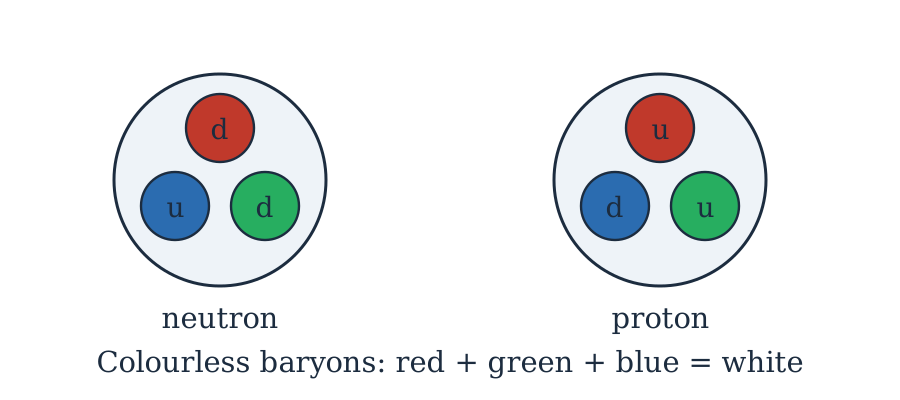
The Two ParticlesThe atomic nucleus comprises two types of particles: protons and neutrons. | |
The ProtonA proton is the nucleus of the simplest atom, hydrogen, called protium. It has a positive charge of the same magnitude as that of the electron. $$q=1.6\times10^{-19}\,\mathrm{C}$$ $$m_p=1.67\times10^{-27}\,\mathrm{kg}$$ | |
The NeutronThe neutron, whose existence was pointed out in 1932 by James Chadwick, is electrically neutral, and its mass is nearly the same as that of the proton. | |
NucleonsThe two types of particles in the nucleus, protons and neutrons, are together called nucleons. | |
Diagram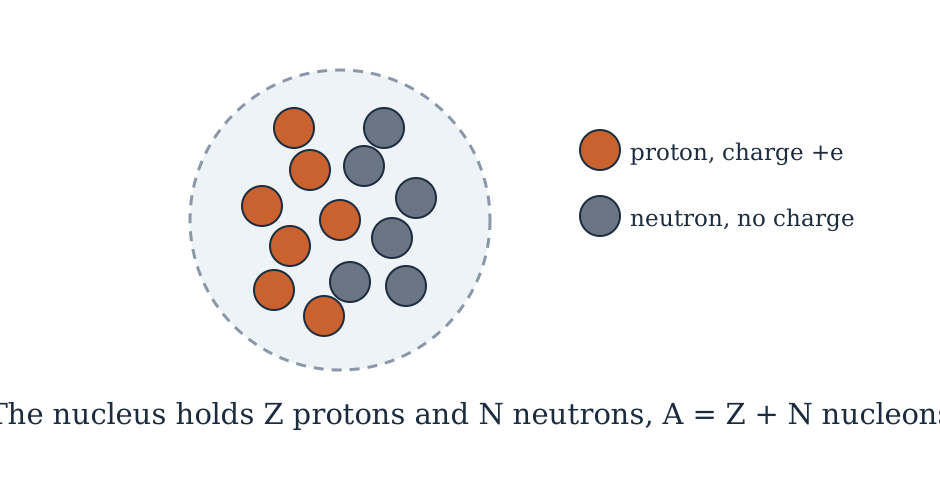 | |
NuclidesBesides hydrogen, the nuclei of all other elements consist of both neutrons and protons. The different nuclei are called nuclides. | |
Atomic NumberThe number of protons in a nucleus is called the atomic number, represented by $Z$. | |
Mass NumberThe total number of nucleons, the sum of the neutrons and the protons, is represented by $A$ and is called the atomic mass number, or simply the mass number. $$A=N+Z$$ Here $N$ represents the neutron number. | |
NotationA given nuclide is written as $^A_ZX$, where $X$ is the chemical symbol for the element. | |
Unified Mass ScaleTo indicate the mass of atomic particles, the unified mass scale $u$ is used instead of the kilogram. By definition $1\,u$ is exactly one twelfth the mass of a carbon-12 atom. $$1\,u=1.6606\times10^{-27}\,\mathrm{kg}=931\,\mathrm{MeV}$$ | |
Masses on This Scale$$m_p=1.007276\,u$$ $$m_n=1.008665\,u$$ $$m_e=0.00055\,u$$ | |
IsotopesNuclei that contain the same number of protons but different numbers of neutrons are called isotopes. | |
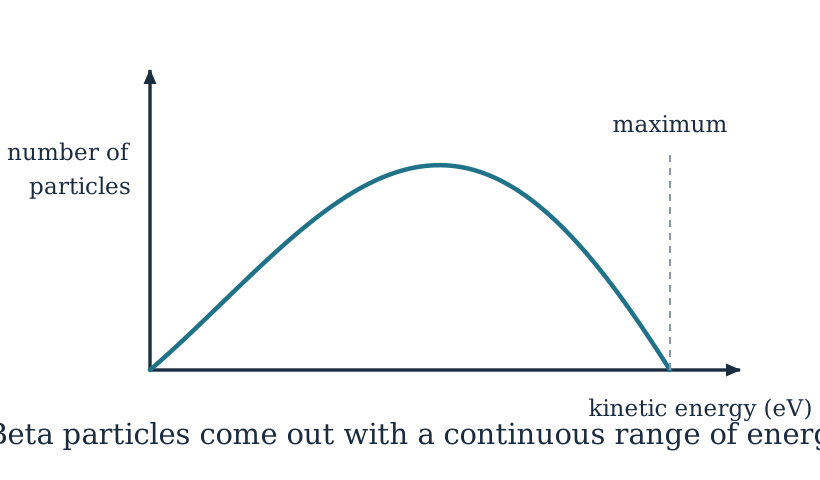
ExampleCarbon nuclei always have 6 protons but may have different numbers of neutrons. The isotopes $^{12}_{\,6}C$ and $^{13}_{\,6}C$ are stable, while $^{14}_{\,6}C$ is unstable and decays into nitrogen with the emission of a beta particle and a neutrino. |
Short Questions
|
SQ 12.1.1
Define the atomic number and the mass number of a nuclide. |
|||||||||||
|
|||||||||||
|
SQ 12.1.2
What is the unified mass unit, and what is it worth in kilogram and in MeV? |
|||||||||||
|
|||||||||||
|
SQ 12.1.3
Who discovered the neutron, and in which year? |
|||||||||||
|
|||||||||||
|
SQ 12.1.4
Write the masses of the proton, the neutron and the electron on the unified mass scale. |
|||||||||||
|
|||||||||||
|
MCQ 12.1.1
The total number of nucleons in a nucleus is called the: |
|||||||
| A | mass number | B | atomic number | ||||
| C | neutron number | D | charge number | ||||
| Solution:It is the sum of the protons and the neutrons, $A=N+Z$. | |||||||
|
MCQ 12.1.2
One unified mass unit is equal to: |
|||||||
| A | 511 keV | B | 931 MeV | ||||
| C | 1 MeV | D | 1.6 MeV | ||||
| Solution:It is also $1.6606\times10^{-27}$ kg. | |||||||
|
MCQ 12.1.3
Nuclei with the same number of protons but different numbers of neutrons are called: |
|||||||
| A | isobars | B | isotones | ||||
| C | isotopes | D | nucleons | ||||
| Solution:Carbon-12, carbon-13 and carbon-14 are isotopes. | |||||||
|
MCQ 12.1.4
The neutron was shown to exist in 1932 by: |
|||||||
| A | Paul Dirac | B | Carl Anderson | ||||
| C | Ernest Rutherford | D | James Chadwick | ||||
| Solution:It is electrically neutral and nearly as heavy as a proton. | |||||||
|
MCQ 12.1.5
A nuclide has 87 nucleons and 50 neutrons. Its atomic number is: |
|||||||
| A | 37 | B | 50 | ||||
| C | 87 | D | 137 | ||||
| Solution:$Z=A-N=87-50$. | |||||||