XII-Physics CH-14

Simple Harmonic Motion

Topic 14.1

Oscillatory Motion

Oscillatory Motion

Oscillatory motion is a to-and-fro motion about a mean position. It is a periodic motion which repeats itself after equal intervals of time.

Examples

A simple pendulum vibrating about its mean position when displaced from rest.
A mass oscillating at the end of a spring in a horizontal or a vertical plane.
The atoms or molecules of a solid oscillating about their mean positions.
The motion of a swing, and air molecules when sound travels through air.
The strings of musical instruments such as a guitar and a violin.

Restoring Force

Every vibrating body has an equilibrium or mean position. When it is displaced from that position a restoring force brings it back, and this force is what causes the oscillatory motion.
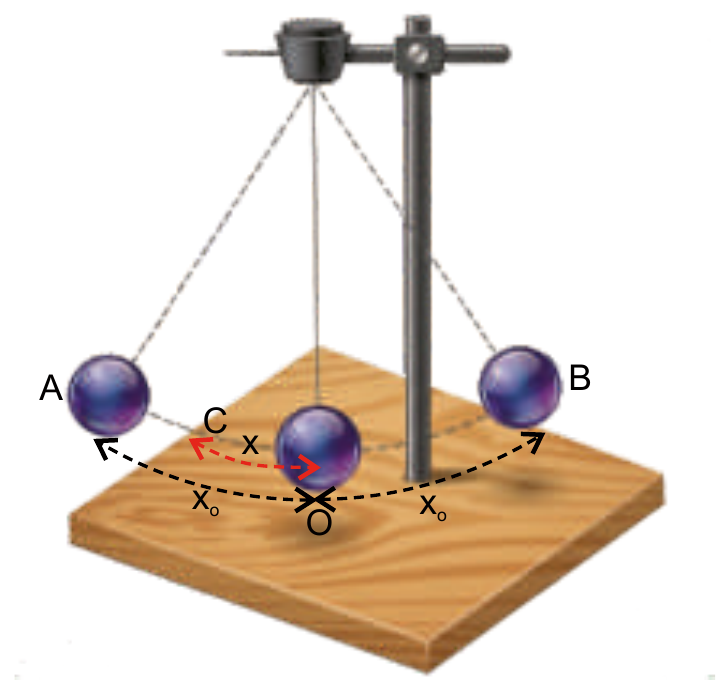
Illustration of different terms of oscillatory motion with the help of vibrating simple pendulum

Oscillation

One complete round trip of a vibrating body about its mean position is called an oscillation. The motion of the bob from A to B and back from B to A is one oscillation.

Instantaneous Displacement

The distance of a vibrating body from its mean position at any instant is called instantaneous displacement and is denoted by $x$.

Amplitude

The magnitude of the maximum displacement of a vibrating body on either side of its mean position is called amplitude and is denoted by $x_o$. In the figure OA and OB are each equal to the amplitude.

Time Period

The time taken to complete one vibration or one cycle is called time period. It is represented by $T$ and its SI unit is the second.
$$T=\frac{1}{f}=\frac{2\pi}{\omega}$$

Frequency

The number of vibrations completed by a vibrating body per unit time is called frequency.
$$f=\frac{n}{t}=\frac{1}{T}$$
Its unit is the hertz, one hertz being one oscillation per second, and its dimension is $[T^{-1}]$.

Angular Frequency

The angular displacement per unit time is called angular frequency and is represented by $\omega$
$$\omega=\frac{\theta}{t}$$
For one revolution the angular displacement is $2\pi$ radian and the time taken is one time period.
$$\omega=\frac{2\pi}{T}=2\pi f$$
Its SI unit is rad s$^{-1}$.

Short Questions

SQ 14.1.1

Why is oscillatory motion called a periodic motion?

Repetition After Equal Intervals

The body repeats the same to-and-fro path about its mean position after equal intervals of time.

Result

Every complete round trip takes the same time period, which is what makes the motion periodic.
SQ 14.1.2

A body completes 20 vibrations in 5 s. Find its frequency and time period.

Frequency

$$f=\frac{n}{t}=\frac{20}{5\,\mathrm{s}}=4\,\mathrm{Hz}$$

Time Period

$$T=\frac{1}{f}=\frac{1}{4\,\mathrm{Hz}}$$
$$T=0.25\,\mathrm{s}$$
SQ 14.1.3

Distinguish between instantaneous displacement and amplitude.

Instantaneous Displacement

It is the distance of the vibrating body from its mean position at any instant.
$$x=x_o\sin\omega t$$

Amplitude

It is the maximum value of that displacement on either side of the mean position, so it is fixed for a given oscillation.
MCQ 14.1.1

The SI unit of angular frequency is:

AhertzBrad s$^{-1}$
CsecondDm s$^{-1}$
Solution:Angular frequency is angular displacement per unit time, so it is measured in radian per second.
MCQ 14.1.2

One complete round trip of a vibrating body about its mean position is called:

AamplitudeBan oscillation
CfrequencyDphase
Solution:One such round trip is one oscillation, and the time it takes is the time period.
MCQ 14.1.3

The dimension of frequency is:

A$[T]$B$[T^{-1}]$
C$[LT^{-1}]$D$[L]$
Solution:Frequency is the number of vibrations per unit time, so it is the reciprocal of a time.
MCQ 14.1.4

If the frequency of a vibrating body is 50 Hz, its time period is:

A50 sB5 s
C0.02 sD0.2 s
Solution:The time period is the reciprocal of the frequency, that is one divided by fifty.
MCQ 14.1.5

In one complete vibration a simple pendulum of amplitude $x_o$ covers a distance of:

A$x_o$B$2x_o$
C$4x_o$D$x_o/2$
Solution:The bob travels the amplitude four times, from the mean position out to each extreme and back.
Topic 14.2

Simple Harmonic Motion

Simple Harmonic Motion

Simple harmonic motion is a type of oscillatory or vibratory motion produced under the action of a restoring force.

Necessary Conditions

The restoring force must be directly proportional to the displacement from the mean position.
The force and the displacement must follow Hooke’s law.
The acceleration must be proportional to the displacement and directed towards the mean position.

Hooke’s Law

$$F=-kx$$
Here $k$ is the spring constant, which depends upon the nature of the material of the spring, and the negative sign shows that the force opposes the displacement.

Condition on Acceleration

$$a=-\frac{k}{m}x$$
$$\frac{k}{m}=\text{constant}$$
$$a\propto-x$$
The negative sign indicates that the acceleration is always directed towards the mean position.

Not Every Periodic Motion

All restoring forces are not proportional to the displacement, so not every periodic vibration is simple harmonic. An electrocardiogram traces the periodic pattern of a beating heart, but the motion of the recorder needle is not simple harmonic.

Short Questions

SQ 14.2.1

State the basic conditions for a body to execute S.H.M.

Conditions for S.H.M

The restoring force must be directly proportional to the displacement from the mean position.
The acceleration must be proportional to the displacement and directed towards the mean position.
$$a=-\frac{k}{m}x$$
$$\frac{k}{m}=\text{constant}$$
$$a\propto-x$$
SQ 14.2.2

Why is the motion of the needle of an electrocardiogram not simple harmonic?

Restoring Force of the Needle

Its restoring force is not proportional to the displacement from the mean position.

Result

The motion repeats itself so it is periodic, but it does not satisfy the condition for simple harmonic motion.
SQ 14.2.3

What does the negative sign in Hooke’s law show?

Meaning of the Negative Sign

$$F=-kx$$
It shows that the restoring force is opposite in direction to the displacement, so it always acts towards the mean position.
MCQ 14.2.1

Simple harmonic motion is produced under the action of:

Aapplied forceBrestoring force
Cfrictional forceDcentripetal force
Solution:The restoring force is proportional to the displacement and always pulls the body back to its mean position.
MCQ 14.2.2

In S.H.M the acceleration of the body is directed:

Aalong the displacementBtowards the mean position
Caway from the mean positionDperpendicular to the displacement
Solution:The negative sign in the relation between acceleration and displacement carries exactly this meaning.
MCQ 14.2.3

The spring constant of a spring depends upon:

Athe applied forceBthe displacement
Cthe nature of the springDthe mass attached to it
Solution:It is fixed by the physical shape and the material of the spring, not by how it is used.
MCQ 14.2.4

A periodic vibration is:

Anot necessarily simple harmonicBalways simple harmonic
Calways dampedDalways forced
Solution:All restoring forces are not proportional to the displacement, so a periodic motion need not be S.H.M.
Topic 14.3

Practical S.H.M Systems

LQ 1starts here — Show that motion of mass attached with spring executes S.H.M. Also find an expression for its time period and frequency.

Mass Attached to an Elastic Spring

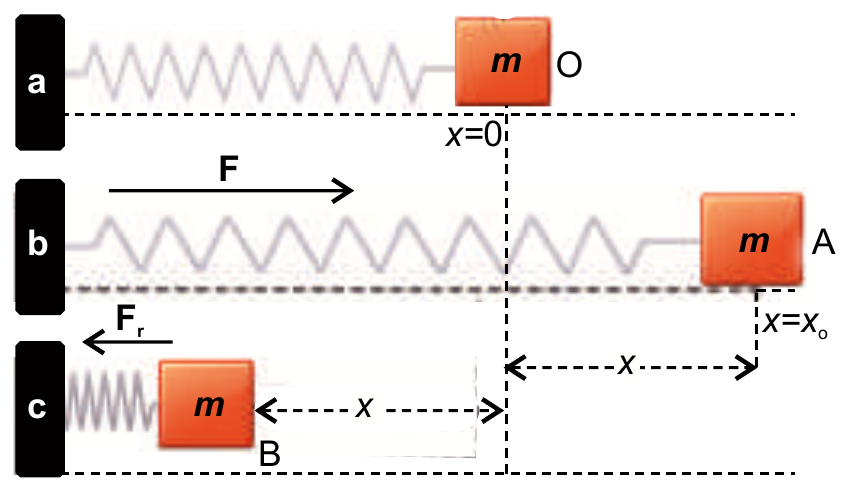
Consider a body of mass $m$ attached to a horizontal spring of spring constant $k$ and lying on a smooth surface. The body is initially at rest at the mean position O.
Mass attached with spring performing S.H.M

Applied Force

A force displaces the body from O to A through a displacement $x$ towards the right. By Hooke’s law the applied force is proportional to the displacement.
$$F\propto x$$
$$F=kx$$

Restoring Force

At the same time the spring exerts an elastic restoring force on the body which is equal in magnitude and opposite in direction to the applied force.
$$F=-kx$$
When the applied force is removed the body moves towards B, crosses the mean position because of its inertia, compresses the spring, and then starts oscillating between A and B.

Acceleration of the Body

By Newton’s second law of motion the force is the product of the mass and the acceleration.
$$F=ma$$
Comparing the two expressions for the force gives the acceleration.
$$ma=-kx$$
$$a=-\frac{k}{m}x$$

Mathematical Form of S.H.M

The ratio of the spring constant to the mass is a constant, so the acceleration is a constant multiple of the displacement.
$$a=-(\text{constant})x$$
$$a\propto-x$$
The acceleration of the body is directly proportional to the displacement and is always directed towards the mean position, so the motion of a mass attached to a spring is simple harmonic.

Time Period and Frequency

Comparing the acceleration with the standard form of S.H.M gives the angular frequency of the system.
$$a=-\omega^2x$$
$$\omega^2=\frac{k}{m}$$
$$\omega=\sqrt{\frac{k}{m}}$$
The angular frequency is $2\pi$ times the frequency of the oscillation.
$$\omega=2\pi f$$
Putting the value of the angular frequency in it
$$f=\frac{1}{2\pi}\sqrt{\frac{k}{m}}$$
The time period is the reciprocal of the frequency.
$$T=\frac{1}{f}$$
$$T=2\pi\sqrt{\frac{m}{k}}$$
LQ 1ends here
LQ 3starts here — What is a simple pendulum? Show that motion of a simple pendulum is S.H.M. Also derive an expression for time period of a simple pendulum, on what factors does it depend?

Simple Pendulum

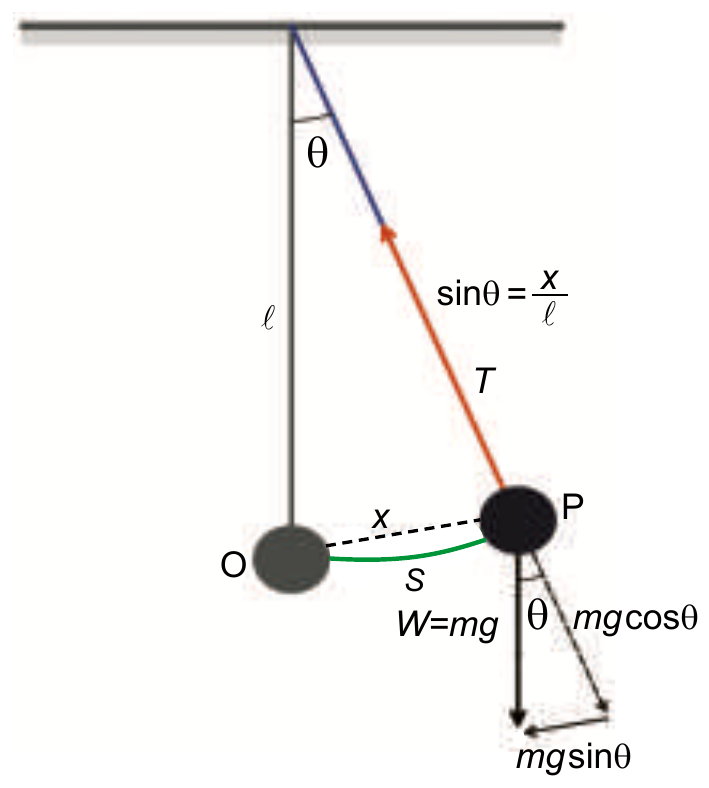
A simple pendulum consists of a small heavy bob of mass $m$ suspended from a rigid support by a light inextensible string of a certain length.
A simple pendulum executing S.H.M

Restoring Force

When the pendulum is displaced from its mean position through an angle $\theta$ to the extreme position P and released, the weight of the bob makes that angle with the direction of the string. The component $mg\cos\theta$ and the tension lie along the same line in opposite directions and cancel each other, so the component $mg\sin\theta$ provides the necessary restoring force towards the mean position.
$$F=-mg\sin\theta$$

Acceleration

Comparing this with Newton’s second law of motion gives the acceleration of the bob.
$$ma=-mg\sin\theta$$
$$a=-g\sin\theta$$

Small Angle Approximation

For small values of the angle its sine is nearly equal to the angle itself in radian.
$$\sin\theta\approx\theta$$
$$a=-g\theta$$

Angular Displacement

By the definition of angular displacement the angle is the length of the arc divided by the length of the string.
$$\theta=\frac{S}{l}$$
For a small angle the displacement is nearly equal to the arc length of the circular path.
$$S\approx x$$
$$\theta=\frac{x}{l}$$
Putting this value of the angle in the expression for the acceleration
$$a=-g\times\frac{x}{l}$$
$$a=-\frac{g}{l}x$$

Motion is S.H.M

The length of the pendulum is fixed and the value of $g$ is constant for a given place, so the whole factor is a constant.
$$a\propto-x$$
This is the mathematical form of S.H.M, so the motion of a simple pendulum is simple harmonic.

Time Period

Comparing the result with the standard form of S.H.M gives the angular frequency of the pendulum.
$$a=-\omega^2x$$
$$\omega^2=\frac{g}{l}$$
$$\omega=\sqrt{\frac{g}{l}}$$
The angular frequency is $2\pi$ divided by the time period of the pendulum.
$$\omega=\frac{2\pi}{T}$$
$$\frac{2\pi}{T}=\sqrt{\frac{g}{l}}$$
$$T=2\pi\sqrt{\frac{l}{g}}$$

Factors it Depends On

The time period is directly proportional to the square root of the length of the string and inversely proportional to the square root of the acceleration due to gravity. It is independent of the mass of the bob and of the amplitude.

Second Pendulum

A pendulum which completes one vibration in two seconds is known as a second pendulum.

Using a Pendulum to Measure g

The length of the pendulum is measured, the pendulum is set into motion, and its time period is measured with a stopwatch. The acceleration due to gravity at that place then follows.
$$T^2=4\pi^2\frac{l}{g}$$
$$g=\frac{4\pi^2l}{T^2}$$
LQ 3ends here

Book Examples

Example 14.3.1

A particle executing simple harmonic motion has an angular frequency of 2 rad s$^{-1}$. Determine its frequency and time period.

Given Data

$$\omega=2\,\mathrm{rad\,s^{-1}}$$

To Find

Frequency $f=?$ and time period $T=?$

Formula

$$\omega=2\pi f$$
$$f=\frac{\omega}{2\pi}$$
$$T=\frac{1}{f}$$

Solution

Putting the values in the formula
$$\begin{aligned}f&=\frac{2\,\mathrm{rad\,s^{-1}}}{2\pi\,\mathrm{rad}} \\ &=0.318\,\mathrm{Hz}\end{aligned}$$
The time period is the reciprocal of the frequency.
$$T=\frac{1}{0.318\,\mathrm{Hz}}=3.14\,\mathrm{s}$$

Result

$$f=0.318\,\mathrm{Hz}$$
$$T=3.14\,\mathrm{s}$$
Example 14.3.2

What is the length of a second pendulum where the value of g is 9.8 m s$^{-2}$?

Given Data

A second pendulum completes one vibration in two seconds.
$$T=2\,\mathrm{s}$$
$$g=9.8\,\mathrm{m\,s^{-2}}$$

To Find

Length of the pendulum $l=?$

Formula

$$T=2\pi\sqrt{\frac{l}{g}}$$
$$l=\frac{gT^2}{4\pi^2}$$

Solution

Putting the values in the formula
$$\begin{aligned}l \\ &=\frac{9.8\,\mathrm{m\,s^{-2}}\times(2\,\mathrm{s})^2}{4\times(3.14)^2}\end{aligned}$$
$$l=\frac{39.2}{39.44}=0.99\,\mathrm{m}$$

Result

$$l=0.99\,\mathrm{m}$$

Short Questions

SQ 14.3.1

On what factors does the time period of a mass-spring system depend?

Depending Factors

$$T=2\pi\sqrt{\frac{m}{k}}$$
The mass attached to the spring.
The spring constant of the spring.
It is independent of the amplitude of the oscillation.
SQ 14.3.2

Why is the time period of a simple pendulum independent of the mass of the bob?

Mass Cancels Out

The restoring force on the bob and its inertia both depend upon its mass, so the mass cancels when the acceleration is found.
$$a=-\frac{g}{l}x$$

Result

The time period is left depending only upon the length and upon $g$.
SQ 14.3.3

What is a second pendulum? Find its length where g is 9.8 m s$^{-2}$.

Second Pendulum

A pendulum which completes one vibration in two seconds is called a second pendulum.

Length

$$l=\frac{gT^2}{4\pi^2}=\frac{9.8\times4}{39.44}$$
$$l=0.99\,\mathrm{m}$$
SQ 14.3.4

A spring of spring constant 50 N m$^{-1}$ carries a mass of 0.2 kg. Find its time period.

Time Period

$$T=2\pi\sqrt{\frac{m}{k}}=6.28\sqrt{\frac{0.2}{50}}$$
$$T=6.28\times0.063$$

Result

$$T=0.4\,\mathrm{s}$$
SQ 14.3.5

Why must the amplitude of a simple pendulum be kept small?

Small Angle Approximation

The derivation replaces the sine of the angle by the angle itself, which holds only for a small angle.
$$\sin\theta\approx\theta$$

Result

For a large amplitude the restoring force is no longer proportional to the displacement, so the motion is not simple harmonic.
MCQ 14.3.1

The time period of a mass-spring system is proportional to:

A$m$B$\sqrt{m}$
C$1/m$D$m^2$
Solution:The mass appears under the square root in the expression for the time period.
MCQ 14.3.2

The restoring force of a simple pendulum is provided by:

Athe tension in the stringBthe component $mg\sin\theta$
Cthe component $mg\cos\theta$Dthe whole weight of the bob
Solution:The other component is balanced by the tension, so only the tangential component is left to restore the bob.
MCQ 14.3.3

The time period of a simple pendulum does not depend upon:

Aits lengthBthe value of $g$
Cthe mass of the bobDnone of these
Solution:The mass cancels out of the derivation, so the period depends only on the length and on gravity.
MCQ 14.3.4

The length of a second pendulum is nearly:

A0.5 mB1 m
C2 mD4 m
Solution:A period of two seconds gives a length of 0.99 m where $g$ is 9.8 m s$^{-2}$.
MCQ 14.3.5

If the length of a simple pendulum is made four times, its time period becomes:

AtwiceBfour times
ChalfDunchanged
Solution:The period varies as the square root of the length, and the square root of four is two.
MCQ 14.3.6

In a mass-spring system the ratio of the spring constant to the mass is equal to:

Athe time periodBthe square of the angular frequency
Cthe frequencyDthe amplitude
Solution:Comparing the acceleration of the system with the standard form of S.H.M gives exactly this.
Topic 14.4

Simple Harmonic Motion and Uniform Circular Motion

LQ 2starts here — Show that motion of the projection of a particle moving around a circle with constant speed is S.H.M and derive a relation for its instantaneous velocity.

S.H.M and Uniform Circular Motion

When a particle moves in a circular path, its projection on the diameter of the circle executes S.H.M, so the displacement, velocity, acceleration and time period of S.H.M can all be understood by relating them to uniform circular motion.

Turntable Experiment

Consider a turntable of radius $x_o$ with a ball attached to its rim, and a beam of light casting the shadow of the ball on a screen. When the turntable rotates with a constant angular speed the ball moves with uniform circular motion, and its shadow oscillates to and fro across the screen in simple harmonic motion, like a body attached to a spring.

Quantitative Analysis

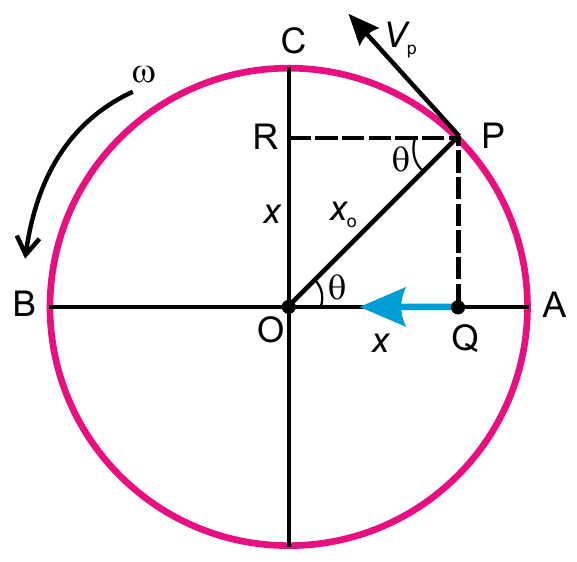
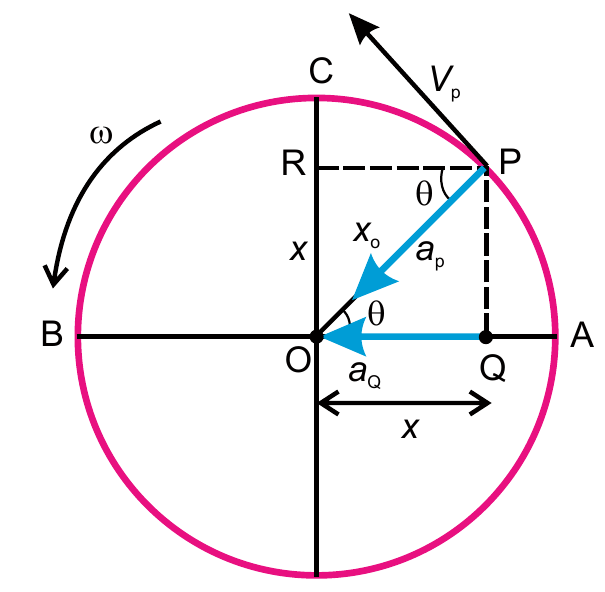
Consider a particle P moving along the circumference of a circle of radius $x_o$ with a uniform angular velocity $\omega$. Its linear velocity at P is along the tangent. Let Q be its projection, which oscillates along the diameter about the mean position O.
A point P moving on circular path with constant angular velocity

Instantaneous Displacement

If A is the initial position of the particle, the radius sweeps out an angle in time $t$
$$\theta=\omega t$$
From the right triangle OQP the ratio of OQ to OP is the cosine of that angle.
$$\cos\theta=\frac{x}{x_o}$$
$$x=x_o\cos\theta$$
Putting the value of the angle swept out in this time
$$x=x_o\cos\omega t$$
This gives the instantaneous displacement of the point Q, which is executing simple harmonic motion.

Instantaneous Velocity

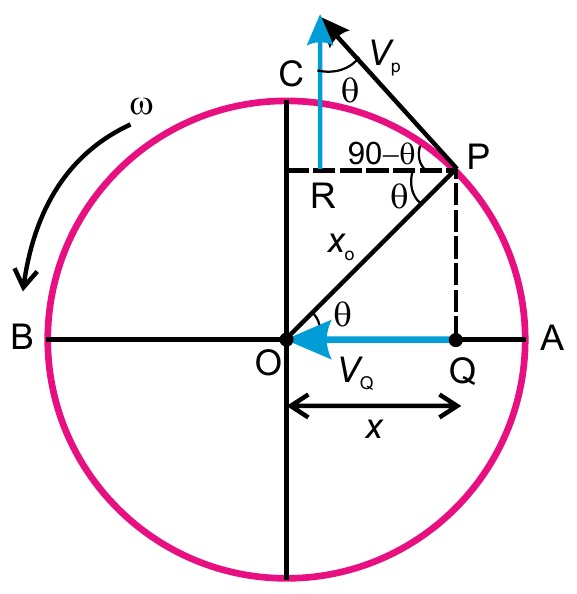
The line PR is the horizontal component of the velocity of the particle and is parallel to the diameter of the circle, so the instantaneous velocity of Q is that horizontal component.
Velocity of the point P and its horizontal component
$$v=v_P\cos(90^{\circ}-\theta)$$
The linear velocity of the particle is $x_o\omega$ and the cosine of the remaining angle is the sine of the angle itself.
$$v_P=x_o\omega$$
$$\cos(90^{\circ}-\theta)=\sin\theta$$
$$v=x_o\omega\sin\theta$$
Putting the value of the angle swept out in this time
$$v=x_o\omega\sin\omega t$$

In Terms of Displacement

The identity between the sine and the cosine of the same angle turns this into a relation between the velocity and the displacement.
$$\sin\omega t=\pm\sqrt{1-\cos^2\omega t}$$
$$\sin\omega t=\pm\sqrt{1-\frac{x^2}{x_o^2}}$$
Putting this value in the expression for the velocity
$$v=\pm x_o\omega\,\frac{\sqrt{x_o^2-x^2}}{x_o}$$
$$v=\pm\omega\sqrt{x_o^2-x^2}$$

Maximum Velocity

At the mean position the displacement is zero, so the velocity there is maximum.
$$v_{max}=v_o=x_o\omega$$

Instantaneous Acceleration

The acceleration of the particle at P is directed towards the centre of the circle, and the acceleration of the projection Q is equal to its horizontal component.
Acceleration of the point P and its horizontal component
$$a=a_P\cos\theta$$
The centripetal acceleration of the particle is $-x_o\omega^2$ and the cosine of the angle is the ratio of the displacement to the radius.
$$a_P=-x_o\omega^2$$
$$\cos\theta=\frac{x}{x_o}$$
Putting both of these in the expression for the acceleration
$$a=-x_o\omega^2\left(\frac{x}{x_o}\right)=-\omega^2x$$

Condition of S.H.M

The particle moves with a uniform angular frequency, so the acceleration is directly proportional to the displacement and the negative sign shows that it is directed towards the mean position.
$$\omega^2=\text{constant}$$
$$a\propto-x$$
Hence the projection of a particle moving along the circumference of a circle executes simple harmonic motion.
LQ 2ends here

Book Examples

Example 14.4.1

A 0.2 kg mass is attached to a spring with a spring constant of 10 N m$^{-1}$. The mass is displaced by 0.1 m from its equilibrium position and released from rest. Find: (a) acceleration at x = 0.05 m (b) velocity at x = 0.05 m.

Given Data

$$m=0.2\,\mathrm{kg}$$
$$k=10\,\mathrm{N\,m^{-1}}$$
$$x_o=0.1\,\mathrm{m}$$
$$x=0.05\,\mathrm{m}$$

To Find

Acceleration $a=?$ and velocity $v=?$

Formula

$$\omega=\sqrt{\frac{k}{m}}$$
$$a=-\omega^2x$$
$$v=\omega\sqrt{x_o^2-x^2}$$

Solution

The angular frequency of the system is
$$\begin{aligned}\omega&=\sqrt{\frac{10\,\mathrm{N\,m^{-1}}}{0.2\,\mathrm{kg}}} \\ &=7.07\,\mathrm{rad\,s^{-1}}\end{aligned}$$
The acceleration at the given displacement is
$$a=-(7.07)^2\times0.05=-50\times0.05=-2.5\,\mathrm{m\,s^{-2}}$$
The velocity at the same displacement is
$$\begin{aligned}v&=7.07\sqrt{(0.1)^2-(0.05)^2}=7.07\times0.0866 \\ &=0.61\,\mathrm{m\,s^{-1}}\end{aligned}$$

Result

$$a=-2.5\,\mathrm{m\,s^{-2}}$$
$$v=0.61\,\mathrm{m\,s^{-1}}$$

Short Questions

SQ 14.4.1

What executes S.H.M when a particle moves in a circle with uniform speed?

Projection on the Diameter

The projection of the particle on the diameter of the circle executes S.H.M, while the particle itself moves with uniform circular motion.

Demonstration

The shadow of a ball on a rotating turntable oscillates across the screen in the same way.
SQ 14.4.2

Where is the velocity of a body executing S.H.M maximum and where is it zero?

Maximum Velocity

At the mean position the displacement is zero, so the velocity is maximum.
$$v_{max}=x_o\omega$$

Zero Velocity

At the extreme positions the displacement equals the amplitude, so the velocity is zero.
SQ 14.4.3

A body executes S.H.M of amplitude 0.2 m with an angular frequency of 5 rad s$^{-1}$. Find its velocity at a displacement of 0.1 m.

Velocity

$$v=\omega\sqrt{x_o^2-x^2}=5\sqrt{0.04-0.01}$$
$$v=5\times0.173$$

Result

$$v=0.87\,\mathrm{m\,s^{-1}}$$
MCQ 14.4.1

The projection of a particle in uniform circular motion on a diameter executes:

Acircular motionBsimple harmonic motion
Crotatory motionDdamped motion
Solution:Its acceleration works out proportional to its displacement and directed towards the centre.
MCQ 14.4.2

The maximum velocity of a body executing S.H.M is:

Athe product of the amplitude and the angular frequencyBthe product of the amplitude and the frequency
Cthe ratio of the amplitude to the angular frequencyDzero
Solution:At the mean position the whole tangential velocity of the reference particle is along the diameter.
MCQ 14.4.3

When the phase angle is zero, the projection of the particle lies at:

Athe mean positionBan extreme position
Chalf the amplitudeDnone of these
Solution:The cosine of zero is one, so the displacement is then equal to the amplitude.
MCQ 14.4.4

The acceleration of the projection is directed:

Aalong the tangentBtowards the mean position
Caway from the centreDperpendicular to the diameter
Solution:It is the horizontal component of the centripetal acceleration, which points at the centre.
Topic 14.5

Phase

LQ 6starts here — Discuss physical significance of phase in simple harmonic motion, and explain how does it relate to timing and synchronization of oscillation?

Phase

The angle which specifies the displacement as well as the direction of motion of a point oscillating in S.H.M is called phase.
$$\theta=\omega t$$
Phase is the quantity which shows the state of motion of an oscillator.

Displacement in Circular Motion

For a body moving in a circle, the displacement of its projection on the diameter is given by the following relation.
$$x=x_o\cos\omega t$$

General Equation

The general way of writing this equation carries a constant along with the angle.
$$x=x_o\cos(\omega t+\phi)$$
The time varying quantity in the bracket is called the phase of the motion, and it describes the state of motion at a given time.

Phase Constant

The constant $\phi$ is called the phase constant or the phase angle. Its value depends upon the displacement and the velocity of the particle at the start of the motion, and it represents the phase difference between the states of motion of two oscillators.
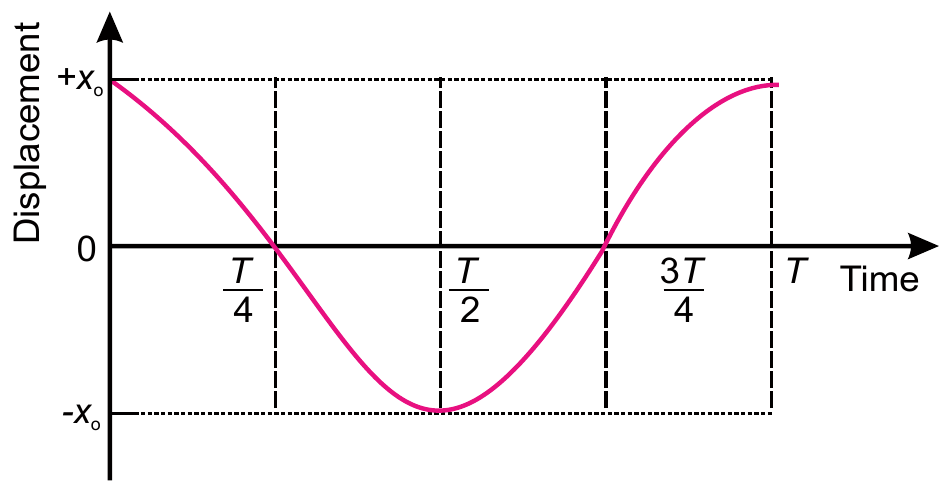
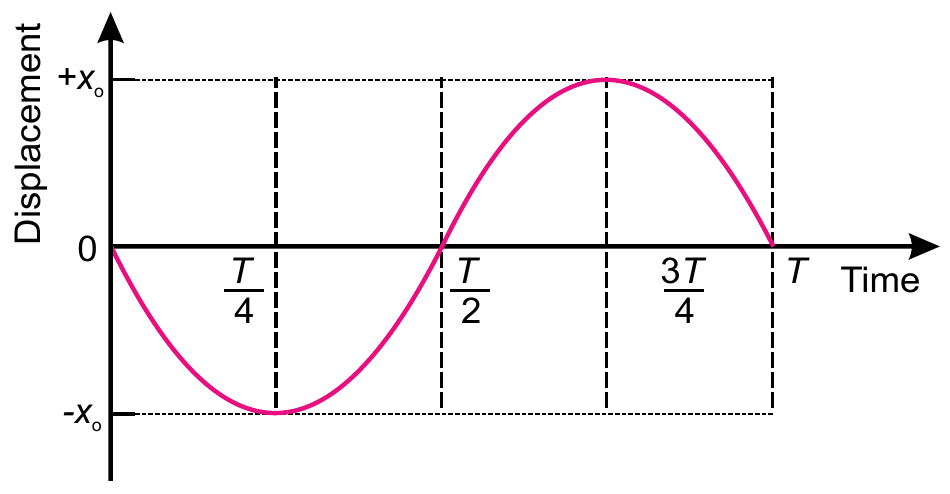
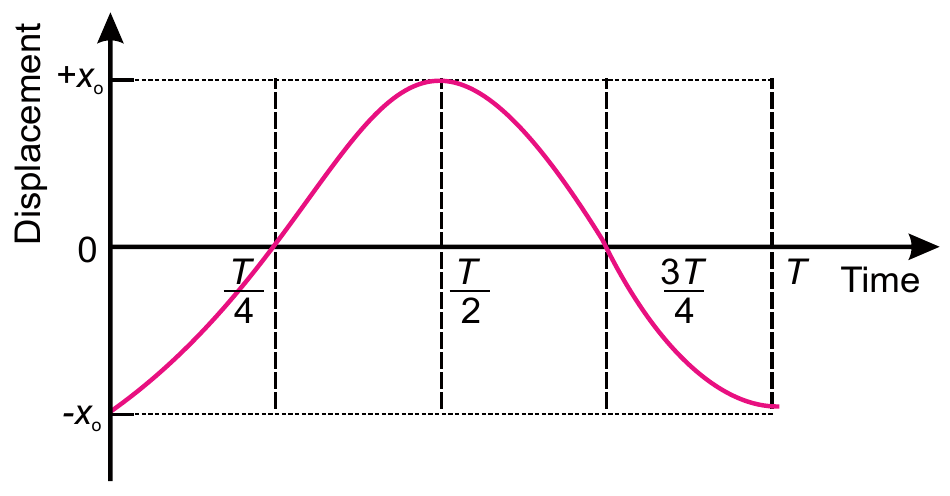
Displacement-time graph for a phase constant of zeroDisplacement-time graph for a phase constant of pi over twoDisplacement-time graph for a phase constant of pi
Graph of x = xₒcos(ωt + φ) for φ = 0, π/2 and π

For a Phase Constant of Zero

At the instants of zero, half a period and one full period the point is at the extreme positions, and at a quarter and at three quarters of a period it is at the mean position.

For a Phase Constant of π/2

At zero, half a period and one full period the point is at the mean position, and at a quarter and at three quarters of a period it is at the extreme positions.

For a Phase Constant of π

The graph is the mirror image of the first one, so wherever the first point is at one extreme this one is at the other.

In Phase and Out of Phase

When the phase difference between two oscillating systems is $\pi$ they are said to be oscillating out of phase, and when it is zero or $2\pi$ they are oscillating in phase.

Timing and Synchronisation

The phase therefore fixes the timing of an oscillation. Two oscillators of the same frequency stay synchronised only while their phase difference remains constant, and they pass through their extreme positions together only when that difference is zero.
LQ 6ends here

Book Examples

Example 14.5.1

The displacement of a particle executing S.H.M is given by x = 0.05 sin(4t + π/3). Find its velocity at the displacement of 0.03 m, its maximum velocity and its amplitude.

Given Data

Comparing with $x=x_o\sin(\omega t+\phi)$
$$x_o=0.05\,\mathrm{m}$$
$$\omega=4\,\mathrm{rad\,s^{-1}}$$
$$x=0.03\,\mathrm{m}$$

To Find

Velocity $v=?$, maximum velocity $v_o=?$ and amplitude $x_o=?$

Formula

$$v=\pm\omega\sqrt{x_o^2-x^2}$$
$$v_o=\omega x_o$$

Solution

Putting the values in the first relation
$$\begin{aligned}v&=\pm4\sqrt{(0.05\,\mathrm{m})^2-(0.03\,\mathrm{m})^2}=\pm4\times0.04 \\ &=\pm0.16\,\mathrm{m\,s^{-1}}\end{aligned}$$
The maximum velocity is at the mean position.
$$v_o=4\times0.05=0.20\,\mathrm{m\,s^{-1}}$$

Result

$$x_o=0.05\,\mathrm{m}$$
$$v=0.16\,\mathrm{m\,s^{-1}}$$
$$v_o=0.20\,\mathrm{m\,s^{-1}}$$

Short Questions

SQ 14.5.1

Define phase and write its relation with time.

Phase

The angle which specifies the displacement as well as the direction of motion of an oscillating point is called phase.
$$\theta=\omega t$$
It shows the state of motion of the oscillator at that instant.
SQ 14.5.2

What is meant by the phase constant?

Phase Constant

It is the constant added to the angle in the general equation of S.H.M.
$$x=x_o\cos(\omega t+\phi)$$
Its value depends upon the displacement and velocity of the particle at the start of the motion.
SQ 14.5.3

When are two oscillators said to be in phase and out of phase?

In Phase

When the phase difference between them is zero or $2\pi$, they are said to be oscillating in phase.
$$\Delta\phi=0$$

Out of Phase

When the phase difference between them is $\pi$, they are said to be oscillating out of phase.
$$\Delta\phi=\pi$$
MCQ 14.5.1

The time varying quantity $(\omega t+\phi)$ is called:

Athe phase constantBthe phase of the motion
Cthe angular frequencyDthe amplitude
Solution:It describes the state of motion of the oscillator at a given time.
MCQ 14.5.2

Two oscillators whose phase difference is $\pi$ are said to be:

Ain phaseBout of phase
CresonatingDdamped
Solution:A phase difference of zero or $2\pi$ would instead make them in phase.
MCQ 14.5.3

The value of the phase constant depends upon the state of the particle at:

Athe extreme positionBthe start of the motion
Cthe mean positionDresonance
Solution:It is fixed by the displacement and the velocity the particle has when timing begins.
MCQ 14.5.4

For a phase constant of $\pi/2$ the point at the start of the motion is at:

Aan extreme positionBthe mean position
Chalf the amplitudeDrest
Solution:The cosine of a right angle is zero, so the displacement at that instant is zero.
Topic 14.6

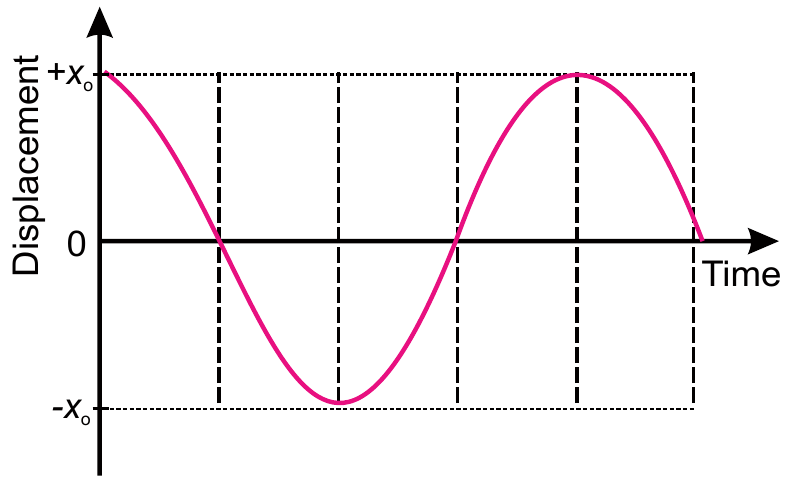
Graphical Representation of S.H.M

Displacement

The displacement of a particle executing S.H.M is given by the following expression.
$$x=x_o\cos\omega t$$
The particle has its maximum displacement, equal to the amplitude, at the extreme positions.

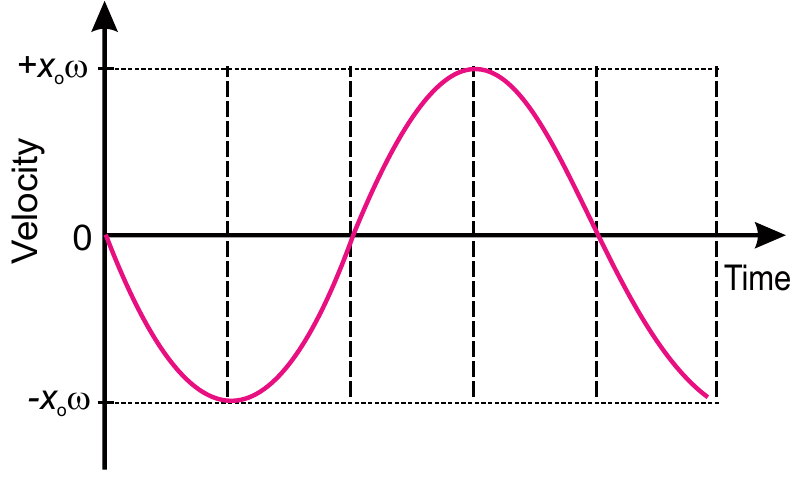
Velocity

$$v=-x_o\omega\sin\omega t$$
The velocity is maximum at the mean position, where it is the product of the amplitude and the angular frequency, and it is zero at the extreme positions.

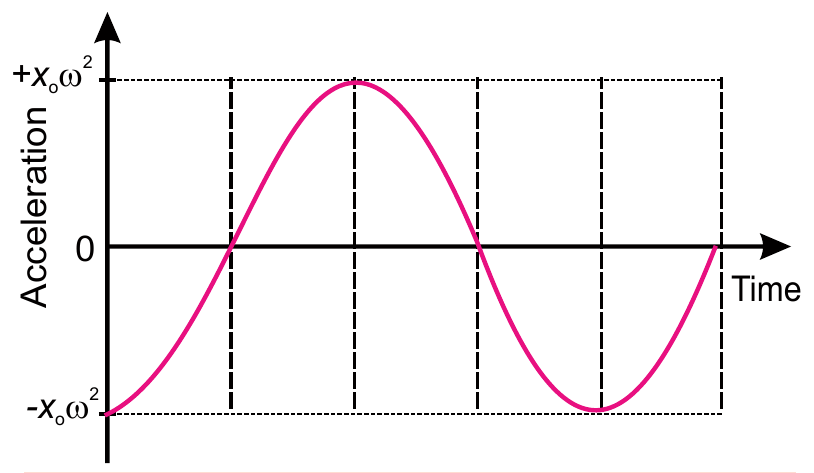
Acceleration

$$a=-\omega^2x$$
Putting the value of the displacement into this expression gives the acceleration in terms of time.
$$a=-x_o\omega^2\cos\omega t$$
The acceleration is maximum at the extreme positions and zero at the mean position.
Displacement of an oscillation performing S.H.MVelocity of an oscillation performing S.H.MAcceleration of an oscillation performing S.H.M
Graphical representation of displacement, velocity and acceleration of oscillation performing S.H.M

Phase Differences

The phase difference between the velocity and the displacement is $\pi/2$.
The phase difference between the acceleration and the displacement is $\pi$.

Short Questions

SQ 14.6.1

What is the phase difference between the displacement and the velocity in S.H.M?

Phase Difference

The velocity leads the displacement by a quarter of a cycle, so the phase difference between them is $\pi/2$ rad.
$$\Delta\phi=\frac{\pi}{2}$$

With Acceleration

The phase difference between the acceleration and the displacement is $\pi$ rad.
$$\Delta\phi=\pi$$
SQ 14.6.2

Write the expressions for the displacement, velocity and acceleration in S.H.M.

Displacement

$$x=x_o\cos\omega t$$

Velocity

$$v=-x_o\omega\sin\omega t$$

Acceleration

$$a=-x_o\omega^2\cos\omega t$$
SQ 14.6.3

Where is the acceleration of an oscillator maximum and where is it zero?

Maximum Acceleration

At the extreme positions, where the displacement is equal to the amplitude.
$$a_{max}=x_o\omega^2$$

Zero Acceleration

The displacement is zero at the mean position, so the acceleration there is zero.
MCQ 14.6.1

The phase difference between the acceleration and the displacement in S.H.M is:

AzeroB$\pi/2$
C$\pi$D$2\pi$
Solution:The acceleration is the negative of a constant times the displacement, so the two are exactly opposite.
MCQ 14.6.2

The velocity-time graph of a body executing S.H.M is:

Aa straight lineBa sine curve
Ca parabolaDa circle
Solution:The velocity varies as the sine of the phase angle, which repeats every cycle.
MCQ 14.6.3

The acceleration of an oscillator is zero at:

Athe extreme positionBthe mean position
Chalf the amplitudeDevery position
Solution:The acceleration is proportional to the displacement, which is zero at the mean position.
MCQ 14.6.4

The maximum velocity of an oscillator of amplitude $x_o$ is:

A$x_o\omega^2$B$x_o\omega$
C$\omega/x_o$D$x_o/\omega$
Solution:The velocity is largest at the mean position, where it is the amplitude times the angular frequency.
Topic 14.7

Conservation of Energy in S.H.M

LQ 4starts here — Derive expressions for K.E. and P.E. of the mass-spring system executing S.H.M. Also prove that its total energy remains same.

Energy of an Oscillator

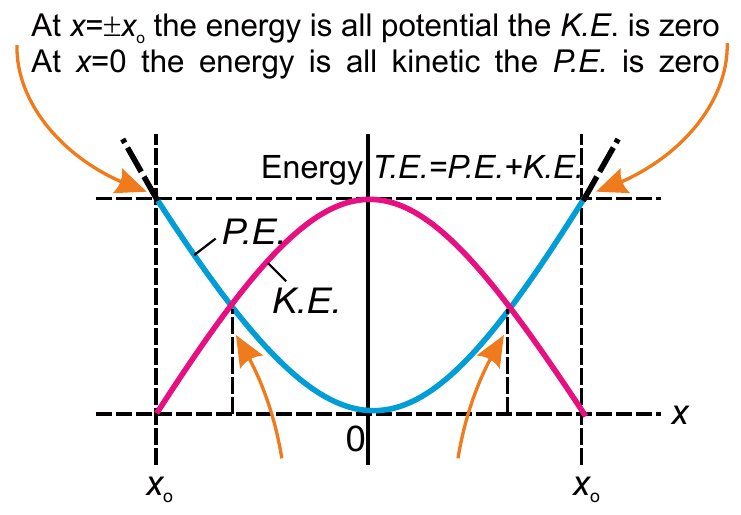
A body executing simple harmonic motion possesses potential energy on account of its displacement from the mean position and kinetic energy on account of its velocity. These energies vary during the oscillation, but the total energy at any instant remains constant in the absence of unbalanced frictional forces.

Average Restoring Force

In a mass-spring system the restoring force is zero at the mean position and maximum at either extreme position, so its average value between them is half of the maximum value.
$$F_{av}=\frac{kx_o}{2}$$

Work Done on the Spring

When the spring is stretched to its maximum displacement, the work done on it is the product of this average force and the displacement.
$$W=\frac{kx_o}{2}\times x_o=\frac{1}{2}kx_o^2$$

Potential Energy

This work done on the mass attached to the spring is stored as elastic potential energy, so the potential energy at any instant is given by the following relation.
$$(P.E.)_{inst}=\frac{1}{2}kx^2$$
The potential energy of the oscillator is zero at the mean position and maximum at either extreme position.
$$(P.E.)_{max}=\frac{1}{2}kx_o^2$$

Kinetic Energy

After the removal of the applied force the mass starts moving, and its instantaneous velocity and the angular frequency of the system are both known, so the kinetic energy at a displacement $x$ follows.
$$K.E.=\frac{1}{2}mv^2$$
$$v^2=\omega^2(x_o^2-x^2)$$
Putting this value of the square of the velocity in it
$$K.E.=\frac{1}{2}m\omega^2(x_o^2-x^2)$$
The spring constant is the product of the mass and the square of the angular frequency.
$$k=m\omega^2$$
$$K.E.=\frac{1}{2}k(x_o^2-x^2)$$
At the mean position the velocity is maximum, so there the whole of the energy is kinetic.
$$T.E.=K.E._{max}=\frac{1}{2}mv_{max}^2$$
$$v_{max}=\omega x_o$$
Putting the maximum velocity in it and using the spring constant again
$$T.E.=\frac{1}{2}m\omega^2x_o^2=\frac{1}{2}kx_o^2$$

Total Energy

The total energy is the sum of the kinetic and the potential energy of the system at a displacement $x$
$$T.E.=\frac{1}{2}k(x_o^2-x^2)+\frac{1}{2}kx^2$$
$$T.E.=\frac{1}{2}kx_o^2$$
The spring constant is the product of the mass and the square of the angular frequency, so the same result can be written in another form.
$$T.E.=\frac{1}{2}m\omega^2x_o^2$$

Conservation of Energy

The total energy of the mass-spring system is therefore constant and is directly proportional to the square of the amplitude of oscillation. When the kinetic energy of the mass is maximum it is passing through the centre of the oscillation and the potential energy is zero; when the potential energy is maximum the mass is at an extreme position and the kinetic energy is zero.
Graphical representation of energy (K.E., P.E. and T.E.) against displacement, for S.H.M
The energy oscillates between kinetic and potential, but their sum remains constant, and this statement of conservation of energy is equally valid for every body executing S.H.M.
LQ 4ends here

Book Examples

Example 14.7.1

A mass of 200 g is attached to a spring. A force of 40 N is applied and the spring is stretched to 10 cm from its mean position. After release, it performs S.H.M. Find the total energy of the mass, its kinetic energy when the displacement is 3 cm, its P.E. when K.E. is equal to its P.E., and its acceleration at the extreme position.

Given Data

$$m=200\,\mathrm{g}=0.2\,\mathrm{kg}$$
$$F=40\,\mathrm{N}$$
$$x_o=10\,\mathrm{cm}=0.1\,\mathrm{m}$$
$$x=3\,\mathrm{cm}=0.03\,\mathrm{m}$$

To Find

Total energy, kinetic energy, potential energy and acceleration

Formula

$$k=\frac{F}{x_o}$$
$$E_T=\frac{1}{2}kx_o^2$$
$$K.E.=\frac{1}{2}k(x_o^2-x^2)$$
$$a=\frac{kx_o}{m}$$

Solution

The spring constant is
$$k=\frac{40\,\mathrm{N}}{0.1\,\mathrm{m}}=400\,\mathrm{N\,m^{-1}}$$
The total energy of the mass is
$$\begin{aligned}E_T&=\frac{1}{2}\times400\,\mathrm{N\,m^{-1}}\times(0.1\,\mathrm{m})^2 \\ &=2\,\mathrm{J}\end{aligned}$$
The kinetic energy at a displacement of 3 cm is
$$\begin{aligned}K.E.&=\frac{1}{2}\times400\left[(0.1)^2-(0.03)^2\right]=200\times0.0091 \\ &=1.82\,\mathrm{J}\end{aligned}$$
When the kinetic energy equals the potential energy each is half of the total energy.
$$P.E.=\frac{E_T}{2}=\frac{2\,\mathrm{J}}{2}=1\,\mathrm{J}$$
The acceleration at the extreme position is
$$\begin{aligned}a&=\frac{400\,\mathrm{N\,m^{-1}}\times0.1\,\mathrm{m}}{0.2\,\mathrm{kg}} \\ &=200\,\mathrm{m\,s^{-2}}\end{aligned}$$

Result

$$E_T=2\,\mathrm{J}$$
$$K.E.=1.82\,\mathrm{J}$$
$$P.E.=1\,\mathrm{J}$$
$$a=200\,\mathrm{m\,s^{-2}}$$

Short Questions

SQ 14.7.1

Where is the potential energy of a mass-spring system maximum?

Maximum Potential Energy

At either extreme position, where the displacement is equal to the amplitude.
$$(P.E.)_{max}=\frac{1}{2}kx_o^2$$

At the Mean Position

The displacement is zero there, so the potential energy is zero.
SQ 14.7.2

Show that the total energy of a mass-spring system depends on the amplitude.

Total Energy

$$T.E.=\frac{1}{2}kx_o^2$$

Result

The spring constant is fixed for a given spring, so the total energy varies as the square of the amplitude of the oscillation.
SQ 14.7.3

A spring of spring constant 200 N m$^{-1}$ is stretched by 0.1 m. Find the energy stored in it.

Energy Stored

$$E=\frac{1}{2}kx^2=\frac{1}{2}\times200\times(0.1)^2$$

Result

$$E=1\,\mathrm{J}$$
SQ 14.7.4

At what displacement is the kinetic energy of an oscillator equal to its potential energy?

Equal Kinetic and Potential Energy

The two are equal when each of them is half of the total energy.
$$\frac{1}{2}k(x_o^2-x^2)=\frac{1}{2}kx^2$$

Result

$$x=\frac{x_o}{\sqrt{2}}$$
That is at 0.707 of the amplitude on either side of the mean position.
MCQ 14.7.1

The kinetic energy of a body executing S.H.M is maximum at:

Athe extreme positionBthe mean position
Chalf the amplitudeDboth extreme positions
Solution:The velocity is greatest at the mean position, and there the whole energy is kinetic.
MCQ 14.7.2

The total energy of a body executing S.H.M is:

Amaximum at the mean positionBmaximum at the extreme positions
Cthe same at every positionDzero at the mean position
Solution:The kinetic and the potential energy interchange, but in the absence of friction their sum is constant.
MCQ 14.7.3

The potential energy of a mass-spring system at a displacement $x$ is:

A$kx$B$\frac{1}{2}kx^2$
C$\frac{1}{2}kx$D$kx^2$
Solution:It is the work done against the average restoring force in stretching the spring that far.
MCQ 14.7.4

If the amplitude of an oscillator is doubled, its total energy becomes:

AdoubleBfour times
ChalfDunchanged
Solution:The total energy varies as the square of the amplitude.
MCQ 14.7.5

In terms of the angular frequency the total energy of a mass-spring system is:

A$\frac{1}{2}m\omega^2x_o$B$\frac{1}{2}m\omega^2x_o^2$
C$\frac{1}{2}m\omega x_o^2$D$m\omega^2x_o^2$
Solution:Putting the spring constant as the mass times the square of the angular frequency gives this form.
Topic 14.8

Free and Forced Oscillations

Free Oscillations

A body is said to be executing free vibrations if it oscillates with its natural frequency without the interference of an external force.

Example

A simple pendulum vibrates freely with its natural frequency, which depends only upon its length, when it is slightly displaced from its mean position.

Energy in Free Oscillations

The total energy of the body remains constant, so the energy is conserved, and in the absence of a resistive force the amplitude of the oscillation also remains constant.

Forced Oscillations

If a freely oscillating system is subjected to an external force then forced vibrations take place, as when a swing is struck repeatedly.

Examples

The vibrations of a factory floor caused by the running of heavy machinery.
The loud music produced by the sounding wooden boards of string instruments.
The vibration of a vehicle caused by the running of its engine.

Short Questions

SQ 14.8.1

Define free vibrations and give an example.

Free Vibrations

A body executes free vibrations when it oscillates with its natural frequency without the interference of an external force.

Example

A simple pendulum slightly displaced from its mean position, whose natural frequency depends only upon its length.
SQ 14.8.2

Give two examples of forced vibrations.

Examples of Forced Vibrations

The vibrations of a factory floor caused by the running of heavy machinery.
The loud music produced by the sounding boards of string instruments.

Cause

Each is produced by an external periodic force acting on the system.
SQ 14.8.3

What happens to the energy of a body executing free vibrations?

Energy in Free Vibrations

The total energy of the body remains constant, so the energy is conserved.

Amplitude

In the absence of a resistive force the amplitude of the oscillation also remains constant.
MCQ 14.8.1

A body vibrating with its own natural frequency executes:

Aforced vibrationsBfree vibrations
Cdamped vibrationsDresonance
Solution:Free vibrations take place when no external force interferes with the body.
MCQ 14.8.2

The natural frequency of a simple pendulum depends only upon:

Athe mass of the bobBthe amplitude
Cits lengthDthe applied force
Solution:For a given place the value of $g$ is fixed, so only the length is left to decide the frequency.
MCQ 14.8.3

A swing struck repeatedly is an example of:

Afree vibrationsBforced vibrations
Cdamped vibrationsDnone of these
Solution:An external periodic force keeps acting on the swing while it oscillates.
Topic 14.9

Damped Oscillation

Damped Oscillation

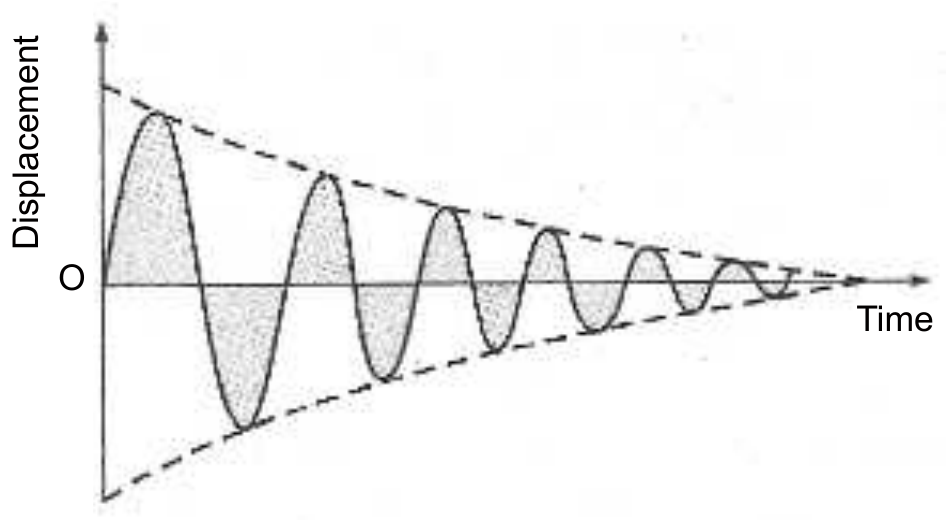
The oscillations with decreasing amplitude in the presence of various resistive forces are called damped oscillations, and the resistive forces themselves are called damping forces.

Cause of Damping

In an ideal free oscillation the total mechanical energy of the body remains constant, but in practical life dissipating forces such as air resistance and friction are always present. The amplitude of the oscillation decreases gradually with time because of these forces and the body finally comes to rest.

Examples

A girl swinging on a swing, where the damping is due to gravity and air friction.
The gradually decreasing amplitude of an oscillating simple pendulum.
Touching an oscillating tuning fork with a finger.
Graphical representation of damped oscillation

Kinds of Damping

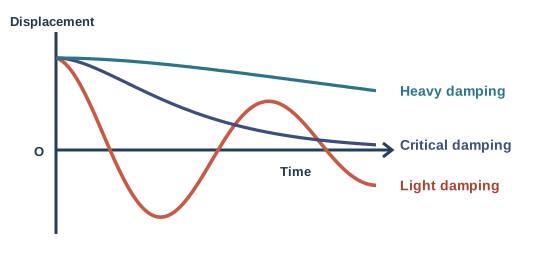
Light damping reduces the energy and the amplitude of the vibrating body gradually, as for a swing in a playground.
Heavy damping causes the system to return to equilibrium very slowly without oscillating, as for a pendulum submerged in thick oil.
Critical damping returns the object to its equilibrium position in the shortest possible time, as with the shock absorbers of a car.
Light, critical and heavy damping

Application of Damped Oscillation

The shock absorbers used in the suspension system of a car are one practical application of damped oscillation. They damp the excessive oscillations produced by a bumpy, rough road and so ensure a comfortable ride for the passengers.

Short Questions

SQ 14.9.1

Define damped oscillations.

Damped Oscillations

The oscillations with decreasing amplitude in the presence of various resistive forces are called damped oscillations, and the resistive forces themselves are called damping forces.
SQ 14.9.2

Name the three kinds of damping with one example of each.

Kinds of Damping

Light damping, which reduces the amplitude gradually, as for a swing in a playground.
Heavy damping, as for a pendulum in thick oil.
Critical damping, which returns the body in the shortest possible time, as with a shock absorber.
SQ 14.9.3

Why does the amplitude of a real pendulum decrease with time?

Dissipating Forces

Air resistance and friction at the support take energy away from the pendulum in every cycle.

Result

The amplitude decreases gradually with time and the pendulum finally comes to rest.
MCQ 14.9.1

The shock absorbers of a car are designed to give:

Alight dampingBheavy damping
Ccritical dampingDno damping
Solution:Critical damping brings the car back to equilibrium in the shortest time without oscillating.
MCQ 14.9.2

A pendulum submerged in thick oil is an example of:

Alight dampingBheavy damping
Ccritical dampingDresonance
Solution:The oil offers a heavy resistance, so the pendulum returns very slowly without oscillating.
MCQ 14.9.3

In a damped oscillation the amplitude of the body:

Aincreases with timeBremains constant
Cdecreases with timeDbecomes infinite
Solution:The resistive forces take energy from the body in every cycle until it comes to rest.
MCQ 14.9.4

The energy of a damped oscillator is lost mainly as:

Aheat against the resistive forcesBsound only
ClightDit is not lost at all
Solution:Air resistance and friction dissipate the mechanical energy of the oscillator.
Topic 14.10

Resonance

LQ 5starts here — Explain resonance. Give some of its advantages and disadvantages.

Driving Force

In a damped oscillation the oscillator cannot maintain its natural frequency for long and its amplitude decreases gradually, but a constant amplitude can be maintained by applying a periodic external force called a driving force. Such an oscillation is a forced oscillation and the frequency of the force is called the driving frequency.

Amplitude of a Forced Oscillation

In a forced oscillation the amplitude depends upon the relation between the driving frequency and the natural frequency of the body.

Resonance

If the frequency of the driving force is the same as the natural frequency of the oscillating body, the amplitude of vibration is very much increased. This phenomenon is known as resonance. It also occurs when the applied force has a frequency which is an integral multiple of the natural frequency of the body.

Demonstration

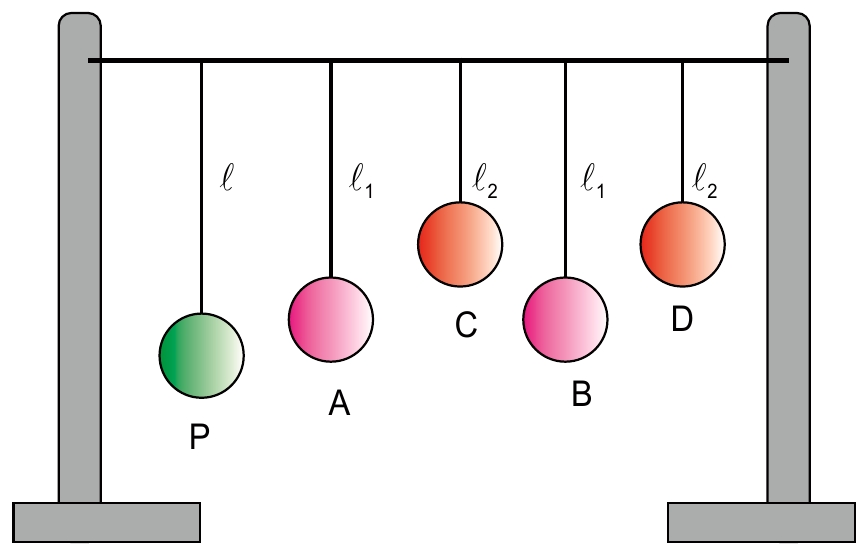
Two pairs of pendulums, A and B of one length and C and D of another, are suspended from a horizontal string, and another pendulum P whose length can be changed is introduced.
A set of five different pendulums of different lengths

Observation

When P is made equal in length to A and B and set into vibration, the vibration reaches the other pendulums through the string. A and B receive a driving force and their amplitude increases by resonance, because their length, natural frequency and natural period are the same as those of P, while C and D continue to remain at rest. If the length of P is instead made equal to that of C and D, then C and D start vibrating while A and B remain at rest.

Where Resonance is Useful

A microwave oven produces waves of wavelength 12 cm at a frequency of 2450 MHz. At this frequency the waves are absorbed by resonance by the water and fat molecules of the food, which heats them and cooks the food. A plastic or glass container does not heat up, because it contains no water molecules.
In tuning an analogue radio the natural frequency of the circuit of the receiver is changed until it equals the transmission frequency of the station. At resonance the energy absorbed from that station is maximum, and it is the only station we hear.
The sound board of a piano, a violin or a guitar resonates with the vibration of the string and amplifies the sound, producing a louder and richer note.
In magnetic resonance imaging strong radio frequency radiations cause nuclei to oscillate and absorb energy, and the pattern of the energy absorbed is used to produce a photograph.

Where Resonance is Avoided

Marching soldiers are advised to break step while crossing a bridge. If they march in step the frequency of their footsteps may become equal to the natural frequency of the bridge, which may then vibrate with a large amplitude and collapse.
The wings of an aeroplane experience aerodynamic forces, turbulence and engine vibration. If the frequency of these forces matches the natural frequency of the wings, resonance occurs and it may be dangerous.
The Tacoma Narrows Bridge was opened to traffic in July 1940, and only four months later a mild wind set it into resonant vibrations until a part of it broke off and went into the water below.
LQ 5ends here

Short Questions

SQ 14.10.1

Define resonance.

Resonance

When the frequency of the driving force becomes equal to the natural frequency of the oscillating body, the amplitude of vibration is very much increased. This phenomenon is called resonance.
$$f=f_o$$
SQ 14.10.2

Why is food heated so efficiently in a microwave oven?

Resonance of Water Molecules

The waves have a frequency of 2450 MHz, at which they are absorbed by the water and fat molecules of the food by resonance, and this heats and cooks it.

Container

A plastic or glass container has no water molecules, so it does not heat up.
SQ 14.10.3

How does the tuning of an analogue radio work?

Tuning by Resonance

Turning the knob changes the natural frequency of the circuit of the receiver until it equals the transmission frequency of the station.

Result

At resonance the energy absorbed from that station is maximum, so it is the only station heard.
SQ 14.10.4

Why did the Tacoma Narrows Bridge collapse?

Resonant Vibrations

Four months after it opened in 1940, a mild wind set the bridge into resonant vibrations.

Result

The amplitude grew so large that the bridge could not stand the stress, and a part of it broke off and went into the water below.
MCQ 14.10.1

Resonance occurs when the driving frequency is:

Agreater than the natural frequencyBless than the natural frequency
Cequal to the natural frequencyDzero
Solution:It also occurs when the driving frequency is an integral multiple of the natural frequency.
MCQ 14.10.2

At resonance the amplitude of the oscillation is:

AmaximumBminimum
CzeroDunchanged
Solution:The driving force feeds the oscillator in step with its own motion, so the amplitude builds up.
MCQ 14.10.3

In the experiment with five pendulums, the ones set vibrating are those:

Aof the greatest massBof the same length as the driving pendulum
Cnearest to the driving pendulumDof the shortest length
Solution:Equal lengths mean equal natural frequencies, which is the condition for resonance.
MCQ 14.10.4

Marching soldiers break step while crossing a bridge to avoid:

AdampingBfree vibrations
CresonanceDfriction
Solution:Steps in time could match the natural frequency of the bridge and set it swinging dangerously.
Topic 14.11

Sharpness of Resonance

Sharpness of Resonance

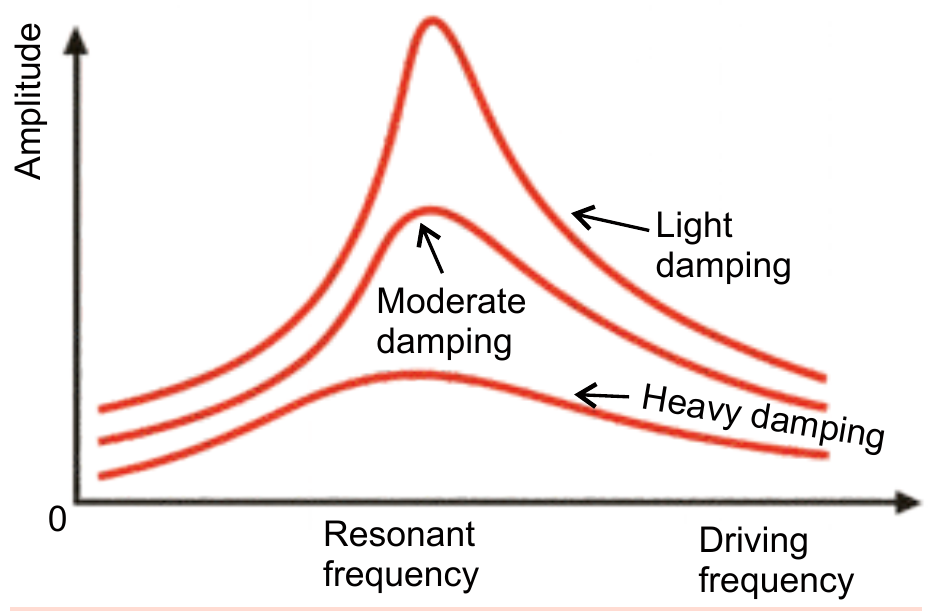
At resonance the amplitude of the oscillator becomes very large. Both the amplitude and its sharpness depend upon the damping.

Effect of Damping

The smaller the damping, the greater the amplitude and the sharper the resonance. A heavily damped system has a fairly flat resonance curve on an amplitude-frequency graph.
Damping system illustration

Demonstration

A pendulum with a light pith-ball bob and another of the same length with a heavy lead bob of equal size are attached to a string and set into vibration by a third pendulum of equal length. The amplitude of the lead bob is much greater than that of the pith-ball, because the damping due to air resistance is much greater for the pith-ball.

Resonance and Standing Waves

Many devices generate and use standing waves, and the relation between a standing wave and resonance can be studied through the Rubens tube, the Chladni plate and acoustic levitation.

Rubens Tube

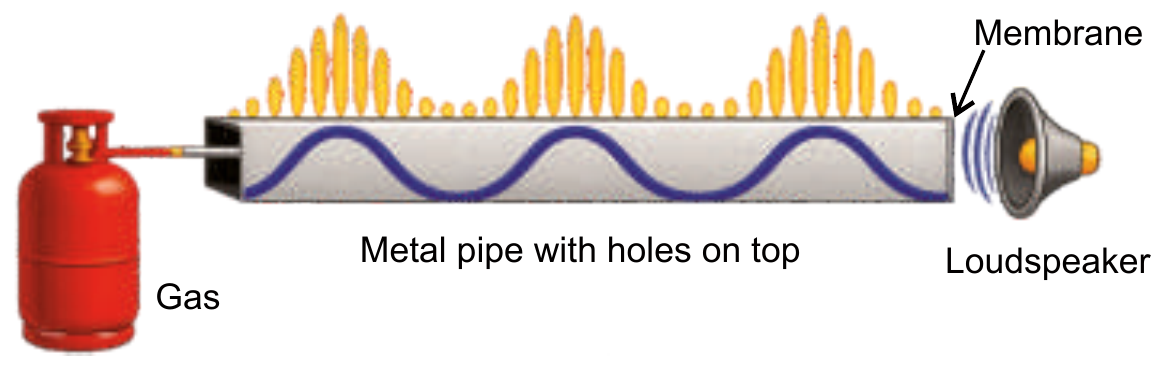
A Rubens tube is a long metal pipe with holes drilled along its top and sealed at both ends. One sealed end is attached to a small speaker or frequency generator and the other is connected to a supply of a flammable gas.
Rubens tube apparatus

Working of the Rubens Tube

When sound waves of the resonant frequency are produced, a standing wave forms inside the tube and creates points of higher and lower pressure. Less gas escapes where the pressure is low, so the flame is lower there, and more gas escapes where the pressure is high, so the flame is higher, and these low and high flames reveal the nodes and antinodes.

Chladni Plate

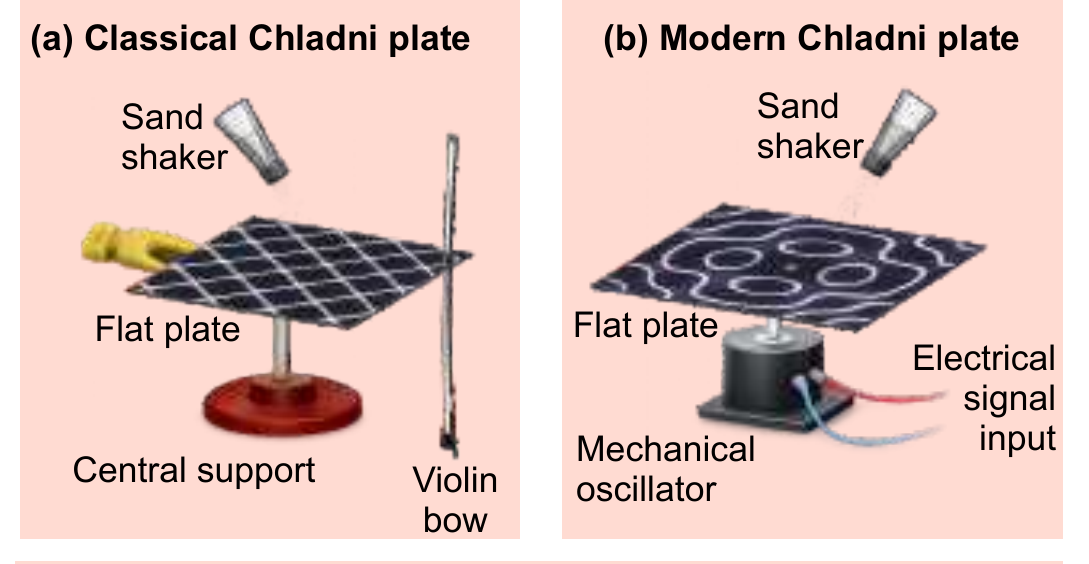
A Chladni plate is usually a circular or square metal plate fixed horizontally to a vibrator and driven transversally at its centre. When it is vibrated at the frequency of a resonant normal mode, nodes and antinodes are formed over its surface.
Chladni plates
Chladni plates
The plate does not vibrate at the points where the nodes are formed, while the rest of it vibrates with its maximum amplitude. Sand sprinkled evenly over the plate shifts from the antinodes to the nodes, because the nodes are stationary.

Acoustic Levitation

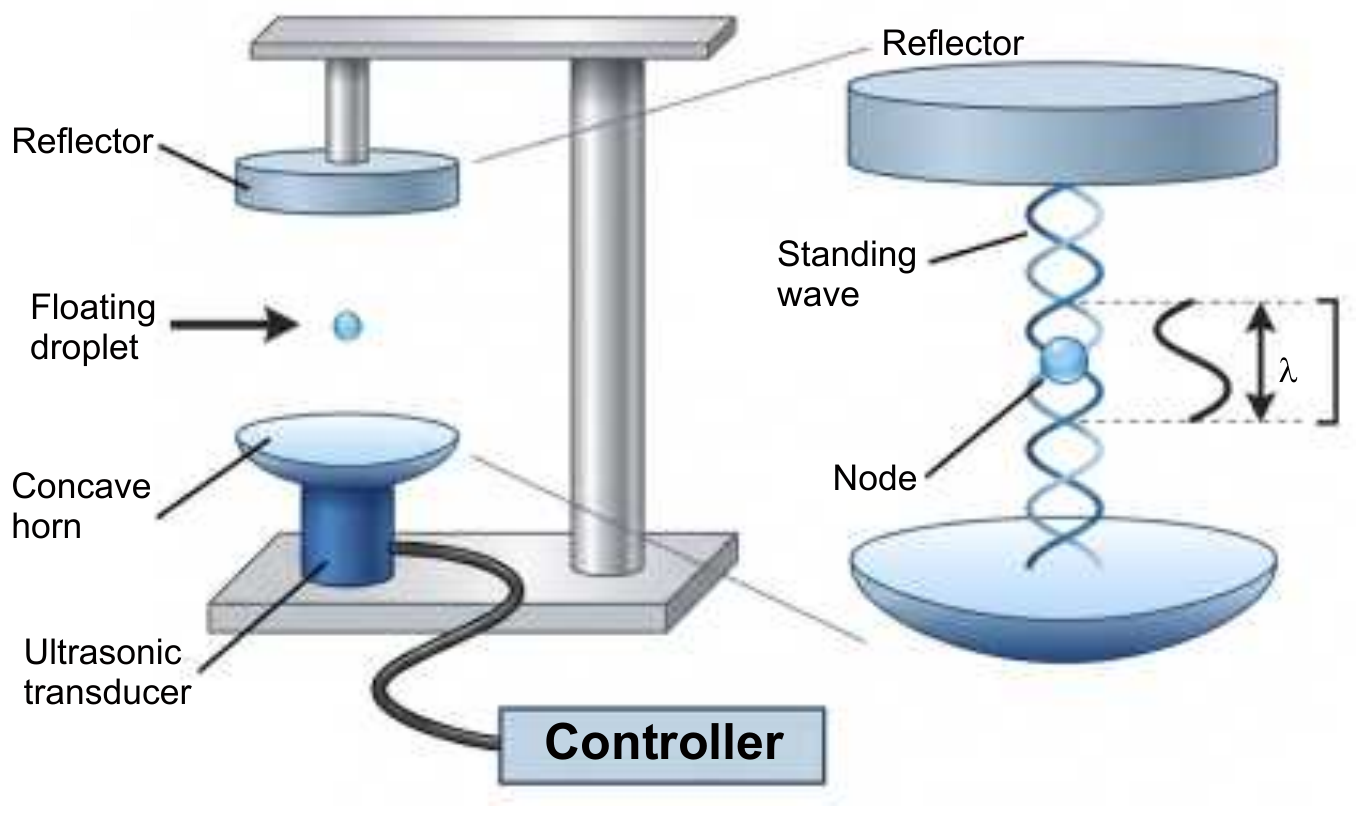
Acoustic levitation is a method of suspending matter in air against gravity using the radiation pressure of high intensity sound waves, so small particles such as bits of styrofoam or droplets of water are held up without any physical contact.
Acoustic levitation setup

Working of an Acoustic Levitator

A levitator consists of a source of sound called a transducer and a reflector. The high frequency sound from the transducer is bounced off the reflector, and the incident and reflected waves form a standing wave in which the pressure is minimum at a node and maximum at an antinode. This difference between the higher and the lower pressure exerts a force on the small particles against gravity, so the nodes of the standing wave act as acoustic traps.

Short Questions

SQ 14.11.1

How does damping affect the sharpness of resonance?

Damping and Sharpness

The smaller the damping, the greater the amplitude and the sharper the resonance.

Heavy Damping

A heavily damped system has a fairly flat resonance curve on an amplitude-frequency graph.
SQ 14.11.2

What do the low and high flames of a Rubens tube show?

Nodes and Antinodes

Less gas escapes where the pressure of the standing wave is low, so the flame is lower there, and more gas escapes where the pressure is high.

Result

The low and high flames therefore reveal the nodes and antinodes inside the tube.
SQ 14.11.3

Why does sand collect at the nodes of a Chladni plate?

Nodes are Stationary

The plate does not vibrate at the points where the nodes are formed, while the rest of it vibrates with its maximum amplitude.

Result

The sand is shaken off the moving parts and settles at the nodes.
MCQ 14.11.1

The sharpness of resonance depends upon:

Athe amplitudeBthe damping
Cthe massDthe length
Solution:The smaller the damping, the taller and the sharper the resonance peak.
MCQ 14.11.2

In an acoustic levitator the small particles are trapped at:

Athe antinodesBthe nodes
Cthe reflectorDthe transducer
Solution:The pressure of the standing wave is minimum at a node, so the nodes act as acoustic traps.
MCQ 14.11.3

A Rubens tube is used to demonstrate:

AdampingBforced vibration
Cacoustic standing wavesDfree vibration
Solution:The heights of the flames along the tube map the nodes and antinodes of the standing wave.
MCQ 14.11.4

A heavily damped system has a resonance curve which is:

Avery sharpBfairly flat
Ca straight lineDa circle
Solution:Heavy damping keeps the amplitude low and spreads the response over a wide band of frequencies.

Chapter Exercise

SQ 14.1

Define simple harmonic motion and write its equation.

Simple Harmonic Motion

Simple harmonic motion is the oscillatory motion in which the acceleration is directly proportional to the displacement and always directed towards the mean position.

Equation

$$a=-\omega^2x$$
The negative sign shows that the acceleration is opposite to the displacement.
SQ 14.2

State the basic conditions for frictionless system to execute simple harmonic motion.

Restoring Force

The restoring force must be directly proportional to the displacement from the mean position and must follow Hooke’s law.
$$F=-kx$$

Acceleration

The acceleration must be proportional to the displacement and always directed towards the mean position.
$$a=-\frac{k}{m}x$$
$$\frac{k}{m}=\text{constant}$$
$$a\propto-x$$
SQ 14.3

Differentiate between free and forced oscillations.

Free OscillationsForced Oscillations
No external force acts on the body.An external periodic force acts on the body.
It vibrates with its own natural frequency.It vibrates with the driving frequency.
Its total energy remains constant.Energy is supplied by the driving force.
A freely swinging simple pendulum.A swing struck repeatedly.
SQ 14.4

Why we cannot construct an ideal simple pendulum? Explain briefly.

Ideal Requirements

It needs a point mass bob, a weightless and perfectly inextensible string, a frictionless support and oscillation in vacuum.

Practical Limitation

None of these is available and air resistance cannot be removed, so an ideal simple pendulum is only a theoretical concept.
SQ 14.5

How does sharpness of resonance occur?

Sharpness of Resonance

At resonance the amplitude becomes very large. Both the amplitude and its sharpness depend upon the damping.

Effect of Damping

The smaller the damping, the greater the amplitude and the sharper the resonance. A heavily damped system has a fairly flat resonance curve.
Damping system illustration
SQ 14.6

What would happen to the time period if the Earth suddenly stop rotating?

Time Period of a Pendulum

$$T=2\pi\sqrt{\frac{l}{g}}$$

Effect on g

The rotation of the Earth reduces the effective value of $g$. If the Earth suddenly stops rotating, the effective value of $g$ increases.

Result

The time period is inversely proportional to the square root of $g$, so the time period of the pendulum decreases.
SQ 14.7

What is restoring force? What provides restoring force for simple harmonic oscillator in the case of simple pendulum and mass-spring system?

Restoring Force

The force which always brings the vibrating body back towards its mean position is called restoring force.

Simple Pendulum

The tangential component of the weight of the bob provides it.
$$F=-mg\sin\theta$$

Mass-Spring System

The elastic force of the deformed spring provides it.
$$F=-kx$$
SQ 14.8

What role do shock absorbers play in oscillations of vehicles in a bumpy road? Explain briefly.

Shock Absorbers as Dampers

Shock absorbers in a vehicle’s suspension provide damping to the excessive oscillations produced by a bumpy road.

Working

They are designed for critical damping, so the vehicle returns to equilibrium in the shortest possible time without oscillating, which gives a comfortable ride.
CRQ 14.1

Why marching troops are asked to break their steps while crossing a bridge? Explain.

Marching in Step and Resonance

If the soldiers march in steps, the frequency of their footsteps may become equal to the natural frequency of the bridge.

Effect

Resonance would then set the bridge vibrating with a very large amplitude and it may collapse. Breaking steps keeps the two frequencies unequal.
CRQ 14.2

A girl is swinging in the sitting position. Describe, how will the period of swing be changed if she stands up?

Effective Length

Standing up raises the centre of gravity of the girl, so the effective length of the swing decreases.

Relation

$$T=2\pi\sqrt{\frac{l}{g}}$$

Result

The time period is directly proportional to the square root of the length, so the period of the swing decreases.
CRQ 14.3

Will a pendulum that keeps correct time at Karachi, be accurate at Murree or at the top of mount Everest? Explain.

Time Period and Gravity

$$T=2\pi\sqrt{\frac{l}{g}}$$

Change in g

The value of $g$ decreases as the altitude increases, so it is smaller at Murree and much smaller at the top of Mount Everest.

Result

The time period becomes longer there, so the pendulum clock runs slow and does not keep correct time.
CRQ 14.4

A wire hangs from a dark high tower so that its upper end is not visible. How can we determine the length of a tower?

Wire as a Simple Pendulum

A bob attached to the lower end of the wire makes the wire behave as a simple pendulum, and its time period is measured with a stopwatch.

Calculation

$$T=2\pi\sqrt{\frac{l}{g}}$$
$$l=\frac{gT^2}{4\pi^2}$$

Result

The length obtained from this relation is the height of the tower.
CRQ 14.5

Will the period of a vibrating spring increase, decrease or remain constant by addition of more mass? Explain.

Time Period and Mass

$$T=2\pi\sqrt{\frac{m}{k}}$$

Effect

The spring constant depends only upon the spring, so it remains unchanged, while the time period is directly proportional to the square root of the mass.

Result

Addition of more mass therefore increases the time period of the vibrating spring.
CRQ 14.6

Can a simple pendulum vibrate at centre of the Earth? Explain.

Value of g at the Centre

The value of $g$ at the centre of the Earth is zero.

Restoring Force

The restoring force $mg\sin\theta$ also becomes zero, so there is nothing to bring the bob back to its mean position.

Result

$$T=2\pi\sqrt{\frac{l}{g}}=\infty$$
The time period becomes infinite, so a simple pendulum cannot vibrate there.
MCQ 14.1

While determining time period of simple pendulum, we keep the amplitude:

AlargeBsmall
CmaximumDzero
Solution:Only for a small amplitude is $\sin\theta\approx\theta$, so the motion stays simple harmonic and the time period formula holds.
MCQ 14.2

In simple harmonic motion, the acceleration of a body is zero, when:

Avelocity is zeroBdisplacement is zero
Cboth velocity and displacement are zeroDboth velocity and displacement are maximum
Solution:The acceleration is $-\omega^2x$, so it is zero where the displacement is zero, that is at the mean position.
MCQ 14.3

If a tunnel is bored through the centre of Earth and a stone is dropped into it, then:

Astone will stop at the centre of EarthBstone will move out from other side of the tunnel
Cstone will perform S.H.M.Dnone of the above
Solution:The restoring force on the stone is proportional to its distance from the centre, so it executes S.H.M about the centre.
MCQ 14.4

Which of the following variables has zero value at the extreme position in S.H.M?

AAccelerationBSpeed
CDisplacementDAngular frequency
Solution:At the extreme position the body momentarily stops, so its speed is zero while the acceleration and the displacement are maximum.
MCQ 14.5

Which of the following force is responsible for S.H.M?

AApplied forceBFrictional force
CRestoring forceDElastic force
Solution:S.H.M is produced by the restoring force, which is proportional to the displacement and directed towards the mean position.
MCQ 14.6

The velocity of a particle moving with S.H.M at the mean position is:

AzeroBminimum
CmaximumDnone of these
Solution:The velocity is $\omega\sqrt{x_o^2-x^2}$, which is largest where the displacement is zero.
MCQ 14.7

A child swinging on a swing in sitting position, stands up, then time period of the swing will:

AincreaseBdecrease
Cremain sameDbecome zero
Solution:Standing up raises the centre of gravity, so the effective length of the swing decreases and the time period falls with the square root of the length.
MCQ 14.8

The total energy of a particle executing S.H.M is proportional to:

Afrequency of oscillationBvelocity of motion
Camplitude of motionDsquare of amplitude of motion
Solution:The total energy is $\frac{1}{2}kx_o^2$, so it varies as the square of the amplitude.
MCQ 14.9

The period of simple pendulum increases how many times if its length is doubled?

A$\sqrt{2}$ timesB2 times
C4 timesD8 times
Solution:The period varies as the square root of the length, so doubling the length multiplies it by $\sqrt{2}$.
Numerical 14.1

A body is executing S.H.M of amplitude 0.05 m and frequency 10 Hz. Find the value of (i) maximum acceleration (ii) maximum velocity. (Ans: 1.97 × 10$^2$ m s$^{-2}$, 3.14 m s$^{-1}$)

Given Data

$$x_o=0.05\,\mathrm{m}$$
$$f=10\,\mathrm{Hz}$$

To Find

Maximum acceleration $a_{max}=?$ and maximum velocity $v_{max}=?$

Formula

$$\omega=2\pi f$$
$$a_{max}=\omega^2x_o$$
$$v_{max}=\omega x_o$$

Solution

The angular frequency of the body is
$$\omega=2\times3.14\times10\,\mathrm{Hz}=62.8\,\mathrm{rad\,s^{-1}}$$
The maximum acceleration is at the extreme position.
$$a_{max}=(62.8)^2\times0.05=1.97\times10^{2}\,\mathrm{m\,s^{-2}}$$
The maximum velocity is at the mean position.
$$v_{max}=62.8\times0.05=3.14\,\mathrm{m\,s^{-1}}$$

Result

$$a_{max}=1.97\times10^{2}\,\mathrm{m\,s^{-2}}$$
$$v_{max}=3.14\,\mathrm{m\,s^{-1}}$$
Numerical 14.2

A mass of 0.5 kg is suspended from a spring. The spring is stretched 0.098 m. Find: (i) the period of oscillation of mass when it is given a small displacement (ii) frequency of oscillation of spring. (Ans: 0.628 s, 1.59 Hz)

Given Data

$$m=0.5\,\mathrm{kg}$$
$$x=0.098\,\mathrm{m}$$
$$g=9.8\,\mathrm{m\,s^{-2}}$$

To Find

Time period $T=?$ and frequency $f=?$

Formula

The weight of the mass stretches the spring, so
$$k=\frac{mg}{x}$$
$$T=2\pi\sqrt{\frac{m}{k}}$$
$$f=\frac{1}{T}$$

Solution

The spring constant is
$$\begin{aligned}k&=\frac{0.5\,\mathrm{kg}\times9.8\,\mathrm{m\,s^{-2}}}{0.098\,\mathrm{m}} \\ &=50\,\mathrm{N\,m^{-1}}\end{aligned}$$
The time period of oscillation is
$$\begin{aligned}T&=2\times3.14\times\sqrt{\frac{0.5\,\mathrm{kg}}{50\,\mathrm{N\,m^{-1}}}}=6.28\times0.1 \\ &=0.628\,\mathrm{s}\end{aligned}$$
The frequency is the reciprocal of the time period.
$$f=\frac{1}{0.628\,\mathrm{s}}=1.59\,\mathrm{Hz}$$

Result

$$T=0.628\,\mathrm{s}$$
$$f=1.59\,\mathrm{Hz}$$
Numerical 14.3

A ball of mass 0.5 kg is attached to an elastic spring. The spring is compressed by 10 cm by a force of 45 N. Calculate the energy stored in the spring. What will be the maximum velocity of the ball if the compressing force is suddenly removed? (Ans: 2.25 J, 3 m s$^{-1}$)

Given Data

$$m=0.5\,\mathrm{kg}$$
$$x_o=10\,\mathrm{cm}=0.1\,\mathrm{m}$$
$$F=45\,\mathrm{N}$$

To Find

Energy stored $E=?$ and maximum velocity $v_{max}=?$

Formula

$$k=\frac{F}{x_o}$$
$$E=\frac{1}{2}kx_o^2$$
$$E=\frac{1}{2}mv_{max}^2$$

Solution

The spring constant is
$$k=\frac{45\,\mathrm{N}}{0.1\,\mathrm{m}}=450\,\mathrm{N\,m^{-1}}$$
The energy stored in the compressed spring is
$$\begin{aligned}E&=\frac{1}{2}\times450\,\mathrm{N\,m^{-1}}\times(0.1\,\mathrm{m})^2 \\ &=2.25\,\mathrm{J}\end{aligned}$$
On release the whole of this energy becomes kinetic energy at the mean position.
$$\begin{aligned}v_{max}&=\sqrt{\frac{2E}{m}}=\sqrt{\frac{2\times2.25\,\mathrm{J}}{0.5\,\mathrm{kg}}} \\ &=3\,\mathrm{m\,s^{-1}}\end{aligned}$$

Result

$$E=2.25\,\mathrm{J}$$
$$v_{max}=3\,\mathrm{m\,s^{-1}}$$
Numerical 14.4

A 8.0 kg body executes S.H.M with amplitude 30 cm. The restoring force is 60 N, when the displacement is 30 cm. Find: (i) time period (ii) acceleration, speed, K.E. and P.E, when displacement is 12 cm. (Ans: 1.3 s, 3.0 m s$^{-2}$, 1.4 m s$^{-1}$, 7.6 J, 1.44 J)

Given Data

$$m=8\,\mathrm{kg}$$
$$x_o=30\,\mathrm{cm}=0.3\,\mathrm{m}$$
$$F=60\,\mathrm{N}$$
$$x=12\,\mathrm{cm}=0.12\,\mathrm{m}$$

To Find

Time period, acceleration, speed, kinetic energy and potential energy

Formula

$$k=\frac{F}{x_o}$$
$$T=2\pi\sqrt{\frac{m}{k}}$$
$$a=-\omega^2x$$
$$v=\omega\sqrt{x_o^2-x^2}$$
$$K.E.=\frac{1}{2}k(x_o^2-x^2)$$
$$P.E.=\frac{1}{2}kx^2$$

Solution

The spring constant and the angular frequency are
$$k=\frac{60\,\mathrm{N}}{0.3\,\mathrm{m}}=200\,\mathrm{N\,m^{-1}}$$
$$\omega=\sqrt{\frac{200}{8}}=5\,\mathrm{rad\,s^{-1}}$$
The time period is
$$\begin{aligned}T&=2\times3.14\times\sqrt{\frac{8\,\mathrm{kg}}{200\,\mathrm{N\,m^{-1}}}} \\ &=1.256\,\mathrm{s}\end{aligned}$$
At a displacement of 0.12 m
$$a=-(5)^2\times0.12=-3.0\,\mathrm{m\,s^{-2}}$$
$$v=5\sqrt{(0.3)^2-(0.12)^2}=5\times0.275=1.4\,\mathrm{m\,s^{-1}}$$
$$K.E.=\frac{1}{2}\times200\times(0.0756)=7.6\,\mathrm{J}$$
$$P.E.=\frac{1}{2}\times200\times(0.12)^2=1.44\,\mathrm{J}$$

Result

$$T=1.3\,\mathrm{s}$$
$$a=-3.0\,\mathrm{m\,s^{-2}}$$
$$v=1.4\,\mathrm{m\,s^{-1}}$$
$$K.E.=7.6\,\mathrm{J}$$
$$P.E.=1.44\,\mathrm{J}$$
Numerical 14.5

A block of mass 5 kg is dropped from a height of 0.8 m onto a spring of spring constant 1960 N m$^{-1}$. Find the displacement through which the spring will be compressed. (Ans: 0.2 m)

Given Data

$$m=5\,\mathrm{kg}$$
$$h=0.8\,\mathrm{m}$$
$$k=1960\,\mathrm{N\,m^{-1}}$$
$$g=9.8\,\mathrm{m\,s^{-2}}$$

To Find

Compression of the spring $x=?$

Formula

The potential energy lost by the falling block is stored in the spring.
$$mgh=\frac{1}{2}kx^2$$
$$x=\sqrt{\frac{2mgh}{k}}$$

Solution

Putting the values in the formula
$$\begin{aligned}x \\ &=\sqrt{\frac{2\times5\,\mathrm{kg}\times9.8\,\mathrm{m\,s^{-2}}\times0.8\,\mathrm{m}}{1960\,\mathrm{N\,m^{-1}}}}\end{aligned}$$
$$x=\sqrt{\frac{78.4}{1960}}=\sqrt{0.04}=0.2\,\mathrm{m}$$

Result

$$x=0.2\,\mathrm{m}$$

Self Test

Seventeen questions across the whole chapter. Work through them without the notes, then check the answers keyed at the foot of the page.

Q 1

A body makes 300 vibrations in one minute. Its frequency is:

A300 HzB60 Hz
C5 HzD0.2 Hz
Q 2

The time period of a body whose angular frequency is $\pi$ rad s$^{-1}$ is:

A1 sB2 s
C3.14 sD6.28 s
Q 3

Which one of these is not a condition for simple harmonic motion?

AThe restoring force is proportional to the displacementBThe force follows Hooke’s law
CThe acceleration points at the mean positionDThe amplitude decreases with time
Q 4

A mass on a spring is pulled aside and released. Its acceleration is largest:

Aat the mean positionBat the extreme position
Chalfway between themDit is the same everywhere
Q 5

The time period of a mass-spring system is doubled by:

Adoubling the massBmaking the mass four times
Cdoubling the spring constantDdoubling the amplitude
Q 6

A simple pendulum is taken to the Moon, where gravity is weaker. Its time period will:

AdecreaseBincrease
Cremain the sameDbecome zero
Q 7

A pendulum clock is taken from Karachi up to Murree. To keep correct time its length must be:

AincreasedBdecreased
Cleft unchangedDdoubled
Q 8

The shadow of a ball on a rotating turntable moves across the screen with:

Auniform velocityBuniform acceleration
Csimple harmonic motionDcircular motion
Q 9

A body executes S.H.M of amplitude 0.1 m and angular frequency 10 rad s$^{-1}$. Its maximum speed is:

A0.01 m s$^{-1}$B0.1 m s$^{-1}$
C1 m s$^{-1}$D10 m s$^{-1}$
Q 10

Two oscillators of the same frequency stay synchronised as long as:

Atheir amplitudes are equalBtheir phase difference stays constant
Ctheir phase difference is $\pi$Dthey are damped equally
Q 11

When the displacement of an oscillator is maximum, its velocity is:

AmaximumBzero
Chalf of its maximum valueDthe same as its acceleration
Q 12

At which displacement is the potential energy of a mass-spring system one quarter of its total energy?

A$x_o$B$x_o/2$
C$x_o/4$Dzero
Q 13

A spring of spring constant 100 N m$^{-1}$ carries a mass oscillating with an amplitude of 0.2 m. Its total energy is:

A0.2 JB1 J
C2 JD4 J
Q 14

The vibration of a factory floor under running machinery is an example of:

Afree vibrationBforced vibration
Ccritical dampingDresonance
Q 15

Which kind of damping brings a system to rest in the shortest time without oscillating?

Alight dampingBheavy damping
Ccritical dampingDno damping
Q 16

Resonance is put to use in all of these except:

Aa microwave ovenBtuning a radio
Cthe sound board of a guitarDthe wings of an aeroplane
Q 17

Sand sprinkled on a vibrating Chladni plate settles where the amplitude of vibration is:

AmaximumBzero
Chalf of its maximum valueDthe same everywhere

Answers 1 (c)2 (b)3 (d)4 (b)5 (b)6 (b)7 (b)8 (c)9 (c)10 (b)11 (b)12 (b)13 (c)14 (b)15 (c)16 (d)17 (b)