XII-Physics CH-18

Quantum Physics

Topic 18.1

Quantum Theory of Radiation

Quantum Theory

Quantum theory treats electromagnetic radiation as discrete packets of energy, and particles on a very small scale as waves. It is probably the most successful theory in physics at explaining unresolved issues and making accurate predictions, though classical physics is still valid in the ordinary processes of everyday life.

Planck’s Hypothesis

In 1901 Max Planck suggested that energy is radiated or absorbed in discrete packets of energy called quanta, rather than as a continuous wave. Quanta is the plural of quantum. Each quantum is associated with radiation of a single frequency.

Energy of a Quantum

The energy $E$ of each quantum is proportional to its frequency $f$
$$E=hf$$
Here $h$ is Planck’s constant.
$$h=6.63\times10^{-34}\,\mathrm{J\,s}$$
Max Planck received the Nobel Prize in physics in 1918 for his discovery of energy quanta.

For Your Information

$h$ is the important constant of quantum theory, as the speed of light $c$ is a constant of the special theory of relativity.

The Photon

Planck suggested that just as matter is not continuous but consists of a large number of tiny particles, so is the radiation energy from a source. He assumed that the granular, particle nature of radiation from hot bodies was due to some property of the atoms producing it.

Einstein’s Photons

Einstein extended the idea and postulated that tiny bundles of energy are an integral part of all electromagnetic radiations and cannot be sub-divided. He called these indivisible bundles photons. A monochromatic beam of wavelength $\lambda$ is a stream of photons travelling at speed $c$, each carrying the energy $hf$.

Electron Volt

Photon energies are usually given in electron volts.
$$1\,\mathrm{eV}=1.6\times10^{-19}\,\mathrm{J}$$

Momentum of a Photon

From the theory of relativity
$$E=mc^2$$
$$p=mc$$
$$E=pc$$
Equating the two expressions for the energy of a photon
$$pc=hf$$
Since
$$c=f\lambda$$
$$p=\frac{h}{\lambda}$$
A photon therefore carries momentum, although it has no rest mass.

Quantum Effects

The quantum theory can be extended to any system, such as a mass oscillating on a spring, but there the energy steps are far too small to be detected, so any particle nature is invisible. Quantum effects are important only for atom-sized objects, where $h$ is a significant factor in any detectable energy change.

Short Questions

SQ 18.1.1

What is a photon?

Photon

An indivisible bundle of electromagnetic energy, as postulated by Einstein. A beam of light is a stream of photons travelling at speed $c$, each carrying the energy
$$E=hf$$
SQ 18.1.2

Why is no particle nature seen in a mass oscillating on a spring?

Energy steps too small

The quantum theory applies to it too, but its energy steps are far too small to be detected. Quantum effects matter only for atom-sized objects, where $h$ is a significant factor in the energy change.
SQ 18.1.3

Define the electron volt and give its value in joules.

Electron volt

The energy gained by an electron when it is accelerated through a potential difference of one volt.
$$1\,\mathrm{eV}=1.6\times10^{-19}\,\mathrm{J}$$
MCQ 18.1.1

Max Planck suggested that energy is radiated in quanta in:

A1905B1923
C1901D1924
Solution:He received the Nobel Prize in 1918 for this discovery.
MCQ 18.1.2

The value of Planck’s constant is:

A$6.63\times10^{-34}$ J s$^{-1}$B$1.6\times10^{-19}$ J
C$3\times10^{8}$ J sD$6.63\times10^{-34}$ J s
Solution:Its unit is the joule second.
MCQ 18.1.3

The momentum of a photon of wavelength $\lambda$ is:

A$h/\lambda$B$h\lambda$
C$\lambda/h$D$hc/\lambda$
Solution:From $p=E/c=hf/c$ and $c=f\lambda$.
MCQ 18.1.4

The energy of a photon of frequency $5\times10^{14}$ Hz is:

A$3.3\times10^{-20}$ JB$3.3\times10^{-19}$ J
C$1.3\times10^{-48}$ JD$3.3\times10^{-18}$ J
Solution:$E=hf=6.63\times10^{-34}\times5\times10^{14}=3.3\times10^{-19}$ J.
MCQ 18.1.5

One electron volt is equal to:

A$1.6\times10^{19}$ JB$9.1\times10^{-31}$ J
C$1.6\times10^{-19}$ JD$6.63\times10^{-34}$ J
Solution:It is the energy of one electronic charge moved through one volt.
MCQ 18.1.6

The momentum of a photon of wavelength 663 nm is:

A$1.0\times10^{-25}$ N sB$1.0\times10^{-30}$ N s
C$4.4\times10^{-40}$ N sD$1.0\times10^{-27}$ N s
Solution:$p=h/\lambda=6.63\times10^{-34}/663\times10^{-9}=1.0\times10^{-27}$ N s.
Topic 18.2

Photoelectric Effect

LQ 1starts here — the photoelectric effect, its experimental arrangement and observations, and the photoelectric equation

Photoelectric Effect

The process of emission of electrons from a metal surface when exposed to light of suitable frequency is called the photoelectric effect. The emitted electrons are known as photoelectrons.

Apparatus

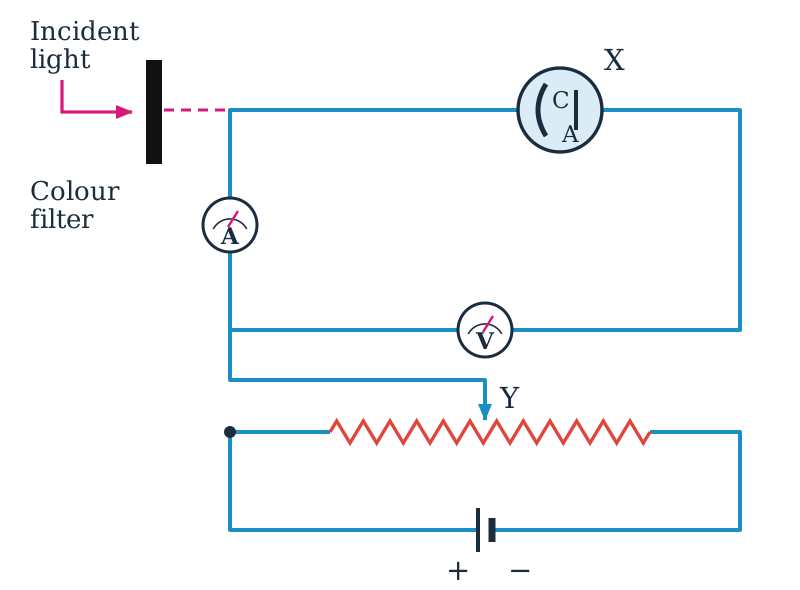
An evacuated glass tube X contains two electrodes. The electrode A connected to the positive terminal of the battery acts as the anode, and the metal electrode C connected to the negative terminal acts as the cathode.
Fig. 18.1: Experimental arrangement to observe photoelectric effect

Photoelectric Current

When monochromatic light of suitable frequency shines on the cathode, it emits electrons. These photoelectrons are attracted by the positive anode and the current is measured by a micro-ammeter. The current stops when the light is cut off, which proves that it flows because of the incident light, so it is called the photoelectric current.

Stopping Potential

The connections of the battery are reversed, so the anode A is negative and the cathode C positive. The photoelectrons are now repelled and the current decreases. At a certain negative potential, called the stopping potential $V_o$, the current becomes zero: even the electrons of maximum energy cannot reach the collector plate.

Maximum Kinetic Energy

$$\frac{1}{2}mv_{max}^2=V_oe$$
Here $m$ is the mass, $v$ the velocity and $e$ the charge of the electron.

Effect of Intensity

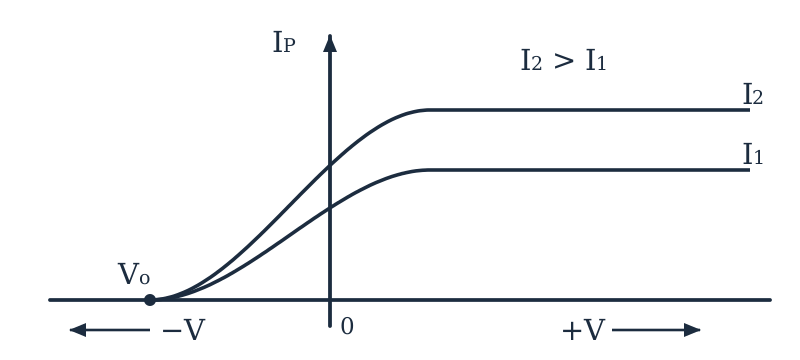
With a beam of higher intensity the current increases, but it stops at the same stopping potential. The two curves are for intensities with $I_2$ greater than $I_1$.
Fig. 18.2: Characteristic curves of photocurrent vs applied voltage for two intensities of monochromatic light

Effect of Frequency

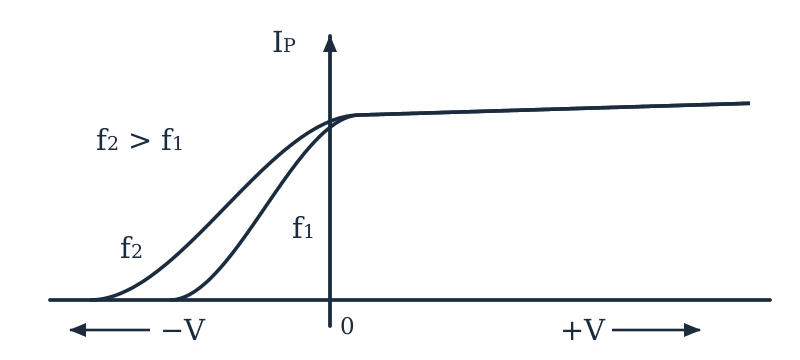
At constant intensity, light of different frequencies gives the same current but a different stopping potential for each frequency, which shows that the maximum kinetic energy increases with the frequency $f$.
Fig. 18.3: Characteristic curves of photocurrent vs applied voltage for light of different frequencies

Results of the Experiments

The electrons are emitted with different energies. The maximum energy depends on the particular metal surface and the frequency of the incident light.
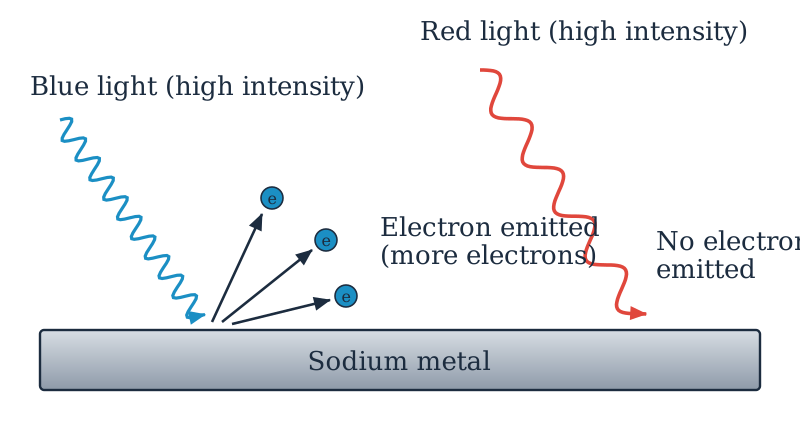
There is a minimum frequency, the threshold frequency $f_o$, below which no electrons are emitted however intense the light may be. Blue light produces photoelectric emission in sodium metal but red light does not.
Electrons are emitted instantaneously, and the intensity of light determines only their number.
Fig. 18.4: Red and blue light incident on sodium metal

Threshold Wavelength

The threshold frequency varies from metal to metal. The corresponding wavelength of the incident light is called the threshold wavelength $\lambda_o$
$$c=f_o\lambda_o$$

Failure of the Wave Theory

By electromagnetic wave theory, increasing the intensity should increase the K.E. of the emitted electrons, which contradicts the experiment. Nor can it explain the threshold frequency: by that theory even light of lesser energy should eventually transfer enough energy to liberate electrons, but this does not happen.

Explanation on the Basis of Quantum Theory

Einstein extended Planck’s idea that light is emitted or absorbed in quanta, photons, each of energy $hf$. A photon is absorbed by a single electron in the metal surface.

Work Function

The minimum energy an electron needs to break away from the metal surface is called the work function $\phi$. If the photon energy is sufficient, the electron is ejected instantaneously. Part of the photon energy is used to break away from the metal and the rest appears as the kinetic energy of the electron.

Einstein’s Photoelectric Equation

$$\text{Incident photon energy}-\text{Work function}=(K.E.)_{max}$$
$$hf-\phi=\frac{1}{2}mv_{max}^2$$

Work Function and Threshold Frequency

When $(K.E.)_{max}$ is zero, the frequency $f$ equals the threshold frequency $f_o$
$$hf_o-\phi=0$$
$$\phi=hf_o$$
So the photoelectric equation can also be written as
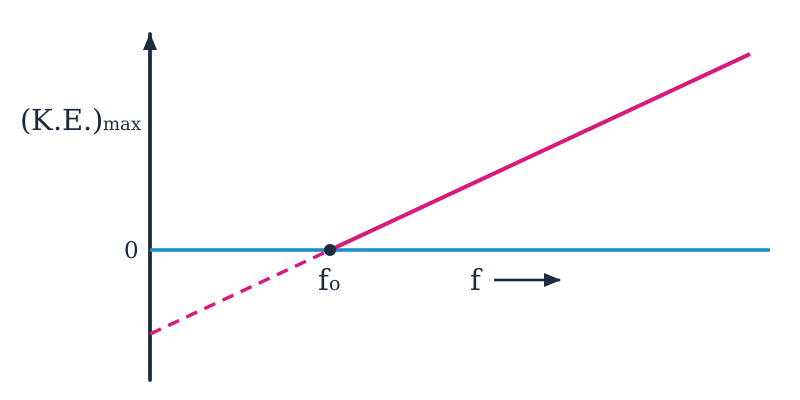
$$(K.E.)_{max}=hf-hf_o$$

Graph

The maximum kinetic energy of the photoelectrons rises in a straight line with the frequency. Below the threshold frequency $f_o$ no photoelectrons are emitted.
A graph of the maximum kinetic energy of photoelectrons vs frequency

Why Intensity Does Not Change the Maximum K.E.

Each electron absorbs one photon of energy $hf$, so its maximum kinetic energy depends only on the frequency. A more intense beam carries more photons, so it only ejects more electrons and the photoelectric current increases.

Not All at Maximum Energy

Not all the emitted electrons have the maximum kinetic energy. Some come straight out of the metal surface, while others lose energy in atomic collisions before coming out, so the equation holds only for the electrons that come out with the full surplus energy.

Particle Nature of Light

The photoelectric effect cannot be explained if light consists of waves with energy spread uniformly over the wavefront. It is explained only if light consists of photons, so it shows the particle nature of light. Albert Einstein was awarded the Nobel Prize in physics in 1921 for this explanation.

For Your Information

At low energies, less than 0.51 MeV, the dominant interaction of electromagnetic radiation with matter is the photoelectric effect.
At intermediate energies the dominant process is the Compton effect.
At higher energies, more than 1.02 MeV, the dominant process is pair production.
LQ 1ends here

Book Examples

Example 18.2.1

Find the energy of a photon in eV of the blue light of wavelength 450 nm.

Given Data

$$\lambda=450\,\mathrm{nm}=450\times10^{-9}\,\mathrm{m}$$
$$h=6.63\times10^{-34}\,\mathrm{J\,s}$$
$$c=3\times10^{8}\,\mathrm{m\,s^{-1}}$$

To Find

Energy of the photon $E=?$

Formula

$$E=hf=\frac{hc}{\lambda}$$

Solution

Putting the values in the formula
$$\begin{aligned}E&=\frac{6.63\times10^{-34}\,\mathrm{J\,s}\times3\times10^{8}\,\mathrm{m\,s^{-1}}}{450\times10^{-9}\,\mathrm{m}} \\ &=4.42\times10^{-19}\,\mathrm{J}\end{aligned}$$
In electron volts
$$\begin{aligned}E&=\frac{4.42\times10^{-19}}{1.6\times10^{-19}}\,\mathrm{eV} \\ &=2.76\,\mathrm{eV}\end{aligned}$$

Result

$$E=2.76\,\mathrm{eV}$$
Example 18.2.2

Yellow light of 577 nm wavelength is incident on a cesium metal surface. The stopping voltage is found to be 0.25 V. Find: (a) the maximum K.E. of photoelectrons (b) the work function of cesium

Given Data

$$\lambda=577\,\mathrm{nm}=577\times10^{-9}\,\mathrm{m}$$
$$V_o=0.25\,\mathrm{V}$$

To Find

(a) Maximum K.E. $(K.E.)_{max}=?$
(b) Work function $\phi=?$

Formula

$$(K.E.)_{max}=V_oe$$
$$hf-\phi=\frac{1}{2}mv_{max}^2$$
$$\phi=\frac{hc}{\lambda}-\frac{1}{2}mv_{max}^2$$

Solution

(a) Putting the values
$$\begin{aligned}(K.E.)_{max}&=0.25\,\mathrm{V}\times1.6\times10^{-19}\,\mathrm{C} \\ &=4\times10^{-20}\,\mathrm{J}\end{aligned}$$
$$\begin{aligned}(K.E.)_{max}&=\frac{4\times10^{-20}}{1.6\times10^{-19}}\,\mathrm{eV} \\ &=0.25\,\mathrm{eV}\end{aligned}$$
(b) The photon energy is
$$\begin{aligned}\frac{hc}{\lambda}&=\frac{6.63\times10^{-34}\times3\times10^{8}}{577\times10^{-9}} \\ &=3.45\times10^{-19}\,\mathrm{J}\end{aligned}$$
$$\begin{aligned}\phi&=3.45\times10^{-19}\,\mathrm{J}-4\times10^{-20}\,\mathrm{J} \\ &=3.05\times10^{-19}\,\mathrm{J}\end{aligned}$$
$$\begin{aligned}\phi&=\frac{3.05\times10^{-19}}{1.6\times10^{-19}}\,\mathrm{eV} \\ &=1.9\,\mathrm{eV}\end{aligned}$$

Result

$$(K.E.)_{max}=0.25\,\mathrm{eV}$$
$$\phi=1.9\,\mathrm{eV}$$

Short Questions

SQ 18.2.1

What is stopping potential? How is it related to the maximum kinetic energy of the photoelectrons?

Stopping potential

The negative potential of the anode at which the photoelectric current becomes zero, so that even the fastest electrons cannot reach it.
$$\frac{1}{2}mv_{max}^2=V_oe$$
SQ 18.2.2

What is threshold wavelength? How is it related to threshold frequency?

Threshold wavelength

The longest wavelength that can eject photoelectrons from a metal, corresponding to its threshold frequency.
$$c=f_o\lambda_o$$
SQ 18.2.3

Why does increasing the intensity of light not change the stopping potential?

One photon per electron

Each electron absorbs a single photon of energy $hf$, so its maximum K.E. depends only on the frequency. A brighter beam ejects more electrons, but the fastest of them are no faster.
SQ 18.2.4

Why could the wave theory not explain the threshold frequency?

Energy would accumulate

By the wave theory even weak, low-frequency light should eventually transfer enough energy to free an electron. It never does, because a photon whose energy $hf$ is less than the work function cannot eject one.
SQ 18.2.5

Why do all the photoelectrons not come out with the same kinetic energy?

Collisions in the metal

Some electrons come straight out of the surface, while others lose energy in atomic collisions before leaving, so only a few carry the full surplus energy.
$$(K.E.)_{max}=hf-\phi$$
SQ 18.2.6

Why is photoelectric emission instantaneous?

Energy given at once

A photon gives all its energy to a single electron in one event, so no time is needed for energy to build up, as the wave theory would require.
SQ 18.2.7

What does the graph of maximum kinetic energy against frequency show?

Straight line

It is a straight line that meets the frequency axis at the threshold frequency $f_o$, below which no electrons are emitted. Its slope is $h$
$$(K.E.)_{max}=hf-hf_o$$
MCQ 18.2.1

The stopping potential is the potential at which the photoelectric current:

Ais maximumBbecomes zero
Cfirst startsDdoubles
Solution:Even the fastest electrons are turned back before reaching the anode.
MCQ 18.2.2

The maximum kinetic energy of the photoelectrons is:

A$V_oe$B$V_o/e$
C$e/V_o$D$V_oe^2$
Solution:The work done by the stopping potential equals the maximum K.E.
MCQ 18.2.3

For light below the threshold frequency:

Aa few slow electrons are emittedBelectrons are emitted after a delay
Celectrons are emitted with maximum energyDno electrons are emitted however intense the light
Solution:Each photon then has less energy than the work function.
MCQ 18.2.4

The photocurrent curves for two intensities of the same light meet the voltage axis at:

Athe same stopping potentialBdifferent stopping potentials
Czero voltsDthe positive side
Solution:The maximum K.E. does not depend on intensity.
MCQ 18.2.5

Light of photon energy 3.0 eV falls on a metal of work function 2.0 eV. The maximum K.E. of the photoelectrons is:

A5.0 eVB1.0 eV
C3.0 eVD2.0 eV
Solution:$(K.E.)_{max}=hf-\phi=3.0-2.0=1.0$ eV.
MCQ 18.2.6

The work function of a metal is $3.3\times10^{-19}$ J. Its threshold frequency is about:

A$2\times10^{14}$ HzB$5\times10^{15}$ Hz
C$5\times10^{14}$ HzD$2\times10^{15}$ Hz
Solution:$f_o=\phi/h=3.3\times10^{-19}/6.63\times10^{-34}=5\times10^{14}$ Hz.
MCQ 18.2.7

The stopping potential for a metal is 2 V. The maximum K.E. of its photoelectrons is:

A$3.2\times10^{-19}$ JB$1.6\times10^{-19}$ J
C2 JD$0.8\times10^{-19}$ J
Solution:$V_oe=2\times1.6\times10^{-19}=3.2\times10^{-19}$ J.
MCQ 18.2.8

The photoelectric effect gives evidence of the:

Awave nature of lightBparticle nature of light
Ctransverse nature of lightDpolarization of light
Solution:It is explained only if light consists of photons.
MCQ 18.2.9

The photoelectric effect is the dominant interaction of radiation with matter at energies:

Amore than 1.02 MeVBbetween 5 and 10 MeV
Cof all values equallyDless than 0.51 MeV
Solution:At intermediate energies the Compton effect dominates, and above 1.02 MeV pair production.
Topic 18.3

Compton Effect

Compton’s Experiment

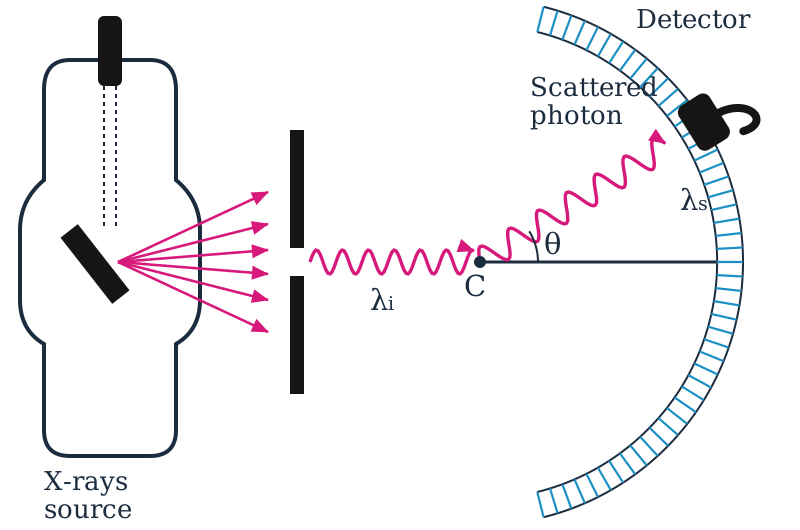
In 1923 Arthur Holly Compton at Washington University studied the scattering of X-rays by loosely bound electrons from a graphite target. He measured the wavelength of the X-rays scattered at an angle $\theta$ with the original direction.
Fig. 18.5: Compton’s scattering experiment

Compton Effect

The wavelength $\lambda_s$ of the scattered X-rays is greater than the wavelength $\lambda_i$ of the incident X-rays. This is known as the Compton effect.

Photon Explanation

The increase in wavelength could not be explained by the classical wave theory. Compton suggested that X-rays consist of photons with energy $hc/\lambda$ and momentum $h/\lambda$.

The Collision

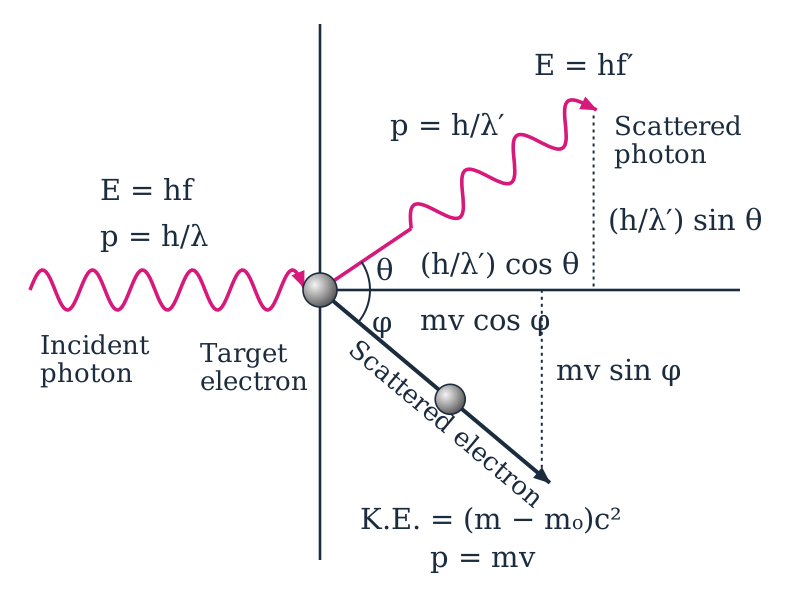
The photon collides with an electron like a billiard ball. An X-ray photon of energy $hf$ strikes an electron initially at rest and loses some energy, which is taken up by the electron. The photon is scattered at an angle $\theta$ with the smaller energy $hf^{\prime}$, and the electron recoils at an angle $\phi$ with the original direction of the photon.
Fig. 18.6: Collision between X-ray photon and stationary electron

K.E. of the Electron

Here $m$ is the mass of the electron moving with velocity $v$ and $m_o$ its rest mass. The difference of its total energy after and before the collision is its kinetic energy.
$$K.E.=mc^2-m_oc^2$$

Conservation of Energy

This is an elastic collision of two balls, so both energy and momentum are conserved.
$$\text{Change in photon energy}=K.E.\text{ of electron}$$
$$hf-hf^{\prime}=mc^2-m_oc^2$$

Compton Shift

Solving the energy and the momentum conservation equations gives the change in wavelength $\Delta\lambda$, known as the Compton shift.
$$\Delta\lambda=\frac{h}{m_oc}(1-\cos\theta)$$

Compton Wavelength

The factor $h/m_oc$ has the dimensions of wavelength and is called the Compton wavelength.
$$\frac{h}{m_oc}=\frac{6.63\times10^{-34}}{9.1\times10^{-31}\times3\times10^{8}}=2.43\times10^{-12}\,\mathrm{m}$$

Scattering at a Right Angle

For X-rays observed at $90^{\circ}$ the cosine is zero, so the Compton shift equals the Compton wavelength.

Confirmation

The equation is in complete agreement with Compton’s experimental result, a striking confirmation of the particle-like interaction of electromagnetic waves with matter. Compton was awarded the Nobel Prize in physics in 1927 for this discovery.

Pair Production

A very high energy photon, such as a $\gamma$-ray photon, can change into an electron-positron pair, as given by Einstein’s energy equation.
$$\text{Energy of photon}=\text{Energy for pair production}+K.E.\text{ of the particles}$$
$$hf=2m_oc^2+K.E.(e^-)+K.E.(e^+)$$

Annihilation of Matter

The converse of pair production is annihilation, in which a particle and its antiparticle interact and annihilate into high energy photons in the $\gamma$-ray range, along with some other elementary particles.

Short Questions

SQ 18.3.1

What is the Compton effect?

Compton effect

When X-rays are scattered by loosely bound electrons, the wavelength $\lambda_s$ of the scattered X-rays is greater than the wavelength $\lambda_i$ of the incident X-rays.
SQ 18.3.2

What is the Compton wavelength? Give its value.

Compton wavelength

The factor $h/m_oc$ of the Compton shift, which has the dimensions of a wavelength. It equals the shift at $90^{\circ}$
$$\frac{h}{m_oc}=2.43\times10^{-12}\,\mathrm{m}$$
SQ 18.3.3

Why is the Compton effect an evidence of the particle nature of X-rays?

Photon-electron collision

The wave theory cannot explain the increase in wavelength. It is explained only by treating X-rays as photons of momentum $h/\lambda$ that collide with electrons like billiard balls.
SQ 18.3.4

At what scattering angle is the Compton shift largest? What is its value?

Backward scattering

The shift is largest at $180^{\circ}$, where the cosine is minus one.
$$\Delta\lambda=\frac{2h}{m_oc}=4.86\times10^{-12}\,\mathrm{m}$$
SQ 18.3.5

What is pair production? What is the least photon energy needed for it?

Pair production

A very high energy photon changes into an electron-positron pair. It needs at least the rest mass energy of the two particles.
$$hf=2m_oc^2=1.02\,\mathrm{MeV}$$
SQ 18.3.6

What is annihilation of matter?

Annihilation

The converse of pair production. A particle and its antiparticle interact and annihilate into high energy photons in the $\gamma$-ray range, with some other elementary particles.
MCQ 18.3.1

In his experiment Compton scattered X-rays from a target of:

AnickelBzinc
CgraphiteDsodium
Solution:Graphite has loosely bound electrons.
MCQ 18.3.2

Compton studied the scattering of X-rays by:

Aatomic nucleiBprotons
CneutronsDloosely bound electrons
Solution:The photon collides with an electron like a billiard ball.
MCQ 18.3.3

The Compton shift is:

A$\frac{h}{m_oc}(1-\cos\theta)$B$\frac{h}{m_oc}(1+\cos\theta)$
C$\frac{h}{m_oc}\sin\theta$D$\frac{m_oc}{h}(1-\cos\theta)$
Solution:It follows from conservation of energy and momentum.
MCQ 18.3.4

The Compton shift for X-rays scattered at $90^{\circ}$ is:

AzeroB2.43 pm
C4.86 pmD1.21 pm
Solution:At $90^{\circ}$ the cosine is zero, so the shift is the Compton wavelength.
MCQ 18.3.5

The Compton shift for X-rays scattered at $60^{\circ}$ is about:

A2.43 pmB4.86 pm
C1.21 pmDzero
Solution:$\Delta\lambda=2.43(1-\cos60^{\circ})=2.43\times0.5=1.21$ pm.
MCQ 18.3.6

The least photon energy needed for pair production is:

A1.02 MeVB0.51 MeV
C2.04 MeVD13.6 eV
Solution:It must supply $2m_oc^2$, twice 0.51 MeV.
MCQ 18.3.7

When a particle meets its antiparticle, they annihilate into:

AX-rays onlyBvisible light
C$\gamma$-ray photonsDa proton
Solution:Annihilation is the converse of pair production.
Topic 18.4

Wave Nature of Particles

LQ 2starts here — de Broglie waves associated with material particles, and wave-particle duality

de Broglie’s Hypothesis

Light displays a dual nature, acting both as a wave and as a particle. Assuming symmetry in nature, the French physicist Louis de Broglie proposed in 1924 that particles should also possess wave-like properties.

de Broglie Relation

The momentum of a photon is $h/\lambda$. de Broglie suggested that the momentum of a material particle of mass $m$ moving with velocity $v$ is given by the same expression.
$$p=\frac{h}{\lambda}=mv$$
$$\lambda=\frac{h}{p}=\frac{h}{mv}$$
Here $\lambda$ is the wavelength associated with the particle waves, so an electron can be considered both a particle and a wave.

Large Objects

An object of large mass and ordinary speed has so small a wavelength that its wave effects, such as interference and diffraction, are negligible. For a rifle bullet of mass 20 g flying at 330 m s$^{-1}$
$$\lambda=\frac{6.63\times10^{-34}}{2\times10^{-2}\times330}=1\times10^{-34}\,\mathrm{m}$$
This wavelength is so small that it is not detectable by any of its effects.

Electrons

For an electron moving at $1\times10^{6}$ m s$^{-1}$
$$\lambda=\frac{6.63\times10^{-34}}{9.1\times10^{-31}\times1\times10^{6}}=7\times10^{-10}\,\mathrm{m}$$
This wavelength is in the X-ray range, so diffraction effects for electrons are measurable while those for bullets are not.

Davisson and Germer Experiment

Clinton J. Davisson and Lester H. Germer gave convincing evidence of the wave nature of electrons: electrons are diffracted from metal crystals in exactly the same manner as X-rays.

Apparatus

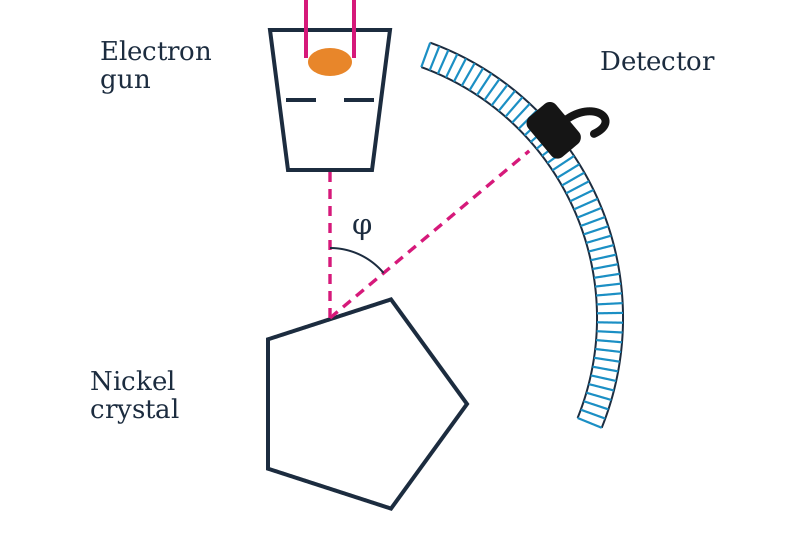
Electrons from a heated filament are accelerated by an adjustable voltage and the beam falls on a nickel crystal. The scattered electrons came off in regular peaks, which were interpreted as diffraction, just like the X-ray diffraction by a NaCl crystal.
Fig. 18.7: Experimental arrangement of Davisson and Germer for electron diffraction

Wavelength of the Electrons

The beam diffracted from the crystal enters a detector and is recorded as a current $I$. The gain in K.E. of an electron accelerated through a potential $V$ in the electron gun is
$$\frac{1}{2}mv^2=Ve$$
$$mv=\sqrt{2mVe}$$
From the de Broglie equation
$$\lambda=\frac{h}{mv}$$
$$\lambda=\frac{h}{\sqrt{2mVe}}$$

Predicted Wavelength

In one experiment the accelerating voltage was 54 volts.
$$\lambda=\frac{6.63\times10^{-34}}{\sqrt{2\times9.1\times10^{-31}\times54\times1.6\times10^{-19}}}=1.67\times10^{-10}\,\mathrm{m}$$

Observed Wavelength

The diffracted beam was obtained at a glancing angle of $65^{\circ}$. For first order diffraction from nickel, of spacing $0.91\times10^{-10}$ m, Bragg’s equation gives
$$2d\sin\theta=m\lambda$$
$$\lambda=2\times0.91\times10^{-10}\times\sin65^{\circ}=1.65\times10^{-10}\,\mathrm{m}$$
The observed wavelength is in excellent agreement with the wavelength predicted by de Broglie.

Other Particles

Diffraction patterns have also been observed with protons, neutrons, hydrogen atoms and helium atoms, giving substantial evidence for the wave nature of particles.

Nobel Prizes

de Broglie received the 1929 Nobel Prize in physics for the dual nature of particles. Davisson and George Paget Thomson shared the 1937 Nobel Prize for the experimental confirmation of the wave nature of particles.

Book Examples

Example 18.4.1

Find the wavelength of two photons produced when a positron-electron pair annihilates. The rest mass energy of each photon is 0.51 MeV.

Given Data

$$\begin{aligned}E&=0.51\,\mathrm{MeV}=0.51\times10^{6}\times1.6\times10^{-19}\,\mathrm{J} \\ &=8.16\times10^{-14}\,\mathrm{J}\end{aligned}$$

To Find

Wavelength of each photon $\lambda=?$

Formula

$$E=hf=\frac{hc}{\lambda}$$
$$\lambda=\frac{hc}{E}$$

Solution

Putting the values in the formula
$$\begin{aligned}\lambda&=\frac{6.63\times10^{-34}\,\mathrm{J\,s}\times3\times10^{8}\,\mathrm{m\,s^{-1}}}{8.16\times10^{-14}\,\mathrm{J}} \\ &=2.44\times10^{-12}\,\mathrm{m}\end{aligned}$$

Result

$$\lambda=2.44\times10^{-12}\,\mathrm{m}=2.44\,\mathrm{pm}$$

Note

The book prints 2.43 pm; its own data give 2.4375 pm, which rounds to 2.44 pm.

Short Questions

SQ 18.4.1

On what idea did de Broglie base his hypothesis?

Symmetry in nature

Light shows both wave and particle properties. Assuming symmetry in nature, de Broglie proposed that material particles should also possess wave-like properties.
SQ 18.4.2

Derive the de Broglie wavelength of an electron accelerated through a potential difference V.

Wavelength from the voltage

The K.E. gained equals the work done by the field.
$$\frac{1}{2}mv^2=Ve$$
$$mv=\sqrt{2mVe}$$
$$\lambda=\frac{h}{mv}$$
$$\lambda=\frac{h}{\sqrt{2mVe}}$$
SQ 18.4.3

How did the Davisson and Germer experiment confirm de Broglie’s hypothesis?

Electron diffraction

Electrons scattered from a nickel crystal came off in regular peaks, a diffraction pattern. The wavelength found from Bragg’s equation, $1.65\times10^{-10}$ m, agreed with the de Broglie value of $1.67\times10^{-10}$ m.
SQ 18.4.4

How does the de Broglie wavelength of a particle change if its speed is doubled?

Wavelength is halved

For the same particle
$$\lambda=\frac{h}{mv}$$
$$\frac{h}{m}=\text{constant}$$
$$\lambda\propto\frac{1}{v}$$
Doubling the speed halves the wavelength.
SQ 18.4.5

Why can a crystal diffract electrons?

Matching size

Electrons of ordinary energies have a wavelength of about $10^{-10}$ m, in the X-ray range, which is of the same order as the atomic spacing in a crystal.
MCQ 18.4.1

de Broglie proposed the wave nature of particles in:

A1901B1923
C1927D1924
Solution:He received the Nobel Prize for it in 1929.
MCQ 18.4.2

The de Broglie wavelength of a particle of mass $m$ and velocity $v$ is:

A$mv/h$B$h/mv$
C$hmv$D$h/m$
Solution:The momentum of a particle is taken as $h/\lambda$, as for a photon.
MCQ 18.4.3

The wavelength of an electron accelerated through a potential $V$ is:

A$h/2mVe$B$\sqrt{2mVe}/h$
C$h/\sqrt{2mVe}$D$h\sqrt{2mVe}$
Solution:Its momentum is $\sqrt{2mVe}$.
MCQ 18.4.4

Davisson and Germer diffracted electrons from a crystal of:

AnickelBNaCl
CgraphiteDquartz
Solution:The nickel crystal has a spacing of $0.91\times10^{-10}$ m.
MCQ 18.4.5

Electrons accelerated through 54 V have a de Broglie wavelength of about:

A$1.67\times10^{-12}$ mB$1.67\times10^{-10}$ m
C$7\times10^{-10}$ mD$1\times10^{-34}$ m
Solution:$\lambda=h/\sqrt{2mVe}=1.67\times10^{-10}$ m, confirmed by diffraction.
MCQ 18.4.6

If the momentum of a particle is doubled, its de Broglie wavelength becomes:

AdoubleBunchanged
Cfour timesDhalf
Solution:Since $\lambda=h/p$, the wavelength varies inversely with momentum.
MCQ 18.4.7

The de Broglie wavelength of an electron moving at $2\times10^{6}$ m s$^{-1}$ is about:

A$3.6\times10^{-10}$ mB$7.3\times10^{-10}$ m
C$1.8\times10^{-10}$ mD$3.6\times10^{-12}$ m
Solution:$\lambda=6.63\times10^{-34}/(9.1\times10^{-31}\times2\times10^{6})=3.6\times10^{-10}$ m.
MCQ 18.4.8

Wave effects cannot be detected for:

Aan electronBa rifle bullet
Ca neutronDa helium atom
Solution:Its wavelength, about $10^{-34}$ m, is far too small.
Topic 18.5

Wave-Particle Duality

Evidence for Light

Interference and diffraction of light provide evidence for its wave nature, while the photoelectric effect and the Compton effect prove its particle nature.

Evidence for Electrons

The experiments of Davisson and Germer and of G. P. Thomson reveal the wave-like nature of electrons, while in J. J. Thomson’s experiment to find e/m the electron had to be taken as a particle.

Wave-Particle Duality

Both wave-like and particle-like properties must be assumed for all matter, such as electrons, protons, neutrons and molecules, and also for light, X-rays and $\gamma$-rays. Matter and radiation have a dual wave-particle nature, and this concept is known as wave-particle duality.

Principle of Complementarity

Niels Bohr pointed out that both the wave and the particle aspects are required for the complete description of radiation and matter. Both are always present and either may be revealed by an experiment, but not both simultaneously in a single experiment.

Nature of the Experiment

The aspect revealed is determined by the experiment being done. A diffraction grating in the path of a light beam reveals it as a wave, while a beam hitting a metal surface must be regarded as a stream of particles. No simple experiment requires light to be interpreted as a wave and as a particle at the same time.

Light

Light behaves as a stream of photons when it interacts with matter, and as a wave in travelling from a source to the place where it is detected.

Conclusion

All micro-particles, electrons, protons, photons and atoms, propagate as if they were waves and exchange energies as if they were particles.

Do You Know

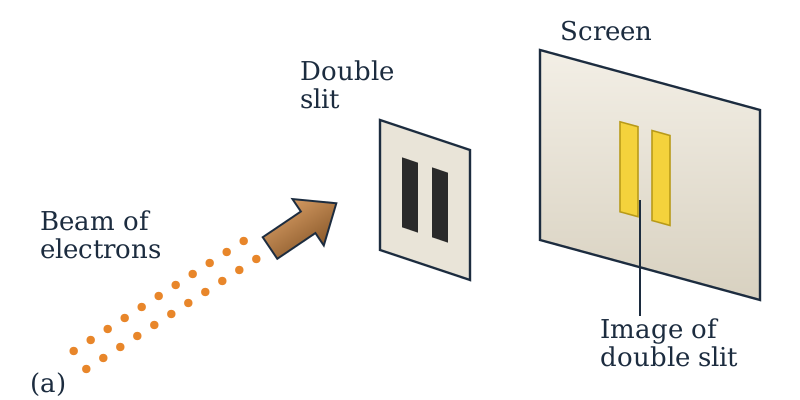
If electrons behaved as discrete particles with no wave properties, they would pass through one slit or the other and strike the screen, producing exact images of the two slits.
If electrons behaved as discrete particles, they would produce exact images of the slits
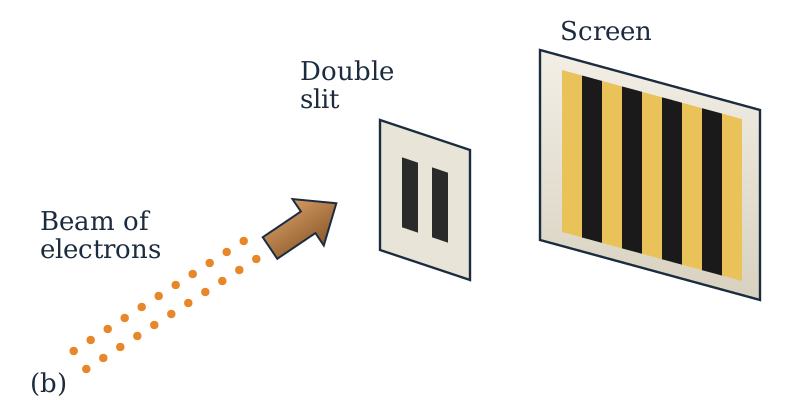
In reality the screen reveals a pattern of bright and dark fringes, as with light, because interference occurs between the waves coming from each slit.
In reality the screen reveals a pattern of bright and dark fringes
LQ 2ends here

Short Questions

SQ 18.5.1

State Bohr’s principle of complementarity.

Complementarity

Both the wave and the particle aspects are needed for a complete description of radiation and matter. Either may be revealed by an experiment, but never both at once.
SQ 18.5.2

Which experiments show the wave nature and which the particle nature of electrons?

Evidence for electrons

Wave nature: the diffraction experiments of Davisson and Germer and of G. P. Thomson.
Particle nature: J. J. Thomson’s experiment to find e/m.
SQ 18.5.3

Can the wave and particle aspects of light be observed in a single experiment?

No, they cannot.

One aspect at a time

The aspect revealed depends on the experiment. A grating shows light as a wave and a metal surface shows it as particles, but no single experiment requires both at the same time.
MCQ 18.5.1

The principle of complementarity was stated by:

AHeisenbergBde Broglie
CNiels BohrDEinstein
Solution:Both aspects are needed, but they are never revealed together.
MCQ 18.5.2

J. J. Thomson’s experiment to find e/m treats the electron as a:

AwaveBphoton
Cwave and particle at onceDparticle
Solution:Its deflection in fields is that of a charged particle.
MCQ 18.5.3

Light behaves as a stream of photons when it:

Atravels through spaceBpasses through a grating
Cinteracts with matterDforms interference fringes
Solution:In travelling from source to detector it behaves as a wave.
MCQ 18.5.4

Fringes formed by electrons passing a double slit show the:

Aparticle nature of electronsBcharge of electrons
Cmass of electronsDwave nature of electrons
Solution:Particles alone would give only images of the two slits.
Topic 18.6

Electron Microscope

LQ 4starts here — the electron microscope compared with an optical microscope

Principle

The electron microscope uses the wave nature of electrons, whose de Broglie wavelength is about a thousand times shorter than the wavelength of visible light. This lets it see fine details not visible to the optical microscope.

Working

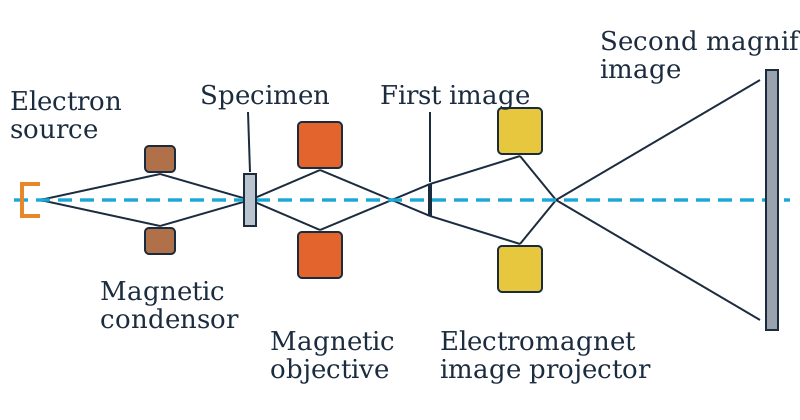
Electrons from a source pass through an electromagnetic lens called the condenser, which focuses the beam on the specimen. The beam is accelerated by voltages of several megavolts. An electromagnetic objective lens forms the image of the specimen, and the electromagnetic projector lens magnifies it further so that it can be photographed on a film, called a micrograph.
Fig. 18.8: A schematic diagram of the transmission electron microscope

High Resolution

The higher the speed of the electrons, the shorter the wavelength and hence the higher the resolution.
$$\lambda=\frac{h}{mv}$$

Scanning Electron Microscope

A three dimensional image of remarkable quality is achieved by the modern scanning electron microscope.

Uses

The electron microscope sees details down to a nanometre, about the atomic level of materials.
Study of cell structure, viruses and bacteria in microbiology.
Investigation of metal fractures.
Study of materials and crystal structure.

Compared with the Optical Microscope

Both form a magnified image of a specimen through an objective and a further projecting lens.
The electron microscope uses a beam of electrons instead of light, and electromagnetic lenses instead of glass lenses.
Its wavelength is about a thousand times shorter, so it resolves far finer detail.
Its image is photographed on a film as a micrograph rather than viewed directly.
LQ 4ends here

Short Questions

SQ 18.6.1

Why does raising the accelerating voltage improve the resolution of an electron microscope?

Shorter wavelength

A higher voltage gives the electrons a higher speed, and so a shorter de Broglie wavelength, which resolves finer details.
$$\lambda=\frac{h}{mv}$$
SQ 18.6.2

What are the functions of the condenser, objective and projector lenses of an electron microscope?

Magnetic lenses

The condenser focuses the electron beam on the specimen.
The objective lens forms the first image of the specimen.
The projector lens magnifies it further onto the film.
SQ 18.6.3

What is a micrograph?

Micrograph

The photograph on a film of the magnified image formed by an electron microscope. The scanning electron microscope gives a three dimensional image.
SQ 18.6.4

Give three uses of the electron microscope.

Uses

Study of cell structure, viruses and bacteria.
Investigation of metal fractures.
Study of materials and crystal structure.
MCQ 18.6.1

In an electron microscope the lens that focuses the beam on the specimen is the:

AobjectiveBcondenser
CprojectorDeyepiece
Solution:The objective then forms the image and the projector magnifies it.
MCQ 18.6.2

The photograph of the image formed by an electron microscope is called a:

AmicrographBspectrograph
ChologramDradiograph
Solution:It is taken on a film.
MCQ 18.6.3

The de Broglie wavelength of the electrons in an electron microscope, compared with visible light, is about:

Aa thousand times shorterBa thousand times longer
Cthe sameDa million times longer
Solution:That is what gives it its high resolution.
MCQ 18.6.4

A three dimensional image is obtained with the:

Atransmission electron microscopeBoptical microscope
Cscanning electron microscopeDcompound microscope
Solution:It is the modern version of the electron microscope.
MCQ 18.6.5

An electron microscope can show details down to about:

A0.1 mmB10 μm
C500 nmD1 nm
Solution:That is about the atomic level of materials.
Topic 18.7

Atomic Spectra

LQ 3starts here — the appearance and formation of emission and absorption line spectra, and how they identify the elements in a mixture of vapours

Atomic Spectra

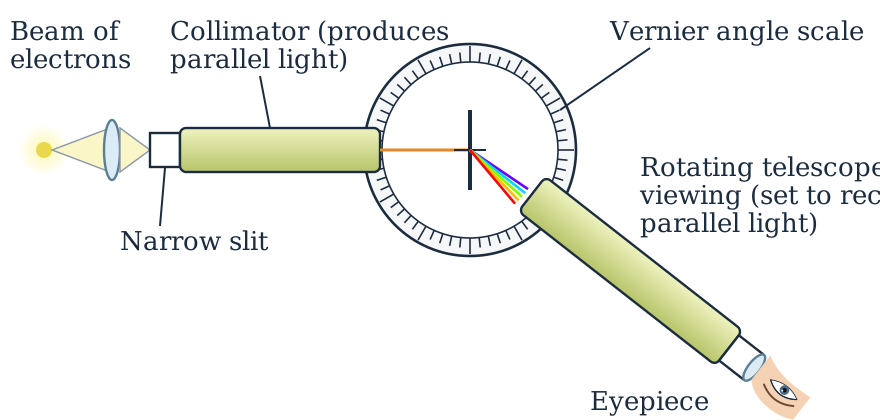
The evidence of the particle nature of quantized photons using a spectrometer is the basis of atomic spectra. The arrangement consists of a discharge tube, a spectrometer and a diffraction grating.
Fig. 18.9: Spectrum produced with a diffracting grating

Spectral Series

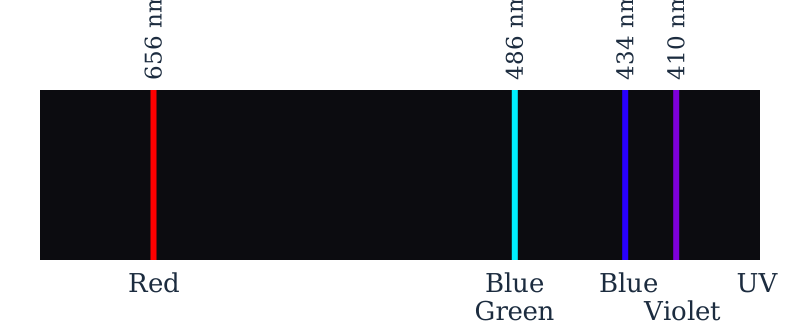
A series of lines is seen on a dark background through the eyepiece. The vapours of different elements exhibit different patterns of such lines, called spectral series, which can be used to identify different elements.

Balmer Series

J. J. Balmer identified one such series in 1885 in the spectrum of atomic hydrogen. It lies in the visible region and consists of four spectral lines.
Fig. 18.10: The Balmer series of atomic hydrogen

Rydberg’s Formula

J. R. Rydberg expressed its results by the formula
$$\frac{1}{\lambda}=R_H\left(\frac{1}{2^2}-\frac{1}{n^2}\right)$$
$$n=3,4,5,\dots$$
Here $n$ is the discrete excited energy level of the electron and $R_H$ the Rydberg constant.
$$R_H=1.0974\times10^{7}\,\mathrm{m^{-1}}$$

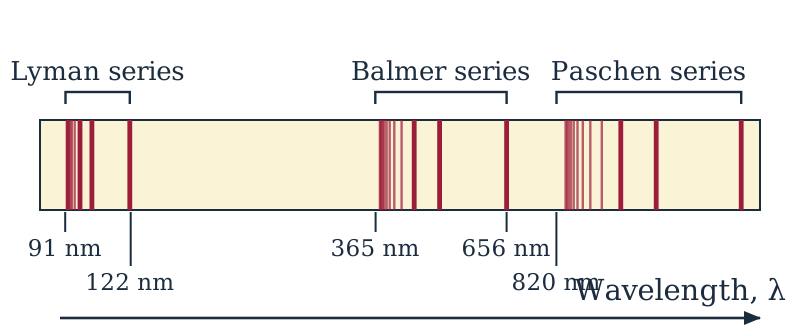
Lyman Series

The spectral lines of hydrogen also extend into the invisible regions. The Lyman series lies in the ultraviolet region.
$$\frac{1}{\lambda}=R_H\left(\frac{1}{1^2}-\frac{1}{n^2}\right)$$
$$n=2,3,4,\dots$$

Paschen Series

The Paschen series lies in the infrared region.
$$\frac{1}{\lambda}=R_H\left(\frac{1}{3^2}-\frac{1}{n^2}\right)$$
$$n=4,5,6,\dots$$

For Your Information

Only the Balmer series lies in the visible region of the electromagnetic spectrum.
Line spectrum of atomic hydrogen

Energy Levels

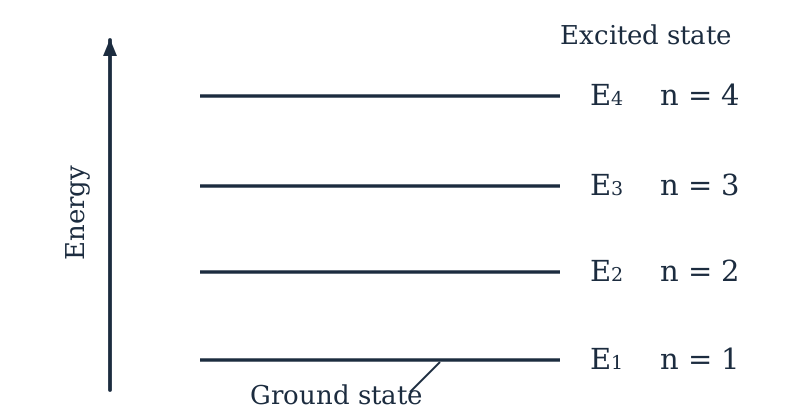
These equations give the allowed energy values of the electron in an isolated hydrogen atom. The state for $n$ equal to 1 is the ground state, and the states for $n$ of 2, 3, 4 and so on are the excited states.
Fig. 18.11: Energy levels

Transitions

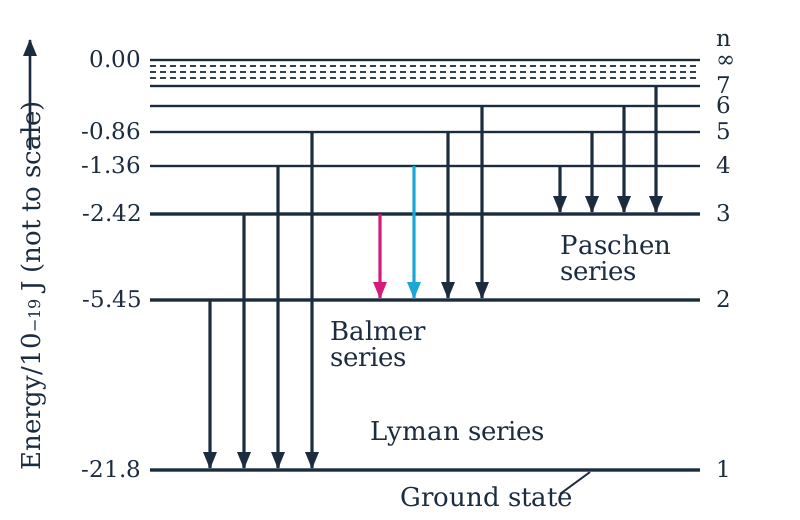
The Lyman series ends on the first level, the Balmer series on the second and the Paschen series on the third.
Fig. 18.12: Different transitions in the hydrogen atom

Emission of Photons

An atom absorbs energy in discrete amounts only and is raised to one of its excited states. The excited states have a very short life, and the electron soon returns to a lower level by emitting photons, observed as an emission spectrum of several spectral lines.
$$hf=E_n-E_p$$

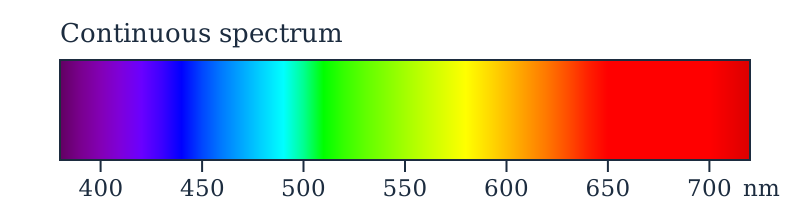
Continuous Spectrum

White light has a continuous spectrum, with all the colours from violet to red.
Fig. 18.13 (a): Spectrum of white light

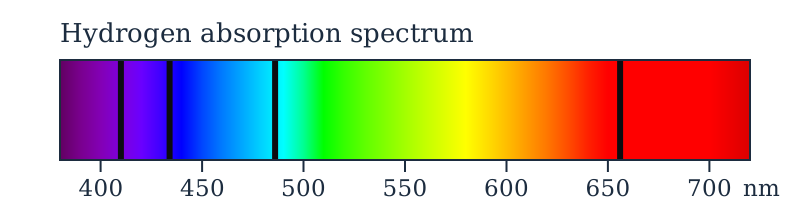
Absorption Spectrum

When white light is passed through a gas at low pressure, light of certain wavelengths is missing and dark lines are seen in their places. This is an absorption spectrum.
Fig. 18.13: Hydrogen absorption spectrum

Formation of the Dark Lines

As the light passes through the gas, electrons absorb discrete amounts of energy and make transitions to higher levels. Only photons of certain frequencies are absorbed, and their wavelengths correspond exactly to the energy needed for these upward transitions.

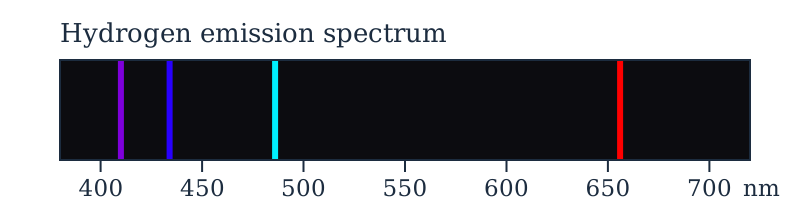
Emission Spectrum

When the excited electrons return to lower levels, photons of specific wavelengths are given out as an emission spectrum.
Fig. 18.13: Hydrogen emission spectrum

Relation of the Two

The wavelengths missing from an absorption line spectrum are exactly those present in the emission line spectrum of the same element.

Identifying Elements

Each element emits and absorbs its own pattern of lines, so the lines seen in the spectrum of a mixture of vapours show which elements are present.

Do You Know

For excitation, a photon must have energy exactly equal to the energy difference between two shells, but an electron with equal or greater K.E. can excite the gas atoms.

For Your Information

The orbital electrons have specific amounts of energy, whereas free electrons may have any amount of energy.
LQ 3ends here

Short Questions

SQ 18.7.1

Write Rydberg’s formula for the Balmer series and give the values of n.

Balmer formula

$$\frac{1}{\lambda}=R_H\left(\frac{1}{2^2}-\frac{1}{n^2}\right)$$
$$n=3,4,5,\dots$$
Here $R_H$ is the Rydberg constant, $1.0974\times10^{7}$ m$^{-1}$.
SQ 18.7.2

What is meant by the ground state and an excited state of an atom?

Ground state

The state of lowest energy, for $n$ equal to 1.

Excited states

The higher states for $n$ of 2, 3, 4 and so on, which have a very short life.
SQ 18.7.3

Calculate the longest wavelength of the Balmer series.

Longest Balmer line

The longest wavelength is for $n$ equal to 3.
$$\frac{1}{\lambda}=1.0974\times10^{7}\left(\frac{1}{4}-\frac{1}{9}\right)=1.524\times10^{6}\,\mathrm{m^{-1}}$$
$$\lambda=6.56\times10^{-7}\,\mathrm{m}=656\,\mathrm{nm}$$
SQ 18.7.4

Find the shortest wavelength of the Lyman series.

Series limit

The shortest wavelength is for $n$ tending to infinity.
$$\frac{1}{\lambda}=R_H$$
$$\lambda=\frac{1}{1.0974\times10^{7}}=9.11\times10^{-8}\,\mathrm{m}=91\,\mathrm{nm}$$
SQ 18.7.5

Why must a photon have exactly the right energy to excite an atom, while an electron need not?

Photon is absorbed whole

A photon gives up all its energy, so it must equal the level difference exactly. An electron with equal or greater K.E. gives only the needed part and keeps the rest.
$$hf=E_n-E_p$$
SQ 18.7.6

What is the function of the collimator and the diffraction grating in a spectrometer?

Collimator and grating

The collimator makes the light from the narrow slit parallel. The grating diffracts each wavelength at its own angle, so the spectrum appears as separate lines.
MCQ 18.7.1

The Balmer series of hydrogen was identified in:

A1901B1885
C1913D1924
Solution:J. J. Balmer found it in the visible spectrum of hydrogen.
MCQ 18.7.2

The value of the Rydberg constant is:

A$1.0974\times10^{-7}$ mB$6.63\times10^{-34}$ J s
C$1.0974\times10^{7}$ m$^{-1}$D$1.0974\times10^{7}$ m
Solution:It has the unit of $1/\lambda$.
MCQ 18.7.3

In the Lyman series formula the values of $n$ are:

A3, 4, 5 and so onB4, 5, 6 and so on
C1, 2, 3 and so onD2, 3, 4 and so on
Solution:The lower level is $n=1$, so $n$ starts at 2.
MCQ 18.7.4

The longest wavelength line of the Balmer series is at:

A656 nmB410 nm
C486 nmD365 nm
Solution:It is the red line, for $n=3$.
MCQ 18.7.5

Using the levels $-2.42\times10^{-19}$ J and $-5.45\times10^{-19}$ J of hydrogen, the photon emitted when the electron falls from $n=3$ to $n=2$ has energy:

A$7.87\times10^{-19}$ JB$3.03\times10^{-19}$ J
C$2.42\times10^{-19}$ JD$5.45\times10^{-19}$ J
Solution:$hf=E_3-E_2=-2.42-(-5.45)=3.03\times10^{-19}$ J, the 656 nm line.
MCQ 18.7.6

The energy needed to raise a hydrogen atom from its ground state ($-21.8\times10^{-19}$ J) to $n=2$ ($-5.45\times10^{-19}$ J) is:

A$5.45\times10^{-19}$ JB$21.8\times10^{-19}$ J
C$16.35\times10^{-19}$ JD$27.25\times10^{-19}$ J
Solution:$E_2-E_1=-5.45-(-21.8)=16.35\times10^{-19}$ J.
MCQ 18.7.7

The dark lines of the absorption spectrum of an element lie at the wavelengths of:

Aits own emission linesBall visible light
Cthe infrared onlyDthe continuous spectrum
Solution:The atoms absorb exactly the photons they would emit.
MCQ 18.7.8

The series limit of the Lyman series is at about:

A122 nmB365 nm
C820 nmD91 nm
Solution:For $n$ tending to infinity, $\lambda=1/R_H=91$ nm.
MCQ 18.7.9

In a spectrometer the collimator:

Adisperses the lightBproduces parallel light
Cfocuses light into the eyeDdetects electrons
Solution:The telescope is set to receive the parallel light after the grating.
Topic 18.8

Uncertainty Principle

LQ 5starts here — the uncertainty principle and its significance

Uncertainty Principle

The position and momentum of a particle cannot be measured simultaneously with perfect accuracy. There is always a fundamental uncertainty in any measurement, which is not associated with the measuring instrument but is a consequence of the wave-particle duality of matter and radiation. It was first proposed by Werner Heisenberg in 1927.

Macroscopic and Atomic Objects

The uncertainty is completely negligible for the position and momentum of macroscopic objects of daily life, but it is a predominant fact of life in the atomic domain. A stream of photons striking a flying tennis ball hardly affects its path, but one photon striking an electron drastically alters its motion.

Locating an Electron

Light has wave properties, so the position of an electron can be found only to within one wavelength of the light used.
$$\Delta x\approx\lambda$$
To reduce this uncertainty light of short wavelength must be used, but it alters the motion drastically and makes the momentum measurement less precise. At most the photon transfers all its momentum to the particle.
$$\Delta p\approx\frac{h}{\lambda}$$
Multiplying the two uncertainties
$$\Delta x\,\Delta p\approx h$$

Statement

The product of the uncertainty $\Delta x$ in the position of a particle at some instant and the uncertainty $\Delta p$ in the x-component of its momentum at the same instant is approximately equal to Planck’s constant $h$.

No Electrons in the Nucleus

The diameter of a nucleus is of the order of $10^{-15}$ m, so an electron inside it would have this uncertainty in position.
$$\Delta p\approx\frac{h}{\Delta x}=\frac{6.63\times10^{-34}}{1\times10^{-15}}=6.63\times10^{-19}\,\mathrm{N\,s}$$
The corresponding energy uncertainty would be of the order of GeV. No such electron has been found in the atom, so electrons do not exist inside the nucleus.

Energy and Time

Another form relates the energy of a particle and the time at which it had that energy.
$$\Delta E\,\Delta t\approx h$$
The more accurately the energy of a particle is determined, the more uncertain is the time during which it has that energy.

Heisenberg’s Careful Result

By more careful calculation Heisenberg found that at the very best
$$\Delta x\,\Delta p\ge\hbar$$
$$\Delta E\,\Delta t\ge\hbar$$
$$\hbar=\frac{h}{2\pi}=1.05\times10^{-34}\,\mathrm{J\,s}$$

Significance

Every measurement on the atomic scale carries an unavoidable uncertainty, however perfect the instrument. We can never accurately describe all aspects of subatomic particles simultaneously, and in the sub-atomic world few things can be predicted with 100% precision.
Werner Heisenberg was awarded the Nobel Prize in 1932 for his contribution to quantum physics.
LQ 5ends here

Book Examples

Example 18.8.1

What can be the velocity of an electron enclosed in a box about the size of an atom of the order of 1.0$\times10^{-10}$ m?

Given Data

$$\Delta x=1.0\times10^{-10}\,\mathrm{m}$$
$$m=9.1\times10^{-31}\,\mathrm{kg}$$

To Find

Velocity of the electron $\Delta v=?$

Formula

$$\Delta p\,\Delta x\approx h$$
$$\Delta p\approx m\Delta v$$
$$m\Delta v\,\Delta x\approx h$$
$$\Delta v\approx\frac{h}{m\Delta x}$$

Solution

Putting the values in the formula
$$\begin{aligned}\Delta v&=\frac{6.63\times10^{-34}\,\mathrm{J\,s}}{9.1\times10^{-31}\,\mathrm{kg}\times1.0\times10^{-10}\,\mathrm{m}} \\ &=7.3\times10^{6}\,\mathrm{m\,s^{-1}}\end{aligned}$$

Result

$$\Delta v=7.3\times10^{6}\,\mathrm{m\,s^{-1}}$$
Example 18.8.2

Find the uncertainty in the energy of a photon which is emitted from an atom radiating for about 10$^{-8}$ second.

Given Data

$$\Delta t=10^{-8}\,\mathrm{s}$$
$$h=6.63\times10^{-34}\,\mathrm{J\,s}$$

To Find

Uncertainty in energy $\Delta E=?$

Formula

$$\Delta E\,\Delta t\approx h$$
$$\Delta E\approx\frac{h}{\Delta t}$$

Solution

Putting the values in the formula
$$\begin{aligned}\Delta E\approx\frac{6.63\times10^{-34}\,\mathrm{J\,s}}{10^{-8}\,\mathrm{s}} \\ &=6.63\times10^{-26}\,\mathrm{J}\end{aligned}$$
In electron volts
$$\begin{aligned}\Delta E\approx\frac{6.63\times10^{-26}}{1.6\times10^{-19}}\,\mathrm{eV} \\ &=4\times10^{-7}\,\mathrm{eV}\end{aligned}$$

Result

$$\Delta E\approx4\times10^{-7}\,\mathrm{eV}$$

Short Questions

SQ 18.8.1

Why is the uncertainty principle not noticed for everyday objects?

Negligible for large objects

The uncertainty is tiny beside the size and momentum of a macroscopic body. Photons striking a flying tennis ball hardly affect its path, but one photon drastically alters the motion of an electron.
SQ 18.8.2

State the energy-time form of the uncertainty principle.

Energy and time

$$\Delta E\,\Delta t\approx h$$
The more accurately the energy of a particle is known, the more uncertain is the time during which it has that energy.
SQ 18.8.3

What is h-bar? Write Heisenberg’s more careful form of the principle.

Reduced Planck constant

$$\hbar=\frac{h}{2\pi}=1.05\times10^{-34}\,\mathrm{J\,s}$$

Careful form

$$\Delta x\,\Delta p\ge\hbar$$
SQ 18.8.4

Can a better instrument remove the uncertainty in measuring the position and momentum of an electron?

No, it cannot.

Fundamental uncertainty

The uncertainty is not due to the instrument but to the wave-particle duality of matter and radiation. Locating the electron with a photon disturbs its momentum.
MCQ 18.8.1

The uncertainty principle was proposed by Heisenberg in:

A1927B1924
C1923D1932
Solution:He received the Nobel Prize in 1932.
MCQ 18.8.2

The position-momentum uncertainty relation is:

A$\Delta x\,\Delta p\approx h/2$B$\Delta x\,\Delta p\approx h^2$
C$\Delta x\,\Delta p\approx h$D$\Delta x/\Delta p\approx h$
Solution:The product of the two uncertainties is about Planck’s constant.
MCQ 18.8.3

An electron is located within $1\times10^{-10}$ m. The uncertainty in its momentum is about:

A$6.63\times10^{-44}$ N sB$6.63\times10^{-34}$ N s
C$6.63\times10^{-14}$ N sD$6.63\times10^{-24}$ N s
Solution:$\Delta p\approx h/\Delta x=6.63\times10^{-34}/10^{-10}=6.63\times10^{-24}$ N s.
MCQ 18.8.4

The value of $\hbar$ is:

A$6.63\times10^{-34}$ J sB$1.05\times10^{-34}$ J s
C$4.17\times10^{-33}$ J sD$2.11\times10^{-34}$ J s
Solution:$\hbar=h/2\pi=6.63\times10^{-34}/6.28=1.05\times10^{-34}$ J s.
MCQ 18.8.5

An atom stays excited for $10^{-9}$ s. The uncertainty in the energy of its photon is about:

A$6.63\times10^{-43}$ JB$6.63\times10^{-25}$ J
C$6.63\times10^{-34}$ JD$6.63\times10^{-16}$ J
Solution:$\Delta E\approx h/\Delta t=6.63\times10^{-34}/10^{-9}=6.63\times10^{-25}$ J.
MCQ 18.8.6

Light of wavelength $\lambda$ can locate a particle only to within about:

A$\lambda/100$B$10\lambda$
C$h/\lambda$D$\lambda$
Solution:The position is known to within one wavelength.

Chapter Exercise

SQ 18.1

How energy of a packet is related to its frequency according to quantum theory? Describe briefly.

Energy proportional to frequency

Radiation is emitted or absorbed in packets called quanta, each of radiation of a single frequency. The energy of a quantum is directly proportional to its frequency.
$$E=hf$$
Here $h$ is Planck’s constant, $6.63\times10^{-34}$ J s.
SQ 18.2

How does the photoelectric current vary with intensity of incident light on a metal surface?

Current proportional to intensity

A more intense beam carries more photons, and each photon ejects one electron, so the photoelectric current increases in proportion to the intensity. The stopping potential, and hence the maximum K.E., stays the same.
SQ 18.3

Which has more energy, a photon of UV radiation or a photon of yellow light? Describe briefly.

A UV photon has more energy.

Higher frequency

UV radiation has a higher frequency, a shorter wavelength, than yellow light, and the energy of a photon increases with frequency.
$$E=hf=\frac{hc}{\lambda}$$
SQ 18.4

Is work function of a metal related to threshold frequency in a photoelectric emission? State briefly.

Yes, it is.

Work function and threshold

At the threshold frequency the photon energy is just enough to free an electron, with no K.E. to spare, so the work function equals the energy of a threshold photon.
$$\phi=hf_o$$
SQ 18.5

Explain briefly, why we can observe the wave-like properties of electrons but not for a flying tennis ball.

Size of the wavelength

$$\lambda=\frac{h}{mv}$$
A tennis ball has a very large mass, so its wavelength is immeasurably small, far below any gap or obstacle. An electron’s tiny mass gives a wavelength of about $10^{-10}$ m, which a crystal can diffract.
SQ 18.6

Radiation with a certain frequency causes electrons to be emitted from the surface of one metal and not from the surface of another metal. Why?

Different work functions

Each metal has its own work function, and so its own threshold frequency. The photon energy $hf$ exceeds the work function of the first metal but is less than that of the second.
$$hf>\phi_1$$
$$hf<\phi_2$$
SQ 18.7

Will high frequency light has more number of electrons than a low frequency light? Describe briefly.

No, it will not.

Frequency and number

The number of electrons depends on the number of photons, that is on the intensity. A higher frequency only gives each electron more kinetic energy, provided both frequencies are above the threshold.
$$(K.E.)_{max}=hf-\phi$$
SQ 18.8

When does light behave as a wave and when does it behaves as consisted of particles?

Travel and interaction

Light behaves as a wave while travelling from source to detector, as in interference and diffraction. It behaves as a stream of photons when it interacts with matter, as in the photoelectric and Compton effects.
SQ 18.9

Name two possible spectral line series in the spectrum of atomic hydrogen. In which region of electromagnetic spectrum each lies?

Hydrogen series

Lyman series, ending on the first level, in the ultraviolet region.
Balmer series, ending on the second level, in the visible region.
The Paschen series, ending on the third level, lies in the infrared.
SQ 18.10

What is meant by Compton shift, and on which factors does it depend?

Compton shift

The increase in wavelength of X-rays scattered by electrons.
$$\Delta\lambda=\frac{h}{m_oc}(1-\cos\theta)$$
It depends only on the scattering angle $\theta$ and the rest mass of the electron, not on the incident wavelength.
CRQ 18.1

Why do solids give rise to a continuous spectrum while hot vapours emit line spectrum?

Isolated and packed atoms

In a hot vapour the atoms are isolated, so each has its own discrete energy levels and emits only photons of definite wavelengths, seen as lines.

Hot solids

In a solid the atoms are packed closely and interact strongly, so their levels spread into a continuous range and every wavelength is emitted.
CRQ 18.2

Light can emit electrons from a metal surface and light can also be diffracted. Comment on the statement.

Dual nature of light

Emission of electrons, the photoelectric effect, shows light as photons, while diffraction shows it as a wave. Both are true: light behaves as a wave while travelling and as particles when it interacts with matter.

Complementarity

The two aspects are never revealed in one experiment.
CRQ 18.3

Why X-rays have different properties from light even though both originate from the transition of electrons between different energy levels in excited atoms? Describe briefly.

Size of the energy gap

X-rays come from transitions of inner electrons of heavy atoms, where the level gaps are very large. Light comes from the outer electrons, whose gaps are only a few eV.

Consequence

Since photon energy is proportional to frequency, the X-ray photons have far higher frequency and energy, and a much shorter wavelength, so they are far more penetrating.
CRQ 18.4

Is energy conserved when an atom emits a photon of light? Describe how.

Yes, it is.

Energy of the photon

The electron falls from a higher level $E_n$ to a lower level $E_p$, and the atom loses exactly the energy the photon carries away.
$$hf=E_n-E_p$$
So the total energy of atom and photon is unchanged.
CRQ 18.5

How can spectrum of hydrogen atom contains many spectral lines when hydrogen atom contains one electron only?

Many atoms, many transitions

A sample of hydrogen contains a huge number of atoms. Their electrons are excited to different levels and return by different routes, and each possible transition emits a photon of its own wavelength, giving its own line.
CRQ 18.6

What should be the speed of an electron if it is to be confined in a box of the size of a nucleus?

Faster than light.

Uncertainty in velocity

$$\Delta x=10^{-15}\,\mathrm{m}$$
$$\Delta v\approx\frac{h}{m\Delta x}=\frac{6.63\times10^{-34}}{9.1\times10^{-31}\times10^{-15}}=7.3\times10^{11}\,\mathrm{m\,s^{-1}}$$
This is greater than the speed of light, which is impossible, so an electron cannot be confined in a nucleus.
CRQ 18.7

An incident X-ray on a metal surface is scattered. What is the wavelength, frequency, energy and speed of the scattered X-ray as compared to incident X-ray?

Scattered X-ray

The photon gives part of its energy to the electron.
Wavelength: greater, by the Compton shift.
Frequency: smaller.
Energy: smaller, as $hf^{\prime}$ is less than $hf$.
Speed: unchanged, the speed of light $c$.
CRQ 18.8

Why does energy and momentum conservation play a key role in driving Compton's effect?

Collision of particles

Compton treated the scattering as an elastic collision of a photon and an electron. The energy lost by the photon appears as the K.E. of the electron, and the momenta balance along and across the incident direction.
$$hf-hf^{\prime}=mc^2-m_oc^2$$
Solving both conservation laws gives the Compton shift, which experiment confirms.
CRQ 18.9

Describe how a line emission spectrum leads to understand the existence of discrete electron energy levels in atoms.

Definite wavelengths

Each line has a definite wavelength, so each emitted photon has a definite energy.
$$hf=E_n-E_p$$

Discrete levels

Only certain energy differences occur, so the electron can have only certain energies. The whole-number $n$ of Rydberg’s formula labels these levels.
CRQ 18.10

Mass of a photon is considered zero, then how does the photon possess momentum? Describe.

Momentum from energy

A photon has no rest mass, but it carries energy, and by the theory of relativity energy has momentum.
$$p=\frac{E}{c}=\frac{h}{\lambda}$$
This momentum is real: light striking a surface exerts a force on it, and X-ray photons recoil from electrons in the Compton effect.
MCQ 18.1

Which particle is emitted when UV light is made incident on a zinc surface?

APhotonBPositron
CElectronDAlpha particle
Solution:UV photons have enough energy to eject photoelectrons from zinc.
MCQ 18.2

The wave nature of electrons is supported by experiments on:

Aline spectrum of atomsBthe production of X-rays
Cphotoelectric effectDelectron diffraction by crystalline material
Solution:Diffraction is a wave property; Davisson and Germer diffracted electrons from a nickel crystal.
MCQ 18.3

The dimensions of Planck's constant are same as that of:

AmomentumBtorque
Cgravitational constantDangular momentum
Solution:$h$ is in J s $=$ kg m$^2$ s$^{-1}$, the unit of angular momentum $mvr$.
MCQ 18.4

Which of the following has the most energetic photons?

ALight wavesBMicrowaves
CX-raysDGamma rays
Solution:Gamma rays have the highest frequency, and photon energy is $E=hf$.
MCQ 18.5

de-Broglie waves are associated with:

Amoving charged particles onlyBmoving neutral particles only
Call moving particlesDall particles whether in motion or at rest
Solution:$\lambda=h/mv$ needs a momentum, charged or not; at rest it has no meaning.
MCQ 18.6

An electron microscope employs the principle:

Aelectron have a wave natureBelectron can be focused by an electric field
Celectron can be focused by a magnetic fieldDall of the above
Solution:It uses the short de Broglie wavelength of electrons, focused by electric and magnetic fields.
MCQ 18.7

Electron, proton, neutron and alpha particle, all have the same speed, which particle will have the shortest wavelength?

AElectronBProton
CNeutronDAlpha particle
Solution:At the same speed $\lambda=h/mv$ is smallest for the largest mass, the alpha particle.
MCQ 18.8

The Balmer series is obtained when all the transitions of electrons terminate at:

An = 1Bn = 2
Cn = 3Dn = 4
Solution:Lyman ends on $n=1$, Balmer on $n=2$ and Paschen on $n=3$.
MCQ 18.9

The spectrum in which different colours are not diffused into each other and are separated by dark spaces is usually known as:

Aline spectrumBcontinuous spectrum
Cband spectrumDabsorption spectrum
Solution:Isolated atoms emit only definite wavelengths, seen as separate lines.
MCQ 18.10

Using uncertainty principle, it can be proved that:

Alight has particle natureBlight has wave nature
Celectron lies out of the nucleusDthere is always uncertainty in measuring accurately energy and momentum for atomic particles
Solution:Confined to $10^{-15}$ m an electron would need an energy of the order of GeV, which no atomic electron has.
MCQ 18.11

According to uncertainty principle, in order to observe the position of an electron with greater accuracy, we must use light of:

Alonger wavelengthBshorter wavelength
Csingle wavelengthDany wavelength
Solution:The position is known only to within one wavelength, $\Delta x\approx\lambda$.
Numerical 18.1

A photon has wavelength 350 nm. What is its energy in joules and also in eV? (Ans: 5.68$\times10^{-19}$ J, 3.55 eV)

Given Data

$$\lambda=350\,\mathrm{nm}=350\times10^{-9}\,\mathrm{m}$$

To Find

Energy of the photon $E=?$

Formula

$$E=\frac{hc}{\lambda}$$

Solution

Putting the values in the formula
$$\begin{aligned}E&=\frac{6.63\times10^{-34}\times3\times10^{8}}{350\times10^{-9}} \\ &=5.68\times10^{-19}\,\mathrm{J}\end{aligned}$$
$$\begin{aligned}E&=\frac{5.68\times10^{-19}}{1.6\times10^{-19}}\,\mathrm{eV} \\ &=3.55\,\mathrm{eV}\end{aligned}$$

Result

$$E=5.68\times10^{-19}\,\mathrm{J}=3.55\,\mathrm{eV}$$
Numerical 18.2

A certain atom has a separation in energy of 3$\times10^{-18}$ J between two of its energy levels. What frequency photon is required to make the atom change from the lower state to higher state? (Ans: 4.5$\times10^{15}$ Hz)

Given Data

$$\Delta E=3\times10^{-18}\,\mathrm{J}$$

To Find

Frequency of the photon $f=?$

Formula

$$hf=\Delta E$$
$$f=\frac{\Delta E}{h}$$

Solution

Putting the values in the formula
$$\begin{aligned}f&=\frac{3\times10^{-18}\,\mathrm{J}}{6.63\times10^{-34}\,\mathrm{J\,s}} \\ &=4.5\times10^{15}\,\mathrm{Hz}\end{aligned}$$

Result

$$f=4.5\times10^{15}\,\mathrm{Hz}$$
Numerical 18.3

What is the wavelength of photon with an energy of 10$\times10^{-19}$ J? (Ans: 1.99$\times10^{-7}$ m)

Given Data

$$E=10\times10^{-19}\,\mathrm{J}$$

To Find

Wavelength $\lambda=?$

Formula

$$E=\frac{hc}{\lambda}$$
$$\lambda=\frac{hc}{E}$$

Solution

Putting the values in the formula
$$\begin{aligned}\lambda&=\frac{6.63\times10^{-34}\times3\times10^{8}}{10\times10^{-19}} \\ &=1.99\times10^{-7}\,\mathrm{m}\end{aligned}$$

Result

$$\lambda=1.99\times10^{-7}\,\mathrm{m}$$
Numerical 18.4

Calculate the threshold frequency for sodium metal whose work function is 2.28 eV and the value of h is 6.63$\times10^{-34}$ J s. (Ans: 5.5$\times10^{14}$ Hz)

Given Data

$$\begin{aligned}\phi&=2.28\,\mathrm{eV}=2.28\times1.6\times10^{-19}\,\mathrm{J} \\ &=3.65\times10^{-19}\,\mathrm{J}\end{aligned}$$
$$h=6.63\times10^{-34}\,\mathrm{J\,s}$$

To Find

Threshold frequency $f_o=?$

Formula

$$\phi=hf_o$$
$$f_o=\frac{\phi}{h}$$

Solution

Putting the values in the formula
$$\begin{aligned}f_o&=\frac{3.65\times10^{-19}\,\mathrm{J}}{6.63\times10^{-34}\,\mathrm{J\,s}} \\ &=5.5\times10^{14}\,\mathrm{Hz}\end{aligned}$$

Result

$$f_o=5.5\times10^{14}\,\mathrm{Hz}$$
Numerical 18.5

What can be the longest wavelength for photoelectric emission from tungsten if its work function is 4.54 eV. (Ans: 273 nm)

Given Data

$$\begin{aligned}\phi&=4.54\,\mathrm{eV}=4.54\times1.6\times10^{-19}\,\mathrm{J} \\ &=7.264\times10^{-19}\,\mathrm{J}\end{aligned}$$

To Find

Threshold wavelength $\lambda_o=?$

Formula

$$\phi=hf_o=\frac{hc}{\lambda_o}$$
$$\lambda_o=\frac{hc}{\phi}$$

Solution

Putting the values in the formula
$$\begin{aligned}\lambda_o&=\frac{6.63\times10^{-34}\times3\times10^{8}}{7.264\times10^{-19}} \\ &=2.74\times10^{-7}\,\mathrm{m}\end{aligned}$$

Result

$$\lambda_o=274\,\mathrm{nm}$$

Note

The book prints 273 nm, which needs more precise constants; with $h$ of $6.63\times10^{-34}$ J s the working gives 274 nm.
Numerical 18.6

An electron is accelerated in an evacuated tube from rest through a potential difference of 550 V. What will be its final momentum? Calculate the wavelength associate with this electron. (Ans: 1.27$\times10^{-23}$ N s, 5.22$\times10^{-11}$ m)

Given Data

$$V=550\,\mathrm{V}$$
$$m=9.1\times10^{-31}\,\mathrm{kg}$$

To Find

Momentum $p=?$ and wavelength $\lambda=?$

Formula

$$\frac{1}{2}mv^2=Ve$$
$$p=mv=\sqrt{2mVe}$$
$$\lambda=\frac{h}{p}$$

Solution

The momentum is
$$\begin{aligned}p&=\sqrt{2\times9.1\times10^{-31}\times550\times1.6\times10^{-19}} \\ &=1.27\times10^{-23}\,\mathrm{N\,s}\end{aligned}$$
The wavelength is
$$\begin{aligned}\lambda&=\frac{6.63\times10^{-34}}{1.2655\times10^{-23}} \\ &=5.24\times10^{-11}\,\mathrm{m}\end{aligned}$$

Result

$$p=1.27\times10^{-23}\,\mathrm{N\,s}$$
$$\lambda=5.24\times10^{-11}\,\mathrm{m}$$

Note

The book prints $5.22\times10^{-11}$ m, from the rounded momentum; the unrounded momentum gives $5.24\times10^{-11}$ m.
Numerical 18.7

The position of a free electron is determined with an uncertainty of 10$^{-7}$ m. What is the uncertainty in its velocity? What would be the position of an electron after one second? (Ans: 7$\times10^{3}$ m s$^{-1}$, anywhere within a distance of 7$\times10^{3}$ m)

Given Data

$$\Delta x=10^{-7}\,\mathrm{m}$$
$$m=9.1\times10^{-31}\,\mathrm{kg}$$
$$t=1\,\mathrm{s}$$

To Find

Uncertainty in velocity $\Delta v=?$ and in position after one second

Formula

$$m\Delta v\,\Delta x\approx h$$
$$\Delta v\approx\frac{h}{m\Delta x}$$

Solution

Putting the values in the formula
$$\begin{aligned}\Delta v&=\frac{6.63\times10^{-34}}{9.1\times10^{-31}\times10^{-7}} \\ &=7.3\times10^{3}\,\mathrm{m\,s^{-1}}\end{aligned}$$
After one second the position is uncertain by
$$\Delta v\times t=7.3\times10^{3}\times1=7.3\times10^{3}\,\mathrm{m}$$

Result

$$\Delta v\approx7\times10^{3}\,\mathrm{m\,s^{-1}}$$
After one second the electron may be anywhere within about $7\times10^{3}$ m.
Numerical 18.8

A stationary nickel nucleus of mass 9.95$\times10^{-26}$ kg emits a photon of energy 1.17 MeV. Find: (i) the wavelength of the photon and its momentum. (ii) the speed of the nucleus after the emission of photon. (Ans: (i) 1.06$\times10^{-12}$ m, 6.25$\times10^{-22}$ N s (ii) 6.29$\times10^{3}$ m s$^{-1}$)

Given Data

$$M=9.95\times10^{-26}\,\mathrm{kg}$$
$$\begin{aligned}E&=1.17\,\mathrm{MeV}=1.17\times10^{6}\times1.6\times10^{-19}\,\mathrm{J} \\ &=1.872\times10^{-13}\,\mathrm{J}\end{aligned}$$

To Find

(i) Wavelength $\lambda=?$ and momentum $p=?$
(ii) Recoil speed of the nucleus $v=?$

Formula

$$\lambda=\frac{hc}{E}$$
$$p=\frac{E}{c}$$
The nucleus was at rest, so by conservation of momentum it recoils with the photon’s momentum.
$$Mv=p$$
$$v=\frac{p}{M}$$

Solution

(i) Putting the values
$$\begin{aligned}\lambda&=\frac{6.63\times10^{-34}\times3\times10^{8}}{1.872\times10^{-13}} \\ &=1.06\times10^{-12}\,\mathrm{m}\end{aligned}$$
$$\begin{aligned}p&=\frac{1.872\times10^{-13}}{3\times10^{8}} \\ &=6.24\times10^{-22}\,\mathrm{N\,s}\end{aligned}$$
(ii) The recoil speed is
$$\begin{aligned}v&=\frac{6.24\times10^{-22}}{9.95\times10^{-26}} \\ &=6.27\times10^{3}\,\mathrm{m\,s^{-1}}\end{aligned}$$

Result

$$\lambda=1.06\times10^{-12}\,\mathrm{m}$$
$$p=6.24\times10^{-22}\,\mathrm{N\,s}$$
$$v=6.27\times10^{3}\,\mathrm{m\,s^{-1}}$$

Note

The book prints $6.25\times10^{-22}$ N s and $6.29\times10^{3}$ m s$^{-1}$, from the rounded wavelength; the photon energy itself gives the values above.
Numerical 18.9

The work function of a metal is 3.5 eV. Light of wavelength 450 nm is incident on the surface. Find out whether electrons will be emitted by the photoelectric effect, from the surface. (Ans: Electrons will not be emitted)

Given Data

$$\phi=3.5\,\mathrm{eV}$$
$$\lambda=450\,\mathrm{nm}=450\times10^{-9}\,\mathrm{m}$$

To Find

Whether photoelectrons are emitted

Formula

$$E=\frac{hc}{\lambda}$$
Electrons are emitted only if the photon energy exceeds the work function.

Solution

The photon energy is
$$\begin{aligned}E&=\frac{6.63\times10^{-34}\times3\times10^{8}}{450\times10^{-9}} \\ &=4.42\times10^{-19}\,\mathrm{J}\end{aligned}$$
$$\begin{aligned}E&=\frac{4.42\times10^{-19}}{1.6\times10^{-19}}\,\mathrm{eV} \\ &=2.76\,\mathrm{eV}\end{aligned}$$
This is less than the work function of 3.5 eV.

Result

Electrons will not be emitted.
Numerical 18.10

A 90 keV X-ray photon is fired at a carbon target and Compton scattering occurs. Find the wavelength of the incident photon and the wavelength of the scattered photon for scattering angle of (a) 30$^{\circ}$ (b) 60$^{\circ}$. (Ans: 13.8 pm (a) 14.1 pm (b) 15 pm)

Given Data

$$\begin{aligned}E&=90\,\mathrm{keV}=90\times10^{3}\times1.6\times10^{-19}\,\mathrm{J} \\ &=1.44\times10^{-14}\,\mathrm{J}\end{aligned}$$
$$\theta=30^{\circ}$$
$$\theta=60^{\circ}$$

To Find

Incident wavelength $\lambda=?$ and scattered wavelength $\lambda^{\prime}=?$

Formula

$$\lambda=\frac{hc}{E}$$
$$\lambda^{\prime}=\lambda+\frac{h}{m_oc}(1-\cos\theta)$$
$$\frac{h}{m_oc}=2.43\,\mathrm{pm}$$

Solution

The incident wavelength is
$$\begin{aligned}\lambda&=\frac{6.63\times10^{-34}\times3\times10^{8}}{1.44\times10^{-14}}=1.38\times10^{-11}\,\mathrm{m} \\ &=13.8\,\mathrm{pm}\end{aligned}$$
(a) At $30^{\circ}$
$$\lambda^{\prime}=13.8+2.43(1-0.866)=14.1\,\mathrm{pm}$$
(b) At $60^{\circ}$
$$\lambda^{\prime}=13.8+2.43(1-0.5)=15.0\,\mathrm{pm}$$

Result

$$\lambda=13.8\,\mathrm{pm}$$
$$\lambda^{\prime}_{30}=14.1\,\mathrm{pm}$$
$$\lambda^{\prime}_{60}=15.0\,\mathrm{pm}$$

Self Test

Seventeen questions across the whole chapter. Work through them without the notes, then check the answers keyed at the foot of the page.

Q 1

If the frequency of a photon is doubled, its energy becomes:

AhalfBfour times
CdoubleDunchanged
Q 2

Quantum effects are important only when observing:

AplanetsBmasses on springs
Call objects equallyDatom-sized objects
Q 3

In the photoelectric apparatus the photoelectrons are collected by the:

Acathode CBanode A
Ccolour filterDrheostat Y
Q 4

The photoelectric current in the book’s apparatus is measured by a:

Amicro-ammeterBvoltmeter
CrheostatDohmmeter
Q 5

Blue light ejects electrons from sodium but red light does not, because red light has a:

Alower intensityBhigher speed
Clower frequencyDlarger number of photons
Q 6

Photons of energy 4.0 eV fall on a metal of work function 2.5 eV. The stopping potential is:

A6.5 VB1.5 V
C4.0 VD2.5 V
Q 7

In the Compton effect the energy lost by the X-ray photon appears as the:

Aheat of the targetBrest mass of the electron
Cenergy of a second photonDK.E. of the recoiling electron
Q 8

The Compton wavelength is given by:

A$h/m_oc$B$m_oc/h$
C$h/m_o$D$hc/m_o$
Q 9

In pair production a photon changes into:

Aan electron and a positronBtwo electrons
Ca proton and an electronDtwo photons
Q 10

The de Broglie wavelength of a 20 g bullet moving at 330 m s$^{-1}$ is about:

A$7\times10^{-10}$ mB$1\times10^{-34}$ m
C$1\times10^{-10}$ mD$1\times10^{-20}$ m
Q 11

de Broglie received the Nobel Prize for the dual nature of particles in:

A1937B1921
C1929D1927
Q 12

Electrons are diffracted by a crystal because their wavelength is comparable to the:

Adiameter of a nucleusBwavelength of light
Csize of the crystalDspacing of its atoms
Q 13

In an electron microscope the electron beam is accelerated through:

Aa few millivoltsBabout one volt
Cseveral megavoltsDa few microvolts
Q 14

In the Paschen series formula the values of $n$ are:

A2, 3, 4 and so onB4, 5, 6 and so on
C3, 4, 5 and so onD1, 2, 3 and so on
Q 15

An absorption spectrum is seen when white light is passed through:

Aa hot solidBa vacuum
Ca plane mirrorDa gas at low pressure
Q 16

An electron confined in a nucleus would have an energy uncertainty of the order of:

AGeVBeV
CmeVDμeV
Q 17

The more accurately the energy of a particle is known, the:

Amore certain is its positionBless certain is its charge
Cless certain is the time it has that energyDmore certain is its momentum

Answers 1 (c)2 (d)3 (b)4 (a)5 (c)6 (b)7 (d)8 (a)9 (a)10 (b)11 (c)12 (d)13 (c)14 (b)15 (d)16 (a)17 (c)