Assumptions of the Kinetic Theory of Gases
ThermodynamicsThermodynamics is the branch of physics that deals with the relationships and conversions between heat and other forms of energy. It encompasses the principles governing the behaviour of systems at macroscopic scales, such as temperature, pressure and volume. | |
SignificanceAlmost all the raw energy available for our use is liberated in the form of heat, so thermodynamics plays a key role in technology. LQ 1starts here — What is Kinetic Molecular Theory? Write its assumptions. | |
Kinetic Theory of GasesIt is a fundamental theory which explains the behaviour of gases on the basis of the motion of their constituent particles. It links macroscopic properties such as pressure, temperature and volume to that motion. | |
Assumptions | |
Gas Particles are in Constant, Random MotionGas molecules are in perpetual, random motion. They move in straight lines until they collide with either another molecule or the walls of the container. | |
Negligible Volume of Gas ParticlesThe volume of the individual gas molecules is negligible as compared to the total volume of the gas, so the particles are considered point masses. | |
No Intermolecular ForcesThere are no attractive or repulsive forces between the gas molecules. The particles exert no force on each other except during collisions. | |
Elastic CollisionsThe collisions between gas molecules, and with the walls of the container, are perfectly elastic. There is no net loss of kinetic energy during collisions. | |
Large Number of ParticlesA gas contains a large number of particles. This large number allows statistical methods to be used to describe the properties of the gas. | |
Average Kinetic Energy is Proportional to TemperatureThe average kinetic energy of the gas particles is directly proportional to the absolute temperature. As the temperature increases, the speed of the gas particles also increases. | |
Pressure due to Particle CollisionsThe pressure exerted by a gas on the walls of its container is due to the collisions of the gas particles with the walls. The force exerted during collisions generates the pressure. | |
Time of Collisions is NegligibleThe time interval of a collision between gas particles is extremely short as compared to the time between collisions. | |
Diagram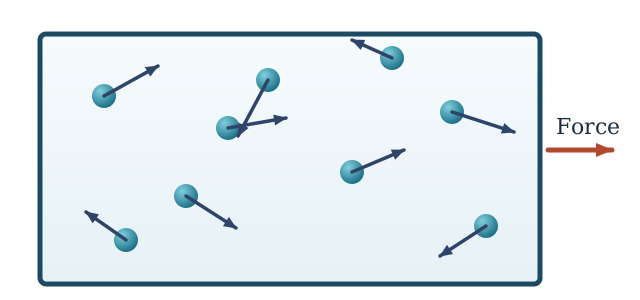 LQ 1ends here LQ 2starts here — What are the limitations of kinetic molecular theory? Explain the conditions where a real gas behaves as an ideal gas. Also prove that PV = NkBT. | |
Limitations of the Kinetic Molecular TheoryThe assumptions hold true for ideal gases only. Real gases show deviations because of intermolecular forces and finite molecular volume, especially at high pressure and low temperature. | |
Equation of State for an Ideal GasA gas that obeys the kinetic theory of gases is termed an ideal gas. Its equation of state is $$PV=nRT$$ Here $P$ is the pressure, $V$ the volume, $n$ the number of moles and $T$ the absolute temperature of the gas. | |
Universal Gas Constant$$R=8.3145\,\mathrm{J\,mol^{-1}K^{-1}}$$ | |
MeaningThe product of pressure and volume is directly proportional to the absolute temperature for an ideal gas. | |
Real Gas Behaving Like an Ideal GasThe number of moles is the mass of the gas divided by its molar mass. $$n=\frac{m}{M}$$ Putting this value in the equation of state $$PV=\frac{m}{M}RT$$ $$PM=\frac{m}{V}RT$$ The density of the gas is its mass per unit volume, so the ratio $m/V$ is the density $\rho$ of the gas. $$PM=\rho RT$$ Rearranging it for the density of the gas $$\rho=\frac{PM}{RT}$$ $$\rho=\frac{M}{R}\times\frac{P}{T}$$ The molar mass of a gas and the general gas constant are both fixed quantities. $$\frac{M}{R}=\text{constant}$$ So the density varies only with the ratio of the pressure to the absolute temperature. $$\rho\propto\frac{P}{T}$$ | |
ConclusionThe density is low at low pressure and high temperature, so the molecules stay far apart and the intermolecular forces become negligible. A real gas therefore behaves like an ideal gas at low pressure and high temperature. | |
Ideal Gas Equation in Terms of Boltzmann ConstantA mole is the number of atoms or molecules per unit Avogadro’s number. $$N_A=6.02\times10^{23}$$ $$n=\frac{N}{N_A}$$ Here $N$ is the number of atoms or molecules. Substituting this in the equation of state $$PV=\frac{N}{N_A}RT$$ $$PV=N\times\frac{R}{N_A}\times T$$ | |
Boltzmann ConstantThe gas constant for a single molecule is termed Boltzmann constant. $$k_B=\frac{R}{N_A}=1.38\times10^{-23}\,\mathrm{J\,K^{-1}}$$ Putting the Boltzmann constant for the ratio of the gas constant to Avogadro\u{2019}s number | |
Result$$PV=Nk_BT$$ LQ 2ends here LQ 3starts here — Discuss gas laws. | |
Gas LawsPressure, volume and temperature are the state functions which describe the quantity of a gas. When one of them changes the second changes with it while the third is kept constant, and the laws which relate them mutually for an ideal gas are termed as gas laws. | |
Boyle’s Law | |
PioneerRobert Boyle (1662) | |
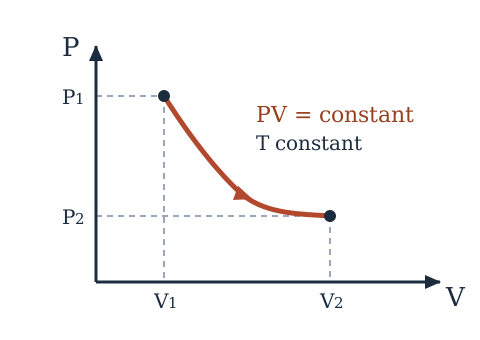
StatementFor a fixed mass of an ideal gas, the pressure exerted by a gas varies inversely with the volume occupied by the gas at constant temperature. | |
Mathematically$$P\propto\frac{1}{V}$$ $$PV=\text{constant}$$ $$P_1V_1=P_2V_2$$ | |
Graph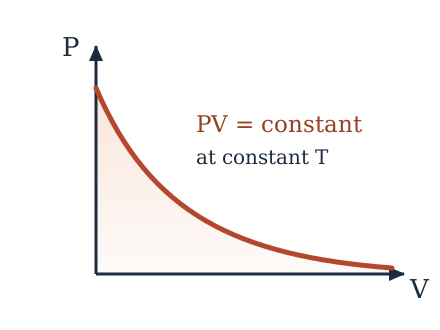 | |
Charles’ Law | |
PioneerJacques Charles (1870) | |
StatementThe volume of a given mass of a gas at constant pressure is directly proportional to the absolute temperature. | |
Mathematically$$V\propto T$$ $$\frac{V}{T}=\text{constant}$$ $$\frac{V_1}{T_1}=\frac{V_2}{T_2}$$ | |
Absolute ZeroThe graph is a straight line which, extended backward, cuts the temperature axis at $-273\,^{\circ}\mathrm{C}$, that is at 0 K. | |
Graph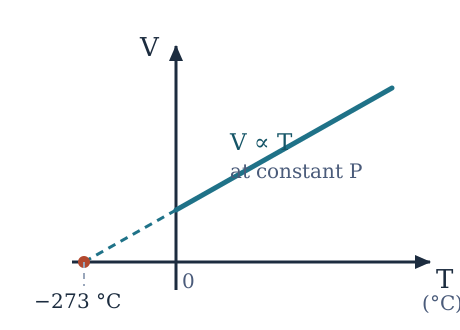 | |
Joseph Gay-Lussac’s Law | |
StatementFor a fixed mass of an ideal gas, the pressure exerted by a gas varies directly with the absolute temperature of the gas at constant volume. | |
Mathematically$$P\propto T$$ $$\frac{P}{T}=\text{constant}$$ $$\frac{P_1}{T_1}=\frac{P_2}{T_2}$$ | |
Graph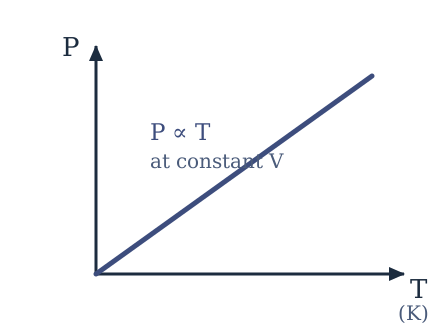 LQ 3ends here | |
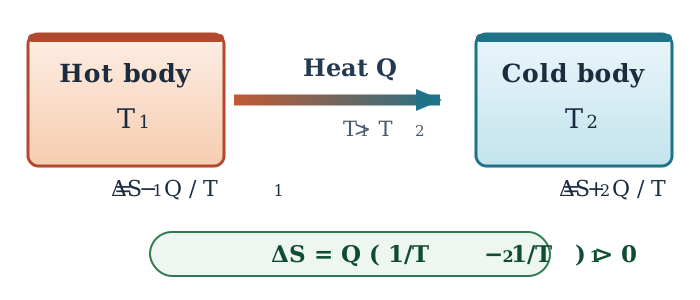
Thermal EquilibriumWhen two bodies are at the same temperature, the thermal energy of each body is equal. As a result there is no driving force for heat transfer between them, and they remain in thermal equilibrium. | |
ExampleWhen a metal spoon is put into a hot cup of coffee, the coffee is hotter at first and heat flows from the coffee to the spoon. Eventually both reach the same temperature, there is no net heat flow, and they are said to be in thermal equilibrium. |
Book Examples
|
Example 6.1.1
One mole of an ideal gas is at a temperature of 300 K. If the Boltzmann constant is $1.38\times10^{-23}\,\mathrm{J\,K^{-1}}$, calculate the volume of the gas at a pressure of 1 atm. [1 atm = 101325 Pa] |
|||||||||||||||||
|
|||||||||||||||||
Short Questions
|
SQ 6.1.1
Why does thermodynamics play a key role in technology? |
|||||||||||
|
|||||||||||
|
SQ 6.1.2
Show that the density of an ideal gas is directly proportional to its pressure and inversely proportional to its absolute temperature. |
|||||||||||
|
|||||||||||
|
SQ 6.1.3
Why can statistical methods be used to describe the properties of a gas? |
|||||||||||
|
|||||||||||
|
SQ 6.1.4
How are the three gas laws obtained from the ideal gas equation? |
|||||||||||
|
|||||||||||
|
SQ 6.1.5
Why must the mass of the gas be fixed in each of the gas laws? |
|||||||||||
|
|||||||||||
|
SQ 6.1.6
A fixed mass of gas in a rigid cylinder is heated from 300 K to 600 K. What happens to its pressure? |
|||||||||||
|
|||||||||||
|
SQ 6.1.7
Show that the universal gas constant is the product of Avogadro’s number and Boltzmann constant. |
|||||||||||
|
|||||||||||
|
SQ 6.1.8
A metal spoon is put into a cup of hot coffee. Explain how the two reach thermal equilibrium. |
|||||||||||
|
|||||||||||
|
MCQ 6.1.1
Almost all the raw energy available for our use is liberated in the form of: |
|||||||
| A | light | B | sound | ||||
| C | electric charge | D | heat | ||||
| Solution:Almost all the raw energy we can use is released as heat, which is why thermodynamics plays a key role in technology. | |||||||
|
MCQ 6.1.2
If the absolute temperature of a gas is doubled, the average kinetic energy of its molecules becomes: |
|||||||
| A | half | B | double | ||||
| C | four times | D | unchanged | ||||
| Solution:The average kinetic energy is directly proportional to the absolute temperature, so doubling $T$ doubles it. | |||||||
|
MCQ 6.1.3
Which one of the following is NOT an assumption of the kinetic theory of gases? |
|||||||
| A | the collisions are perfectly elastic | B | the volume of the molecules is negligible | ||||
| C | the motion of the molecules is random | D | the molecules attract one another strongly | ||||
| Solution:The theory assumes no attractive or repulsive forces between the molecules except during a collision. | |||||||
|
MCQ 6.1.4
At a constant temperature, the density of an ideal gas is directly proportional to its: |
|||||||
| A | pressure | B | volume | ||||
| C | absolute temperature | D | molar mass only | ||||
| Solution:From $PM=\rho RT$, at constant $T$ the density $\rho$ is directly proportional to the pressure $P$. | |||||||
|
MCQ 6.1.5
An ideal gas at 27 °C is compressed to half its volume at constant temperature. Its pressure becomes: |
|||||||
| A | half | B | four times | ||||
| C | double | D | unchanged | ||||
| Solution:At constant temperature $P_1V_1=P_2V_2$, so halving the volume doubles the pressure. | |||||||
|
MCQ 6.1.6
The number of molecules in 0.50 mole of a gas is about: |
|||||||
| A | $3.01\times10^{23}$ | B | $6.02\times10^{23}$ | ||||
| C | $1.20\times10^{24}$ | D | $1.38\times10^{-23}$ | ||||
| Solution:The number of molecules is $N=nN_A=0.50\times6.02\times10^{23}=3.01\times10^{23}$. | |||||||
|
MCQ 6.1.7
In the equation $PV=Nk_BT$, the symbol $N$ stands for the: |
|||||||
| A | number of moles of the gas | B | Avogadro’s number | ||||
| C | number of molecules of the gas | D | molar mass of the gas | ||||
| Solution:$N$ is the number of atoms or molecules, obtained from $n=N/N_A$. | |||||||
|
MCQ 6.1.8
For a fixed mass of gas at constant temperature, the graph of $P$ against $1/V$ is: |
|||||||
| A | a hyperbola | B | a parabola | ||||
| C | a horizontal line | D | a straight line through the origin | ||||
| Solution:Boyle’s law gives $P\propto 1/V$, so plotting $P$ against $1/V$ gives a straight line through the origin. | |||||||
|
MCQ 6.1.9
A fixed mass of gas at 27 °C and 1 atm is heated in a rigid vessel to 327 °C. Its pressure becomes: |
|||||||
| A | 1.5 atm | B | 2 atm | ||||
| C | 4 atm | D | 12 atm | ||||
| Solution:The volume is fixed, so $P/T$ is constant. The temperatures are 300 K and 600 K, so the pressure doubles to 2 atm. | |||||||
|
MCQ 6.1.10
When a metal spoon is placed in hot coffee, heat flows until: |
|||||||
| A | the spoon melts | B | the coffee freezes | ||||
| C | both are at the same temperature | D | the spoon changes its mass | ||||
| Solution:Heat flows from the coffee to the spoon until both reach the same temperature and are in thermal equilibrium. | |||||||