XI-Physics CH-8

Physical Optics and Gravitational Waves

Topic 8.1

Polarization of Light

LQ 1starts here — Define the phenomenon of polarization of waves. How does polarization of electromagnetic waves occur? Also classify the polarization of waves.

Physical Optics

Physical optics with reference to polarization deals with the behaviour of light waves and their interaction with matter.

What Interference and Diffraction Prove

Interference and diffraction effects prove the wave nature of light. These phenomena, however, do not tell us whether the light waves are longitudinal or transverse.

What Polarization Proves

Polarization of light suggests that the light waves are transverse in character.

Vibrations of a Transverse Wave

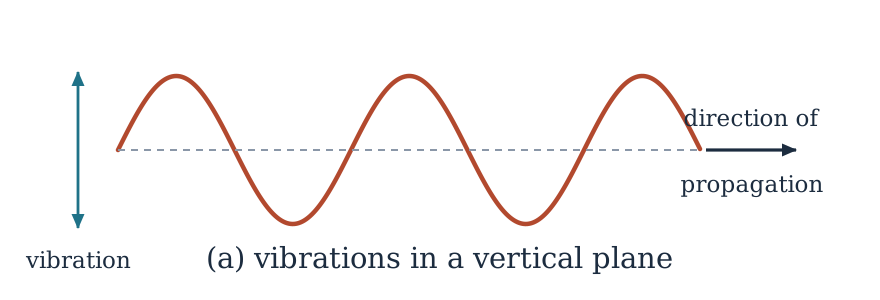
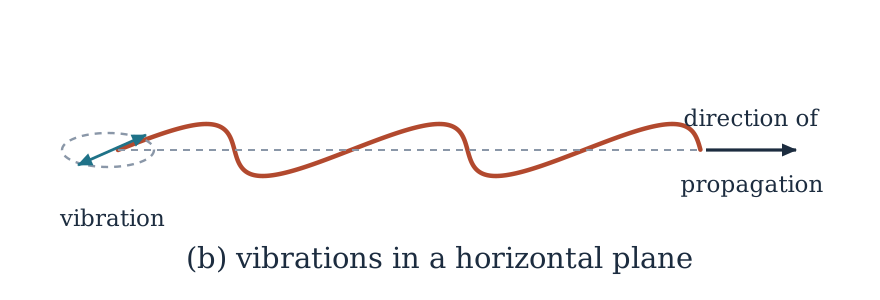
In transverse mechanical waves, such as those produced in a stretched string, the vibrations of the particles of the medium are perpendicular to the direction of propagation of the waves. The vibrations can be confined along a vertical, a horizontal or any other direction.

Vibrations in a Vertical Plane

A transverse wave on a string polarized in a vertical plane

Vibrations in a Horizontal Plane

A transverse wave on a string polarized in a horizontal plane

Plane of Polarization

In each of these cases the transverse mechanical wave is said to be polarized. The plane of polarization is the plane containing the direction of vibration of the particles of the medium and the direction of propagation of the wave.

A Light Wave

A light wave produced by an oscillating charge consists of a periodic variation of the electric field vector $E$ accompanied by the magnetic field vector $B$ at right angles to it.

Unpolarized Light

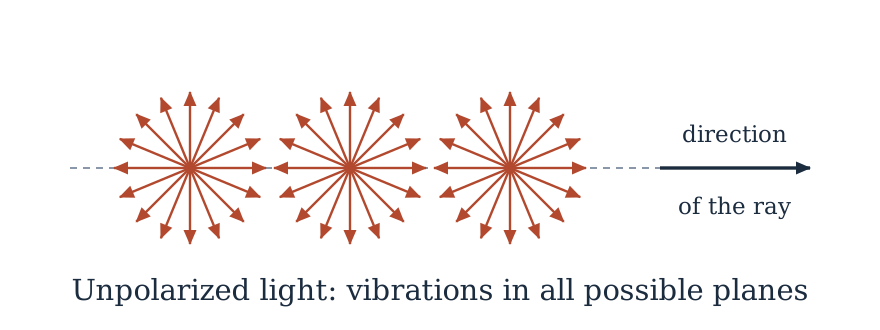
Ordinary light has components of vibration in all possible planes. Such light is unpolarized.

Diagram

Unpolarized light has components of vibration in all possible planes

Examples of Unpolarized Sources

Sunlight, incandescent light bulbs, fluorescent light bulbs, and the light from a candle or a fire.

Polarized Light

If the vibrations are confined only in one plane, the light is said to be polarized.

Polarization

Polarization is the process by which the electric and magnetic vibrations of light waves are restricted to a single plane of vibration.

Only for Transverse Waves

It is a property exhibited only by transverse waves such as light waves. It does not occur for longitudinal waves such as sound waves.

How an Unpolarized Light Can Be Polarized

By passing the light through a polarizing filter, such as a polaroid sheet.
By using a polarizing beam splitter.
By employing certain optical crystals or materials, such as calcite and quartz.

The Most Common Method

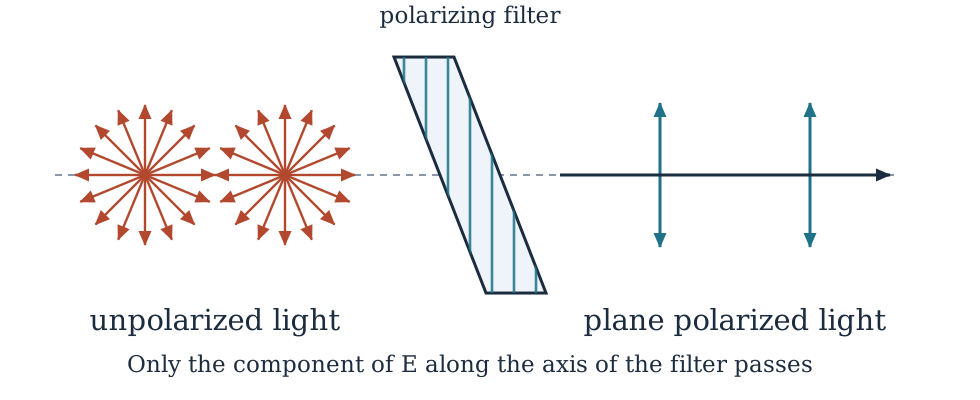
The most common method is to pass the light through a polarizing filter. When unpolarized light passes through the filter, only that electric field vector which is parallel to the axis of the filter can pass through it, while all the other vectors are blocked. The resultant light then becomes polarized.

Diagram

Polarization of light using a polarizing filter

In Simple Words

The process of transforming unpolarized light into polarized light is said to be polarization. The orientation of the electric field vector $E$ of light waves in a specific direction is the basis of polarization.

Short Questions

SQ 8.1.1

Why does polarization not occur in sound waves?

Reason

Sound in air is a longitudinal wave: the particles vibrate along the direction of travel, so there is no plane of vibration across the ray that a filter could select.

Only Transverse

Polarization is a property of transverse waves alone.
SQ 8.1.2

What does polarization tell us about light that interference and diffraction cannot?

Interference and Diffraction

They establish only that light is a wave.

Polarization

It establishes that the light wave is transverse, because only a transverse wave can be confined to a single plane of vibration.
SQ 8.1.3

Define the plane of polarization.

Definition

The plane containing the direction of vibration of the particles and the direction of propagation of the wave.
SQ 8.1.4

What is meant by unpolarized light? Name two sources.

Unpolarized Light

Light whose vibrations lie in all possible planes about the direction of travel.

Sources

Sunlight and an incandescent light bulb. A fluorescent bulb, a candle and a fire are also unpolarized.
SQ 8.1.5

What happens to the electric field vectors of unpolarized light at a polarizing filter?

Transmitted

Only the component of $E$ that is parallel to the transmission axis passes.

Blocked

All the other components are absorbed, so the emerging light vibrates in one plane only.
SQ 8.1.6

Name three methods by which unpolarized light can be polarized.

Methods

Passing the light through a polarizing filter such as a polaroid sheet.
Using a polarizing beam splitter.
Employing optical crystals such as calcite or quartz.
SQ 8.1.7

A light wave carries both an electric and a magnetic field vector. Which one defines the polarization?

Electric Field

The orientation of the electric field vector $E$ in a specific direction is the basis of polarization.

Magnetic Field

The vector $B$ accompanies it at right angles and follows it, so it is not quoted separately.
MCQ 8.1.1

Polarization of light proves that light waves are:

AlongitudinalBstationary
CtransverseDmechanical
Solution:Only a transverse wave has a plane of vibration across the ray that can be selected.
MCQ 8.1.2

Polarization does not occur in:

Alight wavesBradio waves
Csound wavesDX-rays
Solution:Sound in air is longitudinal, and a longitudinal wave cannot be polarized.
MCQ 8.1.3

The plane of polarization contains the direction of vibration and the:

Adirection of the magnetic field onlyBnormal to the ray
Caxis of the analyzerDdirection of propagation
Solution:By definition it is the plane holding both the vibration and the direction of travel.
MCQ 8.1.4

In a light wave the magnetic field vector is, with respect to the electric field vector:

AparallelBat right angles
CantiparallelDat $45^{\circ}$
Solution:$E$ and $B$ accompany each other at right angles.
MCQ 8.1.5

Sunlight is:

AunpolarizedBplane polarized
Ccircularly polarizedDelliptically polarized
Solution:The Sun radiates from very many independent atoms, so its vibrations lie in all planes.
MCQ 8.1.6

A polaroid sheet transmits the component of $E$ which is:

Aperpendicular to its transmission axisBparallel to its transmission axis
Cat $45^{\circ}$ to its axisDalong the direction of the ray
Solution:Every other component is absorbed by the sheet.
MCQ 8.1.7

The basis of polarization is the orientation of the:

Amagnetic field vectorBPoynting vector
Celectric field vectorDpropagation vector
Solution:The chapter defines polarization by the direction of $E$.
MCQ 8.1.8

Which of these is not a way of polarizing unpolarized light?

Apassing it through a polaroid sheetBusing a polarizing beam splitter
Cpassing it through a converging lensDusing a calcite crystal
Solution:A lens changes the direction of the rays but not the plane of vibration.
MCQ 8.1.9

A wave on a stretched string can vibrate in a vertical plane, a horizontal plane or any other. This is possible because the wave is:

AlongitudinalBtransverse
CstationaryDdamped
Solution:Only a transverse vibration has a choice of plane across the direction of travel.
Topic 8.2

Types of Polarization

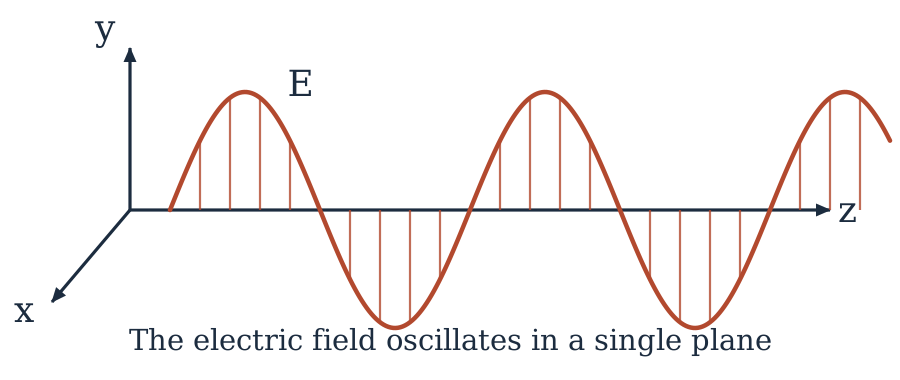
Linear Polarization

When the electric field vector oscillates in a single plane, the light is said to be linearly polarized.

Example

The light passing through a polarizing filter, such as sunglasses.
Linear polarization of light

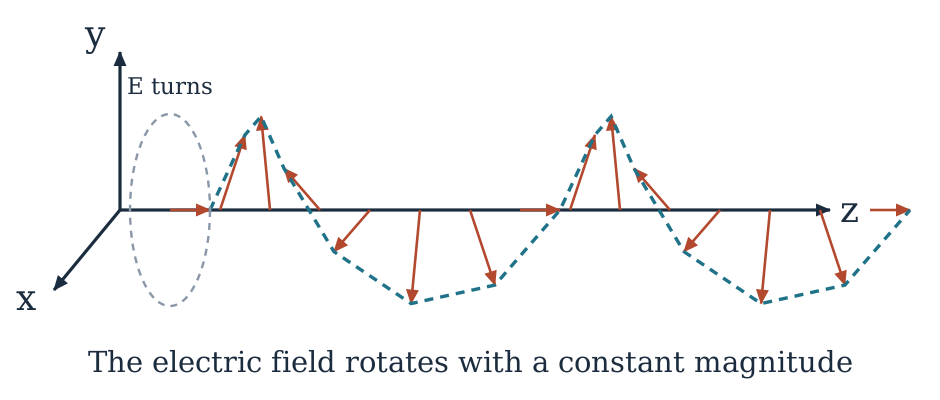
Circular Polarization

When the electric field rotates circularly, either clockwise, which is right-handed, or counterclockwise, which is left-handed, the light is said to be circularly polarized.

Example

The light reflected off a CD, a compact disc, or a DVD, a digital versatile disc.
Circular polarization of light

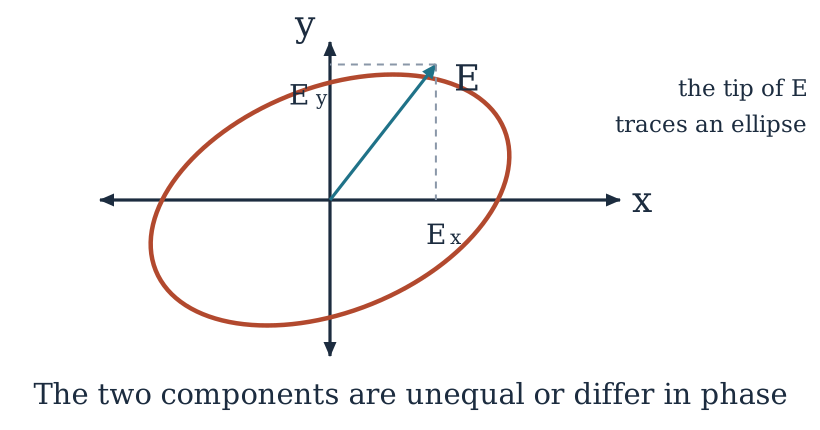
Elliptical Polarization

A combination of linear and circular polarization, in which the electric field vector traces an elliptical path, is called elliptical polarization.

Condition

In elliptical polarization the two components of the electric field $E_x$ and $E_y$ are not equal, or they differ in phase by an arbitrary angle $\delta$.

Example

The light passing through a stress plate or a waveplate.
Elliptical polarization of light
LQ 1ends here

Short Questions

SQ 8.2.1

How does circular polarization differ from linear polarization?

LinearCircular
The field vector oscillates in one plane.The field vector rotates about the ray.
Its magnitude changes from zero to a maximum.Its magnitude stays constant.
Light through a polarizing filter.Light reflected from a CD.
SQ 8.2.2

What condition on the two components of E produces elliptical polarization?

Condition

The two components $E_x$ and $E_y$ are unequal, or they differ in phase by an arbitrary angle.

Result

The tip of the field vector then traces an ellipse.
SQ 8.2.3

Circular polarization is called right-handed or left-handed. What does this describe?

Sense of Rotation

It describes the direction in which the electric field vector turns about the ray: clockwise for right-handed and counterclockwise for left-handed.
SQ 8.2.4

Give one everyday example of each of the three types of polarization.

Linear

Light passing through polarizing sunglasses.

Circular

Light reflected off a CD or a DVD.

Elliptical

Light passing through a stress plate or a waveplate.
MCQ 8.2.1

Light reflected off a compact disc is an example of:

Alinear polarizationBcircular polarization
Celliptical polarizationDno polarization
Solution:The book gives the CD and the DVD as the example of circular polarization.
MCQ 8.2.2

In circular polarization the magnitude of the electric field vector:

Afalls to zero twice in a cycleBgrows steadily
Cis always zeroDstays constant while its direction turns
Solution:The tip of the vector travels round a circle, so its length does not change.
MCQ 8.2.3

Elliptical polarization results when the two components of $E$ are:

Aequal and in phaseBequal and in antiphase
Cboth zeroDunequal or differ in phase by an arbitrary angle
Solution:Equal components in phase give linear polarization instead.
MCQ 8.2.4

Light passing through polarizing sunglasses is:

Acircularly polarizedBlinearly polarized
Celliptically polarizedDunpolarized
Solution:A polarizing filter confines the vibration to a single plane.
MCQ 8.2.5

Light passing through a waveplate is an example of:

Alinear polarizationBelliptical polarization
Ccircular polarizationDdepolarization
Solution:A waveplate introduces a phase difference between the two components.
MCQ 8.2.6

A right-handed circularly polarized wave has its electric field turning:

AclockwiseBcounterclockwise
Cin one planeDalong the ray
Solution:Right-handed is the clockwise sense, left-handed the counterclockwise one.
Topic 8.3

Production and Detection of Plane Polarized Light

LQ 2starts here — How can the plane polarized light be produced and detected? What does it prove?

Why Ordinary Light Is Unpolarized

The light emitted by an ordinary incandescent bulb is unpolarized, because its electrical vibrations are randomly oriented in space.

The Polarizer

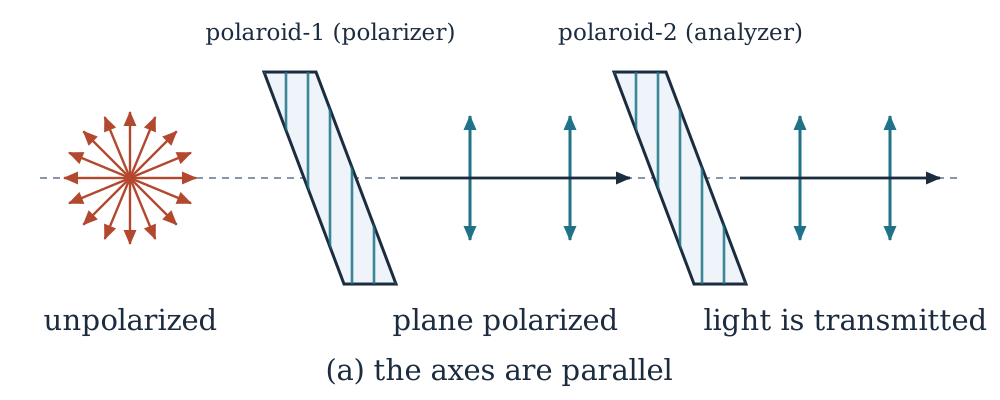
If unpolarized light is made incident on a sheet of polaroid, called the polarizer, the transmitted light will be plane polarized.

The Analyzer

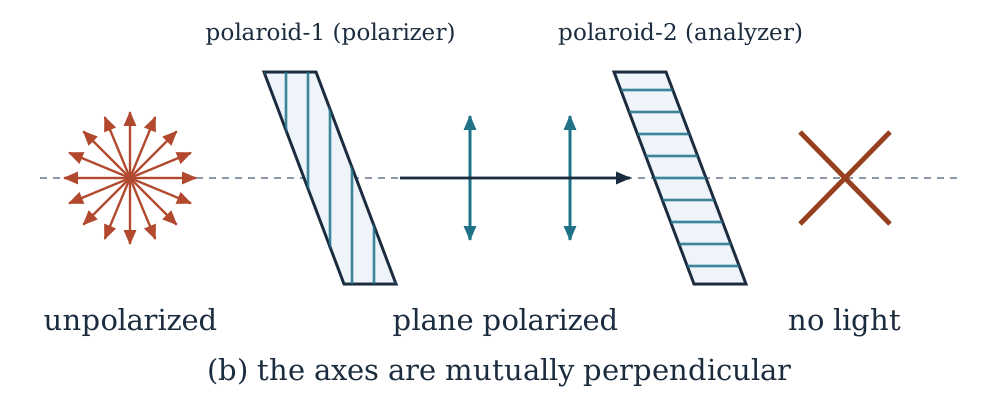
A second sheet of polaroid placed in the path of this light is called the analyzer. The axes of the two polaroids are shown by straight lines drawn on them.

Axes Parallel

When the axes of the two polaroids are parallel, the light is transmitted through the second polaroid.
Light is transmitted when the axes of the polarizer and the analyzer are parallel

Axes Perpendicular

If the analyzer is slowly rotated about the beam of light as the axis of rotation, the light emerging from the second polaroid gets dimmer and dimmer and ultimately disappears when the axes become mutually perpendicular.
The light disappears when the axes of the two polaroids are mutually perpendicular

On Further Rotation

The light reappears on further rotation and becomes brightest when the axes are again parallel to each other.

What the Experiment Proves

This experiment proves that light waves are transverse waves. If the light waves were longitudinal, they would never disappear even if the two polaroids were mutually perpendicular.
LQ 2ends here

Short Questions

SQ 8.3.1

In the two-polaroid experiment, what is the difference in the roles of the polarizer and the analyzer?

Polarizer

The first sheet, which turns the incident unpolarized light into plane polarized light.

Analyzer

The second sheet, which is rotated to test the polarization by varying the transmitted intensity.
SQ 8.3.2

Why is the light brightest when the two polaroid axes are parallel?

Reason

The whole vibration transmitted by the polarizer then lies along the axis of the analyzer, so nothing is resolved away and the full amplitude is passed.
SQ 8.3.3

What would be observed with crossed polaroids if light were a longitudinal wave? What does the actual observation prove?

If Longitudinal

The light would never disappear, because a longitudinal vibration has no plane across the ray to be blocked.

Actual Observation

The light does disappear, which proves that light waves are transverse.
SQ 8.3.4

As the analyzer is turned from the parallel position through one full turn, how many times does the light vanish?

Twice

The light vanishes at $90^{\circ}$ and again at $270^{\circ}$, and it is brightest at $0^{\circ}$ and $180^{\circ}$.
SQ 8.3.5

Why is the light from an ordinary incandescent bulb unpolarized?

Reason

Its electrical vibrations are produced by a very large number of independently radiating atoms, so they are randomly oriented in space.
MCQ 8.3.1

The second polaroid in the production and detection experiment is called the:

ApolarizerBanalyzer
CreflectorDdiffuser
Solution:The first is the polarizer, the second the analyzer.
MCQ 8.3.2

The light emerging from two polaroids disappears when their axes are:

AparallelBmutually perpendicular
Cat $45^{\circ}$Dat $30^{\circ}$
Solution:At $90^{\circ}$ no component of the vibration survives, so $I=0$.
MCQ 8.3.3

If light were a longitudinal wave, then with crossed polaroids the light would:

Adisappear completelyBbe doubled
Cnever disappearDchange colour
Solution:A longitudinal vibration has no plane across the ray for the second sheet to block.
MCQ 8.3.4

Turning the analyzer through one complete revolution, the light is extinguished:

AtwiceBonce
Cthree timesDfour times
Solution:It vanishes at $90^{\circ}$ and again at $270^{\circ}$.
MCQ 8.3.5

The light emerging from the first polaroid is:

AunpolarizedBcircularly polarized
Cplane polarizedDwhite
Solution:The polarizer confines the vibration to its own transmission axis.
MCQ 8.3.6

The brightness is greatest when the two axes are:

AperpendicularBat $60^{\circ}$
CparallelDat $45^{\circ}$
Solution:For $\theta=0$ the whole transmitted amplitude lies along the analyzer axis.
MCQ 8.3.7

The experiment with two polaroids is a demonstration of the:

Atransverse nature of lightBparticle nature of light
Cdispersion of lightDtotal internal reflection
Solution:The disappearance at crossed axes is possible only for a transverse wave.
Topic 8.4

Polarization of Light by the Method of Reflection

LQ 3starts here — How can polarized light be obtained by the method of reflection? Explain.

Malus and Reflection

In 1808, Malus discovered that polarized light is obtained when ordinary light is reflected by a plane sheet of glass.

Observation

If the reflected light is viewed through a polaroid which is slowly rotated about the line of vision, the light is practically extinguished at a certain orientation of the polaroid.

Most Suitable Angle

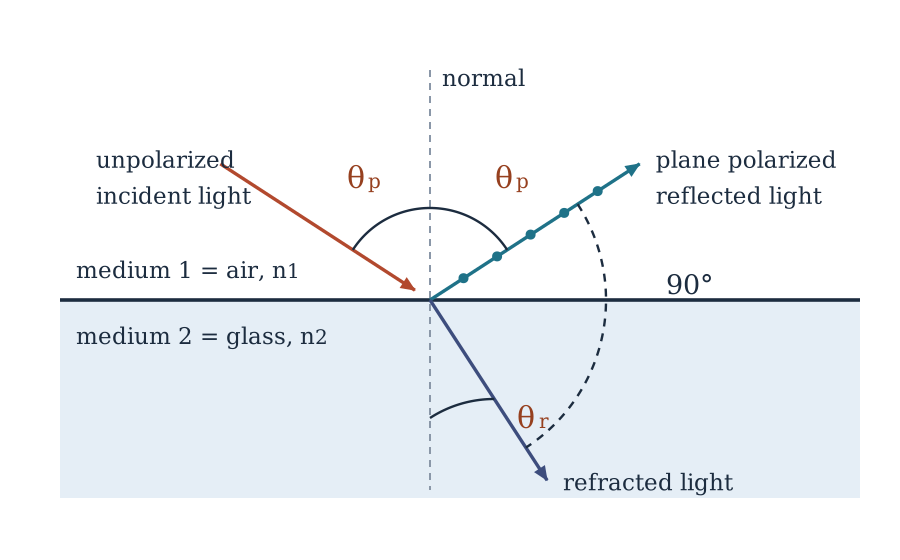
The most suitable angle of incidence is about $57^{\circ}$ for glass, for which the reflected ray becomes plane polarized. This proves that the light reflected by the glass is practically plane polarized.

Ray Diagram

Plane polarization by reflection at the polarizing angle

Partial Polarization

Light reflected from the surface of a table becomes darker when viewed through a rotated polaroid, showing that it is partially plane polarized.

Polarizing Angle

The particular angle of incidence on a transparent medium for which the reflected light is almost plane polarized is called the polarizing angle.

Brewster’s Law

Let a beam of unpolarized light be made incident on the surface of medium 2. If the reflected beam of light is almost plane polarized, the reflected and the refracted beams are at right angles to each other at the polarizing angle.
$$\theta_p+\theta_r=90^{\circ}$$
$$\theta_r=90^{\circ}-\theta_p$$

From Snell’s Law

$$n_1\sin\theta_p=n_2\sin\theta_r$$
$$n_1\sin\theta_p=n_2\sin(90^{\circ}-\theta_p)$$
$$n_1\sin\theta_p=n_2\cos\theta_p$$
Dividing by the cosine gives the tangent of the polarizing angle.
$$\frac{\sin\theta_p}{\cos\theta_p}=\frac{n_2}{n_1}$$
$$\tan\theta_p=\frac{n_2}{n_1}$$

Meaning of the Symbols

Here $n_1$ is the refractive index of medium 1 and $n_2$ is the refractive index of medium 2.

When Medium 1 Is Air

For air the refractive index is unity, so the law takes its simple form.
$$n_1=1$$
$$\tan\theta_p=n$$

Statement

Brewster proved that the tangent of the angle of polarization is numerically equal to the refractive index of the medium on which the light is incident.

Brewster Angle

The angle $\theta_p$ for which the reflected ray and the refracted ray make an angle of $90^{\circ}$ between them is also called the Brewster angle.
LQ 3ends here

Book Examples

Example 8.4.1

A beam of light strikes the surface of a plate of glass with a refractive index of $\sqrt{3}$ at the polarizing angle. What will be the angle of refraction of the wave of light?

Given Data

$$n=\sqrt{3}$$

To Find

Angle of refraction $\theta_r=?$

Formula

$$\tan\theta_p=n$$
$$\theta_p+\theta_r=90^{\circ}$$

Solution

The polarizing angle is the inverse tangent of the refractive index.
$$\theta_p=\tan^{-1}(\sqrt{3})=60^{\circ}$$
The reflected and the refracted rays are at right angles, so
$$\theta_r=90^{\circ}-60^{\circ}=30^{\circ}$$

Result

$$\theta_r=30^{\circ}$$
Example 8.4.2

Find the refractive index of a medium if the polarizing angle is $54.5^{\circ}$.

Given Data

$$\theta_p=54.5^{\circ}$$

To Find

Refractive index $n=?$

Formula

$$\tan\theta_p=n$$

Solution

Putting the value of the polarizing angle
$$n=\tan54.5^{\circ}=1.4$$

Result

$$n=1.4$$

Short Questions

SQ 8.4.1

Why is the reflected light at the polarizing angle plane polarized while the light reflected from a table top is only partially polarized?

At the Polarizing Angle

The reflected and refracted rays are at right angles, so only the vibration parallel to the surface can be reflected.

At Other Angles

Some of the other vibration is reflected too, so the beam is only partially polarized.
SQ 8.4.2

State Brewster’s law and write it for light incident from air.

Statement

The tangent of the polarizing angle is equal to the refractive index of the medium on which the light is incident.

From Air

$$\tan\theta_p=n$$
SQ 8.4.3

What is the angle between the reflected ray and the refracted ray at the polarizing angle?

Right Angle

The two rays are separated by $90^{\circ}$
$$\theta_p+\theta_r=90^{\circ}$$
SQ 8.4.4

Show that the angle of refraction at the polarizing angle is the complement of the polarizing angle.

From the Right Angle

The reflected and refracted rays are perpendicular, so
$$\theta_p+\theta_r=90^{\circ}$$
Therefore
$$\theta_r=90^{\circ}-\theta_p$$
That is, the refraction angle is the complement of the polarizing angle.
SQ 8.4.5

Two media have refractive indices 1.33 and 1.52. For which is the polarizing angle greater?

Greater for the Denser Medium

The polarizing angle is the inverse tangent of the refractive index, which increases with $n$
$$\tan\theta_p=n$$
So the medium of refractive index 1.52 has the greater polarizing angle.
SQ 8.4.6

Who discovered polarization by reflection and in which year?

Malus

In 1808 Malus discovered that polarized light is obtained when ordinary light is reflected by a plane sheet of glass.
MCQ 8.4.1

The polarizing angle for glass is about:

A$33^{\circ}$B$45^{\circ}$
C$57^{\circ}$D$90^{\circ}$
Solution:The book gives about $57^{\circ}$ as the most suitable angle of incidence for glass.
MCQ 8.4.2

At the polarizing angle the reflected and refracted rays are separated by:

A$90^{\circ}$B$45^{\circ}$
C$57^{\circ}$D$180^{\circ}$
Solution:This right angle is what makes the reflected beam plane polarized.
MCQ 8.4.3

Brewster’s law for light incident from air is:

A$\sin\theta_p=n$B$\tan\theta_p=n$
C$\cos\theta_p=n$D$\cot\theta_p=n$
Solution:With $n_1=1$ the general form $\tan\theta_p=n_2/n_1$ reduces to this.
MCQ 8.4.4

For a medium of refractive index 1, the polarizing angle would be:

A$0^{\circ}$B$57^{\circ}$
C$90^{\circ}$D$45^{\circ}$
Solution:The inverse tangent of one is $45^{\circ}$.
MCQ 8.4.5

If the polarizing angle of a medium is $60^{\circ}$, its refractive index is:

A0.58B1.73
C1.15D2.00
Solution:$\tan 60^{\circ}=1.73$.
MCQ 8.4.6

At a polarizing angle of $56^{\circ}$ the angle of refraction is:

A$56^{\circ}$B$44^{\circ}$
C$34^{\circ}$D$90^{\circ}$
Solution:The refraction angle is the complement, $90^{\circ}-56^{\circ}$.
MCQ 8.4.7

Light reflected from a table top is:

Acompletely plane polarizedBcircularly polarized
Cpartially plane polarizedDunpolarized
Solution:It becomes darker but does not vanish when a polaroid is turned in front of it.
MCQ 8.4.8

Polarization by reflection was discovered by:

AMalusBBrewster
CEinsteinDNewton
Solution:Malus discovered it in 1808; Brewster gave the law connecting the angle to the refractive index.
MCQ 8.4.9

Brewster’s law in its general form is:

A$\tan\theta_p=n_1/n_2$B$\tan\theta_p=n_1 n_2$
C$\tan\theta_p=n_2/n_1$D$\tan\theta_p=n_1-n_2$
Solution:It follows from Snell’s law together with $\theta_p+\theta_r=90^{\circ}$.
Topic 8.5

Malus’s Law

LQ 4starts here — State Malus’s law. Explain the intensity formula.

Statement

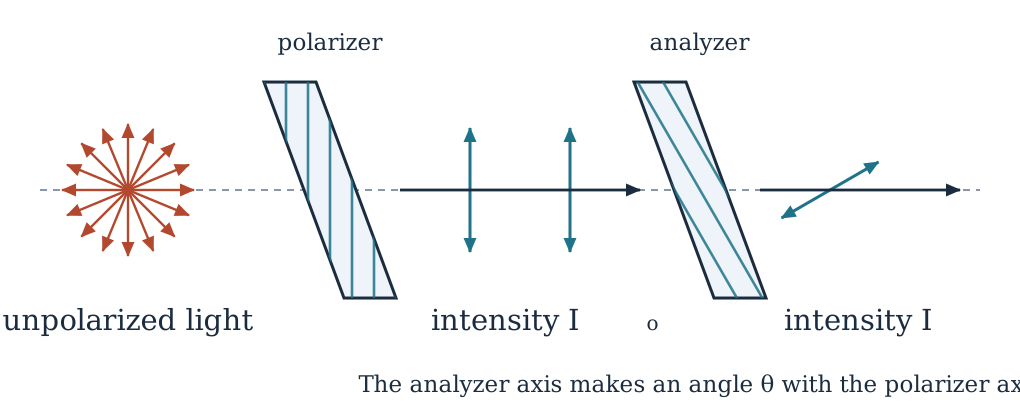
Malus’s law states that the intensity $I$ of plane polarized light after passing through an analyzer is directly proportional to the square of the cosine of the angle $\theta$ between the transmission axis of the analyzer and that of the polarizer.

Mathematically

$$I\propto\cos^2\theta$$
$$I=I_o\cos^2\theta$$
Here $I_o$ is the intensity of the incident polarized light.

What the Law Relates

Malus’s law gives a mathematical relation between the intensity of the light incident on the first polaroid, the polarizer, and the intensity of the light obtained after passing it through the second polaroid, the analyzer.

Diagram

Schematic representation of Malus’s law

The Analyzer

An analyzer is also a polarizer that is placed after a polarizer. Rotation of the analyzer affects the intensity of the polarized light. It is used to further reduce the intensity of the light and also to adjust it by adjusting the angle of the analyzer with respect to the polarizer.

Polaroids

Certain transparent crystalline materials, such as tourmaline and calcite crystals, are capable of confining the vibrations of light waves in only one plane. Such materials are called polaroids, and they have a high directionality in their crystal structure.

Other Ways of Polarizing

Light can also be polarized by natural phenomena such as reflection, refraction and scattering.

Why the Intensity Varies

If a polaroid is rotated in front of a polarized ray of light, it causes a variation in the intensity of the light that gets through. The reason is the angle between the initial polarizer and the axis of the second polarizer.

Resolution of the Amplitude

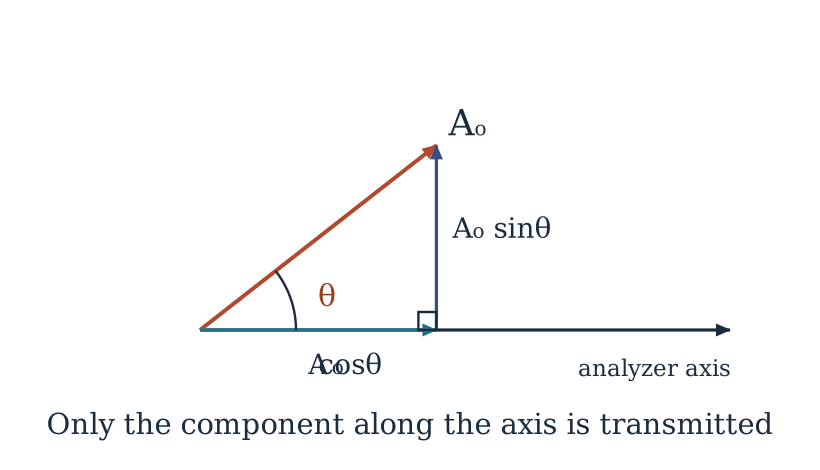
When the incident polarized light of amplitude $A_o$ strikes the analyzer at an angle $\theta$, it is resolved into two components.
$$A_o\cos\theta$$
$$A_o\sin\theta$$

Diagram

Resolution of the amplitude into components of plane polarized light

Which Component Passes

The component $A_o\sin\theta$ is absorbed in the analyzer. Only $A_o\cos\theta$ passes through, so the amplitude of the transmitted light is
$$A=A_o\cos\theta$$

From Amplitude to Intensity

The intensity is proportional to the square of the amplitude.
$$I\propto A^2$$
$$I=kA^2$$
Taking the constant $k$ as unity
$$I=A^2$$
$$I=A_o^2\cos^2\theta$$
$$I=I_o\cos^2\theta$$
Here $I_o$ is the intensity of the incident polarized light.

Axes Parallel

When the angle is zero, the intensity transmitted through the analyzer is equal to the initial intensity that passes through the polarizer.
$$\theta=0^{\circ}$$
$$I=I_o$$

Axes Perpendicular

When the angle is a right angle the light is extinguished completely, so no light is allowed to pass through the analyzer.
$$\theta=90^{\circ}$$
$$I=0$$
LQ 4ends here
LQ 8starts here — What is meant by optical activity? Discuss it.

Optical Activity

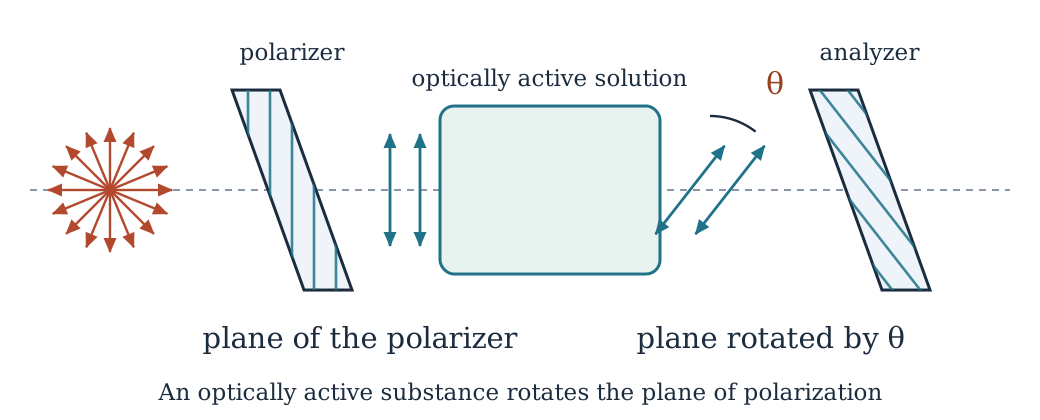
Optical activity is the ability of a substance to rotate the plane of polarization of light passing through it. The rotation is detected with a polarizer and an analyzer.

Diagram

An optically active substance rotates the plane of polarization of the light passing through it

Optically Active Substances

Many crystals and solutions rotate the plane of polarization of the light passing through them. Such substances are said to be optically active. Quartz crystals, cinnabar, sugar water, insulin and collagen are examples.

What the Rotation Depends On

The type of the substance.
The concentration of the substance, that is, the amount present in a given quantity of a mixture or solution.
The distance the light travels through it.
The wavelength of the light.

Cause

Optical activity occurs due to the asymmetric shape of the molecules in the substance, such as their being helical. A few millimetres thickness of such crystals will rotate the plane of polarization by many degrees.

Use

Certain organic substances, such as sugar and tartaric acid, show optical rotation when they are in solution, and this property is used to determine their concentration in the solution.
LQ 8ends here
LQ 5starts here — What is a polaroid? Explain two main applications of polarization.

Importance of Polarization

Optics and Photonics

Polarization is essential for applications such as polarized sunglasses, liquid crystal display screens and optical communication systems.

Imaging and Microscopy

Polarization enhances image quality by reducing glare, the unwanted light that interferes with vision, and by improving contrast, especially in microscopy and medical imaging.

Medical Applications

Polarization is used in cancer diagnosis, tissue imaging and laser surgery, using its ability to distinguish between different tissue types.

Astronomy

Polarization helps us analyze cosmic phenomena, such as the polarization of light from distant stars or the cosmic microwave background radiation.

Two Main Applications of Polarization

Sky Photography

A camera which is used to photograph the clouds is fitted with a polaroid, and the light coming from the sky is polarized by the polaroid.

Why

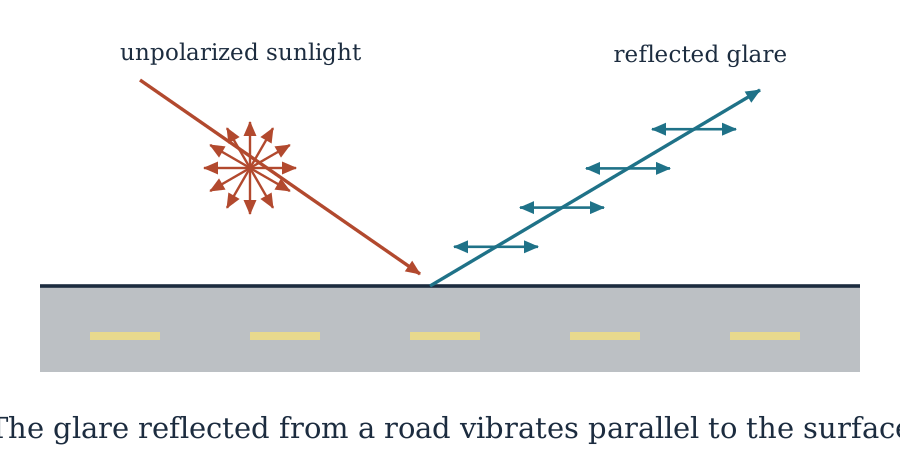
Polarizers reduce the glare and the haze produced by the scattering of light by the small particles and molecules present in the atmosphere. They also enhance the contrast by blocking the excessive bright white light while allowing the other colours to pass, creating a brighter and more detailed image.

Diagram

Light reflected from a road is polarized parallel to the surface

Stress Analysis of Materials

In materials science, polarizers are used to analyze the stress and the strain in materials such as plastics, metals and glass.

How It Works

When a material is stressed, its molecular structure changes, which affects the way it interacts with light, and interference patterns or fringes are formed which give qualitative information about the material.

What the Researcher Learns

The stress patterns in the material.
Potential weaknesses or defects.
The optical properties of the material.
How the material will behave under different conditions.

Photoelasticity

This technique is known as photoelasticity and is widely used in engineering, materials science and quality control.
LQ 5ends here

Book Examples

Example 8.5.1

Polarized light with an intensity of 75 W m$^{-2}$ passes through an analyzer with its axis at $30^{\circ}$ to the polarizer’s axis. What is the emerging intensity?

Given Data

$$I_o=75\,\mathrm{W\,m^{-2}}$$
$$\theta=30^{\circ}$$

To Find

Emerging intensity $I=?$

Formula

$$I=I_o\cos^2\theta$$

Solution

Putting the values in Malus’s law
$$I=75\times(\cos30^{\circ})^2=75\times(0.866)^2$$
$$I=75\times0.75=56.25\,\mathrm{W\,m^{-2}}$$

Result

$$I=56.25\,\mathrm{W\,m^{-2}}$$
Example 8.5.2

A polarized light with an amplitude of 5 units passes through a polarizer with its electric field aligned at $60^{\circ}$ to the original polarization direction. Find the amplitude of the light after passing through the analyzer.

Given Data

$$A_o=5\ \text{units}$$
$$\theta=60^{\circ}$$

To Find

Transmitted amplitude $A=?$

Formula

$$A=A_o\cos\theta$$

Solution

Only the component along the axis of the analyzer is transmitted.
$$A=5\times\cos60^{\circ}=5\times0.5=2.5\ \text{units}$$

Result

$$A=2.5\ \text{units}$$

Short Questions

SQ 8.5.1

State Malus’s law and name the angle it involves.

Statement

The intensity of plane polarized light after passing through an analyzer is directly proportional to the square of the cosine of the angle between the transmission axes of the analyzer and the polarizer.

Formula

$$I=I_o\cos^2\theta$$
SQ 8.5.2

Which component of the incident amplitude is absorbed by the analyzer, and which is transmitted?

Absorbed

The component $A_o\sin\theta$, which lies across the transmission axis.

Transmitted

The component $A_o\cos\theta$, which lies along the axis.
SQ 8.5.3

Why is the intensity, and not the amplitude, proportional to the square of the cosine?

Reason

Only the amplitude falls by the factor $\cos\theta$, and the intensity is proportional to the square of the amplitude.
$$I\propto A^2$$
$$I=I_o\cos^2\theta$$
SQ 8.5.4

If the angle between the polarizer and the analyzer is doubled from $30^{\circ}$ to $60^{\circ}$, does the transmitted intensity halve?

No

The intensity follows the square of the cosine, which is not a linear function of the angle.
$$\cos^2 30^{\circ}=0.75$$
$$\cos^2 60^{\circ}=0.25$$
The intensity falls to one third of its earlier value, not to one half.
SQ 8.5.5

What is a polaroid, and what property of its structure makes it work?

Polaroid

A transparent crystalline material, such as tourmaline or calcite, that confines the vibrations of light waves to only one plane.

Structure

Such materials have a high directionality in their crystal structure.
SQ 8.5.6

Name three natural phenomena by which light can be polarized.

Phenomena

Reflection, refraction and scattering.
SQ 8.5.7

What is optical activity? Name two optically active substances.

Optical Activity

The ability of a substance to rotate the plane of polarization of the light passing through it.

Examples

Quartz crystals and sugar solution. Cinnabar, insulin and collagen are also optically active.
SQ 8.5.8

On what factors does the angle of rotation of an optically active substance depend?

Factors

The type of the substance.
The concentration of the substance.
The distance the light travels through it.
The wavelength of the light.
SQ 8.5.9

What is photoelasticity and where is it used?

Photoelasticity

The technique of shining polarized light through a stressed transparent material and reading the interference fringes that form.

Use

It shows the stress patterns and the defects of a material, and is used in engineering, materials science and quality control.
MCQ 8.5.1

In Malus’s law the angle $\theta$ is measured between:

Athe ray and the analyzerBthe ray and the normal
Cthe two field vectors $E$ and $B$Dthe transmission axes of the polarizer and the analyzer
Solution:It is the angle between the two transmission axes.
MCQ 8.5.2

The component of the amplitude absorbed by the analyzer is:

A$A_o\sin\theta$B$A_o\cos\theta$
C$A_o\tan\theta$D$A_o$
Solution:Only the component along the axis, $A_o\cos\theta$, is transmitted.
MCQ 8.5.3

Plane polarized light of intensity $I_o$ falls on an analyzer whose axis is at $60^{\circ}$. The emerging intensity is:

A$0.5I_o$B$0.75I_o$
C$0.25I_o$D$0.87I_o$
Solution:$\cos^2 60^{\circ}=0.25$.
MCQ 8.5.4

Unpolarized light of intensity $I_o$ falls on a single polaroid. The transmitted intensity is:

A$I_o$B$I_o/4$
C$I_o/2$Dzero
Solution:The vibrations are shared equally over all planes, so half the intensity is passed.
MCQ 8.5.5

Polarized light of 80 W m$^{-2}$ passes an analyzer at $45^{\circ}$. The emerging intensity is:

A20 W m$^{-2}$B40 W m$^{-2}$
C56.6 W m$^{-2}$D80 W m$^{-2}$
Solution:$\cos^2 45^{\circ}=0.5$, so $I=80\times0.5$.
MCQ 8.5.6

If the amplitude of the transmitted light is half the incident amplitude, the angle between the axes is:

A$30^{\circ}$B$45^{\circ}$
C$60^{\circ}$D$75^{\circ}$
Solution:$\cos\theta=0.5$ gives $\theta=60^{\circ}$.
MCQ 8.5.7

Optical activity is the ability of a substance to:

Aabsorb polarized lightBrotate the plane of polarization
Cdepolarize lightDreflect polarized light
Solution:Quartz and sugar solution rotate the plane by a measurable angle.
MCQ 8.5.8

The rotation produced by an optically active solution does not depend on the:

Adirection of the incident rayBconcentration of the solution
Cpath length in the solutionDwavelength of the light
Solution:The book lists the substance, the concentration, the distance and the wavelength.
MCQ 8.5.9

Optical activity arises from the:

Adensity of the substanceBcolour of the substance
Casymmetric shape of the moleculesDtemperature of the substance
Solution:A helical molecule turns the plane of vibration as the light passes.
MCQ 8.5.10

Measuring the rotation of an optically active solution is used to find its:

Arefractive indexBboiling point
CdensityDconcentration
Solution:Sugar and tartaric acid solutions are measured in exactly this way.
MCQ 8.5.11

Reading the fringe pattern in a stressed transparent material with polarized light is called:

AphotoemissionBphotoelasticity
CphotometryDphotolithography
Solution:It is widely used in engineering and quality control.
MCQ 8.5.12

Polarizers used in sky photography chiefly reduce:

Aglare and hazeBthe exposure time
Cthe focal lengthDchromatic aberration
Solution:The glare and the haze come from light scattered by small particles in the atmosphere.
Topic 8.6

Gravitational Waves

LQ 6starts here — What are gravitational waves? Describe the basic types of gravitational waves.

Gravitational Wave

A gravitational wave is a stretching and compressing of space-time, and it can be observed by measuring the change in length between two objects.

Definition

Gravitational waves are ripples in the fabric of space-time, produced by violent cosmic events such as colliding black holes or neutron stars, that travel at the speed of light and carry information about their source.

A Simple Example

If we throw a stone into a pond, the stone creates ripples on the water surface, which stands for space-time. These ripples travel outward carrying information about the stone, which stands for the cosmic event, and they can be detected on the shore, which stands for the gravitational wave observatories.

Prediction

Gravitational waves are a prediction of Einstein’s general theory of relativity, confirmed by observation, and they open a new window into the universe’s most extreme phenomena.

Gravity in General Relativity

According to Einstein’s general theory of relativity, gravity is not a force but a curvature of space-time caused by massive bodies. Gravity is like a dent in a mattress: heavy things warp the space around them, and that is why we feel gravity.

Detection

Gravitational waves were first predicted by Albert Einstein in 1916. They were first detected in 2015 and announced in 2016, the first observation of its kind.

Binary System

A binary system in the context of gravitational waves is a system consisting of two compact objects, such as black holes, neutron stars or white dwarfs, which are orbiting each other and emitting gravitational waves.

Continuous Gravitational Waves

When a single massive object spins at a constant rate, such as a neutron star, continuous gravitational waves are produced with a constant frequency and amplitude. White dwarf binary systems produce continuous gravitational waves.

Compact Binary Inspiral Gravitational Waves

They are produced when a binary system, such as binary neutron stars, binary black holes, or a neutron star and a black hole, orbits each other.

Burst Gravitational Waves

They are produced by violent events such as supernovas, gamma-ray bursts or cosmic strings.

Stochastic Gravitational Waves

They are weak random signals produced by the superposition of many weak gravitational wave sources, such as distant binary systems. These are the most difficult to detect.

Every Accelerating Object

Every physical object that accelerates produces gravitational waves, and vehicles and aeroplanes are included in this. The masses and accelerations of objects on the Earth are far too small to make gravitational waves big enough to be detected with our instruments.

Observatories

As the binary systems orbit each other, they emit gravitational waves which can be detected by observatories such as LIGO, the Laser Interferometer Gravitational-wave Observatory in the USA, and Virgo, a large scale observatory at Cascina in Italy.

What the Waves Carry

The waves carry information about the system’s mass, spin and merger dynamics, and they move with the speed of light.

Mergers

Binary systems are significant sources of gravitational waves, and their mergers, the collision and union of two massive objects resulting in a more massive single object, are among the most intense cosmic events.

How the Waves Travel

As the masses orbit and accelerate, their gravitational intensity fluctuates, generating waves that radiate outward in all directions. These waves are not bound by the binary system’s gravity, so they travel freely through space-time at the speed of light, weakening in intensity as they move away from the source.

Characteristics They Depend On

The masses of the objects.
The orbital period and the frequency.
The eccentricity of the orbit.

Eccentricity

Eccentricity $e$ is a measure of the amount by which an object deviates from a perfect circle.
$$e=0\ \text{circular orbit}$$
$$0<e<1\ \text{elliptical orbit}$$
$$e=1\ \text{parabolic trajectory}$$
$$e>1\ \text{hyperbolic trajectory}$$
LQ 6ends here

Space-Time Distortion

Gravitational waves passing through a body with mass can cause the body to experience periodic stretching and compressing, known as space-time distortion.

Tidal Forces

This effect is known as tidal forces and is a result of the wave’s oscillating nature. As the gravitational wave passes through the body, it causes the space-time around the body to oscillate, leading to a periodic stretching and compressing of the body in the direction perpendicular to the wave’s propagation.

An Everyday Parallel

This effect is similar to the way the tides on the Earth are caused by the gravitational pull of the Moon and the Sun.

What the Distortion Depends On

The amount of stretching and compressing depends on the strength of the gravitational wave and on the mass and size of the body. This effect is an important prediction of Einstein’s general theory of relativity.

Waves Passing Through the Earth

Gravitational waves generated by far off celestial events, such as the merger of two black holes or neutron stars, pass through the Earth. Their amplitude, however, is extremely small.
$$10^{-21}\ \text{to}\ 10^{-18}\,\mathrm{m}$$

What That Means

The distortion caused by the wave is incredibly tiny and requires extremely sensitive instruments to detect.

Why They Matter

Despite their small amplitude, gravitational waves offer a unique window into the universe, allowing us to study strong-field gravity, to test general relativity, and to explore the universe in ways previously impossible.

Short Questions

SQ 8.6.1

Define a gravitational wave in terms of what it does to space-time.

Definition

A gravitational wave is a stretching and compressing of space-time which can be observed by measuring the change in length between two objects.
SQ 8.6.2

Why is gravity described as a curvature rather than a force in general relativity?

Curvature

A massive body warps the space-time around it, and a second body simply follows the shortest path in that warped geometry.

Analogy

Gravity is like a dent in a mattress, which is why we feel it as a pull.
SQ 8.6.3

What is a binary system in the context of gravitational waves?

Binary System

A system of two compact objects — black holes, neutron stars or white dwarfs — which are orbiting each other and emitting gravitational waves.
SQ 8.6.4

Name the four basic types of gravitational waves.

Types

Continuous, compact binary inspiral, burst and stochastic gravitational waves.
SQ 8.6.5

Why are stochastic gravitational waves the most difficult to detect?

Reason

They are weak random signals formed by the superposition of very many faint sources, so no single sharp signal stands out of the background.
SQ 8.6.6

Every accelerating object emits gravitational waves. Why can we not detect those from a moving car?

Reason

The mass and the acceleration of everyday objects are far too small, so the waves they radiate are far below the sensitivity of any instrument.
SQ 8.6.7

What does the eccentricity of an orbit measure, and what value describes a circle?

Eccentricity

It measures the amount by which an orbit deviates from a perfect circle.

Values

$$e=0\ \text{circular orbit}$$
$$0<e<1\ \text{elliptical orbit}$$
$$e=1\ \text{parabolic trajectory}$$
$$e>1\ \text{hyperbolic trajectory}$$
SQ 8.6.8

Why do gravitational waves weaken as they travel outward?

Reason

The waves are not bound by the binary system’s gravity and spread freely through space-time, so the same energy is carried over an ever larger area and the intensity falls with distance.
MCQ 8.6.1

Gravitational waves were predicted by Albert Einstein in:

A1916B1905
C1935D1965
Solution:They were first detected in 2015, a century later.
MCQ 8.6.2

Gravitational waves travel with the speed of:

AsoundBlight
Cthe orbiting bodiesDthe Earth
Solution:They are not bound by the source system and travel freely at $c$.
MCQ 8.6.3

A neutron star spinning at a constant rate emits:

Aburst gravitational wavesBstochastic gravitational waves
Ccontinuous gravitational wavesDno gravitational waves
Solution:A constant spin gives a constant frequency and amplitude.
MCQ 8.6.4

A supernova produces:

Aburst gravitational wavesBcontinuous gravitational waves
Ccompact binary inspiral wavesDstochastic waves
Solution:Gamma-ray bursts and cosmic strings also give burst waves.
MCQ 8.6.5

The amplitude of the gravitational waves reaching the Earth is of the order of:

A$10^{-6}$ to $10^{-3}$ mB$10^{-21}$ to $10^{-18}$ m
C$10^{3}$ mD1 m
Solution:This is why extremely sensitive instruments are needed.
MCQ 8.6.6

The periodic stretching and compressing of a body by a passing gravitational wave is known as:

Aviscous dragBsurface tension
Cthe Doppler effectDtidal forces
Solution:It is the same kind of effect as the ocean tides raised by the Moon and the Sun.
MCQ 8.6.7

An eccentricity of $e=1$ describes:

Aa circular orbitBa parabolic trajectory
Can elliptical orbitDa hyperbolic trajectory
Solution:A circle has $e=0$, an ellipse $0<e<1$ and a hyperbola $e>1$.
MCQ 8.6.8

Gravitational waves stretch and compress a body in the direction:

Aalong the wave’s propagationBperpendicular to the wave’s propagation
Cof the Earth’s axisDof the observer’s line of sight
Solution:The distortion is transverse to the direction the wave travels.
MCQ 8.6.9

The merger of two compact objects means their:

Aseparation into two smaller objectsBchange into radiation only
Ccollision and union into one more massive objectDescape from each other
Solution:Mergers are among the most intense cosmic events known.
MCQ 8.6.10

As a gravitational wave moves away from its source, its intensity:

AdecreasesBincreases
Cstays constantDfalls to zero at once
Solution:The same energy is spread over an ever larger area.
Topic 8.7

Interferometer

LQ 7starts here — What is an interferometer? Describe the basic LIGO interferometer in detail.

Interferometer

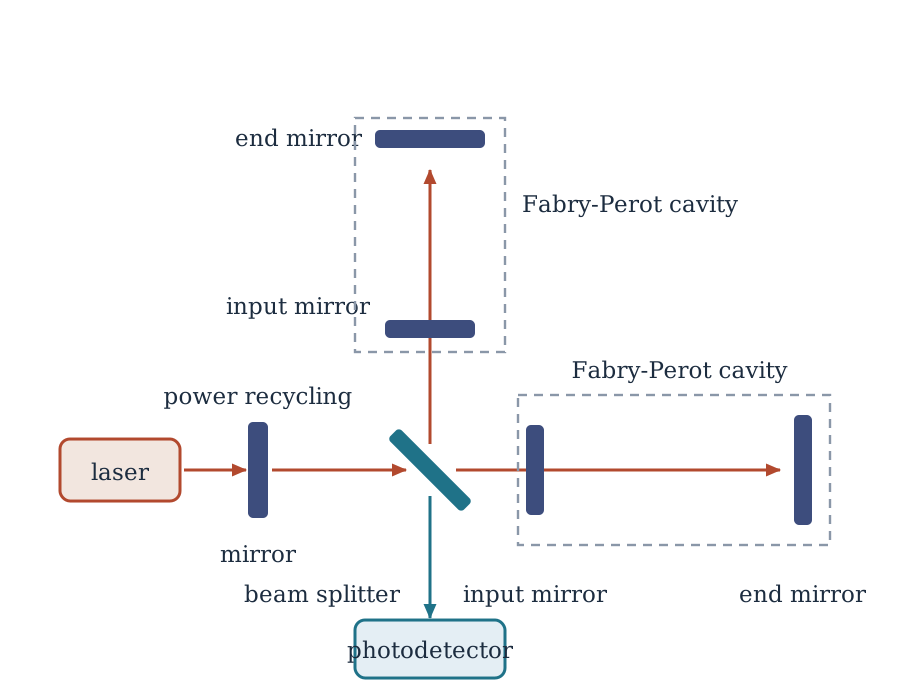
An interferometer is an optical tool used in detecting gravitational waves. It is a very sensitive detection device that uses the interference of laser beams.

LASER

The word stands for Light Amplification by Stimulated Emission of Radiation.

What It Measures

An interferometer that detects gravitational waves is a highly sensitive instrument that uses laser light to measure tiny changes in the distance between mirrors, caused by gravitational waves passing through the detector.

LIGO

These interferometers are called LIGO, the Laser Interferometer Gravitational-wave Observatory.

Diagram

Basic LIGO interferometer

Difference From a Conventional Interferometer

LIGO is about 1000 times larger than a conventional device.
LIGO uses a laser, whereas a conventional interferometer has a normal light source.

Basic Components

Laser

It produces a stable and high intensity beam of light.

Power Recycling Mirror

It continually reflects the laser light that has already travelled through the instrument back into the interferometer, which is why the term recycling is used.

Beam Splitter

It divides the laser beam into two perpendicular beams.

Mirrors

They reflect the beams, creating two perpendicular arms.

Fabry-Perot Cavity

It consists of two mirrors facing each other. The purpose of the cavity is to enhance the path length.

Photodetectors

They measure the returning beams, detecting tiny phase shifts if any.

Arm Cavities

They enhance the laser light, increasing the sensitivity.

Working

A laser beam is split into two perpendicular beams, each travelling down two identical arms of the interferometer.
The beams bounce off the mirrors at the ends of each arm and return to the starting point, where they are recombined.
If a gravitational wave passes through, it causes a tiny disturbance in the distances between the mirrors, resulting in a phase shift between the two beams.
When the beams recombine they create an interference pattern, which is measured by a photodetector.
The tiny phase shift caused by the gravitational wave alters the interference pattern, allowing the detector to sense the wave’s presence.

The First Detection

On 14 September 2015 the universe’s gravitational waves were observed for the very first time by LIGO. They came from a collision between two black holes and took 1.3 billion years to arrive at the LIGO detector in the USA.

Nobel Prize

For their work on the observation of gravitational waves, Rainer Weiss, Barry C. Barish and Kip S. Thorne received the Nobel Prize in 2017. One of the team members, Nergis Mavalvala, a professor at MIT, belongs to Pakistan.

Virgo

Virgo is another facility for measuring gravitational waves, working under the European Gravitational Observatory at Cascina near Pisa in Italy.

Comparison

Virgo is also an interferometer, with two arms of 3 km, whereas LIGO has 4 km arms. Virgo has been involved in detecting gravitational wave events, with its first detection in 2017.

The Name

The Virgo Observatory is named after the Virgo constellation, which is visible in the night sky during March, April and May. The Virgo cluster is a group of about 1500 galaxies about 50 million light years away.

Light Year

One light year is the distance which light travels in one year.
$$1\,\mathrm{LY}=9.5\times10^{12}\,\mathrm{km}$$
LQ 7ends here

Book Examples

Example 8.7.1

If the gravitational waves have a wavelength of 4000 km, find their frequency.

Given Data

$$\lambda=4000\,\mathrm{km}=4\times10^{6}\,\mathrm{m}$$
$$c=3\times10^{8}\,\mathrm{m\,s^{-1}}$$

To Find

Frequency $f=?$

Formula

Gravitational waves travel with the speed of light.
$$v=f\lambda$$
$$f=\frac{c}{\lambda}$$

Solution

Putting the values
$$\begin{aligned}f&=\frac{3\times10^{8}}{4\times10^{6}} \\ &=0.75\times10^{2}\,\mathrm{s^{-1}}\end{aligned}$$

Result

$$f=75\,\mathrm{Hz}$$
Example 8.7.2

A binary system emits gravitational waves with a frequency of $10^{4}$ Hz. What is the wavelength of these waves?

Given Data

$$f=10^{4}\,\mathrm{Hz}=10^{4}\,\mathrm{s^{-1}}$$
$$c=3\times10^{8}\,\mathrm{m\,s^{-1}}$$

To Find

Wavelength $\lambda=?$

Formula

$$v=f\lambda$$
$$\lambda=\frac{c}{f}$$

Solution

Putting the values
$$\lambda=\frac{3\times10^{8}}{10^{4}}=3\times10^{4}\,\mathrm{m}$$

Result

$$\lambda=3\times10^{4}\,\mathrm{m}$$

Short Questions

SQ 8.7.1

What does an interferometer actually measure when a gravitational wave passes?

Measurement

It measures a tiny change in the distance between its mirrors, which appears as a phase shift between the two recombined laser beams.
SQ 8.7.2

Why is the beam splitter essential to the interferometer?

Reason

It divides the laser beam into two perpendicular beams, so that a wave which stretches one arm and compresses the other produces a difference the recombined beams can show.
SQ 8.7.3

What is the purpose of the power recycling mirror?

Purpose

It continually reflects the laser light that has already travelled through the instrument back into the interferometer, which is why the term recycling is used.
SQ 8.7.4

What does the Fabry-Perot cavity do, and what is it made of?

Made Of

Two mirrors facing each other in each arm.

Purpose

To enhance the path length travelled by the light, which raises the sensitivity of the detector.
SQ 8.7.5

State two differences between LIGO and a conventional interferometer.

Size

LIGO is about 1000 times larger.

Source

LIGO uses a laser, while a conventional interferometer uses a normal light source.
SQ 8.7.6

Compare LIGO and Virgo.

LIGOVirgo
It is situated in the USA.It is at Cascina near Pisa in Italy.
Each arm is 4 km long.Each arm is 3 km long.
Its first detection was in 2015.Its first detection was in 2017.
MCQ 8.7.1

The interferometer detects a gravitational wave as a:

Achange in the colour of the laserBchange in the laser power
Crise in temperatureDphase shift between the two recombined beams
Solution:The phase shift alters the interference pattern read by the photodetector.
MCQ 8.7.2

The component that divides the laser beam into two perpendicular beams is the:

Abeam splitterBpower recycling mirror
CphotodetectorDFabry-Perot cavity
Solution:The two beams then travel down the two arms.
MCQ 8.7.3

The Fabry-Perot cavity is used to enhance the:

Alaser powerBwavelength
Cbeam widthDpath length
Solution:It is made of two mirrors facing each other in each arm.
MCQ 8.7.4

The arms of LIGO are:

A3 km longB400 m long
C40 km longD4 km long
Solution:Virgo, the European detector, has 3 km arms.
MCQ 8.7.5

The first direct observation of gravitational waves was made on:

A14 September 2016B1 January 2017
C16 November 1916D14 September 2015
Solution:The result was announced in 2016 and came from two colliding black holes.
MCQ 8.7.6

The Nobel Prize for the observation of gravitational waves was awarded in:

A2015B2016
C2019D2017
Solution:Rainer Weiss, Barry C. Barish and Kip S. Thorne shared it.
MCQ 8.7.7

The Virgo observatory is situated in:

AItalyBthe USA
CGermanyDJapan
Solution:It works under the European Gravitational Observatory at Cascina near Pisa.
MCQ 8.7.8

One light year is approximately:

A$9.5\times10^{12}$ kmB$9.5\times10^{8}$ km
C$3\times10^{8}$ kmD$1.5\times10^{8}$ km
Solution:It is the distance light travels in one year.

Chapter Exercise

SQ 8.1

Why are the polaroid sunglasses better than the ordinary sunglasses?

Ordinary Sunglasses

They only reduce the total amount of light entering the eye.

Polaroid Sunglasses

They pass vibrations of one plane only, so they cut the glare that interferes with vision.

Reason

Light reflected from water and roads is partially polarized, and the polaroid blocks these vibrations.
SQ 8.2

Is light from the sky partially polarized? How is it so?

Yes

Light coming from the sky is partially polarized.

Reason

Sunlight is scattered by the small molecules of the atmosphere, and scattering is one of the natural ways of polarizing light.

Proof

A polaroid rotated in front of the sky changes its brightness.
SQ 8.3

How is Malus’s law used in everyday life?

Malus’s Law

$$I=I_o\cos^2\theta$$

Sunglasses and Cameras

Rotating the polaroid changes $\theta$, so the intensity passed is controlled and glare is cut.

LCD Screens

A liquid crystal between two polaroids sets the brightness of a pixel.

Biology

It studies the polarization of light by cell membranes.
SQ 8.4

What are the applications of Brewster’s angle?

Brewster’s Law

$$\tan\theta_p=n$$

Applications

It gives the refractive index of a medium from the polarizing angle.
It produces plane polarized light by reflection from glass or water.
Polaroid sunglasses and camera filters use it to cut reflected glare.
SQ 8.5

What is the space-time curvature?

Space-Time Curvature

According to Einstein’s general theory of relativity, gravity is not a force but a curvature of space-time caused by massive bodies.

Explanation

A heavy body warps the space around it, like a dent in a mattress, and that is why we feel gravity.
CRQ 8.1

Write down some applications of plane polarized light.

Optics

Polaroid sunglasses, LCD screens and optical communication.

Imaging

It reduces glare and improves contrast in medical imaging.

Medical

Cancer diagnosis, tissue imaging and laser surgery.

Astronomy

Study of light from distant stars.

Materials

Stress analysis of plastics, metals and glass.
CRQ 8.2

Would it be possible to use a polarizer as an analyzer? If yes, give at least two examples.

Yes

An analyzer is also a polarizer, only placed after the first one, so any polaroid can serve either purpose.

Example 1

In the two-polaroid experiment the second sheet analyzes the light passed by the first.

Example 2

A rotated polaroid shows that light reflected from water is partially polarized.
CRQ 8.3

Explain how Malus’s law is used in the design of polarized sunglasses. How do these surfaces reduce glare from reflective surface? Provide an example to illustrate your answer.

Malus’s Law

$$I=I_o\cos^2\theta$$

Design

The axis of the lens is kept vertical, so horizontal vibrations meet it at right angles and their intensity falls to zero.

Glare

Light reflected from a road or water is polarized mostly in the horizontal plane, so it is cut off.

Example

A driver then sees no dazzling glare from a wet road.
CRQ 8.4

How will the sky appear if there had been no atmosphere?

Dark Sky

With no air there would be no molecules to scatter sunlight, so the sky would look black even in the daytime.

Stars

Stars and planets would stay visible during the day.

No Polarization

The sky light would not be polarized, so a rotated polaroid would show no change.
CRQ 8.5

What is the significance of detecting gravitational waves?

Confirmation

It confirmed the waves predicted by Einstein in 1916 and tests general relativity.

New Window

The waves carry information about the mass, spin and merger of their source, opening a new window on colliding black holes.

First Detection

LIGO detected them on 14 September 2015.
CRQ 8.6

How are tidal forces formed?

Formation

When a gravitational wave passes through a body, the space-time around it oscillates.

Effect

The body is stretched and compressed periodically at right angles to the travel of the wave. This distortion is called a tidal force.

Comparison

It is like the tides caused by the pull of the Moon and the Sun.
MCQ 8.1

The phenomenon of polarization of light is:

Athe process of scattering of lightBthe property of light to vibrate in a specific plane
Cthe ability of light to travel in a straight lineDthe phenomenon of light changing colour
Solution:Correct answer: (b) the property of light to vibrate in a specific plane.
MCQ 8.2

Malus’s law states that:

Athe intensity of light is directly proportional to the square of the cosine of the angle between the light wave and the analyzerBthe intensity of light is directly proportional to the square of the sine of the angle between the light wave and the analyzer
Cthe intensity of light is directly proportional to the angle between the light wave and the analyzerDthe intensity of light is inversely proportional to the angle between the light wave and the analyzer
Solution:Correct answer: (a) the intensity of light is directly proportional to the square of the cosine of the angle between the light wave and the analyzer.
MCQ 8.3

The intensity of light when it passes through a polarizer:

AincreasesBdecreases
Cremains the sameDbecomes zero
Solution:Correct answer: (b) decreases.
MCQ 8.4

The angle between the light wave and the analyzer is called:

Apolarization angleBrefraction angle
Creflection angleDazimuth angle
Solution:Correct answer: (a) polarization angle.
MCQ 8.5

The key purpose of an analyzer in a polarization experiment is:

Ato polarize the lightBto measure the intensity of light
Cto change the direction of lightDto filter out unwanted light
Solution:Correct answer: (b) to measure the intensity of light.
MCQ 8.6

The mathematical representation of Malus’s law is:

A$I=I_o\cos^2\theta$B$I=I_o\sin^2\theta$
C$I=I_o\tan^2\theta$D$I=I_o\cot^2\theta$
Solution:Correct answer: (a) $I=I_o\cos^2\theta$.
MCQ 8.7

The effect of increasing the angle between the light wave and the analyzer on the intensity of light is:

Athe intensity increasesBthe intensity decreases
Cthe intensity remains the sameDthe intensity becomes zero
Solution:Correct answer: (b) the intensity decreases.
MCQ 8.8

The condition for maximum intensity of light in a polarization experiment is when:

Athe light wave and analyzer are perpendicularBthe light wave and analyzer are parallel
Cthe light wave and analyzer are at an angle of $45^{\circ}$Dthe light wave and analyzer are at an angle of $60^{\circ}$
Solution:Correct answer: (b) the light wave and analyzer are parallel.
MCQ 8.9

The unwanted light that interferes with vision is termed as:

AhazeBglare
CcontrastDflare
Solution:Correct answer: (b) glare.
MCQ 8.10

Who predicted the existence of gravitational waves?

AGalileo GalileiBAlbert Einstein
CIsaac NewtonDLeonardo da Vinci
Solution:Correct answer: (b) Albert Einstein.
MCQ 8.11

What are gravitational waves?

AElectromagnetic wavesBMechanical waves
COcean wavesDRipples in the fabric of spacetime
Solution:Correct answer: (d) Ripples in the fabric of spacetime.
MCQ 8.12

Which is the primary method used to detect gravitational waves?

AOptical telescopesBRadio telescopes
CLASER interferometryDGravitational lensing
Solution:Correct answer: (c) LASER interferometry.
MCQ 8.13

Which of the following is a primary source of gravitational waves?

ABinary black hole mergerBSolar flares
CEarthquakeDSolar wind
Solution:Correct answer: (a) Binary black hole merger.
Numerical 8.1

When an unpolarized light of intensity $I_o$ is incident on a polarizing sheet, find the intensity of light which does not get transmitted. (Ans: $I_o/2$)

Given Data

Unpolarized light of intensity $I_o$ falls on one polarizing sheet.

To Find

The intensity that is not transmitted

Formula

Unpolarized light has its vibrations equally in all planes, so a polarizer passes half of it.
$$I=\frac{I_o}{2}$$

Solution

The intensity blocked is the incident intensity less the transmitted intensity.
$$I_o-\frac{I_o}{2}=\frac{I_o}{2}$$

Result

$$\frac{I_o}{2}$$
Numerical 8.2

A polarized light beam passes through a polarizer at an angle of $45^{\circ}$. Find the intensity of the transmitted light if the initial intensity is 100 W m$^{-2}$. (Ans: 50 W m$^{-2}$)

Given Data

$$I_o=100\,\mathrm{W\,m^{-2}}$$
$$\theta=45^{\circ}$$

To Find

Transmitted intensity $I=?$

Formula

$$I=I_o\cos^2\theta$$

Solution

Putting the values in Malus’s law
$$I=100\times(\cos45^{\circ})^2=100\times(0.707)^2$$
$$I=100\times0.5=50\,\mathrm{W\,m^{-2}}$$

Result

$$I=50\,\mathrm{W\,m^{-2}}$$
Numerical 8.3

A light wave passes through a polarizer with its electric field aligned at $30^{\circ}$ to the horizontal. If the amplitude of the wave is 10 units, what is the amplitude of the wave passing through the polarizer? (Ans: 8.66 units)

Given Data

$$A_o=10\ \text{units}$$
$$\theta=30^{\circ}$$

To Find

Transmitted amplitude $A=?$

Formula

Only the component along the transmission axis passes.
$$A=A_o\cos\theta$$

Solution

Putting the values
$$A=10\times\cos30^{\circ}=10\times0.866=8.66\ \text{units}$$

Result

$$A=8.66\ \text{units}$$
Numerical 8.4

What angle is required between the direction of polarized light and the axis of a polaroid filter to reduce its intensity by 85%? (Ans: $67.5^{\circ}$)

Given Data

The intensity is reduced by 85%, so the fraction transmitted is
$$\frac{I}{I_o}=0.15$$

To Find

The angle $\theta=?$

Formula

$$I=I_o\cos^2\theta$$
$$\cos\theta=\sqrt{\frac{I}{I_o}}$$

Solution

Taking the square root of the transmitted fraction
$$\cos\theta=\sqrt{0.15}=0.387$$
$$\theta=\cos^{-1}(0.387)=67.2^{\circ}$$

Result

$$\theta=67.2^{\circ}$$

Note

The book rounds this angle to $67.5^{\circ}$.
Numerical 8.5

An unpolarized light having intensity of 15 W m$^{-2}$ is incident on a pair of polarizers. The first polaroid filter has its transmission axis at $50^{\circ}$ from the vertical. The second polaroid filter has its transmission axis at $20^{\circ}$ from the vertical. Calculate the intensity of light transmitted through both filters. (Ans: 7.5 W m$^{-2}$, 5.6 W m$^{-2}$ respectively)

Given Data

$$I_o=15\,\mathrm{W\,m^{-2}}$$
$$\theta_1=50^{\circ}$$
$$\theta_2=20^{\circ}$$

To Find

The intensities $I_1=?$ and $I_2=?$

Formula

A polarizer passes half of an unpolarized beam.
$$I_1=\frac{I_o}{2}$$
The second filter then follows Malus’s law.
$$I_2=I_1\cos^2\theta$$

Solution

After the first filter
$$I_1=\frac{15}{2}=7.5\,\mathrm{W\,m^{-2}}$$
The angle between the two transmission axes is
$$\theta=50^{\circ}-20^{\circ}=30^{\circ}$$
After the second filter
$$I_2=7.5\times(\cos30^{\circ})^2=7.5\times0.75=5.6\,\mathrm{W\,m^{-2}}$$

Result

$$I_1=7.5\,\mathrm{W\,m^{-2}}$$
$$I_2=5.6\,\mathrm{W\,m^{-2}}$$
Numerical 8.6

Two polarizing sheets have their polarizing directions parallel so that the intensity of the emitted light is maximum. Through what angle must either sheet be rotated if the intensity is to be dropped by half? (Ans: $45^{\circ}$)

Given Data

The axes start parallel, and the intensity is to fall to half.
$$\frac{I}{I_o}=\frac{1}{2}$$

To Find

The angle of rotation $\theta=?$

Formula

$$I=I_o\cos^2\theta$$

Solution

Putting the required fraction
$$\cos^2\theta=0.5$$
$$\cos\theta=0.707$$
$$\theta=\cos^{-1}(0.707)=45^{\circ}$$

Result

$$\theta=45^{\circ}$$
Numerical 8.7

We wish to use a glass plate of refractive index 1.5 in air as a polarizer. Find the polarizing angle and the angle of refraction. (Ans: $56.3^{\circ}$, $33.7^{\circ}$ respectively)

Given Data

$$n=1.5$$

To Find

The angles $\theta_p=?$ and $\theta_r=?$

Formula

$$\tan\theta_p=n$$
$$\theta_r=90^{\circ}-\theta_p$$

Solution

From Brewster’s law
$$\theta_p=\tan^{-1}(1.5)=56.3^{\circ}$$
The reflected and the refracted rays are at right angles, so
$$\theta_r=90^{\circ}-56.3^{\circ}=33.7^{\circ}$$

Result

$$\theta_p=56.3^{\circ}$$
$$\theta_r=33.7^{\circ}$$
Numerical 8.8

At what angle of incidence will light reflected from water be completely polarized? (Ans: $53^{\circ}$)

Given Data

The refractive index of water is
$$n=1.33$$

To Find

The polarizing angle $\theta_p=?$

Formula

$$\tan\theta_p=n$$

Solution

Putting the refractive index of water
$$\theta_p=\tan^{-1}(1.33)=53^{\circ}$$

Result

$$\theta_p=53^{\circ}$$
Numerical 8.9

A beam of unpolarized light is incident on a stack of four polarizing sheets that are lined up so that the characteristic direction of each is rotated by $30^{\circ}$ clockwise with respect to the preceding sheet. What fraction in percentage of the incident intensity will be transmitted? (Ans: 21%)

Given Data

Four sheets, each turned through the same angle from the one before it.
$$\theta=30^{\circ}$$

To Find

The fraction transmitted

Formula

The first sheet halves the unpolarized beam, and each of the other three applies Malus’s law.
$$I=\frac{I_o}{2}(\cos^2\theta)^3$$

Solution

The square of the cosine of the angle is
$$\cos^2 30^{\circ}=(0.866)^2=0.75$$
For the three sheets that follow the first
$$(0.75)^3=0.4219$$
So the transmitted fraction is
$$\frac{I}{I_o}=0.5\times0.4219=0.21$$

Result

$$\frac{I}{I_o}=21\%$$
Numerical 8.10

A polarizer and an analyzer have their axes aligned at $60^{\circ}$. What is the fraction of the initial intensity that emerges? (Ans: 0.25)

Given Data

$$\theta=60^{\circ}$$

To Find

The fraction $I/I_o=?$

Formula

$$I=I_o\cos^2\theta$$

Solution

Dividing both sides by the incident intensity
$$\frac{I}{I_o}=(\cos60^{\circ})^2=(0.5)^2=0.25$$

Result

$$\frac{I}{I_o}=0.25$$
Numerical 8.11

If the gravitational waves have a wavelength of 3000 km, then find their frequency, assuming they move with the speed of light. (Ans: 100 Hz)

Given Data

$$\lambda=3000\,\mathrm{km}=3\times10^{6}\,\mathrm{m}$$
$$c=3\times10^{8}\,\mathrm{m\,s^{-1}}$$

To Find

Frequency $f=?$

Formula

$$v=f\lambda$$
$$f=\frac{c}{\lambda}$$

Solution

Putting the values
$$f=\frac{3\times10^{8}}{3\times10^{6}}=100\,\mathrm{Hz}$$

Result

$$f=100\,\mathrm{Hz}$$

Self Test

Seventeen questions across the whole chapter. Work through them without the notes, then check the answers keyed at the foot of the page.

Q 1

A wave that cannot be polarized is:

Aa light waveBa radio wave
Ca sound wave in airDan X-ray
Q 2

The plane of polarization contains the direction of propagation and the:

Adirection of vibrationBnormal to the ray
Caxis of the analyzerDmagnetic field only
Q 3

Ordinary light from an incandescent bulb is unpolarized because its vibrations are:

Aconfined to one planeBrandomly oriented in space
Calong the rayDof a single frequency
Q 4

Light reflected off a DVD is an example of:

Alinear polarizationBelliptical polarization
Cno polarizationDcircular polarization
Q 5

With two polaroids the light disappears when their axes are:

AparallelBat $30^{\circ}$
Cmutually perpendicularDat $45^{\circ}$
Q 6

The disappearance of light at crossed polaroids proves that light waves are:

AtransverseBlongitudinal
CstationaryDmechanical
Q 7

Brewster’s law for light incident from air on a medium of refractive index $n$ is:

A$\sin\theta_p=n$B$\tan\theta_p=n$
C$\cos\theta_p=n$D$\theta_p=n$
Q 8

At the polarizing angle the reflected and refracted rays are separated by:

A$45^{\circ}$B$57^{\circ}$
C$180^{\circ}$D$90^{\circ}$
Q 9

A medium has a polarizing angle of $45^{\circ}$. Its refractive index is:

A1.00B1.33
C1.50D1.73
Q 10

Plane polarized light of intensity $I_o$ meets an analyzer at $60^{\circ}$. The intensity that emerges is:

A$0.75I_o$B$0.50I_o$
C$0.25I_o$D$0.87I_o$
Q 11

Unpolarized light of intensity $I_o$ passes a single polaroid. The transmitted intensity is:

A$I_o$B$I_o/2$
C$I_o/4$Dzero
Q 12

The component of the amplitude absorbed by the analyzer is:

A$A_o\cos\theta$B$A_o\tan\theta$
C$A_o\sin\theta$D$A_o$
Q 13

A sugar solution turns the plane of polarization. Such a substance is called:

Aoptically denseBoptically active
CbirefringentDanisotropic
Q 14

Gravitational waves are:

Aelectromagnetic wavesBocean waves
Cripples in the fabric of space-timeDlongitudinal sound waves
Q 15

Gravitational waves produced by the steady spin of a single neutron star are:

AcontinuousBburst
CstochasticDcompact binary inspiral
Q 16

The component of a LIGO interferometer that divides the laser beam into two perpendicular beams is the:

Apower recycling mirrorBphotodetector
Carm cavityDbeam splitter
Q 17

The arms of the Virgo detector are each:

A4 km longB3 km long
C1 km longD400 m long

Answers 1 (c)2 (a)3 (b)4 (d)5 (c)6 (a)7 (b)8 (d)9 (a)10 (c)11 (b)12 (c)13 (b)14 (c)15 (a)16 (d)17 (b)