XI-Physics CH-9

Electrostatics and Current Electricity

Topic 9.1

Coulomb’s Law

Electric Charge

Charge on an Electron

The charge on a proton is $+e$ and that on an electron is $-e$
$$e=1.6\times10^{-19}\,\mathrm{C}$$

Smallest Free Charge

This is the smallest amount of free charge that has been discovered. Charges of larger magnitude are built up on an object by adding or removing electrons.

Quantization of Charge

Any amount of charge $q$ is an integer multiple of the electronic charge.
$$q=Ne$$
Here $N$ is an integer.

Electrostatics

Electrostatics is the study of the phenomena and the properties of electric charges at rest. When charges are in motion we call it an electric current.

Coulomb’s Law

Coulomb’s law is a fundamental principle in electrostatics that quantifies the force between two charged objects.

Statement

The force between two point charges is directly proportional to the product of the magnitudes of the charges and inversely proportional to the square of the distance between them.

Pioneer

Charles de Coulomb, a French physicist, made the first measurement of the force between electric charges in 1784.

Mathematically

$$F\propto q_1q_2$$
$$F\propto\frac{1}{r^2}$$
$$F\propto\frac{q_1q_2}{r^2}$$
$$F=k\frac{q_1q_2}{r^2}$$

Symbols

$F$ is the magnitude of the mutual force that acts on each of the two point charges.
$q_1$ and $q_2$ are the magnitudes of the two point charges.
$r$ is the distance between the two charges.
$k$ is the constant of proportionality.
The force always acts along the line joining the two point charges.

Constant k

The value of $k$ depends upon the nature of the medium between the two charges and the system of units in which $F,\,q$ and $r$ are measured.

For Free Space

$$k=\frac{1}{4\pi\varepsilon_o}$$
Here $\varepsilon_o$ is an electrical constant known as the permittivity of free space.
$$\varepsilon_o=8.85\times10^{-12}\,\mathrm{C^2\,N^{-1}\,m^{-2}}$$
$$k=\frac{1}{4\pi\times8.85\times10^{-12}}=9\times10^{9}\,\mathrm{N\,m^2\,C^{-2}}$$

Coulomb’s Force in Free Space

$$F=\frac{1}{4\pi\varepsilon_o}\frac{q_1q_2}{r^2}$$

Mutual Force

Coulomb’s force is a mutual force: if $q_1$ exerts a force on $q_2$, then $q_2$ also exerts an equal and opposite force on $q_1$. The force on $q_2$ due to $q_1$ acts along the unit vector $\hat{r}_{21}$ directed from $q_1$ to $q_2$
$$\mathbf{F}_{21}=\frac{1}{4\pi\varepsilon_o}\frac{q_1q_2}{r^2}\hat{r}_{21}$$
The unit vector $\hat{r}_{12}$ directed from $q_2$ to $q_1$ is opposite to it.
$$\hat{r}_{21}=-\hat{r}_{12}$$
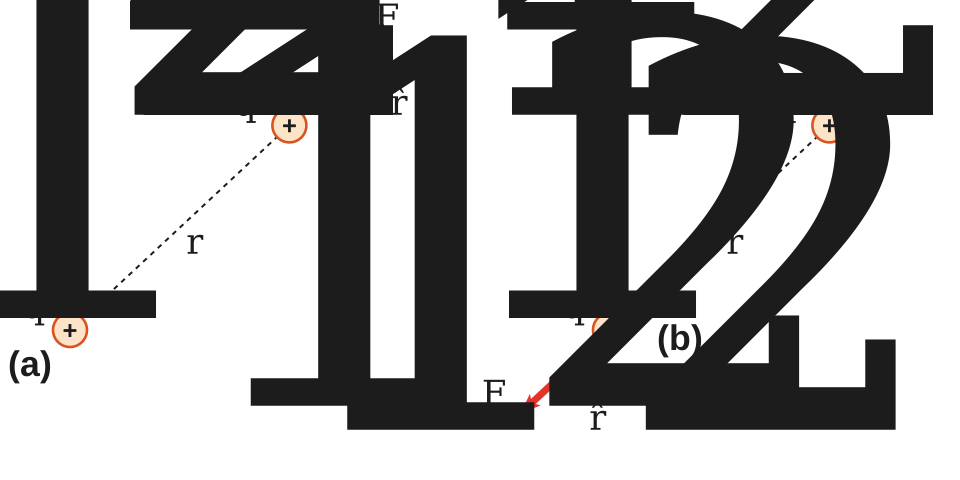
The mutual Coulomb forces and the unit vectors along the line of centres
Substituting in the force on $q_2$
$$\mathbf{F}_{21}=-\left(\frac{1}{4\pi\varepsilon_o}\frac{q_1q_2}{r^2}\hat{r}_{12}\right)$$
The bracket is the force $\mathbf{F}_{12}$ on $q_1$ due to $q_2$, so equating the two
$$\mathbf{F}_{21}=-\mathbf{F}_{12}$$

Signs

The sign of the charges determines whether the forces are attractive or repulsive.
Like charges: the product $q_1q_2$ is positive and the forces are repulsive.
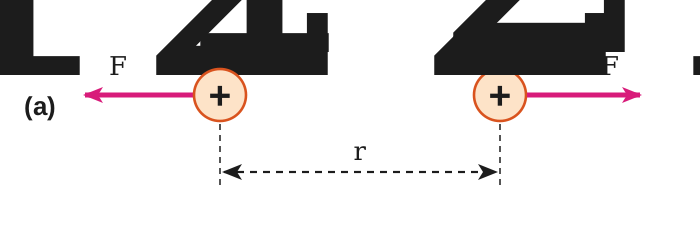
Repulsive forces between like charges
Unlike charges: the product $q_1q_2$ is negative and the forces are attractive.
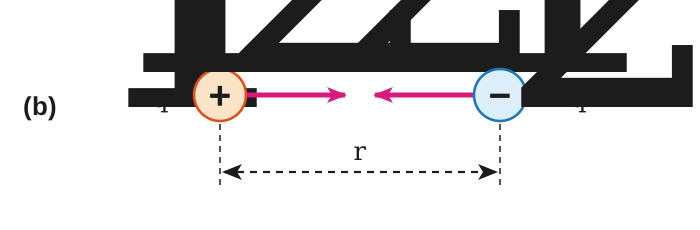
Attractive forces between unlike charges

Effect of Medium

If the medium between the charges is an insulator, it is usually referred to as a dielectric. The presence of a dielectric always reduces the electrostatic force as compared with that in free space, by a certain factor which is a constant for the given dielectric.

Relative Permittivity

This constant is known as the relative permittivity and is represented by $\varepsilon_r$. For air it is very nearly unity.
$$\varepsilon_r=1.0006$$
This value is so close to one that with negligible error the free-space equation gives the electric force in air.

Force in Medium

$$F=\frac{1}{4\pi\varepsilon_o\varepsilon_r}\frac{q_1q_2}{r^2}$$

Vector Form

With $\hat{r}$ the unit vector along the line joining the two charges, Coulomb’s law in vector form is
$$\mathbf{F}=\frac{1}{4\pi\varepsilon_o\varepsilon_r}\frac{q_1q_2}{r^2}\hat{r}$$
In free space $\varepsilon_r$ is one.

Book Examples

Example 9.1.1

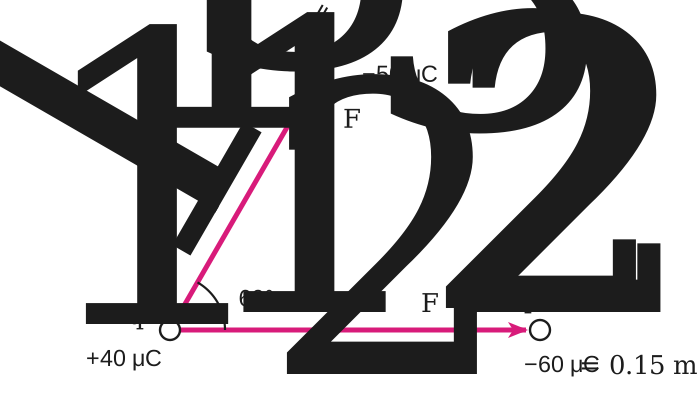
Three point charges $q_1=+40\ \mu$C, $q_2=-60\ \mu$C and $q_3=-50\ \mu$C are lying in the same plane. The charge $q_2$ is 0.15 m from $q_1$ along the base, and $q_3$ is 0.12 m from $q_1$ at $60^{\circ}$ to the base. Find the magnitude and direction of the net force acting on $q_1$.

Given Data

$$q_1=40\times10^{-6}\,\mathrm{C}$$
$$q_2=60\times10^{-6}\,\mathrm{C}$$
$$q_3=50\times10^{-6}\,\mathrm{C}$$
$$r_2=0.15\,\mathrm{m}$$
$$r_1=0.12\,\mathrm{m}$$

Diagram

Three point charges lying in the same plane

To Find

The net force $F=?$ on $q_1$ and its direction

Formula

$$F=k\frac{q_1q_2}{r^2}$$

Solution

The force on $q_1$ exerted by $q_2$ is attractive and acts along the base.
$$\begin{aligned}F_{12}&=\frac{(9\times10^{9})(40\times10^{-6})(60\times10^{-6})}{(0.15)^2} \\ &=960\,\mathrm{N}\end{aligned}$$
The force on $q_1$ exerted by $q_3$ is also attractive and acts along the slant.
$$\begin{aligned}F_{13}&=\frac{(9\times10^{9})(40\times10^{-6})(50\times10^{-6})}{(0.12)^2} \\ &=1250\,\mathrm{N}\end{aligned}$$
Resolving the slant force into its rectangular components
$$F_{13x}=1250\times\cos60^{\circ}=1250\times0.5=625\,\mathrm{N}$$
$$F_{13y}=1250\times\sin60^{\circ}=1250\times0.866=1075\,\mathrm{N}$$
The x-component of the resultant is
$$F_x=960+625=1585\,\mathrm{N}$$
The y-component of the resultant is
$$F_y=1075\,\mathrm{N}$$
The magnitude of the resultant is
$$F=\sqrt{(1585)^2+(1075)^2}=1915\,\mathrm{N}$$
For the direction
$$\tan\theta=\frac{1075}{1585}=0.678$$
$$\theta=34^{\circ}$$

Result

$$F=1915\,\mathrm{N}$$
$$\theta=34^{\circ}\ \text{with the line joining } q_1 \text{ and } q_2$$

Note

The book prints the magnitude as 1975 N; the two components above give 1915 N.

Short Questions

SQ 9.1.1

Why is any observed charge always an integral multiple of the electronic charge?

Quantization

The electronic charge is the smallest free charge that exists, and a body is charged only by adding or removing whole electrons.

Relation

$$q=Ne$$
Here $N$ is an integer.
SQ 9.1.2

How does a dielectric between two charges change the Coulomb force?

It Reduces It

A dielectric always reduces the force compared with free space, by a constant factor for the given dielectric.

Relative Permittivity

$$F=\frac{1}{4\pi\varepsilon_o\varepsilon_r}\frac{q_1q_2}{r^2}$$
SQ 9.1.3

Why is the free-space form of Coulomb’s law used for charges in air?

Reason

The relative permittivity of air is very nearly one.
$$\varepsilon_r=1.0006$$
So the free-space equation gives the force in air with negligible error.
SQ 9.1.4

State how the Coulomb force between two charges changes when the distance between them is trebled.

It Falls to One Ninth

The force follows an inverse square law.
$$Fr^2=\text{constant}$$
$$F\propto\frac{1}{r^2}$$
Trebling the distance divides the force by nine.
SQ 9.1.5

What is meant by saying that Coulomb’s force is a mutual force?

Meaning

If one charge exerts a force on the other, the other exerts an equal and opposite force on the first.
$$\mathbf{F}_{12}=-\mathbf{F}_{21}$$
MCQ 9.1.1

The charge on a body can never be:

A$3.2\times10^{-19}$ CB$2.4\times10^{-19}$ C
C$1.6\times10^{-19}$ CD$4.8\times10^{-19}$ C
Solution:Charge is quantized, so it must be a whole multiple of $1.6\times10^{-19}$ C.
MCQ 9.1.2

The value of the constant in Coulomb’s law in free space is:

A$9\times10^{9}$ N m$^2$ C$^{-2}$B$8.85\times10^{-12}$ N m$^2$ C$^{-2}$
C$6.67\times10^{-11}$ N m$^2$ C$^{-2}$D$1.6\times10^{-19}$ N m$^2$ C$^{-2}$
Solution:It is $1/4\pi\varepsilon_o$ with $\varepsilon_o=8.85\times10^{-12}$.
MCQ 9.1.3

If the distance between two point charges is halved, the force between them becomes:

AhalfBtwice
Cone quarterDfour times
Solution:The force follows an inverse square law.
MCQ 9.1.4

The presence of a dielectric between two charges:

Aincreases the forceBreduces the force
Cleaves the force unchangedDreverses the force
Solution:The force is divided by the relative permittivity of the dielectric.
MCQ 9.1.5

Two charges of $+4\ \mu$C and $-9\ \mu$C are 3 m apart in air. The force between them is:

A0.36 NB3.6 N
C0.036 ND36 N
Solution:$F=9\times10^{9}\times4\times10^{-6}\times9\times10^{-6}/9=0.036$ N.
MCQ 9.1.6

Electrostatics is the study of charges that are:

Aat restBin uniform motion
CacceleratingDoscillating
Solution:Charges in motion constitute an electric current.
Topic 9.2

Electric Field Strength

Electric Field Strength

Definition

The electric intensity of the field, or simply the electric field, at any point is defined as the force experienced by a unit positive charge placed at that point.

Idea of a Field

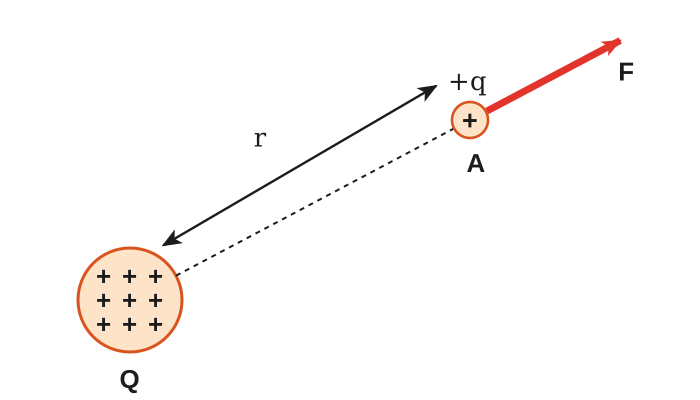
A charge experiences an electrostatic force in the presence of other charges. Consider a positively charged object $Q$. If a small charge $+q$ is placed at a point $A$, it experiences an electrostatic force $F$ due to $Q$, so an electric field is said to exist at $A$.
A test charge at A experiences a force due to the charge Q, so an electric field exists at A

Strength of the Field

Coulomb’s law suggests that the field gets stronger as the point $A$ gets closer to $Q$. The strength of the field at a position is known as its intensity at that point.

Formula

$$E=\frac{F}{q}$$

Vector

Electric intensity is a force per unit charge, so it is a vector quantity. Its direction is the same as that of $F$.

Field of a Point Charge

Putting Coulomb’s force for a point charge $Q$
$$E=\frac{1}{4\pi\varepsilon_o}\frac{qQ}{r^2}\times\frac{1}{q}$$
$$E=\frac{1}{4\pi\varepsilon_o}\frac{Q}{r^2}$$

Force on a Charge

$$F=qE$$

Unit

$$1\,\mathrm{N\,C^{-1}}$$

Electric Field Lines

Definition

Electric field lines are a visual map used to represent the direction and the strength of an electric field around a charged object. As they give information about the electric force, they are commonly called electric lines of force.

Pioneer

Michael Faraday proposed the idea of electric field lines.

Positive Charge

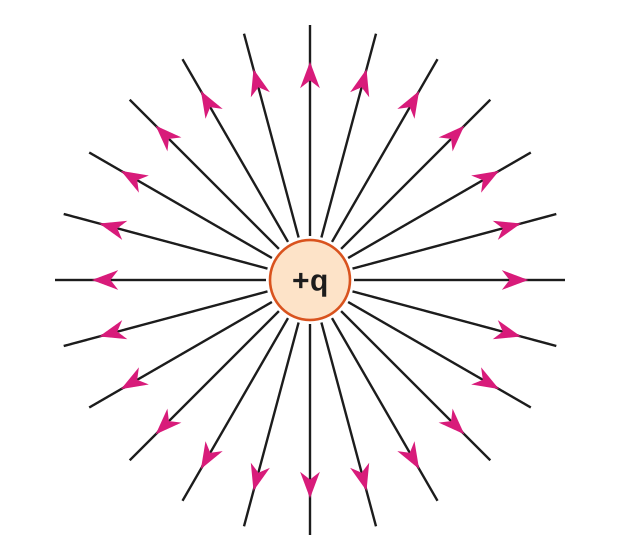
A positive test charge placed near a positive charge experiences a repulsive force, so the field created is directed radially outward.
The electric field lines are directed radially outward from a positive point charge

Negative Charge

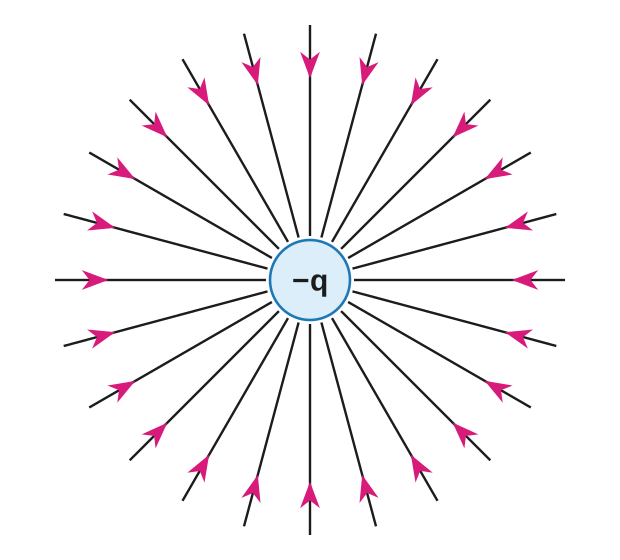
Here the lines are directed radially inward, because the force on a positive test charge is now one of attraction.
The electric field lines are directed radially inward towards a negative point charge

Strength From the Map

The field lines are closer to each other near the charges where the field is strong, and they continuously spread out where the field is weaker. The number of lines per unit area passing perpendicularly through it is proportional to the magnitude of the electric field.

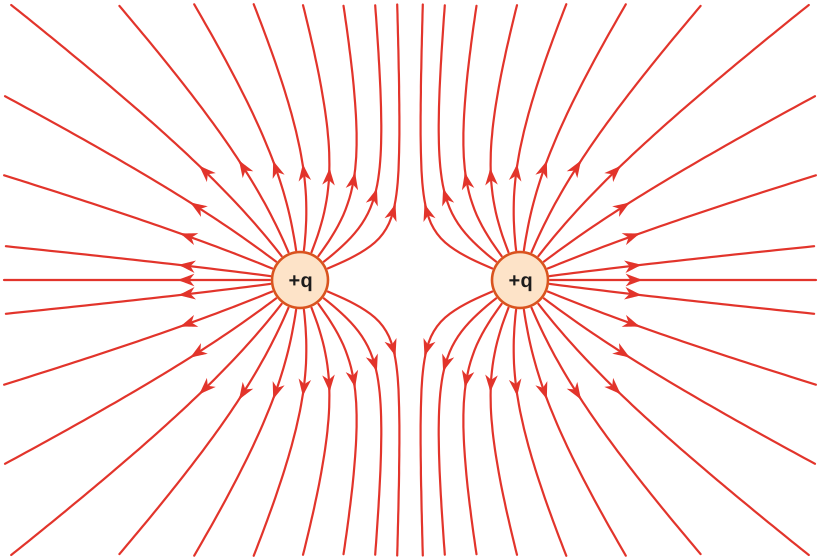
Two Like Charges

The lines in the region between two like charges seem to repel each other, and the middle region shows a zero field spot, called a neutral zone.
The electric field lines of two identical positive point charges

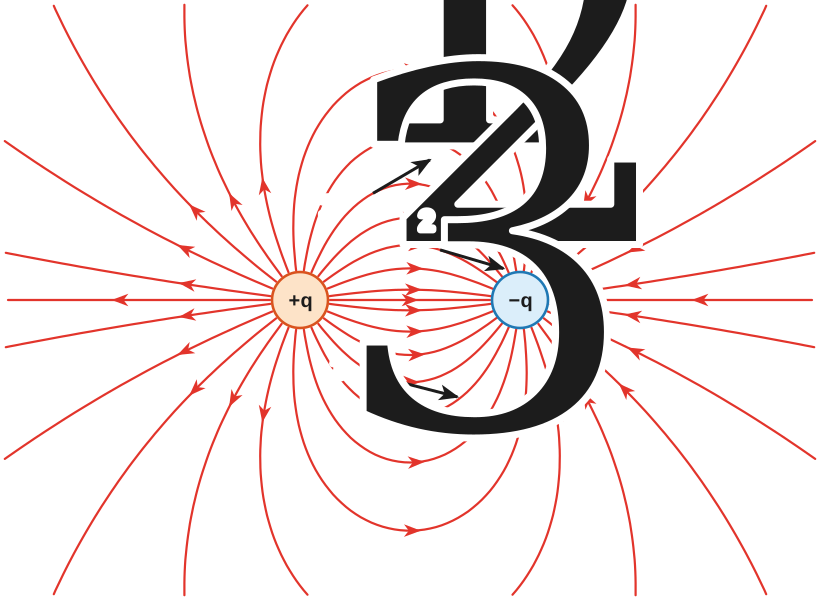
Two Opposite Charges

The field lines start from the positive charge and end on the negative charge. The direction of the resultant intensity at a point is given by the tangent drawn to the field line at that point.
The electric field lines of two equal and opposite point charges

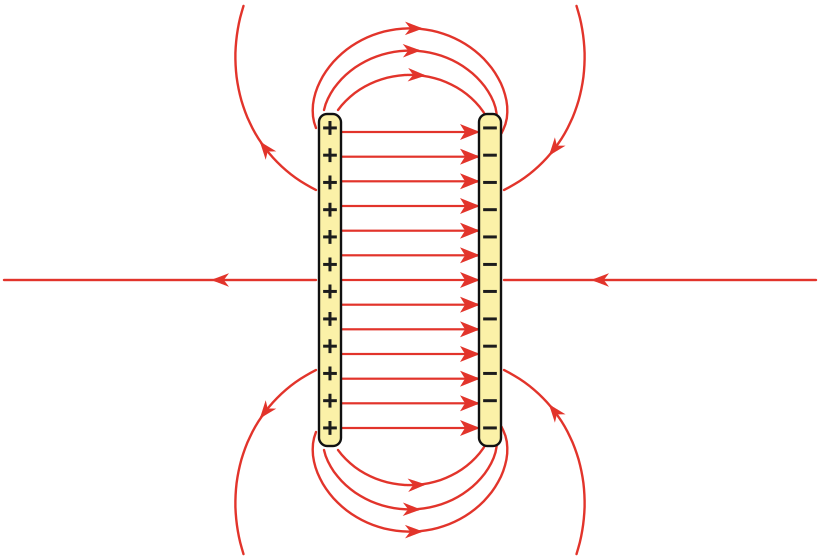
Uniform Field

Where the field lines are parallel and equally spaced, the same number of lines passes per unit area, so the field is uniform at all points. The field between the plates of a parallel plate capacitor is uniform in the middle region.
In the central region of a parallel plate capacitor the field lines are parallel and evenly spaced

Properties

Electric field lines originate from positive charges and end on negative charges.
The tangent to a field line at any point gives the direction of the electric field at that point.
The lines are closer where the field is strong and farther apart where the field is weak.
No two lines cross each other, because $E$ has only one direction at any given point.

Book Examples

Example 9.2.1

Two positive point charges $q_1=16.0\ \mu$C and $q_2=4.0\ \mu$C are separated by a distance of 3.0 m. Find the spot on the line joining the two charges where the electric field is zero.

Given Data

$$q_1=16.0\,\mu\mathrm{C}$$
$$q_2=4.0\,\mu\mathrm{C}$$
$$r=3.0\,\mathrm{m}$$

To Find

The distance $d$ of the zero-field point from $q_2$

Formula

$$E=\frac{1}{4\pi\varepsilon_o}\frac{q}{r^2}$$

Solution

Between the two charges the two fields point in opposite directions, so the resultant is zero where their magnitudes are equal. Let the point $P$ be a distance $d$ from $q_2$
$$E_1=E_2$$
$$\begin{aligned}\frac{1}{4\pi\varepsilon_o}\frac{16.0}{(3.0-d)^2} \\ &=\frac{1}{4\pi\varepsilon_o}\frac{4.0}{d^2}\end{aligned}$$
Cancelling the constant and cross-multiplying
$$16d^2=4(3.0-d)^2$$
$$4d^2=(3.0-d)^2$$
Taking the square root and rearranging
$$d^2+2d-3=0$$
$$d=+1\,\mathrm{m}\ \text{or}\ d=-3\,\mathrm{m}$$
The negative value corresponds to a location off to the right of both charges, where the two fields are equal in magnitude but in the same direction, so they do not cancel there.

Result

$$d=+1.0\,\mathrm{m}\ \text{from } q_2$$
Example 9.2.2

A proton experiences an electrostatic force equal to its weight at a particular point in an electric field. What is the field intensity at that point? (Mass of a proton is $1.67\times10^{-27}$ kg and $e=1.6\times10^{-19}$ C)

Given Data

$$m=1.67\times10^{-27}\,\mathrm{kg}$$
$$q=e=1.6\times10^{-19}\,\mathrm{C}$$
$$g=9.8\,\mathrm{m\,s^{-2}}$$

To Find

Field intensity $E=?$

Formula

The electrostatic force equals the weight, so
$$E=\frac{F}{q}=\frac{mg}{q}$$

Solution

Putting the values
$$\begin{aligned}E&=\frac{1.67\times10^{-27}\times9.8}{1.6\times10^{-19}} \\ &=1.0\times10^{-7}\,\mathrm{N\,C^{-1}}\end{aligned}$$

Result

$$E=1.0\times10^{-7}\,\mathrm{N\,C^{-1}}$$

Short Questions

SQ 9.2.1

What is the direction of the electric field at a point, and how is it read off a field-line map?

Direction

It is the direction of the force on a unit positive charge placed at that point.

From the Map

It is given by the tangent drawn to the field line at that point.
SQ 9.2.2

How does a field-line diagram show where the field is strong?

Spacing

The lines are closer together where the field is strong and farther apart where it is weak.

Rule

The number of lines per unit area passing perpendicularly through it is proportional to the magnitude of the field.
SQ 9.2.3

What is a neutral zone, and where does it appear in a field-line map?

Neutral Zone

A spot where the resultant field is zero.

Where

It appears in the middle region between two like charges, where the two fields are equal and opposite.
SQ 9.2.4

Why must the field lines of a parallel plate capacitor be evenly spaced in the middle region?

Reason

Even spacing means the same number of lines passes per unit area everywhere there, so the field has the same magnitude and direction at every point. That is what makes the field uniform.
SQ 9.2.5

A test charge is used to define electric intensity. Why must it be small?

Reason

A large test charge would disturb the very charge distribution whose field is being measured, so the reading would not be the original field.
MCQ 9.2.1

The unit of electric field intensity is:

AN CBN C$^{-1}$
CJ C$^{-1}$DC N$^{-1}$
Solution:It is a force per unit charge, and it also equals the volt per metre.
MCQ 9.2.2

The electric field at a distance $r$ from a point charge $Q$ is proportional to:

A$r^2$B$1/r^2$
C$1/r$D$r$
Solution:$E=Q/4\pi\varepsilon_o r^2$.
MCQ 9.2.3

Electric field lines never cross because at any point the field has:

Aonly one magnitudeBzero magnitude
Ctwo directionsDonly one direction
Solution:A crossing would give the field two directions at the same point.
MCQ 9.2.4

Electric field lines start on and end on:

Anegative charges and positive chargesBpositive charges only
Cpositive charges and negative chargesDnegative charges only
Solution:This is why the lines between two opposite charges run from + to −.
MCQ 9.2.5

A charge of 5 $\mu$C in a field feels a force of 0.2 N. The field intensity is:

A$4\times10^{4}$ N C$^{-1}$B$4\times10^{-4}$ N C$^{-1}$
C$1\times10^{6}$ N C$^{-1}$D$2.5\times10^{-5}$ N C$^{-1}$
Solution:$E=F/q=0.2/(5\times10^{-6})$.
MCQ 9.2.6

The idea of representing a field by lines of force was proposed by:

ACharles CoulombBCarl Gauss
CGustav KirchhoffDMichael Faraday
Solution:They are also called electric lines of force.
Topic 9.3

Electric Flux

Electric Flux

Definition

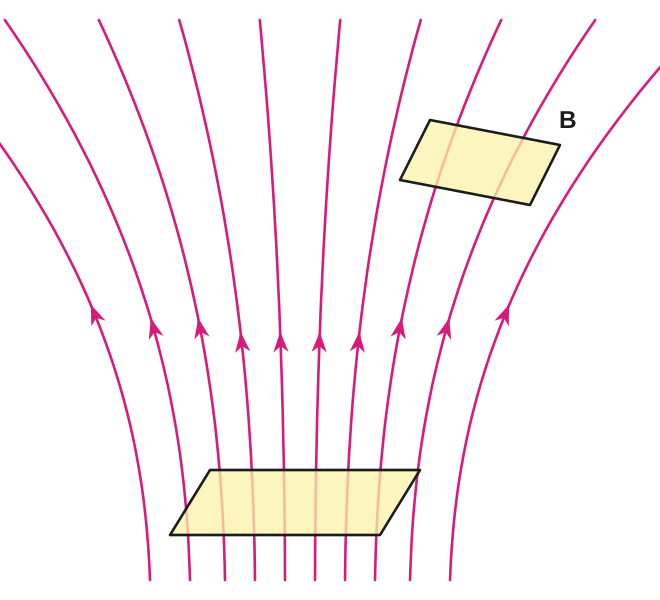
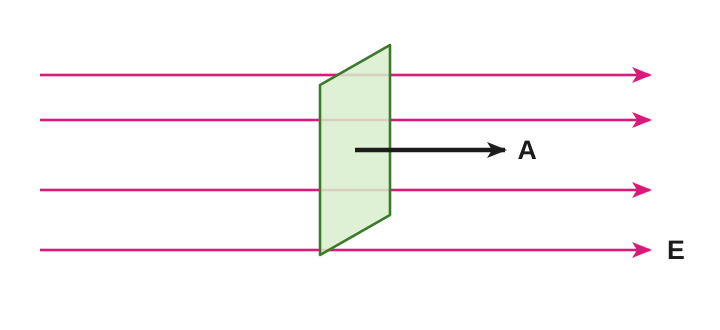
When an element of area is placed in an electric field, some of the lines of force pass through it. The number of field lines passing through a certain element of area is known as the electric flux through that area. It is denoted by $\Phi_E$.
Electric flux through a surface held normal to E

Field Lines and Intensity

The field lines are drawn such that the number of lines passing through a unit area held perpendicular to them represents the intensity $E$ of the field at that point.

Vector Area

The element of area is represented by a vector area $\mathbf{A}$ whose magnitude is equal to the surface area $A$ of the element and whose direction is along the normal to the area.

Three Cases

The flux through the area depends upon how it is held in the field.

Area Normal to the Field

When the area is held perpendicular to the field lines, $EA$ lines pass through it, and the flux is a maximum.
Maximum flux: the area is held perpendicular to the field lines
$$\Phi_E=EA$$

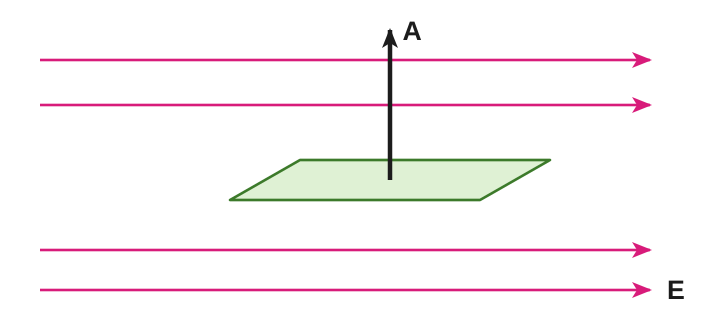
Area Parallel to the Field

When the area is held parallel to the field lines, no lines cross it, so the flux is zero.
Minimum flux: the area is held parallel to the field lines
$$\Phi_E=0$$

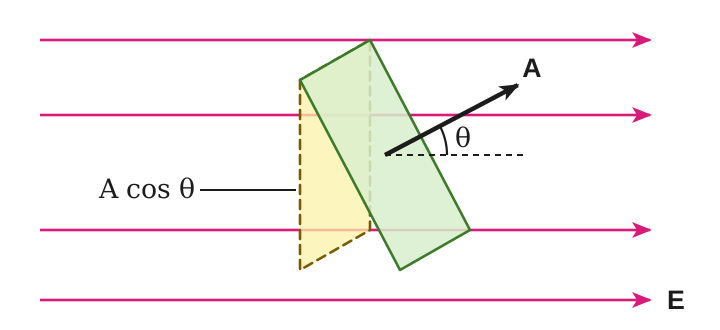
Area Inclined to the Field

When the area is neither perpendicular nor parallel to the field lines but is inclined at an angle $\theta$ with the field, the projection of the area perpendicular to the lines is $A\cos\theta$.
The area is inclined at an angle to the field, so its projection is A cosθ

General Formula

$$\Phi_E=\mathbf{E}\cdot\mathbf{A}=EA\cos\theta$$
Here $\theta$ is the angle between the field lines and the normal to the area.

Scalar

Electric flux is a scalar product, so it is a scalar quantity.

Unit

$$1\,\mathrm{N\,m^2\,C^{-1}}$$

Flux Through a Surface Enclosing a Charge

Statement

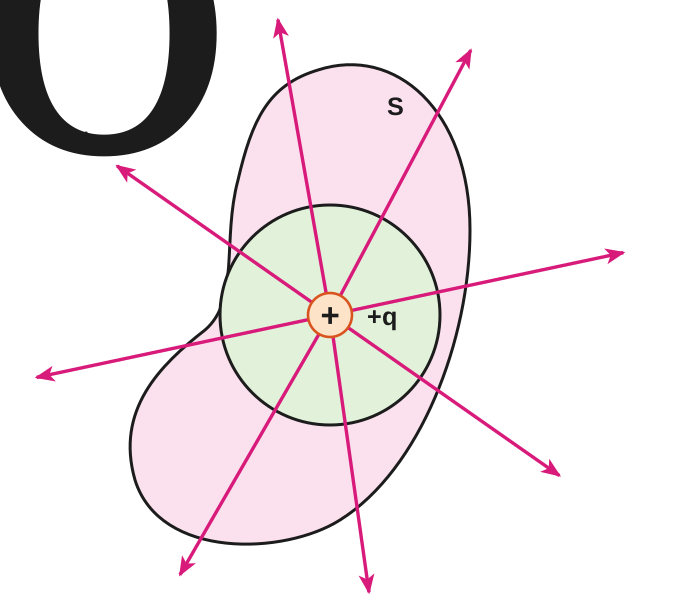
The total electric flux through a closed surface enclosing a charge $q$ is $1/\varepsilon_o$ times the charge, whatever the shape of the surface.

Set Up

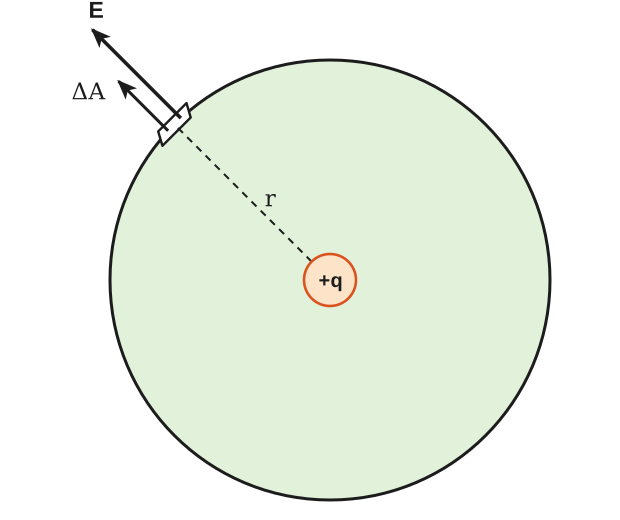
Consider a sphere of radius $r$ with a point charge $q$ at its centre. To apply the flux formula the surface must be flat, so the total surface area of the sphere is divided into $n$ small patches.
The total electric flux through a sphere with a point charge at its centre

Angle at Each Patch

The direction of the electric intensity and of the vector area is the same at each patch.
$$\theta=0^{\circ}$$
$$\cos\theta=1$$

Intensity at Each Patch

$$E_1=E_2=\dots=E_n=E=\frac{1}{4\pi\varepsilon_o}\frac{q}{r^2}$$

Total Flux

$$\Phi_E=E(\Delta A_1+\Delta A_2+\dots+\Delta A_n)$$
$$\Phi_E=E\times4\pi r^2$$
Substituting the intensity of the point charge
$$\Phi_E=\frac{1}{4\pi\varepsilon_o}\frac{q}{r^2}\times4\pi r^2$$
$$\Phi_E=\frac{q}{\varepsilon_o}$$

Any Closed Surface

If a closed surface $S$ encloses this sphere, the flux through $S$ is the same as that through the sphere. So the total flux through a closed surface does not depend upon the shape or geometry of the surface. It depends upon the medium and the charge enclosed.
The flux through any closed surface S enclosing the charge is the same as through the sphere

Short Questions

SQ 9.3.1

What decides whether the flux through an area is a maximum, a minimum or something in between?

The Orientation

It is the angle between the field and the normal to the area.

Formula

$$\phi_e=EA\cos\theta$$
The flux is a maximum at $0^{\circ}$ and zero at $90^{\circ}$.
SQ 9.3.2

Why is electric flux a scalar quantity even though both E and A are vectors?

Reason

The flux is the scalar product of the two vectors, and a scalar product has magnitude only.
SQ 9.3.3

How is the direction of a vector area defined?

Along the Normal

The magnitude of the vector area equals the surface area of the element, and its direction is along the normal drawn to the area.
SQ 9.3.4

Why does the flux through a closed surface not depend upon the shape of the surface?

Reason

Every field line that leaves the enclosed charge must cross the surface, whatever its shape. So the flux depends only on the charge enclosed and the medium.
MCQ 9.3.1

The electric flux through an area held parallel to the field lines is:

Aa maximumBzero
C$EA$D$EA/2$
Solution:No lines cross the area, and $\cos 90^{\circ}=0$.
MCQ 9.3.2

The SI unit of electric flux is:

AN C$^{-1}$BN m C$^{-1}$
CN m$^2$ C$^{-1}$DC m$^{-2}$
Solution:It is the product of a field and an area.
MCQ 9.3.3

The flux through an area is a maximum when the angle between the field and the normal to the area is:

A$0^{\circ}$B$30^{\circ}$
C$60^{\circ}$D$90^{\circ}$
Solution:The cosine is then one.
MCQ 9.3.4

The total flux through a sphere with a charge $q$ at its centre is:

A$q\varepsilon_o$B$q/4\pi\varepsilon_o$
C$q/\varepsilon_o$D$4\pi q\varepsilon_o$
Solution:The area of the sphere cancels the inverse square in the field.
MCQ 9.3.5

Electric flux is:

Aa vectorBsometimes a vector
Ca unit vectorDa scalar
Solution:It is the scalar product of the field and the vector area.
Topic 9.4

Gauss’s Law

Gauss’s Law

Statement

The total electric flux through any closed surface is $1/\varepsilon_o$ times the total charge enclosed in it.

Set Up

Suppose the point charges $q_1,\,q_2$ up to $q_n$ are arbitrarily distributed in an arbitrarily shaped closed surface.
Point charges enclosed by an arbitrarily shaped closed surface

Total Flux

Each charge contributes its own flux, so
$$\Phi_E=\frac{q_1}{\varepsilon_o}+\frac{q_2}{\varepsilon_o}+\dots+\frac{q_n}{\varepsilon_o}$$
$$\Phi_E=\frac{1}{\varepsilon_o}(q_1+q_2+\dots+q_n)$$

Total Charge

$$Q=q_1+q_2+\dots+q_n$$
$$\Phi_E=\frac{Q}{\varepsilon_o}$$

Applications of Gauss’s Law

Definition

An imaginary closed surface passing through the point at which the electric intensity is to be evaluated is known as a Gaussian surface. Its choice is such that the flux through it can be easily evaluated.

Use

Gauss’s law can be applied to calculate the electric intensity due to different charge configurations. In all such cases an imaginary closed surface is considered which passes through the point at which the intensity is to be evaluated.

Field of a Charged Conducting Sphere

Statement

The field at any point outside a charged conducting sphere is the same as though its entire charge were concentrated at its centre.

Set Up

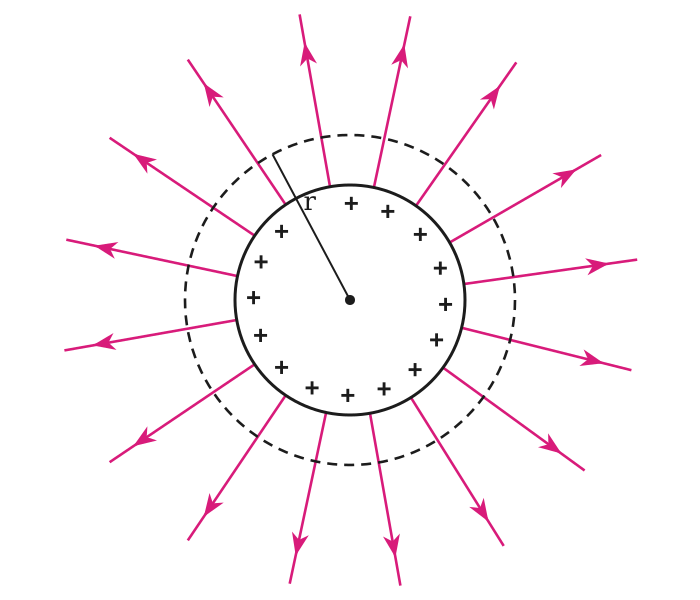
Consider a conducting sphere of radius $R$ carrying a charge $q$. All the charge is distributed uniformly over the surface of the sphere.
The Gaussian surface used to find the field outside a charged conducting sphere

Symmetry

From the spherical symmetry the electric field is radial everywhere, and its magnitude depends only on the distance $r$ from the centre. So the magnitude $E$ is uniform over a spherical surface of any radius $r$ concentric with the conductor.

Gaussian Surface

We take an imaginary sphere of radius $r$ greater than the radius $R$ of the conducting sphere.
$$A=4\pi r^2$$

Flux

$$\Phi_E=EA=E\times4\pi r^2$$

By Gauss’s Law

$$\Phi_E=\frac{q}{\varepsilon_o}$$
$$E\times4\pi r^2=\frac{q}{\varepsilon_o}$$

Field Outside

$$E=\frac{1}{4\pi\varepsilon_o}\frac{q}{r^2}$$
The field at any point outside the sphere is the same as though the entire charge were concentrated at its centre.

At the Surface

The radius of the Gaussian surface equals that of the conductor.
$$r=R$$
$$E=\frac{1}{4\pi\varepsilon_o}\frac{q}{R^2}$$

Short Questions

SQ 9.4.1

What is a Gaussian surface, and how is one chosen?

Gaussian Surface

An imaginary closed surface passing through the point at which the intensity is to be found.

Choice

It is chosen so that the flux through it can be easily evaluated, usually by symmetry.
SQ 9.4.2

Why is the field outside a charged conducting sphere the same as that of a point charge?

Reason

The charge spreads uniformly over the surface, so by spherical symmetry the field is radial and its magnitude is the same everywhere on a concentric sphere.
$$E=\frac{1}{4\pi\varepsilon_o}\frac{q}{r^2}$$
This is the field of a point charge at the centre.
SQ 9.4.3

What is the electric field just outside the surface of a charged conducting sphere of radius R?

At the Surface

The Gaussian radius equals the radius of the sphere.
$$r=R$$
$$E=\frac{1}{4\pi\varepsilon_o}\frac{q}{R^2}$$
SQ 9.4.4

Two closed surfaces of very different shapes enclose the same charge. Compare the flux through them.

Equal

The flux through both is the same.
$$\phi_e=\frac{Q}{\varepsilon_o}$$
Gauss’s law depends only on the charge enclosed, not on the geometry of the surface.
MCQ 9.4.1

Gauss’s law states that the total flux through a closed surface is:

A$Q\varepsilon_o$B$Q/\varepsilon_o$
C$\varepsilon_o/Q$D$Q/4\pi\varepsilon_o$
Solution:Here $Q$ is the total charge enclosed by the surface.
MCQ 9.4.2

The flux through a closed surface does not depend on:

Athe shape of the surfaceBthe charge enclosed
Cthe mediumDthe permittivity
Solution:Only the enclosed charge and the medium matter.
MCQ 9.4.3

For a point outside a charged conducting sphere, the charge may be treated as if it were:

Aa point charge at the centreBspread over the Gaussian surface
CzeroDconcentrated at the nearest point of the surface
Solution:This is what the Gaussian calculation shows.
MCQ 9.4.4

All the charge given to a conducting sphere resides:

Aon its outer surfaceBat its centre
Cuniformly through its volumeDon its inner surface
Solution:The mutual repulsion of the charges drives them to the surface.
MCQ 9.4.5

A closed surface encloses no charge. The flux through it is:

AzeroBinfinite
C$1/\varepsilon_o$Dequal to $EA$
Solution:Every line that enters also leaves, so the net flux is zero.
Topic 9.5

Electric Potential

LQ 1starts here — Explain the electric potential and prove that electric field intensity is equal to the negative of the potential gradient.

Electric Potential Difference

Definition

The potential difference between two points $A$ and $B$ in an electric field is defined as the work done in carrying a unit positive charge from $A$ to $B$ while keeping the charge in equilibrium.
$$\Delta V=V_B-V_A=\frac{W_{AB}}{q}$$

Set Up

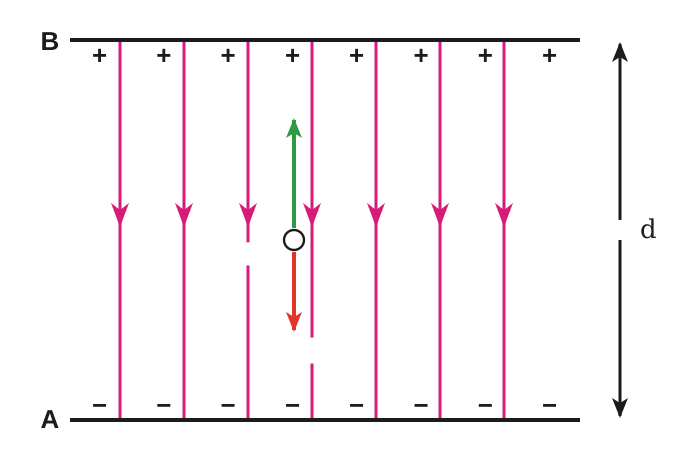
Two oppositely charged parallel plates produce a uniform electric field. A positive charge $q$ moving from plate $B$ to plate $A$ gains kinetic energy, and to move it from $A$ to $B$ an external force is needed to make it move against the field, so it gains potential energy.
A charge carried between two oppositely charged parallel plates

Electrostatic Equilibrium

As the charge is moved from $A$ to $B$ it is kept in electrostatic equilibrium, that is, it moves with uniform velocity. This is achieved by applying a force $F$ equal and opposite to $qE$ at every point along its path.

Work and Potential Energy

The work done by the external force against the electric field increases the electrical potential energy of the charge that is moved.
$$\Delta U=W_{AB}$$
$$U_B-U_A=W_{AB}$$
Here $U_A$ and $U_B$ are the potential energies at the points $A$ and $B$.

Relation to Potential Energy

$$\Delta U=q\Delta V$$
So the potential difference between two points is the difference of the potential energy per unit charge.

Unit

The unit of potential energy is the joule, so the unit of potential difference is the joule per coulomb, which is called the volt.
$$1\,\mathrm{V}=1\,\mathrm{J\,C^{-1}}$$

One Volt

A potential difference of 1 volt exists between two points if the work done in moving a 1 coulomb positive charge from one point to the other, keeping electrostatic equilibrium, is one joule.

Electric Potential

Definition

The electric potential at any point in an electric field is equal to the work done in bringing a unit positive charge from infinity to that point, keeping it in electrostatic equilibrium.
$$V=\frac{W}{q}$$

Reference Point

To give a concept of the electric potential at a point we must have a reference at which the potential is taken as zero. This point is usually taken at infinity.

Scalars

Both potential and potential difference are scalar quantities, because both $W$ and $q$ are scalars.

Electric Field as Potential Gradient

Statement

The electric field intensity is equal to the negative of the gradient of the electric potential. The negative sign shows that the direction of $E$ is along the decreasing potential.

Set Up

The field between the two charged plates is uniform and its value is $E$. The potential difference between $A$ and $B$ is
$$V_B-V_A=\frac{W_{AB}}{q}$$

Work Done

The applied force must be opposite to $qE$ to keep the charge in equilibrium, so the work done is negative.
$$W_{AB}=-qEd$$

Substituting the Work

$$V_B-V_A=\frac{-qEd}{q}=-Ed$$
$$E=-\frac{\Delta V}{d}$$

Infinitesimal Separation

If the plates are separated by an infinitesimally small distance $\Delta d$
$$E=-\frac{\Delta V}{\Delta d}$$

Potential Gradient

The quantity $\Delta V/\Delta d$ gives the maximum value of the rate of change of potential with distance, because the charge has been moved along a field line in which the distance between the two plates is minimum. It is known as the potential gradient.

Unit

The unit of electric intensity is the volt per metre, which is equal to the newton per coulomb.
$$1\,\mathrm{V\,m^{-1}}=1\,\mathrm{N\,C^{-1}}$$
LQ 1ends here

Book Examples

Example 9.5.1

Two parallel metal plates are 1.0 cm apart. These are connected to a battery of 12 volts. Find the magnitude of the electric field intensity between them.

Given Data

$$\Delta V=12\,\mathrm{V}$$
$$\Delta d=1.0\,\mathrm{cm}=1\times10^{-2}\,\mathrm{m}$$

To Find

Field intensity $E=?$

Formula

$$E=-\frac{\Delta V}{\Delta d}$$

Solution

Putting the values
$$E=-\frac{12}{1\times10^{-2}}=-1200\,\mathrm{V\,m^{-1}}$$

Result

The magnitude of the field is
$$E=1200\,\mathrm{V\,m^{-1}}$$
Example 9.5.2

Two horizontal parallel metal plates are connected to a 12 volt battery. An electron is released from the negative plate. Determine its velocity as it reaches the positive plate. (Mass of an electron is $9.1\times10^{-31}$ kg and $e=1.6\times10^{-19}$ C)

Given Data

$$\Delta V=12\,\mathrm{V}$$
$$e=1.6\times10^{-19}\,\mathrm{C}$$
$$m=9.1\times10^{-31}\,\mathrm{kg}$$

To Find

Velocity at the positive plate $v=?$

Formula

The electron is repelled by the negative plate and attracted by the positive one, so it loses potential energy and gains kinetic energy.
$$e\Delta V=\frac{1}{2}mv^2$$

Solution

Putting the values
$$12\times1.6\times10^{-19}=\frac{1}{2}\times9.1\times10^{-31}\times v^2$$
$$\begin{aligned}v^2&=\frac{2\times12\times1.6\times10^{-19}}{9.1\times10^{-31}} \\ &=4.2\times10^{12}\,\mathrm{m^2\,s^{-2}}\end{aligned}$$
$$v=2.1\times10^{6}\,\mathrm{m\,s^{-1}}$$

Result

$$v=2.1\times10^{6}\,\mathrm{m\,s^{-1}}$$

Short Questions

SQ 9.5.1

Why must a charge be moved in electrostatic equilibrium when the potential difference is defined?

Reason

Moving it with uniform velocity means it gains no kinetic energy, so all the work done by the external force goes into potential energy.
SQ 9.5.2

Why is the potential at a point always quoted relative to infinity?

Reference

Only differences of potential have physical meaning, so a zero must be chosen. The point at infinity is taken as the zero, and the potential at a point is then the work done in bringing a unit positive charge from infinity to it.
SQ 9.5.3

Why does the equation for the electric field as a potential gradient carry a negative sign?

Reason

The field points in the direction in which the potential decreases.
$$E=-\frac{\Delta V}{\Delta d}$$
SQ 9.5.4

Show that the volt per metre and the newton per coulomb are the same unit.

Working

$$1\,\mathrm{V\,m^{-1}}=\frac{1\,\mathrm{J\,C^{-1}}}{1\,\mathrm{m}}$$
$$=\frac{1\,\mathrm{N\,m}}{1\,\mathrm{m\,C}}=1\,\mathrm{N\,C^{-1}}$$
So the two units are identical.
SQ 9.5.5

Why is the potential gradient between two plates the maximum rate of change of potential with distance?

Reason

The charge is moved along a field line, along which the distance between the two plates is the shortest. Any other path is longer for the same change of potential.
MCQ 9.5.1

The unit of electric potential difference is the:

Anewton per coulombBjoule
Ccoulomb per jouleDvolt
Solution:One volt is one joule per coulomb.
MCQ 9.5.2

Electric potential is:

Aa vectorBsometimes a vector
Ca scalarDa unit vector
Solution:Both the work and the charge in its definition are scalars.
MCQ 9.5.3

The electric field is equal to the:

Anegative of the potential gradientBpotential gradient
Cpotential times the distanceDpotential divided by the charge
Solution:The negative sign shows that $E$ points along the decreasing potential.
MCQ 9.5.4

The potential at a point is defined with respect to a zero taken at:

Athe surface of the EarthBinfinity
Cthe negative plateDthe centre of the charge
Solution:The potential at a point is the work done in bringing unit positive charge from infinity.
MCQ 9.5.5

Two plates 2 mm apart are at a potential difference of 100 V. The field between them is:

A$5\times10^{4}$ V m$^{-1}$B$2\times10^{4}$ V m$^{-1}$
C$5\times10^{2}$ V m$^{-1}$D200 V m$^{-1}$
Solution:$E=V/d=100/(2\times10^{-3})$.
MCQ 9.5.6

One volt per metre is the same as:

A1 J C$^{-1}$B1 N m C$^{-1}$
C1 C N$^{-1}$D1 N C$^{-1}$
Solution:A joule per coulomb per metre is a newton per coulomb.
Topic 9.6

Electron Volt

Definition

The amount of energy equal to $1.6\times10^{-19}$ J is called one electron volt. It is the amount of energy acquired or lost by an electron as it traverses a potential difference of one volt.
$$1\,\mathrm{eV}=1.6\times10^{-19}\,\mathrm{J}$$

Change in Potential Energy

When a particle of charge $q$ moves from a point $A$ at potential $V_A$ to a point $B$ at potential $V_B$, keeping electrostatic equilibrium, the change in potential energy is
$$\Delta U=q(V_B-V_A)=q\Delta V$$

No External Force

If no external force acts on the charge to maintain equilibrium, this change in potential energy appears as a change in kinetic energy.
$$\Delta K.E=q\Delta V$$

Electron Through One Volt

Taking the charge of an electron and a potential difference of one volt
$$q=e=1.6\times10^{-19}\,\mathrm{C}$$
$$\Delta V=1\,\mathrm{V}$$
$$\Delta K.E=1.6\times10^{-19}\times1=1.6\times10^{-19}\,\mathrm{J}$$

Book Examples

Example 9.6.1

A particle carrying a charge of $2e$ falls through a potential difference of 3.0 V. Calculate the energy acquired by it.

Given Data

$$q=2e$$
$$\Delta V=3.0\,\mathrm{V}$$

To Find

Energy acquired $\Delta U=?$

Formula

$$\Delta U=q\Delta V$$

Solution

Putting the values
$$\Delta U=2e\times3.0=6.0\,\mathrm{eV}$$
Converting into joule
$$\Delta U=6.0\times1.6\times10^{-19}=9.6\times10^{-19}\,\mathrm{J}$$

Result

$$\Delta U=6.0\,\mathrm{eV}=9.6\times10^{-19}\,\mathrm{J}$$

Short Questions

SQ 9.6.1

Why is the electron volt a convenient unit in atomic physics?

Reason

Energies at the atomic scale are of the order of $10^{-19}$ J, so the joule is inconveniently large. One electron volt is exactly the energy an electron gains through one volt.
$$1\,\mathrm{eV}=1.6\times10^{-19}\,\mathrm{J}$$
SQ 9.6.2

An alpha particle and a proton are accelerated through the same potential difference. Compare the energies they gain.

Alpha Gains Twice

The energy gained is the charge times the potential difference.
$$\Delta U=q\Delta V$$
The alpha particle carries $2e$ and the proton $e$, so the alpha particle gains twice the energy.
SQ 9.6.3

A charge falls through a potential difference and no external force keeps it in equilibrium. What becomes of the change in potential energy?

Kinetic Energy

It appears as a gain in kinetic energy.
$$\Delta K.E=q\Delta V$$
MCQ 9.6.1

One electron volt is equal to:

A$1.6\times10^{-19}$ JB$1.6\times10^{-19}$ V
C$9.1\times10^{-31}$ JD$1.6\times10^{19}$ J
Solution:It is the energy an electron gains through one volt.
MCQ 9.6.2

An alpha particle accelerated through 5 V gains an energy of:

A10 eVB5 eV
C2.5 eVD20 eV
Solution:The alpha particle carries a charge of $2e$.
MCQ 9.6.3

The electron volt is a unit of:

Apotential differenceBenergy
CchargeDpower
Solution:It is a charge multiplied by a potential difference.
MCQ 9.6.4

An electron accelerated through 1000 V gains an energy of:

A$1.6\times10^{-22}$ JB1000 J
C$1.6\times10^{-19}$ JD$1.6\times10^{-16}$ J
Solution:$1000\,\mathrm{eV}=1000\times1.6\times10^{-19}$ J.
Topic 9.7

Motion of Charged Particles in a Uniform Electric Field

Statement

A charged particle in a uniform electric field experiences a constant force $qE$, so it moves with uniform acceleration: a positive charge along the field and a negative charge opposite to it.

Uniform Field

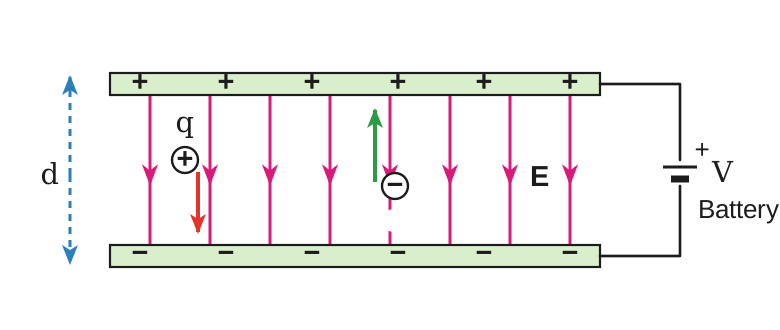
Two oppositely charged parallel metal plates produce a uniform electric field between them. The direction of the field is from the positive to the negative plate.

Direction of Motion

A positive charge placed in the field moves in the direction of the field, whereas a negative charge moves opposite to the field.
The force on a charge placed in the uniform field between two charged plates

Force on the Charge

$$F=qE$$

Field From the Plate Voltage

$$E=\frac{V}{d}$$

Symbols

$V$ is the potential difference between the plates.
$d$ is the separation of the plates.

Acceleration

An electron placed between the plates accelerates towards the positive plate due to the force acting on it.
$$F=ma$$
$$a=\frac{F}{m}=\frac{qE}{m}$$

Velocity Gained

If the electron is released from the negative plate, the velocity it has gained on reaching the positive plate follows from the third equation of motion, with the plate separation $d$ as the distance covered.
$$2ad=v^2-v_i^2$$

Starting From Rest

$$v_i=0$$
$$v=\sqrt{2ad}$$

Short Questions

SQ 9.7.1

How is the field between two parallel plates found from the plate voltage?

Formula

The field is the potential difference divided by the separation.
$$E=\frac{V}{d}$$
It is the same at every point in the middle region.
SQ 9.7.2

Which way does a negative charge move in a uniform electric field, and why?

Against the Field

The force on it is $qE$ with a negative $q$, so the force is opposite to $E$. It therefore moves towards the positive plate.
SQ 9.7.3

Write the expression for the acceleration of an electron released between two charged plates.

Working

$$F=eE$$
$$a=\frac{F}{m}=\frac{eE}{m}$$
Here $m$ is the mass of the electron.
SQ 9.7.4

An electron is released from rest at the negative plate. How is its speed at the positive plate found?

From the Equation of Motion

The acceleration is uniform and the distance covered is the plate separation.
$$2ad=v^2-v_i^2$$
Starting from rest
$$v=\sqrt{2ad}$$
MCQ 9.7.1

The direction of the electric field between two charged plates is:

Afrom the negative to the positive plateBfrom the positive to the negative plate
Calong the platesDout of the plates
Solution:A positive charge placed in it moves the same way.
MCQ 9.7.2

The field between two plates a distance $d$ apart at a potential difference $V$ is:

A$Vd$B$d/V$
C$V/d$D$V/d^2$
Solution:This is the potential gradient between the plates.
MCQ 9.7.3

The acceleration of a charge $q$ of mass $m$ in a field $E$ is:

A$qEm$B$mE/q$
C$qE/m$D$m/qE$
Solution:It follows from $F=qE$ and $F=ma$.
MCQ 9.7.4

An electron released at the negative plate of a pair of plates 2 cm apart with $E=1000$ V m$^{-1}$ has an acceleration of about:

A$1.76\times10^{14}$ m s$^{-2}$B$1.76\times10^{11}$ m s$^{-2}$
C$1.6\times10^{-19}$ m s$^{-2}$D$9.8$ m s$^{-2}$
Solution:$a=eE/m=1.6\times10^{-19}\times1000/9.1\times10^{-31}$.
Topic 9.8

Path of a Charged Particle

What Decides the Path

The path of a charged particle is determined by the electric field in the region.

Straight Path

The path is typically straight if the field is uniform and the charged particle is moving along the field.

Parabolic Path

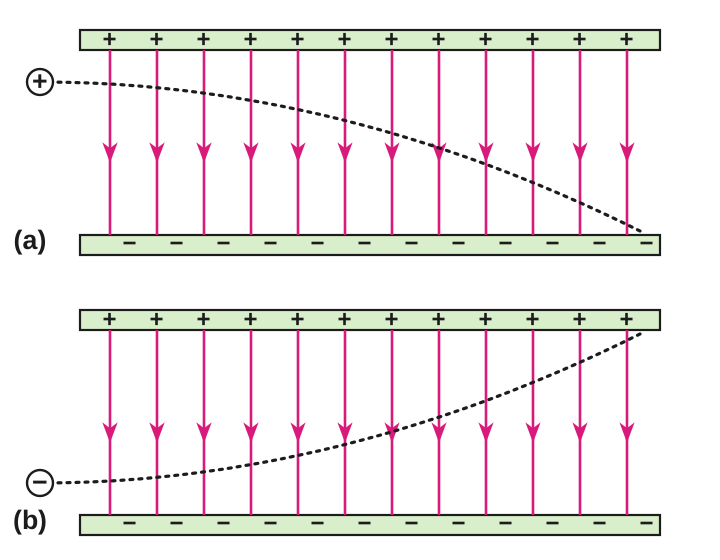
If a charged particle enters perpendicularly to the uniform field between the oppositely charged parallel plates with a certain velocity, it will not go straight. Its path will be parabolic, just like a projectile thrown horizontally in the gravitational field.
A charged particle entering a uniform field at right angles follows a parabolic path

Two Components

The horizontal component of the velocity remains constant.
The vertical component is accelerated due to the electric force.

Direction of Deflection

A positively charged particle is attracted towards the negatively charged plate and is deflected in that direction.
A negatively charged particle is attracted towards the positively charged plate and is deflected in that direction.

Short Questions

SQ 9.8.1

Why is the path of a charged particle entering a uniform field at right angles a parabola?

Reason

The component of the velocity along the entry direction stays constant while the component across it is uniformly accelerated. That is exactly the motion of a horizontal projectile, whose path is a parabola.
SQ 9.8.2

When is the path of a charged particle in an electric field a straight line?

Condition

When the field is uniform and the particle is moving along the field, so there is no force across its motion.
SQ 9.8.3

Two particles of equal mass and opposite charge enter the same field at right angles with the same speed. Compare their deflections.

Equal and Opposite

The magnitude of the force is the same, so the magnitude of the deflection is the same. The positive one bends towards the negative plate and the negative one towards the positive plate.
MCQ 9.8.1

A charged particle entering a uniform field at right angles follows a path that is:

AcircularBstraight
ChelicalDparabolic
Solution:It is the same motion as a horizontal projectile in gravity.
MCQ 9.8.2

For a charged particle deflected between two plates, the component of the velocity that stays constant is the:

Aone across the fieldBone along the entry direction
Cvertical oneDresultant
Solution:No force acts along the entry direction.
MCQ 9.8.3

A negatively charged particle in a uniform field is deflected towards the:

Anegatively charged plateBnearer plate
Cpositively charged plateDfarther plate
Solution:Unlike charges attract.
MCQ 9.8.4

The path of a charged particle moving along a uniform field is:

AparabolicBstraight
CcircularDelliptical
Solution:The force is along the motion, so only the speed changes.
Topic 9.9

Shielding From External Electric Field

Faraday Cage

Definition

A Faraday cage is an enclosure that blocks external electric fields in conductive materials.

Pioneer

The English scientist Michael Faraday invented the Faraday cage, or Faraday shield, in 1836.

What It Does

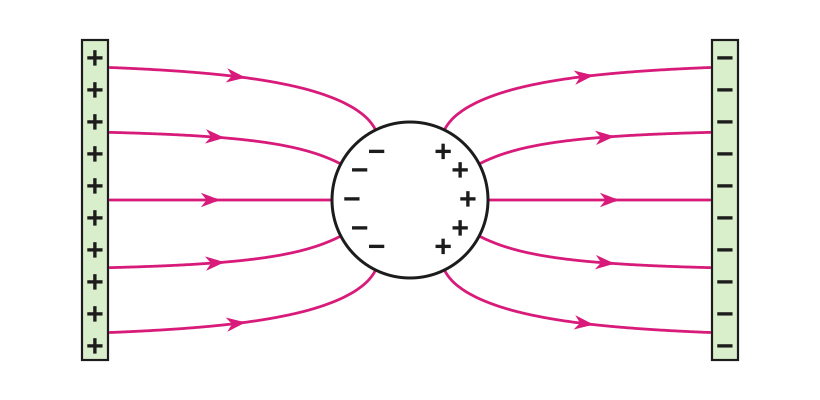
It acts like a hollow conductor in which devices or objects can be put for protection from external electrical fields. Any electrical shock received by the cage runs through its outer surface without causing any harm inside, and the electric field inside the hollow conductor remains zero.
A hollow conductor shields its interior from an external electric field

Working of a Faraday Cage

Free Electrons

Suppose a piece of conductor, say copper, carries a number of free electrons. Each electron experiences a force of repulsion because of the electric field of its neighbouring electrons, so all the electrons rush to the surface of the conductor.

Charge on the Surface

Once static equilibrium is established with all the excess charge on the surface, no further movement of charge occurs. At equilibrium under electrostatic conditions, any excess charge resides on the surface of a conductor.

Field Inside

The excess charges arrange themselves on the surface precisely in the manner that the total field within the interior becomes zero. So the conductor shields any charge within it from the electric fields outside the conductor, and circuits are often enclosed within metal boxes to eliminate the interference of external fields.

Field at the Surface

The electric field just outside the surface of a conductor is perpendicular to the surface at equilibrium.

Reason

If the field were not perpendicular there would be a component parallel to the surface. The free electrons on the surface would then move under that component, but at equilibrium no electron flow occurs, so there can be no parallel component.

Uses of a Faraday Cage

Material

The principle demands a material that contains a lot of free electrons that can move freely to the surface. Only conductors have free electrons, so insulators cannot be used to construct a Faraday cage.

Examples in Daily Life

The chassis and body of a car protect the people inside during a thunderstorm, because the charge travels over the metal surface into the ground.
The metal body of a microwave oven prevents the microwaves from spreading into the environment.
The metal frame of an aeroplane distributes the electricity of a lightning strike along its surface and keeps the passengers and devices safe.

Short Questions

SQ 9.9.1

Why does all the excess charge on a conductor move to its surface?

Reason

Every free electron is repelled by its neighbours, so the charges push each other as far apart as they can get, which is the surface. Once there, no further movement occurs.
SQ 9.9.2

Why is the electric field just outside a charged conductor perpendicular to its surface?

Reason

A parallel component would drive the free surface electrons along the surface. At equilibrium there is no electron flow, so there can be no parallel component.
SQ 9.9.3

Give two everyday examples of a Faraday cage.

Examples

The metal body of a car, which protects the people inside during a thunderstorm.
The metal body of a microwave oven, which keeps the microwaves inside.
The metal frame of an aeroplane, which carries a lightning strike over its surface.
SQ 9.9.4

Why must the electric field inside a hollow conductor be zero at equilibrium?

Reason

The excess charges arrange themselves on the surface precisely so that their fields cancel everywhere inside. If any field remained, the free charges would keep moving and equilibrium would not have been reached.
MCQ 9.9.1

A Faraday cage was invented in 1836 by:

AMichael FaradayBJames Clerk Maxwell
CCharles CoulombDCarl Gauss
Solution:It is also called a Faraday shield.
MCQ 9.9.2

The electric field inside a hollow conductor at equilibrium is:

Auniform and largeBzero
Cequal to the outside fieldDperpendicular to the surface
Solution:The surface charges arrange themselves so that the interior field cancels.
MCQ 9.9.3

A Faraday cage cannot be built from:

AcopperBaluminium
CsteelDan insulator
Solution:An insulator has no free electrons to move to the surface.
MCQ 9.9.4

At equilibrium under electrostatic conditions, any excess charge on a conductor resides:

Aat its centreBthroughout its volume
Con the earth wireDon its surface
Solution:Mutual repulsion drives the charges as far apart as possible.
MCQ 9.9.5

The field just outside a charged conductor is:

Aparallel to the surfaceBperpendicular to the surface
Cat $45^{\circ}$ to the surfaceDzero
Solution:A parallel component would move the surface electrons.
Topic 9.10

Electric Current

Electric Current

Definition

If a net charge $Q$ passes through any cross-section of a conductor in time $t$, the current flowing through it is
$$I=\frac{Q}{t}$$

Charge Carriers

The charge carriers in a conductor are the free electrons. When the ends of a conductor are connected to a battery or some other source of potential, an electric field is set up at every point within the conductor.

Force on the Electrons

The free electrons experience a force in the direction of $-E$ and start moving. They are not accelerated in a straight line, because they keep colliding with the atoms of the conductor.

Drift Velocity

The overall effect of these collisions is to transfer the energy of the accelerated electrons to the lattice, with the result that the electrons acquire an average velocity called the drift velocity in the direction of $-E$
$$v_d\approx10^{-3}\,\mathrm{m\,s^{-1}}$$

Current Is Set Up at Once

The slow drift velocity does not mean that it takes a long time for a current to be set up. On turning the switch on, all the free electrons in the circuit start drifting at once, they repel their neighbours, and the disturbance propagates along the wire almost instantaneously.

Unit

The SI unit of current is the ampere. It is the current due to the flow of one coulomb of charge per second through any cross-section of a conductor.
$$1\,\mathrm{A}=1\,\mathrm{C\,s^{-1}}$$

Direct and Alternating Current

Direct Current

If the charges move around a circuit in the same direction at all times, the current is said to be direct current. Batteries produce direct current.

Alternating Current

If the charges move first one way and then the opposite way, changing direction at regular intervals, the current is said to be alternating current. Most electric generators produce alternating current, and the electricity supplied to our homes and factories is A.C.

Conventional Current

Definition

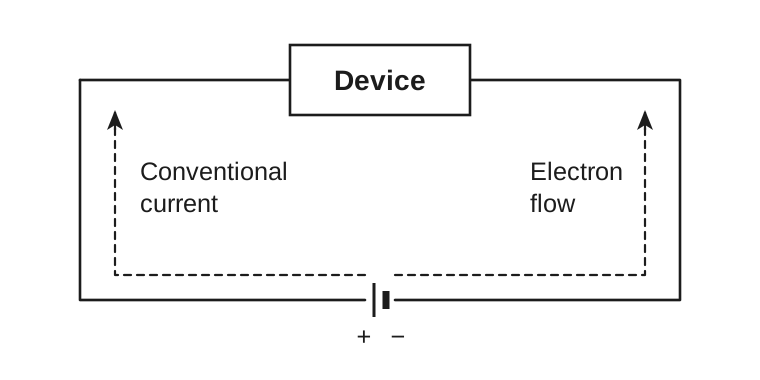
Conventional current is the hypothetical flow of positive charges that would have the same effect in the circuit as the flow of negative charges that actually occurs.
Conventional current and the actual flow of electrons in a circuit

Background

The electric current is due to the flow of electrons through the metal wires, but early scientists believed that it was due to the flow of positive charges. Scientists have kept the convention.

Direction

The conventional current flows from the positive terminal towards the negative terminal of a battery. Its direction is always from a point of higher potential towards a point of lower potential. From now on the current $I$ always means the conventional current.

Short Questions

SQ 9.10.1

If the drift velocity of the electrons is only about a millimetre per second, why does a bulb light the instant the switch is closed?

Reason

On closing the switch the field is set up along the whole circuit at once, so all the free electrons begin drifting together. The disturbance propagates along the wire almost instantaneously.
SQ 9.10.2

Why are the free electrons not accelerated in a straight line inside a conductor?

Collisions

They keep colliding with the atoms of the lattice, which transfers their energy to it. The result is a steady average speed, the drift velocity, rather than a growing one.
SQ 9.10.3

Distinguish between direct current and alternating current.

Direct CurrentAlternating Current
The charges move in the same direction at all times.The charges reverse direction at regular intervals.
It is produced by a battery.It is produced by most generators.
It is used in electronic circuits.It is supplied to homes and factories.
SQ 9.10.4

Why is the conventional current taken opposite to the actual flow of electrons?

Reason

Early scientists believed the current was a flow of positive charge, and the convention has been kept because a flow of positive charge one way has the same effect in a circuit as a flow of negative charge the other way.
MCQ 9.10.1

The charge carriers in a metal conductor are:

Afree electronsBprotons
Cpositive ionsDholes
Solution:They drift opposite to the field.
MCQ 9.10.2

The drift velocity of electrons in a metal is of the order of:

A$10^{3}$ m s$^{-1}$B$10^{-3}$ m s$^{-1}$
C$10^{8}$ m s$^{-1}$D$10^{6}$ m s$^{-1}$
Solution:It is very slow, yet the current is set up almost at once.
MCQ 9.10.3

One ampere is one:

Ajoule per secondBcoulomb per second
Ccoulomb per voltDvolt per second
Solution:It is the SI unit of electric current.
MCQ 9.10.4

The conventional current in a circuit flows from:

Athe positive terminal to the negative terminal outside the cellBthe negative terminal to the positive terminal outside the cell
Chigh to low potential inside the cellDthe anode to the cathode inside the cell
Solution:It is the direction in which positive charges would move.
MCQ 9.10.5

A charge of 60 C passes a cross-section in 20 s. The current is:

A1200 AB3 A
C0.33 AD30 A
Solution:$I=Q/t=60/20$.
Topic 9.11

Current Through a Conductor

Statement

The current through a conductor is the product of the number of charge carriers per unit volume, the area of cross-section, the drift velocity and the charge on each carrier.

Set Up

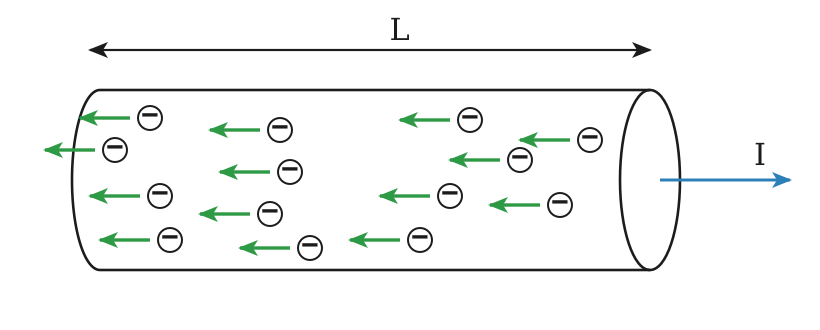
Consider a segment of a current-carrying conductor of length $L$ and area of cross-section $A$. The volume of the segment is $AL$.
Negative charge carriers drifting through a segment of a conductor

Number of Carriers

Let $n$ be the number of charge carriers per unit volume. The total number of charge carriers in the segment at any time is
$$N=nAL$$

Charge in the Segment

If the charge on a charge carrier is $q$, the total charge present inside the segment at any instant is
$$Q=nALq$$

Time to Cross the Segment

Assuming the drift velocity of the charge carriers to be $v$, the time taken by all the charge carriers to exit through the far face is
$$t=\frac{L}{v}$$

Current

By the definition of current
$$I=\frac{Q}{t}=\frac{nALq}{L/v}$$
$$I=nAvq$$

Symbols

$n$ is the number of charge carriers per unit volume.
$A$ is the area of cross-section.
$v$ is the drift velocity.
$q$ is the charge on one carrier.

Book Examples

Example 9.11.1

A copper wire has a cross-sectional area of $2\times10^{-6}\ \mathrm{m^2}$ and carries a current of 3 A. If the number of electrons per unit volume is $8.5\times10^{28}\ \mathrm{m^{-3}}$, calculate the drift velocity of the electrons in the wire. (Charge on an electron is $1.6\times10^{-19}$ C)

Given Data

$$I=3\,\mathrm{A}$$
$$A=2\times10^{-6}\,\mathrm{m^2}$$
$$n=8.5\times10^{28}\,\mathrm{m^{-3}}$$
$$q=1.6\times10^{-19}\,\mathrm{C}$$

To Find

Drift velocity $v=?$

Formula

$$I=nAvq$$
$$v=\frac{I}{nAq}$$

Solution

Putting the values
$$\begin{aligned}v \\ &=\frac{3}{8.5\times10^{28}\times2\times10^{-6}\times1.6\times10^{-19}}\end{aligned}$$
$$v=1.1\times10^{-4}\,\mathrm{m\,s^{-1}}$$

Result

$$v=1.1\times10^{-4}\,\mathrm{m\,s^{-1}}$$

Short Questions

SQ 9.11.1

On what four quantities does the current in a conductor depend?

The Four

The number of charge carriers per unit volume, the area of cross-section, the drift velocity and the charge on one carrier.
$$I=nAvq$$
SQ 9.11.2

Two wires of the same material carry the same current, but one is thicker. Compare the drift velocities.

Slower in the Thick Wire

The number density and the charge are the same, so
$$v=\frac{I}{nAq}$$
The drift velocity is inversely proportional to the area, so it is smaller in the thicker wire.
SQ 9.11.3

Why does the length of the segment not appear in the final expression for the current?

Reason

A longer segment holds proportionally more charge but also takes proportionally longer to empty, so the length cancels.
$$I=\frac{nALq}{L/v}=nAvq$$
MCQ 9.11.1

The current through a conductor is given by:

A$I=nAv/q$B$I=nA/vq$
C$I=Avq/n$D$I=nAvq$
Solution:Here $n$ is the number of carriers per unit volume.
MCQ 9.11.2

For a fixed current, the drift velocity in a wire is inversely proportional to the:

AlengthBarea of cross-section
CresistivityDtemperature
Solution:$v=I/nAq$.
MCQ 9.11.3

The number of charge carriers in a segment of length $L$ and area $A$ is:

A$nA/L$B$nAL$
C$nL/A$D$n/AL$
Solution:It is the number density times the volume.
MCQ 9.11.4

In the derivation of the current through a conductor, the length of the segment:

Aappears in the numeratorBcancels out
Cappears in the denominatorDappears squared
Solution:A longer segment holds more charge but takes proportionally longer to empty.
Topic 9.12

Ohm’s Law

Statement

The current flowing through a conductor is directly proportional to the potential difference applied across the conductor, provided there is no change in the physical state of the conductor.

Mathematically

$$I\propto V$$
$$\frac{V}{I}=\text{constant}$$
$$V=IR$$

Resistance

Here $R$ is a constant of proportionality known as the resistance of the conductor.

Unit

The SI unit of resistance is the ohm, denoted by the Greek capital letter $\Omega$
$$1\,\Omega=1\,\mathrm{V\,A^{-1}}$$

One Ohm

The resistance of a conductor is 1 ohm if a current of 1 ampere flows through it when a potential difference of 1 volt is applied across its ends.

Short Questions

SQ 9.12.1

What is the condition attached to Ohm’s law?

Condition

There must be no change in the physical state of the conductor, in particular no change of temperature.
SQ 9.12.2

Define the ohm.

Definition

The resistance of a conductor is one ohm if a current of 1 ampere flows through it when a potential difference of 1 volt is applied across its ends.
$$1\,\Omega=1\,\mathrm{V\,A^{-1}}$$
SQ 9.12.3

A conductor obeys Ohm’s law. What is the shape of its current-voltage graph?

A Straight Line

The current is directly proportional to the potential difference, so the graph is a straight line through the origin, and its slope is $1/R$.
MCQ 9.12.1

Ohm’s law holds only if there is no change in the:

Aphysical state of the conductorBlength of the connecting wires
Cemf of the cellDdirection of the current
Solution:A change of temperature is the usual cause of a departure from the law.
MCQ 9.12.2

The graph of current against voltage for an ohmic conductor is:

Aa parabolaBa hyperbola
Ca straight line not through the originDa straight line through the origin
Solution:Its slope is the reciprocal of the resistance.
MCQ 9.12.3

A potential difference of 6 V drives 0.5 A through a conductor. Its resistance is:

A12 $\Omega$B3 $\Omega$
C0.08 $\Omega$D6 $\Omega$
Solution:$R=V/I=6/0.5$.
MCQ 9.12.4

One ohm is one:

Aampere per voltBvolt per coulomb
Cvolt per ampereDjoule per ampere
Solution:It follows directly from $V=IR$.
Topic 9.13

Resistivity and Its Dependence Upon Temperature

Resistivity

Definition

Resistivity is the resistance of a metre cube of a material.
$$\rho=\frac{RA}{L}$$

Resistance of a Wire

It has been seen experimentally that the resistance $R$ of a wire is directly proportional to its length $L$ and inversely proportional to its area of cross-section $A$
$$R\propto L$$
$$R\propto\frac{1}{A}$$
$$\frac{RA}{L}=\text{constant}$$
$$R=\rho\frac{L}{A}$$

Resistivity

Here $\rho$ is a constant of proportionality known as the resistivity or specific resistance of the material of the wire.

Resistance and Resistivity

Resistance is a characteristic of a particular wire, whereas resistivity is a property of the material of which the wire is made.

Unit

$$1\,\Omega\,\mathrm{m}$$

Conductance and Conductivity

Conductance

Conductance is another quantity used to describe the electrical properties of materials. It is the reciprocal of resistance.
$$G=\frac{1}{R}$$

Conductivity

Conductivity $\sigma$ is the reciprocal of resistivity.
$$\sigma=\frac{1}{\rho}$$

Unit

$$1\,\Omega^{-1}\,\mathrm{m^{-1}}$$

Best Conductors

Silver and copper are the two best conductors, which is why most electric wires are made of copper.

Dependence Upon Temperature

Statement

The resistance of a metallic conductor increases with temperature, nearly linearly over a considerable range of temperature.

Cause

The resistance offered by a conductor is due to the collisions which the free electrons make with the atoms of the lattice. As the temperature rises, the amplitude of vibration of the atoms increases, so the probability of collision also increases.

Collision Cross-Section

The atoms then offer a bigger target, that is, the collision cross-section of the atoms increases with temperature. This makes the collisions more frequent, and hence the resistance of the conductor increases.

Temperature Coefficient of Resistance

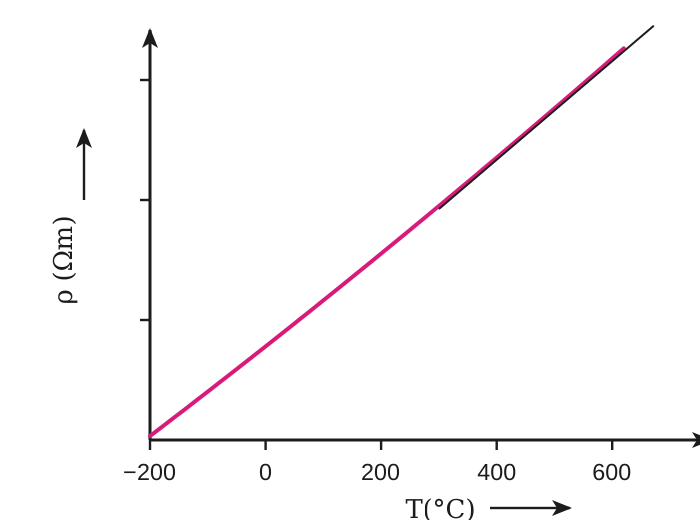
Experimentally, the change in resistance of a metallic conductor with temperature is found to be nearly linear over a considerable range of temperature above and below $0^{\circ}$C.
Variation of the resistivity of a metallic conductor with temperature
Over such a range, the fractional change in resistance per kelvin is the temperature coefficient of resistance.
$$\alpha=\frac{R_t-R_o}{R_o\,t}$$
Here $R_o$ and $R_t$ are the resistances at $0^{\circ}$C and $t^{\circ}$C.

In Terms of Resistivity

Since the resistivity depends upon temperature in the same way
$$R_o=\rho_o\frac{L}{A}$$
$$R_t=\rho_t\frac{L}{A}$$
$$\alpha=\frac{\rho_t-\rho_o}{\rho_o\,t}$$

Negative Coefficients

There are substances such as germanium and silicon whose resistance decreases with an increase in temperature. These substances have negative temperature coefficients.

Book Examples

Example 9.13.1

A current of 0.75 A flows through an iron wire when a battery of 1.5 V is connected across its ends. The length of the wire is 5.0 m and its cross-sectional area is $2.5\times10^{-7}\ \mathrm{m^2}$. Compute the resistivity of iron.

Given Data

$$I=0.75\,\mathrm{A}$$
$$V=1.5\,\mathrm{V}$$
$$L=5.0\,\mathrm{m}$$
$$A=2.5\times10^{-7}\,\mathrm{m^2}$$

To Find

Resistivity $\rho=?$

Formula

$$R=\frac{V}{I}$$
$$\rho=\frac{RA}{L}$$

Solution

The resistance of the wire is
$$R=\frac{1.5}{0.75}=2.0\,\Omega$$
The resistivity of the iron is
$$\begin{aligned}\rho&=\frac{2.0\times2.5\times10^{-7}}{5.0} \\ &=1.0\times10^{-7}\,\Omega\,\mathrm{m}\end{aligned}$$

Result

$$\rho=1.0\times10^{-7}\,\Omega\,\mathrm{m}$$
Example 9.13.2

A platinum wire has a resistance of 10 $\Omega$ at $0^{\circ}$C and 20 $\Omega$ at $193^{\circ}$C. Find the temperature coefficient of resistance of platinum.

Given Data

$$R_o=10\,\Omega$$
$$R_t=20\,\Omega$$
$$t=193\,\mathrm{K}$$

To Find

Temperature coefficient $\alpha=?$

Formula

$$\alpha=\frac{R_t-R_o}{R_o\,t}$$

Solution

Putting the values
$$\alpha=\frac{20-10}{10\times193}=5.18\times10^{-3}\,\mathrm{K^{-1}}$$

Result

$$\alpha=5.18\times10^{-3}\,\mathrm{K^{-1}}$$

Short Questions

SQ 9.13.1

Distinguish between resistance and resistivity.

ResistanceResistivity
It is a characteristic of a particular wire.It is a property of the material.
It depends on the length and the area.It does not depend on the length or the area.
It is measured in ohm.It is measured in ohm metre.
SQ 9.13.2

What is the physical meaning of resistivity?

Meaning

It is the resistance of a metre cube of the material.
$$\rho=\frac{RA}{L}$$
SQ 9.13.3

Define conductance and conductivity, and give the unit of each.

Conductance

The reciprocal of resistance, measured in $\Omega^{-1}$
$$G=\frac{1}{R}$$

Conductivity

The reciprocal of resistivity, measured in $\Omega^{-1}\,\mathrm{m^{-1}}$
$$\sigma=\frac{1}{\rho}$$
SQ 9.13.4

Which substances have a negative temperature coefficient of resistance?

Semiconductors

Germanium and silicon are examples. Their resistance decreases as the temperature rises.
SQ 9.13.5

Why are most electric wires made of copper rather than silver?

Reason

Silver and copper are the two best conductors, with the lowest resistivities, but copper is far cheaper, so it is used for wiring.
MCQ 9.13.1

The resistance of a wire is:

Ainversely proportional to its lengthBdirectly proportional to its length
Cindependent of its lengthDproportional to the square of its length
Solution:It is also inversely proportional to the area of cross-section.
MCQ 9.13.2

The SI unit of resistivity is:

A$\Omega$ m$^{-1}$B$\Omega$ m$^2$
C$\Omega^{-1}$ mD$\Omega$ m
Solution:Resistivity is the resistance of a metre cube of the material.
MCQ 9.13.3

Conductivity is the reciprocal of:

AresistanceBconductance
Cthe temperature coefficientDresistivity
Solution:Conductance is the reciprocal of resistance.
MCQ 9.13.4

The resistance of a metal rises with temperature because:

Athe collision cross-section of the atoms increasesBthe number of free electrons falls
Cthe wire gets longerDthe resistivity falls
Solution:Larger lattice vibrations make collisions more frequent.
MCQ 9.13.5

Which of these has a negative temperature coefficient of resistance?

AcopperBsilver
CtungstenDgermanium
Solution:Silicon behaves in the same way.
MCQ 9.13.6

A wire of resistance 4 $\Omega$ is drawn out to twice its length at constant volume. Its resistance becomes:

A8 $\Omega$B2 $\Omega$
C16 $\Omega$D1 $\Omega$
Solution:The length doubles and the area halves, so the resistance is four times as large.
Topic 9.14

Electrical Power

Definition

The rate at which the battery is supplying electrical energy is the power output of the battery.
$$P=\frac{W}{t}=\frac{VQ}{t}$$
Since the charge per unit time is the current
$$P=VI$$

Circuit

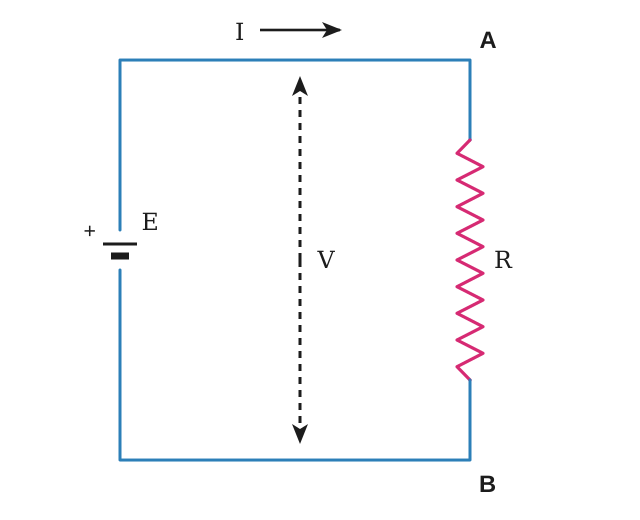
Consider a circuit consisting of a battery of emf $E$ connected in series with a resistance $R$. A steady current $I$ flows and a steady potential difference $V$ exists between the terminals of the resistor.
A battery of emf E driving a steady current through a resistance R

Work Done by the Battery

The battery is continuously lifting charge uphill through the potential difference $V$, so the work done in moving a charge $Q$ up through it is
$$W=VQ$$
This is the energy supplied by the battery.

Power Dissipated

The power supplied by the battery is dissipated in the resistor. By the principle of conservation of energy, the power dissipated in the resistor is given by the same relation.

Other Forms

In Terms of Current

$$P=VI=(IR)I=I^2R$$

In Terms of Potential Difference

$$P=VI=V\left(\frac{V}{R}\right)=\frac{V^2}{R}$$

Three Equations

$$P=VI=I^2R=\frac{V^2}{R}$$

Unit

If $V$ is in volts and $I$ in amperes, the power is expressed in watts.

Short Questions

SQ 9.14.1

Write the three equations for the power dissipated in a resistor and say when each is convenient.

The Three

$$P=VI$$
$$P=I^2R$$
$$P=\frac{V^2}{R}$$

Use

The first when both $V$ and $I$ are known, the second when the current is known and the third when the voltage is known.
SQ 9.14.2

A resistor is connected across a fixed supply. What happens to the power dissipated if its resistance is doubled?

It Halves

At a fixed voltage
$$P=\frac{V^2}{R}$$
So the power is inversely proportional to the resistance and falls to half.
SQ 9.14.3

Why is the power supplied by the battery equal to the power dissipated in the resistor?

Conservation of Energy

The steady current carries away no energy of its own, so all the energy the battery supplies per second must be dissipated in the resistor.
MCQ 9.14.1

The power dissipated in a resistor is not given by:

A$P=VI$B$P=I^2R$
C$P=I^2/R$D$P=V^2/R$
Solution:The correct form with the current is $P=I^2R$.
MCQ 9.14.2

A 6 V supply drives 2 A through a lamp. The power used is:

A3 WB12 W
C0.33 WD8 W
Solution:$P=VI=6\times2$.
MCQ 9.14.3

At a fixed voltage, doubling the resistance of a heater:

Ahalves the powerBdoubles the power
Cleaves the power unchangedDquadruples the power
Solution:$P=V^2/R$.
MCQ 9.14.4

At a fixed current, doubling the resistance:

Ahalves the powerBleaves the power unchanged
Cquadruples the powerDdoubles the power
Solution:$P=I^2R$.
Topic 9.15

Electromotive Force and Potential Difference

Electromotive Force

Definition

The emf $E$ of the source is defined as the energy supplied to unit charge by the cell.
$$E=\frac{W}{Q}$$

Source

A source of electrical energy, say a cell or a battery, when connected across a resistance, maintains a steady current through it. The cell continuously supplies energy which is dissipated in the resistance of the circuit.

Work of the Cell

A charge $Q$ passing through any cross-section of the circuit enters the cell at its low potential end and leaves at its high potential end. The source must supply energy $W$ to the positive charge to compel it to go to the point of high potential.

Not a Force

Electromotive force is not a force and we do not measure it in newtons. The unit of emf is the joule per coulomb, which is the volt.

Source of the Energy

The energy supplied by the cell to the charge carriers is derived from the conversion of chemical energy into electrical energy inside the cell.

Internal Resistance

Definition

Like other components in a circuit, a cell also offers some resistance. This resistance is due to the electrolyte present between the two electrodes of the cell and is called the internal resistance of the cell.

Equivalent Circuit

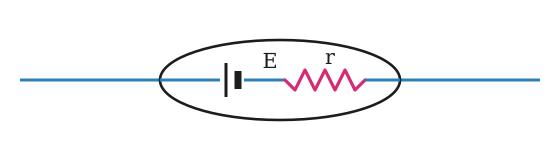
A cell of emf $E$ having an internal resistance $r$ is equivalent to a source of pure emf $E$ with a resistance $r$ in series.
An equivalent circuit of a cell of emf E and internal resistance r

Terminal Potential Difference

Definition

The potential difference across the terminals of a cell when a current $I$ is drawn from it is its terminal potential difference $V$. It is less than the emf by the drop $Ir$ across the internal resistance.

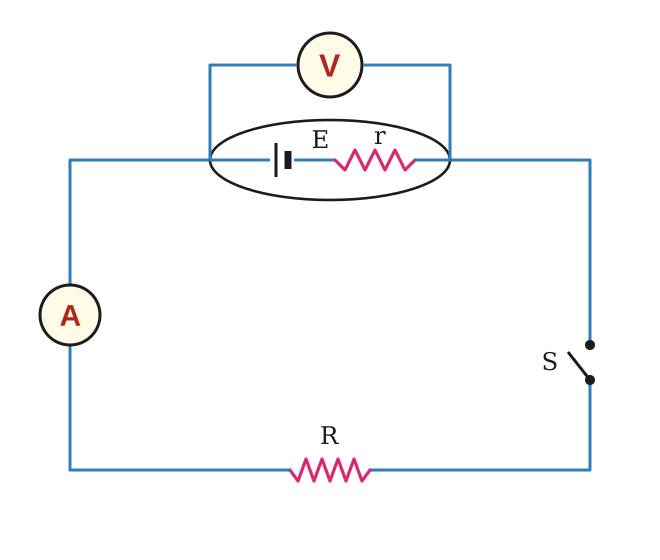
Circuit

A voltmeter of infinite resistance measures the potential difference $V$ across the terminals of the cell, and a resistance $R$ is connected across it through a switch.
The terminal potential difference of a cell measured on a closed circuit

Current

$$I=\frac{E}{R+r}$$

Terminal Voltage

$$E=IR+Ir$$
$$E=V+Ir$$
$$V=E-Ir$$
Here $V$ is the terminal potential difference of the cell in the presence of the current $I$.

On Open Circuit

When the switch is open no current passes through the resistance, so the voltmeter reads the emf as the terminal voltage. In the presence of a current the terminal voltage is less than the emf by $Ir$.

Energy Interpretation

The left side of the equation is the energy gained by unit charge as it passes through the cell from its negative to its positive terminal.
On the right side, a part of this energy equal to $Ir$ is dissipated inside the cell.
The rest is dissipated in the external resistance as the potential drop $IR$.

Emf and Potential Difference

Cause and Effect

The emf is the cause and the potential difference is its effect. The emf is always present even when no current is drawn, but the potential difference across the conductor is zero when no current flows through it.

Book Examples

Example 9.15.1

The potential difference between the terminals of a battery in open circuit is 2.2 V. When it is connected across a resistance of 5.0 $\Omega$ the potential falls to 1.8 V. Calculate the current and the internal resistance of the battery.

Given Data

$$E=2.2\,\mathrm{V}$$
$$R=5.0\,\Omega$$
$$V=1.8\,\mathrm{V}$$

To Find

The current $I=?$ and the internal resistance $r=?$

Formula

$$V=IR$$
$$E=V+Ir$$

Solution

On open circuit the terminal voltage is the emf, so the emf is 2.2 V. The current on load is
$$I=\frac{1.8}{5.0}=0.36\,\mathrm{A}$$
The internal resistance follows from the drop inside the cell.
$$2.2=1.8+0.36\,r$$
$$r=\frac{2.2-1.8}{0.36}=1.1\,\Omega$$

Result

$$I=0.36\,\mathrm{A}$$
$$r=1.1\,\Omega$$

Short Questions

SQ 9.15.1

Why is electromotive force not really a force?

Reason

It is the energy supplied to unit charge by the cell, so it is measured in joule per coulomb, that is, in volts, and not in newtons.
SQ 9.15.2

What causes the internal resistance of a cell?

The Electrolyte

It is due to the electrolyte present between the two electrodes of the cell.
SQ 9.15.3

A voltmeter across a cell reads 1.5 V on open circuit and 1.3 V on load. What do the two readings mean?

On Open Circuit

No current flows, so the reading is the emf of the cell.

On Load

The reading is the terminal potential difference, which is lower by the drop inside the cell.
$$V=E-Ir$$
SQ 9.15.4

Interpret the equation for a cell on load in terms of energy.

Energy Account

The left side is the energy given to unit charge by the cell.
$$E=IR+Ir$$
On the right, $Ir$ is dissipated inside the cell and $IR$ in the external resistance.
MCQ 9.15.1

The emf of a cell is the energy supplied to:

Aunit chargeBunit current
Cunit resistanceDunit time
Solution:Its unit is therefore the joule per coulomb, that is, the volt.
MCQ 9.15.2

The internal resistance of a cell is due to its:

AterminalsBconnecting wires
CelectrolyteDexternal resistor
Solution:It lies between the two electrodes.
MCQ 9.15.3

The terminal potential difference of a cell on load is:

A$E+Ir$B$E-Ir$
C$E/Ir$D$Ir-E$
Solution:The drop $Ir$ occurs inside the cell.
MCQ 9.15.4

A cell of emf 1.5 V and internal resistance 0.5 $\Omega$ drives 0.4 A. Its terminal voltage is:

A1.7 VB0.2 V
C1.5 VD1.3 V
Solution:$V=1.5-0.4\times0.5$.
MCQ 9.15.5

The terminal voltage of a cell equals its emf when:

Athe current is a maximumBno current is drawn
Cthe internal resistance is largeDthe external resistance is zero
Solution:With no current there is no drop across the internal resistance.
Topic 9.16

Kirchhoff’s Rules

LQ 2starts here — State and explain Kirchhoff’s rules.

Definition

Kirchhoff’s rules are two fundamental principles in circuit analysis that help to determine the current and the voltage in electrical circuits. They are particularly useful for analysing complex circuits that cannot be simplified by Ohm’s law and series or parallel combinations.

Kirchhoff’s First Rule

Statement

The sum of all the currents meeting at a point in the circuit is zero.
$$\sum I=0$$

Sign Convention

A current flowing towards a point is taken as positive.
A current flowing away from a point is taken as negative.

Example

With $I_1$ and $I_2$ flowing into the point $A$ and $I_3$ and $I_4$ flowing away from it
Four currents meeting at a point in a circuit
$$I_1+I_2+(-I_3)+(-I_4)=0$$
$$I_1+I_2=I_3+I_4$$

In Other Words

The sum of all the currents flowing towards a point is equal to the sum of all the currents flowing away from the point.

Conservation of Charge

Kirchhoff’s first rule, also known as the point rule, is a manifestation of the law of conservation of charge. If there is no sink or source of charge at a point, the total charge flowing towards the point must equal the total charge flowing away from it.

Kirchhoff’s Second Rule

Statement

The algebraic sum of the voltage changes in a closed circuit or a loop must be equal to zero.
$$\sum \Delta V=0$$

Energy of the Charge

A voltage change is equal to the work done on a unit positive charge, or the energy gained or lost by it, in moving from one point to the other.
A closed circuit with two cells and two resistances

Going Round the Loop

Passing through the cell $E_1$ from low to high potential, the charge gains energy $E_1Q$.
Passing through the cell $E_2$ from high to low potential, it loses energy $E_2Q$.
Going through the resistor $R_1$ it loses energy $IR_1Q$.
Going through the resistor $R_2$ it loses energy $IR_2Q$.

Conservation of Energy

$$E_1Q-IR_1Q-E_2Q-IR_2Q=0$$
$$E_1-IR_1-E_2-IR_2=0$$
The algebraic sum of the potential changes in a closed circuit is zero. This rule is a particular way of stating the law of conservation of energy.

Sign Conventions

The sign of the potential change across a cell and across a resistor

Across a Source

If a source of emf is traversed from the negative to the positive terminal, the potential change is positive. It is negative in the opposite direction.

Across a Resistor

If a resistor is traversed in the direction of the current, the change in potential is negative. It is positive in the opposite direction.

Procedure for Solving Circuit Problems

Steps

Draw the circuit diagram.
Choose the loops so that each resistance is included at least once in the selected loops.
Assume a loop current in each loop, all the loop currents in the same sense, either clockwise or anticlockwise.
Write the loop equations for all the selected loops.
Solve these equations for the unknown quantities.

Shared Resistance

Where a resistance is common to two loops, the current of the loop being worked is taken as positive and the current of the other loop as negative.
LQ 2ends here

Book Examples

Example 9.16.1

Calculate the currents in the three resistances of the circuit shown, where $R_1=10\ \Omega$, $R_2=30\ \Omega$, $R_3=15\ \Omega$, $E_1=40$ V, $E_2=60$ V and $E_3=50$ V.

Given Data

$$R_1=10\,\Omega$$
$$R_2=30\,\Omega$$
$$R_3=15\,\Omega$$
$$E_1=40\,\mathrm{V}$$
$$E_2=60\,\mathrm{V}$$
$$E_3=50\,\mathrm{V}$$

Diagram

A two-loop circuit solved with Kirchhoff’s rules

To Find

The current through each resistance

Formula

$$\sum \Delta V=0$$

Solution

Two loops $abcda$ and $ebcfe$ are chosen so that each resistance is included at least once, and clockwise loop currents $I_1$ and $I_2$ are assumed. Applying the second rule to the loop $abcda$
$$-E_1-I_1R_1-(I_1-I_2)R_2+E_2=0$$
Putting the values
$$-40-10I_1-30(I_1-I_2)+60=0$$
$$4I_1-3I_2=2$$
Applying the second rule to the loop $ebcfe$
$$-E_3-(I_2-I_1)R_2-I_2R_3+E_2=0$$
Putting the values
$$-50-30(I_2-I_1)-15I_2+60=0$$
$$6I_1-9I_2=-2$$
Solving the two equations
$$I_1=\frac{2}{3}=0.66\,\mathrm{A}$$
$$I_2=\frac{2}{9}=0.22\,\mathrm{A}$$
The actual current in the shared resistance is the difference of the two loop currents.
$$I_1-I_2=0.66-0.22=0.44\,\mathrm{A}$$

Result

The current through $R_1$ is 0.66 A, through $R_2$ is 0.44 A and through $R_3$ is 0.22 A.

Short Questions

SQ 9.16.1

Which conservation law does each of Kirchhoff’s rules express?

First Rule

The conservation of charge, since no charge accumulates at a point.

Second Rule

The conservation of energy, since a charge taken round a loop returns with the energy it started with.
SQ 9.16.2

State the sign convention for the potential change across a source of emf.

Traversed − to +

The potential change is positive.

Traversed + to −

The potential change is negative.
SQ 9.16.3

State the sign convention for the potential change across a resistor.

Along the Current

The change in potential is negative.

Against the Current

The change in potential is positive.
SQ 9.16.4

Why must all the loop currents be assumed in the same sense?

Reason

A single consistent sense makes the sign of a shared resistance unambiguous: the current of the loop being worked is taken as positive and the other as negative in every loop equation.
SQ 9.16.5

How is the actual current through a resistance shared by two loops found?

As a Difference

It is the difference of the two loop currents, and its direction is that of the larger current.
MCQ 9.16.1

Kirchhoff’s first rule follows from the conservation of:

AenergyBmomentum
CmassDcharge
Solution:No charge accumulates at a point in the circuit.
MCQ 9.16.2

Kirchhoff’s second rule follows from the conservation of:

AchargeBmomentum
CenergyDcurrent
Solution:A charge taken round a loop returns with the energy it started with.
MCQ 9.16.3

Traversing a source of emf from its positive to its negative terminal, the potential change is:

ApositiveBnegative
CzeroDequal to $IR$
Solution:It is positive in the opposite direction.
MCQ 9.16.4

Traversing a resistor in the direction of the current, the change in potential is:

AnegativeBpositive
CzeroDequal to the emf
Solution:The charge falls from high to low potential across the resistor.
MCQ 9.16.5

Three currents of 2 A and 3 A flow into a node and one of 4 A flows out. The remaining current out of the node is:

A1 AB5 A
C9 AD3 A
Solution:The current in must equal the current out.
Topic 9.17

Wheatstone Bridge

LQ 3starts here — What is a Wheatstone bridge? Explain its working with the help of a diagram.

Definition

The Wheatstone bridge is an electric circuit of four resistances connected in a closed mesh, with a battery across one pair of opposite corners and a sensitive galvanometer across the other pair. It is used to find an unknown resistance.

Circuit

The Wheatstone bridge consists of four resistances $R_1,\,R_2,\,R_3$ and $R_4$ connected so as to form a mesh $ABCDA$. A battery is connected between the points $A$ and $C$, and a sensitive galvanometer of resistance $R_g$ is connected between the points $B$ and $D$.
The Wheatstone bridge circuit

Condition Sought

If the switch is closed a current will flow through the galvanometer. We have to find the condition under which no current flows through the galvanometer even after the switch is closed.

Kirchhoff’s Second Rule

Taking anticlockwise loop currents $I_1$ and $I_2$

Loop ABDA

$$-I_1R_1-(I_1-I_2)R_g+I_1R_3=0$$

Loop BCDB

$$-I_2R_2+I_2R_4+(I_1-I_2)R_g=0$$

Balance Condition

The current through the galvanometer is zero when the two loop currents are equal.
$$I_1-I_2=0$$
$$I_1=I_2$$
The two loop equations reduce to
$$I_1R_1=I_1R_3$$
$$I_2R_2=I_2R_4$$
Dividing the two
$$\frac{R_1}{R_2}=\frac{R_3}{R_4}$$
$$\frac{R_1}{R_3}=\frac{R_2}{R_4}$$

Conclusion

Whenever this condition is satisfied, no current flows through the galvanometer and it shows no deflection. Conversely, when the galvanometer shows no deflection, the condition is satisfied.

Use

If three resistances of known adjustable values are used with a fourth of unknown value, and the known ones are adjusted until the galvanometer shows no deflection, then the unknown resistance can be determined from the three known ones.
LQ 3ends here

Short Questions

SQ 9.17.1

What is the balance condition of a Wheatstone bridge?

Condition

No current flows through the galvanometer when the two ratios are equal.
$$\frac{R_1}{R_3}=\frac{R_2}{R_4}$$
SQ 9.17.2

Why does the resistance of the galvanometer not matter at balance?

Reason

At balance no current passes through the galvanometer, so its resistance drops out of the equations altogether.
SQ 9.17.3

How is an unknown resistance measured with a Wheatstone bridge?

Method

Three resistances of known adjustable value are used with the unknown one. They are adjusted until the galvanometer shows no deflection, and the unknown is then found from the balance condition.
MCQ 9.17.1

At balance in a Wheatstone bridge:

Athe galvanometer reads a maximumBthe battery current is zero
Cno current flows through the galvanometerDall four resistances are equal
Solution:The two ends of the galvanometer are then at the same potential.
MCQ 9.17.2

The Wheatstone bridge is used to measure:

Aan unknown resistanceBan unknown current
Cthe internal resistance of a cellDan unknown power
Solution:Three known adjustable resistances are used with the unknown one.
MCQ 9.17.3

The Wheatstone bridge is analysed using:

AGauss’s lawBCoulomb’s law
CKirchhoff’s second ruleDthe principle of superposition
Solution:Two loops are taken and their voltage equations written.
MCQ 9.17.4

In a balanced bridge with $R_1=10\ \Omega$, $R_2=20\ \Omega$ and $R_3=30\ \Omega$, the fourth resistance is:

A15 $\Omega$B60 $\Omega$
C40 $\Omega$D5 $\Omega$
Solution:From $R_1/R_3=R_2/R_4$, $R_4=R_2R_3/R_1$.
Topic 9.18

Potentiometer

LQ 5starts here — What is a potentiometer? Describe its working.

Potentiometer

Definition

A potentiometer is an instrument mainly used to compare potential differences and to find the value of an unknown resistance. It works on the principle of the Wheatstone bridge, and measures a potential difference without drawing any current from it.

Limitation of a Voltmeter

A voltmeter is connected across the two points between which the potential difference is to be measured. Its resistance must be large compared to the circuit resistance, otherwise an appreciable current flows through it, which alters the circuit current and the potential difference being measured.

Ideal Voltmeter

A voltmeter can read the correct potential difference only when it does not draw any current from the circuit. An ideal voltmeter would have an infinite resistance.

Other Instruments

A digital voltmeter and a cathode-ray oscilloscope practically do not draw any current because of their large resistance, so they are very accurate, but these instruments are very expensive.

Potential Divider

Definition

A resistance wire with a sliding contact, connected across a battery so that any part of the battery voltage, from zero to $E$, can be taken between one end and the contact, is called a potential divider.

Construction

A potentiometer consists of a resistor $R$ in the form of a wire on which a terminal $C$ can slide. The resistance between $A$ and $C$ can be varied from zero to $R$ as the sliding contact is moved from $A$ to $B$.
A potential divider: the drop between A and C changes as C is moved

Potential Drop

If a battery of emf $E$ is connected across $R$, the current flowing through it is
$$I=\frac{E}{R}$$
Representing the resistance between $A$ and $C$ by $r$, the potential drop between these points is
$$V=Ir=\frac{rE}{R}$$

Range

As $C$ is moved from $A$ to $B$ the resistance $r$ varies from zero to $R$, so the potential drop between $A$ and $C$ changes from zero to E.

Measurement of an Unknown emf

Circuit

Here $R$ is in the form of a straight wire of uniform area of cross-section. The cell whose emf $E_x$ is to be measured is connected between $A$ and the sliding contact $C$ through a galvanometer. The positive terminal of $E_x$ and that of the potential divider are connected to the same point $A$.
Measuring an unknown emf by the null method with a potentiometer

Null Condition

If the point $C$ and the negative terminal of $E_x$ are at the same potential, the two terminals of the galvanometer are at the same potential and no current flows through the galvanometer. The position of $C$ is adjusted until the galvanometer shows no deflection.

Result

Under this condition the emf $E_x$ is equal to the potential difference between $A$ and $C$
$$E_x=\frac{rE}{R}$$

In Terms of Length

For a wire of uniform cross-section the resistance is proportional to the length of the wire, so
$$E_x=\frac{\ell E}{L}$$

Symbols

$L$ is the total length of the wire $AB$.
$\ell$ is the length from $A$ to $C$ after $C$ has been adjusted for no deflection.

Limit

The maximum potential that can be obtained between $A$ and $C$ is $E$, so the unknown emf must not exceed this value, otherwise the null condition will not be obtained.

Accuracy

The unknown emf is determined when no current is drawn from it, so the potentiometer is one of the most accurate methods for measuring potential.

Comparison of emfs of Two Cells

Balancing Lengths

The balancing lengths $\ell_1$ and $\ell_2$ are found separately for the two cells.
$$E_1=\frac{\ell_1E}{L}$$
$$E_2=\frac{\ell_2E}{L}$$

Ratio

Dividing the two equations
$$\frac{E_1}{E_2}=\frac{\ell_1}{\ell_2}$$
So the ratio of the emfs is equal to the ratio of the balancing lengths.
LQ 5ends here

Short Questions

SQ 9.18.1

Why can an ordinary voltmeter not read a potential difference exactly?

Reason

It draws some current from the circuit, which alters both the circuit current and the very potential difference being measured. An ideal voltmeter would have infinite resistance.
SQ 9.18.2

Why is the potentiometer one of the most accurate ways of measuring an emf?

Reason

At the null point no current is drawn from the cell being measured, so there is no drop across its internal resistance and its full emf is balanced.
SQ 9.18.3

Why must the unknown emf not exceed the emf of the driver cell?

Reason

The largest potential the divider can provide between $A$ and $C$ is the driver emf. A larger unknown emf can never be balanced, so the null condition would never be reached.
SQ 9.18.4

How are the emfs of two cells compared with a potentiometer?

By Balancing Lengths

The balancing length is found separately for each cell.
$$\frac{E_1}{E_2}=\frac{\ell_1}{\ell_2}$$
So the ratio of the emfs equals the ratio of the balancing lengths.
MCQ 9.18.1

A potentiometer works on the principle of the:

AGauss lawBWheatstone bridge
COhm lawDFaraday cage
Solution:Both are null methods.
MCQ 9.18.2

An ideal voltmeter would have a resistance of:

AzeroBone ohm
Cthe same value as the circuitDinfinity
Solution:Then it would draw no current from the circuit.
MCQ 9.18.3

With a potentiometer wire of uniform cross-section, the unknown emf is proportional to the:

Atotal lengthBarea of the wire
Cresistance of the galvanometerDbalancing length
Solution:Resistance is proportional to length for a uniform wire.
MCQ 9.18.4

Two cells balance at 40 cm and 60 cm on the same potentiometer. The ratio of their emfs is:

A2 : 3B3 : 2
C4 : 10D1 : 1
Solution:The ratio of the emfs equals the ratio of the balancing lengths.
MCQ 9.18.5

A potentiometer measures an emf accurately because at balance it draws:

Ano current from the cellBa very large current
Ca constant currentDthe same current as the driver cell
Solution:So there is no drop across the cell’s internal resistance.
Topic 9.19

Use of a Galvanometer

Definition

A galvanometer is an instrument for detecting a current. It is often used in null methods to achieve precise measurements in electrical circuits.

Null Method

The null method involves adjusting the circuit until the galvanometer shows no deflection, that is, a zero reading. This indicates that certain required conditions are met in the circuit.

At the Null Point

In this state the electric potentials at both ends of the galvanometer are the same. Although a galvanometer has its own resistance, at the null reading its resistance does not come into play, because no current is passing through it.

Applications

The null method is widely used in bridge circuits such as the Wheatstone bridge and the potentiometer.

In the Wheatstone Bridge

The galvanometer is connected between the mid-points of opposite sides. The variable resistance is adjusted until the galvanometer shows no deflection. At this point the bridge is balanced and the unknown resistance can be calculated from the ratio of the known resistances.

In the Potentiometer

An unknown voltage is measured by comparison with a known reference voltage applied across the resistance wire. A galvanometer and a jockey are used to make contact along the wire, and at the null point the potential difference between the jockey and the end of the wire equals the unknown voltage. The position of the jockey gives the measure of the unknown voltage.

Advantages of the Null Method

It eliminates the effect of the galvanometer’s internal resistance on the measurement, giving more accurate readings.
Galvanometers are highly sensitive and can detect currents of the order of $10^{-9}$ A.
No deflection indicates a direct and clear condition of balance, making the null point easy to identify.

Short Questions

SQ 9.19.1

What is a null method?

Null Method

Adjusting a circuit until the galvanometer shows no deflection, which shows that the required condition of balance has been met.
SQ 9.19.2

Give two advantages of using a galvanometer in a null method.

Accuracy

It eliminates the effect of the galvanometer’s own internal resistance on the measurement.

Sensitivity

A galvanometer can detect currents of the order of $10^{-9}$ A, so the balance point is found precisely.
SQ 9.19.3

What is true of the potentials at the two ends of the galvanometer at the null point?

They Are Equal

The two ends are at the same potential, which is why no current passes through the instrument.
MCQ 9.19.1

A galvanometer is an instrument for:

Aproducing a currentBstoring charge
Cdetecting a currentDmeasuring resistance directly
Solution:In a null method it is used to detect the absence of a current.
MCQ 9.19.2

A galvanometer can detect currents of the order of:

A$10^{-3}$ AB1 A
C$10^{-9}$ AD$10^{3}$ A
Solution:This high sensitivity is what makes the null point sharp.
MCQ 9.19.3

At the null point the resistance of the galvanometer does not matter because:

Ano current passes through itBits resistance is zero
Cits resistance is infiniteDit is short circuited
Solution:A resistance carrying no current produces no potential drop.
MCQ 9.19.4

The null method is used in:

Aan ammeterBa voltmeter
Ca rheostatDthe Wheatstone bridge and the potentiometer
Solution:Both are balanced until the galvanometer reads zero.
Topic 9.20

Thermistors

Thermistor

Definition

A thermistor is a heat sensitive resistor.

Temperature Coefficient

Most thermistors have a negative temperature coefficient of resistance, that is, their resistance decreases when their temperature is increased. Thermistors with a positive temperature coefficient are also available.

Symbol

Circuit symbols for a thermistor

Why the Resistance Falls

Increasing temperature provides more energy to the charge carriers, the electrons or the holes, enabling them to move more freely, which reduces the resistance.

Construction

Thermistors are made by heating under high pressure a semiconductor ceramic made from mixtures of the metallic oxides of manganese, nickel, cobalt, copper and iron. These are pressed into the desired shapes and then baked at a high temperature. They may be in the form of beads, rods or washers.

Applications of Thermistors

Temperature Measurement

Thermistors are used in thermometers and in electric devices such as air conditioners, refrigerators, heaters, microwave ovens and incubators, to monitor temperature.

Low Temperatures

Thermistors with a high negative temperature coefficient are very accurate for measuring low temperatures, especially near 10 K, because the higher resistance at low temperature makes a more accurate measurement possible.

Temperature Sensors

They convert changes of temperature into an electrical voltage which is duly processed. They are used in the coolant temperature sensors of automobile engines to prevent overheating, and in digital thermometers.

Temperature Compensation

Thermistors are used in circuits where temperature changes could affect performance, such as oscillators, battery charging circuits and power systems.

Inrush Current Limiting

They are used to limit the initial flow of current when a device is first turned on.

Voltage Divider

A thermistor used as a potential divider
When the temperature of the thermistor increases, its resistance decreases, which decreases the voltage drop across the thermistor. As a result the potential at the point $B$ increases, and this can be used to trigger a circuit connected to it.

Fire Alarm

In a fire alarm the use of a thermistor turns the NOT gate low when it gets heated. The output of the NOT gate goes high and turns the siren on.

Short Questions

SQ 9.20.1

Why does the resistance of a thermistor fall as its temperature rises?

Reason

The rise in temperature gives more energy to the charge carriers, the electrons and the holes, so more of them are free to move and the resistance falls.
SQ 9.20.2

How is a thermistor made?

Manufacture

A semiconductor ceramic made from mixtures of the metallic oxides of manganese, nickel, cobalt, copper and iron is heated under high pressure, pressed into shape and baked at a high temperature. Beads, rods and washers are the usual shapes.
SQ 9.20.3

Why is a thermistor with a high negative temperature coefficient good for measuring very low temperatures?

Reason

At low temperature its resistance is high, and a large resistance can be measured more precisely, so the temperature reading near 10 K is more accurate.
SQ 9.20.4

Explain how a thermistor works in a fire alarm.

Working

Heat lowers the thermistor’s resistance, so the potential at the divider’s mid-point rises. This takes the input of the NOT gate low, its output goes high and the siren is turned on.
MCQ 9.20.1

A thermistor is a resistor that is sensitive to:

AlightBheat
CsoundDpressure
Solution:The light sensitive one is the LDR.
MCQ 9.20.2

Most thermistors have a temperature coefficient of resistance that is:

ApositiveBzero
CnegativeDinfinite
Solution:Their resistance falls as the temperature rises.
MCQ 9.20.3

Thermistors are made from mixtures of the oxides of:

Amanganese, nickel and cobaltBsodium and potassium
Csilicon and carbonDlead and tin
Solution:Copper and iron oxides are also used.
MCQ 9.20.4

A thermistor with a high negative temperature coefficient is best for measuring:

Avery high temperaturesBvery low temperatures
Clight intensityDpressure
Solution:The high resistance at low temperature makes the reading more accurate.
MCQ 9.20.5

In a thermistor potential divider, heating the thermistor makes the potential at the mid-point:

AfallBstay the same
Cbecome zeroDrise
Solution:Its resistance falls, so the drop across it falls.
Topic 9.21

Light Dependent Resistor

LQ 4starts here — What is a light dependent resistor (LDR)? How can this be used as an ON-OFF switch for lighting?

Light Dependent Resistor

Definition

A light dependent resistor (LDR) is a resistor whose resistance decreases with increasing light intensity. Because of this property it is also known as a photo resistor.

Material

LDRs are typically made from a semiconductor material such as cadmium sulphide, deposited in a special pattern on an insulating plate.

Working Principle

The principle used is the increase in the conductivity of the material on exposing it to light.

In Darkness

The semiconductor material has few free electrons, which results in a high resistance.

In Light

When light photons hit the material, they transfer energy to the electrons in the outer orbits, making them free to conduct electricity, which decreases the resistance.

Rule

The amount of light hitting the surface determines the number of free electrons. Less light means fewer free electrons and hence a higher resistance. This change in resistance can be measured and used in circuits to sense light levels.

Applications of LDRs

Light Sensors

LDRs are used in light sensing circuits such as automatic lighting systems in homes and street lights. An LDR works just like a switch that turns on at dusk and off at dawn.

Camera Exposure Control

LDRs help in adjusting the exposure time in cameras based on the amount of available light.

Voltage Divider

A light dependent resistor used as a potential divider
In the dark the LDR has a very high resistance compared with the standard resistance of 100 kΩ in the circuit, so the voltage drop across the LDR is very large. When the LDR is exposed to light its resistance falls to a very low value and the voltmeter registers a lower reading.

As a Switch

A change in light intensity therefore gives rise to a change in voltage, so by connecting the mid-point $B$ to a NOT gate the LDR can be used as a switch.
LQ 4ends here

Reliability of a Concrete Bridge

Principle

Inspectors can easily check the reliability of a concrete bridge with the help of carbon fibres embedded in its slab, because carbon fibres are good conductors of electricity due to their high carbon content.

Method

The carbon fibres are embedded within the slab during construction and connected to form a conductor network.
A small electric current is applied to the network, and the integrity of the structure is determined by measuring the resistance of the network.
If the resistance remains the same over time, the bridge is maintaining its structural integrity.
If the resistance increases, the concrete is deteriorating or the carbon fibres are being damaged.

Other Methods

Other sensors continuously monitor strain, vibration and temperature, and internal flaws such as cracks or voids are detected using ultrasound waves.

Short Questions

SQ 9.21.1

Why does the resistance of an LDR fall when light shines on it?

Reason

The light photons transfer energy to the electrons in the outer orbits, making them free to conduct. More free electrons mean a lower resistance.
SQ 9.21.2

What material is an LDR usually made from?

Material

A semiconductor such as cadmium sulphide, deposited in a special pattern on an insulating plate.
SQ 9.21.3

What reading does a voltmeter across an LDR give in the dark, and why?

A Large Reading

In the dark the LDR’s resistance is very high compared with the fixed resistance, so most of the supply voltage is dropped across the LDR.
SQ 9.21.4

How do carbon fibres let an inspector judge a concrete bridge?

Method

The fibres conduct electricity, so a small current is passed through the embedded network and its resistance is measured.

Reading It

A steady resistance means the structure is sound; a rising resistance means the concrete is deteriorating or the fibres are breaking.
MCQ 9.21.1

The resistance of an LDR:

Aincreases as the light gets brighterBdecreases as the light gets brighter
Cdoes not depend on the lightDfalls to zero in the dark
Solution:That is why it is also called a photo resistor.
MCQ 9.21.2

An LDR is usually made from:

AcopperBcarbon
CtungstenDcadmium sulphide
Solution:It is deposited in a special pattern on an insulating plate.
MCQ 9.21.3

An LDR used in a street light acts as a switch that turns the lamp:

Aon at dawn and off at duskBon at dusk and off at dawn
Con all dayDoff all night
Solution:Its resistance rises as the light fails.
MCQ 9.21.4

Carbon fibres embedded in a concrete bridge are used because they:

Aare transparentBconduct electricity
Care magneticDexpand with heat
Solution:A rise in the network resistance shows that the concrete is deteriorating.
MCQ 9.21.5

Internal flaws such as cracks or voids in a bridge are detected using:

Aultrasound wavesBX-rays
Cradio wavesDmicrowaves
Solution:Other sensors continuously monitor strain, vibration and temperature.

Chapter Exercise

SQ 9.1

How does a moving conductor like an aeroplane acquire charge as it flies through the air? Describe briefly.

Charging by Friction

While flying, the body of the aeroplane rubs against air, dust and ice particles. Electrons shift by this friction, so the aeroplane is left charged.

On the Surface

This excess charge resides on its outer surface, and the metal frame acts as a Faraday cage that keeps the passengers safe.
SQ 9.2

Define electric intensity and electric potential.

Electric Intensity

The force experienced by a unit positive charge placed at that point. It is a vector.
$$E=\frac{F}{q}$$

Electric Potential

The work done in carrying a unit positive charge to that point while keeping electrostatic equilibrium.
$$V=\frac{W}{q}$$
SQ 9.3

A battery is rated at 100 A h (ampere-hour). How much charge can this battery supply?

Given Data

The rating is $100\,\mathrm{A\,h}$, and one hour is $3600\,\mathrm{s}$.

Formula

$$Q=It$$

Solution

$$Q=(100)(3600)$$
$$Q=3.6\times10^5\,\mathrm{C}$$
SQ 9.4

Is electron-volt a unit of potential difference or energy? Explain.

Energy

The electron-volt is a unit of energy and not of potential difference.

Definition

It is the energy acquired or lost by an electron as it traverses a potential difference of one volt.
$$1\,\mathrm{eV}=1.6\times10^{-19}\,\mathrm{J}$$
SQ 9.5

A copper wire of length $L$ has resistance $R$. It is stretched to double of its length. What will be the resistance of the new length of wire?

Formula

$$R=\rho\frac{L}{A}$$

On Stretching

The volume stays the same, so on doubling the length the area of cross-section becomes half.

New Resistance

$$R^\prime=\rho\frac{2L}{A/2}=4R$$
Thus the resistance becomes four times.
SQ 9.6

Why does the resistance of a conductor rise with increase in temperature?

Reason

On heating, the amplitude of vibration of the atoms of the lattice increases.

Collisions

The atoms then offer a bigger target, so their collisions with the free electrons become more frequent.

Result

The flow of electrons is opposed more, so the resistance increases.
$$R_t=R_o(1+\alpha\,\Delta T)$$
SQ 9.7

Is the filament resistance lower or higher in a 500 W–220 V light bulb than in a 100 W–220 V bulb?

Formula

$$P=\frac{V^2}{R}\quad\text{or}\quad R=\frac{V^2}{P}$$

Conclusion

At the same voltage the resistance is inversely proportional to the power.
So the 500 W bulb has the lower filament resistance, one-fifth that of the 100 W bulb.
SQ 9.8

Why does resistance of a thermistor changes as temperature increases?

Thermistor

It is a heat sensitive resistor, and most thermistors have a negative temperature coefficient.

Reason

A rise in temperature gives more energy to the charge carriers, the electrons and holes, so they move more freely.

Result

Therefore the resistance decreases as the temperature increases.
$$R_t=R_o(1+\alpha\,\Delta T)$$
SQ 9.9

Which materials can be used to construct Faraday’s cage and why?

Materials

Conductors such as copper, aluminium and other metals, or a metal mesh.

Reason

A Faraday cage needs a material having plenty of free electrons that can move to its surface. The excess charge then settles so that the field inside is zero.

Insulators

They have no free electrons, so they cannot be used.
CRQ 9.1

Electric lines of force never cross each other. Why?

Direction of Field

The tangent to a line of force gives the direction of E at that point.

If They Crossed

There would be two directions of the electric field at the point of crossing.

Conclusion

A single point cannot have two field directions, so the lines never cross.
CRQ 9.2

Is $E$ necessarily zero inside a charged rubber balloon if the balloon is spherical? Assume that charge is distributed uniformly over the surface.

Yes

The electric intensity inside is zero.

Reason

Draw a closed surface inside the balloon and apply Gauss’s law. It encloses no charge, as all the charge lies on the spherical surface.
$$\phi_e=\frac{Q}{\varepsilon_o}=0$$
So a uniformly charged spherical shell gives no field at any interior point.
CRQ 9.3

Electrostatic force is $10^{39}$ times stronger than gravitational force. Argue that our galaxy should be almost electrically neutral.

Argument

If a galaxy carried a small excess charge, its electrostatic repulsion would be about $10^{39}$ times the gravitational attraction.

Result

Such a huge repulsion would blow the galaxy apart.

Conclusion

Galaxies are in fact held together by gravity, so their positive and negative charges must balance almost exactly.
CRQ 9.4

An uncharged conducting hollow sphere is placed in the field of a positive charge $q$. What will be the net flux through the shell?

Zero

The net flux through the shell is zero.

Reason

By Gauss’s law the flux depends only on the charge enclosed by the surface.
$$\phi_e=\frac{Q}{\varepsilon_o}$$
Here the shell is uncharged and the charge $q$ lies outside it, so no charge is enclosed.
CRQ 9.5

A potential difference is applied across the ends of a copper wire. What is the effect on the drift velocity of free electrons by (i) increasing the potential difference? (ii) decreasing the length and the temperature of the wire?

Relation

$$I=nAqv_d$$
The drift velocity rises with the current in the wire.

Increasing the Potential Difference

The current increases, so the drift velocity also increases.

Decreasing Length and Temperature

Both lower the resistance, so the current and the drift velocity increase.
CRQ 9.6

Why the terminal potential difference of a battery decreases when the current drawn from it is increased?

Terminal Voltage

A cell of emf $E$ has an internal resistance $r$ in series.
$$V=E-Ir$$

Reason

The drop $Ir$ inside the cell grows as the current increases, so more of the emf is used up inside the cell.

Result

The terminal potential difference falls. On open circuit, with no current, the voltmeter reads the full emf.
MCQ 9.1

Two point charges A and B are separated by 10 m. If the distance between them is reduced to 5 m, the force exerted on each:

Adecreases to half its original valueBincreases to twice the original value
Cdecreases to one quarter of its original valueDincreases four times its original value
Solution:Correct answer: (d) increases four times its original value.
MCQ 9.2

Which of the following charges is possible on a particle?

A$2.5\times10^{-19}$ CB$3.2\times10^{-19}$ C
C$1.6\times10^{-20}$ CD$6.02\times10^{23}$ C
Solution:Correct answer: (b) $3.2\times10^{-19}$ C.
MCQ 9.3

Which diagram best represents the electric field lines around two oppositely charged particles?

Alines running radially inward on both chargesBlines running radially outward from both charges
Clines running from the negative charge to the positive chargeDlines running from the positive charge to the negative charge
Solution:Correct answer: (d) lines running from the positive charge to the negative charge.
MCQ 9.4

What is the work done on an electron by a potential difference of 100 volts?

A$1.6\times10^{-19}$ eVB$1.6\times10^{-17}$ eV
C$6.25\times10^{-17}$ eVD100 eV
Solution:Correct answer: (d) 100 eV.
MCQ 9.5

The potential at a point situated at a distance of 50 cm from a charge of 50 $\mu$C is:

A$9\times10^{4}$ voltsB$18\times10^{4}$ volts
C$9\times10^{5}$ voltsD$18\times10^{5}$ volts
Solution:Correct answer: (c) $9\times10^{5}$ volts.
MCQ 9.6

A ball of weight 0.1 N having a charge of 100 $\mu$C remained suspended between two oppositely charged horizontal metal plates. The electric intensity between the plates is:

A10 N C$^{-1}$B100 N C$^{-1}$
C1000 N C$^{-1}$D10000 N C$^{-1}$
Solution:Correct answer: (c) 1000 N C$^{-1}$.
MCQ 9.7

A piece of wire has a resistance of 4 $\Omega$. It is doubled on itself so that its length becomes half but the area of cross-section is doubled. Its resistance now will be:

A8 $\Omega$B4 $\Omega$
C2 $\Omega$D1 $\Omega$
Solution:Correct answer: (d) 1 $\Omega$.
MCQ 9.8

The current through a conductor is 3.0 A when it is attached across a potential difference of 6.0 V. How much power is used?

A0.5 WB2.0 W
C9.0 WD18 W
Solution:Correct answer: (d) 18 W.
MCQ 9.9

The algebraic sum of potential changes for a complete circuit is zero. It is the statement of:

AOhm’s lawBGauss’s law
CKirchhoff’s first lawDKirchhoff’s second law
Solution:Correct answer: (d) Kirchhoff’s second law.
MCQ 9.10

The radius of curvature of the path of a charged particle in a uniform magnetic field is directly proportional to:

Athe particle’s chargeBthe particle’s momentum
Cthe particle’s energyDthe flux density of the field
Solution:Correct answer: (b) the particle’s momentum.
Numerical 9.1

Two unequal point charges repel each other with a force of 0.4 N when they are 5.0 cm apart. Find the force which each charge exerts on the other when they are (a) 2.5 cm apart (b) 15.0 cm apart. [Ans: (a) 1.6 N (b) 0.04 N]

Given Data

$$F_1=0.4\,\mathrm{N}$$
$$r_1=5.0\,\mathrm{cm}$$
$$r_2=2.5\,\mathrm{cm}$$
$$r_3=15.0\,\mathrm{cm}$$

To Find

The forces $F_2=?$ and $F_3=?$

Formula

The charges do not change, so the product $kq_1q_2$ is the same in every case.
$$Fr^2=\text{constant}$$
$$F_2=F_1\left(\frac{r_1}{r_2}\right)^2$$

Solution

At 2.5 cm the separation is halved, so
$$F_2=0.4\times\left(\frac{5.0}{2.5}\right)^2=0.4\times4=1.6\,\mathrm{N}$$
At 15.0 cm the separation is three times as great, so
$$\begin{aligned}F_3&=0.4\times\left(\frac{5.0}{15.0}\right)^2=\frac{0.4}{9} \\ &=0.04\,\mathrm{N}\end{aligned}$$

Result

$$F_2=1.6\,\mathrm{N}$$
$$F_3=0.04\,\mathrm{N}$$
Numerical 9.2

A particle of charge $+20\ \mu$C is placed between two parallel plates 10 cm apart and having a potential difference of 0.5 kV between them. Calculate the electric field between the plates, and the electric force exerted on the charged particle. (Ans: 5 kN C$^{-1}$, 100 mN)

Given Data

$$q=20\times10^{-6}\,\mathrm{C}$$
$$d=10\,\mathrm{cm}=0.10\,\mathrm{m}$$
$$V=0.5\,\mathrm{kV}=500\,\mathrm{V}$$

To Find

The field $E=?$ and the force $F=?$

Formula

$$E=\frac{V}{d}$$
$$F=qE$$

Solution

The field between the plates is
$$E=\frac{500}{0.10}=5000\,\mathrm{N\,C^{-1}}=5\,\mathrm{kN\,C^{-1}}$$
The force on the charge is
$$F=20\times10^{-6}\times5000=0.1\,\mathrm{N}=100\,\mathrm{mN}$$

Result

$$E=5\,\mathrm{kN\,C^{-1}}$$
$$F=100\,\mathrm{mN}$$
Numerical 9.3

The electron and proton in a hydrogen atom are separated on the average by a distance of approximately $5.3\times10^{-11}$ m. Find the ratio of the electric force to the gravitational force between the electron and the proton in this state. (Ans: $2.3\times10^{39}$)

Given Data

$$r=5.3\times10^{-11}\,\mathrm{m}$$
$$e=1.6\times10^{-19}\,\mathrm{C}$$
$$m_e=9.1\times10^{-31}\,\mathrm{kg}$$
$$m_p=1.67\times10^{-27}\,\mathrm{kg}$$

To Find

The ratio $F_e/F_g=?$

Formula

$$F_e=k\frac{e^2}{r^2}$$
$$F_g=G\frac{m_em_p}{r^2}$$
The separation is the same for both, so it cancels in the ratio.
$$\frac{F_e}{F_g}=\frac{ke^2}{Gm_em_p}$$

Solution

The numerator is
$$ke^2=9\times10^{9}\times(1.6\times10^{-19})^2=2.3\times10^{-28}$$
The denominator is
$$\begin{aligned}Gm_em_p&=6.67\times10^{-11}\times9.1\times10^{-31}\times1.67\times10^{-27} \\ &=1.01\times10^{-67}\end{aligned}$$
So the ratio is
$$\begin{aligned}\frac{F_e}{F_g}&=\frac{2.3\times10^{-28}}{1.01\times10^{-67}} \\ &=2.3\times10^{39}\end{aligned}$$

Result

$$\frac{F_e}{F_g}=2.3\times10^{39}$$
Numerical 9.4

After a pleasant shower, a water droplet of mass $1.2\times10^{-11}$ kg is located in the air near the ground. An atmospheric electric field of magnitude $6.0\times10^{4}$ N C$^{-1}$ points vertically downward in the vicinity of the droplet. The droplet remains suspended at rest in the air. Find the electric charge on the droplet. (Ans: $-1.96\times10^{-15}$ C)

Given Data

$$m=1.2\times10^{-11}\,\mathrm{kg}$$
$$E=6.0\times10^{4}\,\mathrm{N\,C^{-1}}$$
$$g=9.8\,\mathrm{m\,s^{-2}}$$

To Find

The charge $q=?$

Formula

The droplet hangs at rest, so the electric force balances its weight.
$$qE=mg$$
$$q=\frac{mg}{E}$$

Solution

Putting the values
$$\begin{aligned}q&=\frac{1.2\times10^{-11}\times9.8}{6.0\times10^{4}} \\ &=1.96\times10^{-15}\,\mathrm{C}\end{aligned}$$
The field points downward while the force on the droplet must point upward, so the charge is negative.

Result

$$q=-1.96\times10^{-15}\,\mathrm{C}$$
Numerical 9.5

An electron enters the region of a uniform electric field with $v_x=2.99\times10^{7}$ m s$^{-1}$ and $E=300$ N C$^{-1}$. The horizontal length of the plates is 10.0 cm. Find the acceleration of the electron while it is in the electric field, and how long it takes to pass through the field. (Ans: $5.27\times10^{13}$ m s$^{-2}$, $3.34\times10^{-9}$ s)

Given Data

$$v_x=2.99\times10^{7}\,\mathrm{m\,s^{-1}}$$
$$E=300\,\mathrm{N\,C^{-1}}$$
$$L=10.0\,\mathrm{cm}=0.10\,\mathrm{m}$$
$$e=1.6\times10^{-19}\,\mathrm{C}$$
$$m=9.1\times10^{-31}\,\mathrm{kg}$$

To Find

The acceleration $a=?$ and the time $t=?$

Formula

$$F=eE$$
$$a=\frac{eE}{m}$$
The horizontal component of the velocity is unchanged, so
$$t=\frac{L}{v_x}$$

Solution

The acceleration across the field is
$$\begin{aligned}a&=\frac{1.6\times10^{-19}\times300}{9.1\times10^{-31}} \\ &=5.27\times10^{13}\,\mathrm{m\,s^{-2}}\end{aligned}$$
The time spent between the plates is
$$t=\frac{0.10}{2.99\times10^{7}}=3.34\times10^{-9}\,\mathrm{s}$$

Result

$$a=5.27\times10^{13}\,\mathrm{m\,s^{-2}}$$
$$t=3.34\times10^{-9}\,\mathrm{s}$$
Numerical 9.6

A disc of area 10 cm$^2$ is placed in a vertical electric field $E=5\times10^{5}$ N C$^{-1}$. If the plane of the disc makes an angle of $30^{\circ}$ with the horizontal, determine the electric flux through the disc. (Ans: $250\sqrt{3}$ N m$^2$ C$^{-1}$)

Given Data

$$A=10\,\mathrm{cm^2}=1\times10^{-3}\,\mathrm{m^2}$$
$$E=5\times10^{5}\,\mathrm{N\,C^{-1}}$$

To Find

The flux $\phi_e=?$

Formula

$$\phi_e=EA\cos\theta$$

Solution

The plane of the disc is at $30^{\circ}$ to the horizontal, so its normal is at $30^{\circ}$ to the vertical field.
$$\theta=30^{\circ}$$
Putting the values
$$\phi_e=5\times10^{5}\times1\times10^{-3}\times\cos30^{\circ}$$
$$\phi_e=500\times0.866=433\,\mathrm{N\,m^2\,C^{-1}}$$

Result

$$\phi_e=250\sqrt{3}=433\,\mathrm{N\,m^2\,C^{-1}}$$
Numerical 9.7

A circular copper rod is 50 cm long and has 1 cm diameter. Find the resistance across its ends. What should be the side of the square cross-section of a 50 cm long tungsten rod if its resistance is the same? [Resistivity of copper is $1.69\times10^{-8}\ \Omega$ m and that of tungsten is $5.0\times10^{-8}\ \Omega$ m] (Ans: $1.08\times10^{-4}\ \Omega$, 1.52 cm)

Given Data

$$L=50\,\mathrm{cm}=0.50\,\mathrm{m}$$
$$d=1\,\mathrm{cm}=0.01\,\mathrm{m}$$
$$\rho_{Cu}=1.69\times10^{-8}\,\Omega\,\mathrm{m}$$
$$\rho_{W}=5.0\times10^{-8}\,\Omega\,\mathrm{m}$$

To Find

The resistance $R=?$ and the side $a=?$ of the tungsten rod

Formula

$$A=\pi r^2$$
$$R=\rho\frac{L}{A}$$

Solution

The area of cross-section of the copper rod is
$$A=\pi(0.005)^2=7.85\times10^{-5}\,\mathrm{m^2}$$
So its resistance is
$$\begin{aligned}R&=\frac{1.69\times10^{-8}\times0.50}{7.85\times10^{-5}} \\ &=1.08\times10^{-4}\,\Omega\end{aligned}$$
For the tungsten rod of the same resistance and length
$$\begin{aligned}A&=\frac{\rho_{W}L}{R}=\frac{5.0\times10^{-8}\times0.50}{1.08\times10^{-4}} \\ &=2.32\times10^{-4}\,\mathrm{m^2}\end{aligned}$$
The cross-section is a square, so
$$a=\sqrt{2.32\times10^{-4}}=0.0152\,\mathrm{m}=1.52\,\mathrm{cm}$$

Result

$$R=1.08\times10^{-4}\,\Omega$$
$$a=1.52\,\mathrm{cm}$$
Numerical 9.8

The copper winding of an electric fan has a resistance of 50 $\Omega$ at $30^{\circ}$C. After running for some time the resistance becomes 52 $\Omega$. How much is the increase in temperature of the winding? [For copper $\alpha=0.0039$ K$^{-1}$] (Ans: $10.3^{\circ}$C)

Given Data

$$R=50\,\Omega$$
$$R'=52\,\Omega$$
$$\alpha=0.0039\,\mathrm{K^{-1}}$$

To Find

The rise in temperature $\Delta t=?$

Formula

$$\Delta R=R\alpha\Delta t$$
$$\Delta t=\frac{\Delta R}{R\alpha}$$

Solution

The change in resistance is
$$\Delta R=52-50=2\,\Omega$$
So the rise in temperature is
$$\Delta t=\frac{2}{50\times0.0039}=10.3\,^{\circ}\mathrm{C}$$

Result

$$\Delta t=10.3\,^{\circ}\mathrm{C}$$
Numerical 9.9

During an experiment a copper wire 50 m long and 150 $\mu$m thick is hung vertically. Then a current of 1 A is passed across its ends for 50 s. Find the resistance of the wire and the heat dissipated during this process. [Resistivity of copper is $1.69\times10^{-8}\ \Omega$ m] (Ans: 47.8 $\Omega$, 2390 J)

Given Data

$$L=50\,\mathrm{m}$$
$$d=150\,\mu\mathrm{m}=150\times10^{-6}\,\mathrm{m}$$
$$I=1\,\mathrm{A}$$
$$t=50\,\mathrm{s}$$
$$\rho=1.69\times10^{-8}\,\Omega\,\mathrm{m}$$

To Find

The resistance $R=?$ and the heat $Q=?$

Formula

$$A=\pi r^2$$
$$R=\rho\frac{L}{A}$$
$$Q=I^2Rt$$

Solution

The area of cross-section is
$$A=\pi(75\times10^{-6})^2=1.77\times10^{-8}\,\mathrm{m^2}$$
So the resistance of the wire is
$$R=\frac{1.69\times10^{-8}\times50}{1.77\times10^{-8}}=47.8\,\Omega$$
The heat dissipated in 50 s is
$$Q=(1)^2\times47.8\times50=2390\,\mathrm{J}$$

Result

$$R=47.8\,\Omega$$
$$Q=2390\,\mathrm{J}$$
Numerical 9.10

The emf of a battery is 12 V. It is connected to a 3.6 $\Omega$ resistor. If the internal resistance of the battery is 0.2 $\Omega$, what will be the terminal voltage across the battery? (Ans: 11.4 V)

Given Data

$$E=12\,\mathrm{V}$$
$$R=3.6\,\Omega$$
$$r=0.2\,\Omega$$

To Find

The terminal voltage $V=?$

Formula

$$I=\frac{E}{R+r}$$
$$V=E-Ir$$

Solution

The current in the circuit is
$$I=\frac{12}{3.6+0.2}=\frac{12}{3.8}=3.16\,\mathrm{A}$$
So the terminal voltage is
$$V=12-3.16\times0.2=12-0.63=11.4\,\mathrm{V}$$

Result

$$V=11.4\,\mathrm{V}$$

Self Test

Seventeen questions across the whole chapter. Work through them without the notes, then check the answers keyed at the foot of the page.

Q 1

The force between two point charges 4 cm apart is $F$. At 8 cm apart it becomes:

A$2F$B$F/2$
C$F/4$D$4F$
Q 2

A dielectric placed between two charges:

Aincreases the forceBreduces the force
Creverses the forceDleaves the force unchanged
Q 3

The electric field at a point is defined as the force on:

Aa unit positive chargeBa unit negative charge
Cone electronDone coulomb of negative charge
Q 4

Two electric field lines can never cross because at a point the field has:

Aonly one magnitudeBzero magnitude
Conly one directionDtwo directions
Q 5

The electric flux through an area held at right angles to the field lines is:

AzeroB$EA\cos 45^{\circ}$
C$EA/2$D$EA$
Q 6

The total flux through a closed surface enclosing a charge $Q$ is:

A$Q\varepsilon_o$B$Q/\varepsilon_o$
C$Q/4\pi\varepsilon_o$Dzero
Q 7

At a point outside a charged conducting sphere, the field is the same as that of:

Aa point charge at the centreBa uniformly charged rod
Can infinite planeDzero charge
Q 8

The electric field is equal to the negative of the:

Aelectric fluxBpotential energy
Cpotential gradientDcharge density
Q 9

A particle of charge $3e$ falls through a potential difference of 2 V. The energy it gains is:

A2 eVB3 eV
C5 eVD6 eV
Q 10

A charged particle entering a uniform field at right angles follows a path that is:

AcircularBstraight
CparabolicDhelical
Q 11

At equilibrium, the excess charge on a conductor resides:

Athroughout its volumeBon its surface
Cat its centreDon its earth wire
Q 12

The current through a conductor is given by:

A$I=nAvq$B$I=nA/vq$
C$I=Avq/n$D$I=nv/Aq$
Q 13

The resistance of a wire is inversely proportional to its:

AlengthBresistivity
CtemperatureDarea of cross-section
Q 14

A 12 V supply drives 0.5 A through a lamp. The power used is:

A24 WB6 W
C0.04 WD12 W
Q 15

The terminal potential difference of a cell on load is:

A$E+Ir$B$Ir-E$
C$E-Ir$D$E/Ir$
Q 16

Kirchhoff’s first rule is a consequence of the conservation of:

AenergyBmomentum
CmassDcharge
Q 17

In a balanced Wheatstone bridge the current through the galvanometer is:

Aa maximumBzero
Cequal to the battery currentDhalf the battery current

Answers 1 (c)2 (b)3 (a)4 (c)5 (d)6 (b)7 (a)8 (c)9 (d)10 (c)11 (b)12 (a)13 (d)14 (b)15 (c)16 (d)17 (b)