XI-Physics CH-10

Electromagnetism

Topic 10.1

Force on a Current-Carrying Conductor in a Uniform Magnetic Field

Electromagnetism

A magnetic field is produced around a current-carrying conductor, and a changing magnetic field gives rise to a current in a conductor placed in it. Electromagnetism studies how electric charges and magnetic fields interact.

Oersted

In 1820 Hans Christian Oersted found that electricity and magnetism are correlated.

Diagram

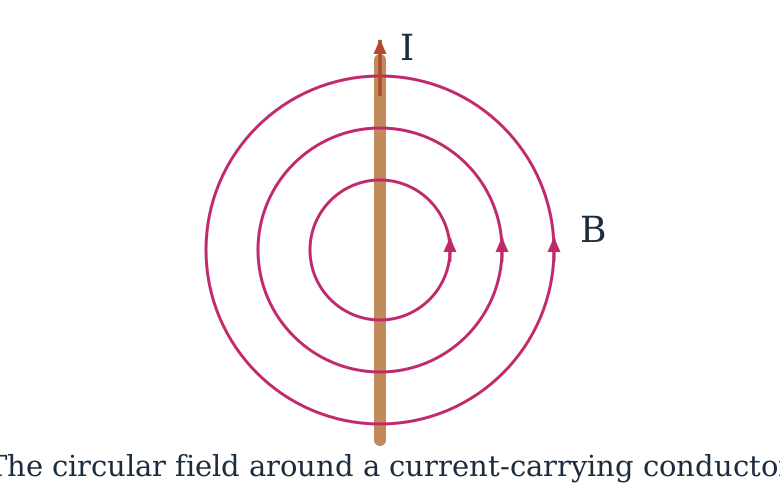
The circular magnetic field produced by a current in a straight conductor

Lodestone

Magnetism started with lodestone, a natural mineral discovered in ancient Türkiye. Lodestone, or magnetite, can attract metals like iron and steel and aligns with the Earth’s magnetic poles, which led to the invention of the compass.
LQ 2starts here — Find an expression for the force exerted on a current-carrying conductor placed in a uniform magnetic field.

The Observation

It has been observed experimentally that a current-carrying conductor placed in a magnetic field experiences a force.

The Set Up

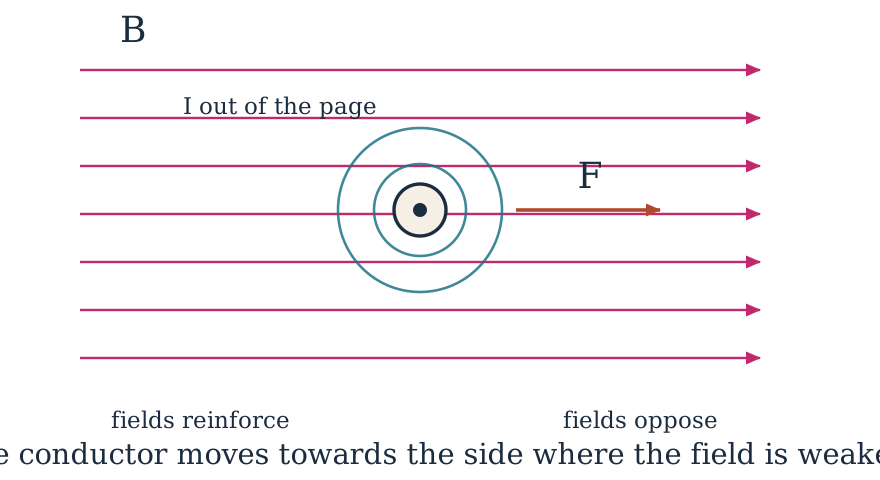
Consider a straight conductor carrying a steady current, placed perpendicular to a uniform magnetic field, with the current directed out of the paper.

Diagram

A current-carrying conductor in a uniform magnetic field moves towards the side where the field is weaker

Why the Force Arises

Just as two magnets exert forces on each other through their magnetic fields, a current-carrying conductor experiences a force due to the interaction between its own magnetic field and the external one.

Where the Fields Add and Cancel

The field produced by the current and the external field reinforce each other on the left side of the conductor and oppose each other on the right side. The conductor therefore moves towards the side where the field is weaker.

Direction of the Force

The force is perpendicular to both the conductor and the magnetic field.

Fleming’s Left-Hand Rule

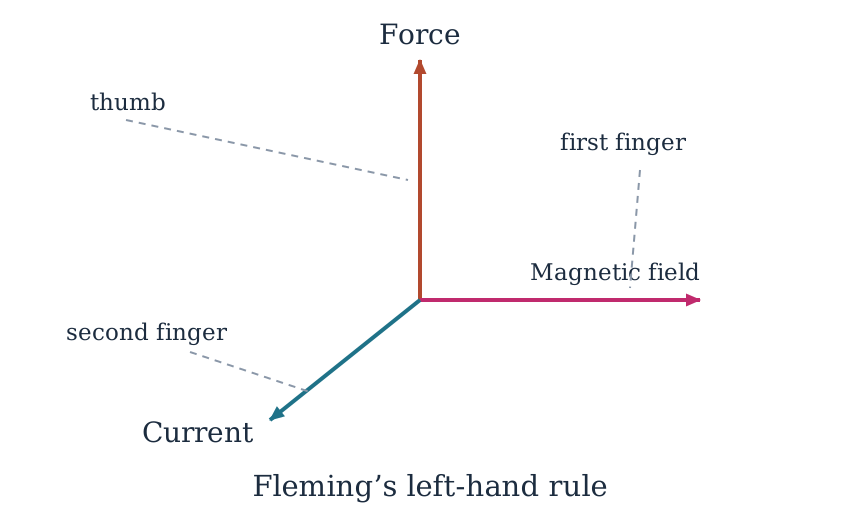
Position your left hand so that the first finger points in the direction of the magnetic field and the second finger points in the direction of the current. The thumb then points in the direction of the force.

Diagram

Fleming’s left-hand rule

Right-Hand Rule

Curl the fingers of your right hand from the current to the magnetic field through the smaller angle; the stretched thumb indicates the direction of the force.

Magnitude of the Force

Experimentally, the magnitude of the force on the conductor is directly proportional to the current $I$, to the length $L$ of the conductor and to the strength $B$ of the external field.
$$F\propto BIL$$
$$F=kBIL$$
In SI units the constant is one.
$$k=1$$
$$F=BIL$$

Magnetic Induction

The strength of the magnetic field is also known as the magnetic induction $B$, which has the same direction as the field.

Definition of B

$$B=\frac{F}{IL}$$
The magnetic induction is numerically equal to the force exerted on a conductor of length one metre carrying a current of one ampere, placed at right angles to the magnetic field.

Unit

The SI unit of $B$ is the tesla.
$$1\,\mathrm{T}=1\,\mathrm{N\,A^{-1}\,m^{-1}}$$

A Vector

Magnetic induction is a vector quantity whose direction is the same as that of the magnetic field.

The Vector L

A vector $L$ is defined whose magnitude is equal to the length of the conductor and whose direction is along the flow of the current.

Conductor at an Angle

If the conductor makes an angle $\theta$ with the magnetic field, only the component of $L$ perpendicular to $B$ carries the force.
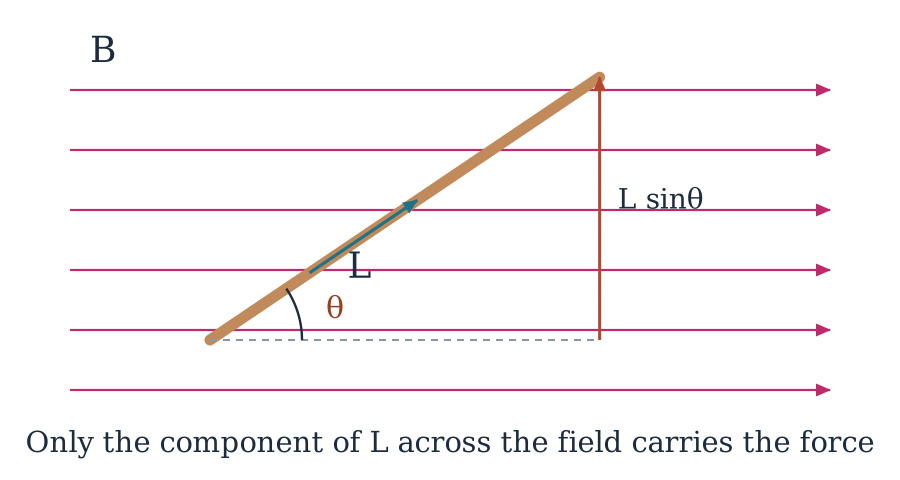
A conductor placed at an angle θ to the magnetic field
$$F=BIL\sin\theta$$

In Vector Form

$$\mathbf{F}=I(\mathbf{L}\times\mathbf{B})$$

Maximum and Zero

The force is a maximum when the conductor is perpendicular to the field and zero when it lies along the field.
$$\theta=90^{\circ}$$
$$F=BIL$$
$$\theta=0^{\circ}$$
$$F=0$$
LQ 2ends here

Book Examples

Example 10.1.1

A 20.0 cm wire carrying a current of 10.0 A is placed in a uniform magnetic field of 0.30 T. If the wire makes an angle of $40^{\circ}$ with the direction of the magnetic field, find the magnitude of the force acting on the wire.

Given Data

$$L=20.0\,\mathrm{cm}=0.20\,\mathrm{m}$$
$$I=10.0\,\mathrm{A}$$
$$B=0.30\,\mathrm{T}$$
$$\theta=40^{\circ}$$

To Find

Force $F=?$

Formula

$$F=BIL\sin\theta$$

Solution

Putting the values
$$F=0.30\times10.0\times0.20\times\sin40^{\circ}$$
$$F=0.60\times0.643=0.39\,\mathrm{N}$$

Result

$$F=0.39\,\mathrm{N}$$

Short Questions

SQ 10.1.1

Why does a current-carrying conductor in a magnetic field move at all?

Two Fields Interact

The conductor has its own circular field. On one side it reinforces the external field and on the other it opposes it.

Result

The conductor is pushed towards the side where the resultant field is weaker.
SQ 10.1.2

State Fleming’s left-hand rule.

Rule

Hold the left hand so that the first finger points along the magnetic field and the second finger along the current. The thumb then gives the direction of the force.
SQ 10.1.3

Define the tesla.

Definition

A field has a flux density of one tesla if it exerts a force of one newton on a conductor of length one metre carrying one ampere placed at right angles to the field.
$$1\,\mathrm{T}=1\,\mathrm{N\,A^{-1}\,m^{-1}}$$
SQ 10.1.4

A conductor lies along the direction of a magnetic field. What force does it experience?

None

The force depends on the component of the length across the field.
$$F=BIL\sin\theta$$
The conductor lies along the field, so the angle is zero.
$$\theta=0^{\circ}$$
$$F=0$$
SQ 10.1.5

A 0.5 m wire carries 4 A at right angles to a 0.2 T field. Find the force on it.

Working

$$F=BIL\sin90^{\circ}$$
$$F=0.2\times4\times0.5=0.4\,\mathrm{N}$$
MCQ 10.1.1

A current-carrying conductor placed along the direction of a magnetic field experiences a force of:

ABILBBIL/2
C2BILDzero
Solution:The sine of zero is zero.
MCQ 10.1.2

The magnetic force on a conductor is a maximum when the conductor is:

Aalong the fieldBat $45^{\circ}$ to the field
Cperpendicular to the fieldDat $30^{\circ}$ to the field
Solution:The sine is then one.
MCQ 10.1.3

Electricity and magnetism were first found to be correlated by:

AOerstedBFaraday
CLenzDFleming
Solution:He made the discovery in 1820.
MCQ 10.1.4

The thumb in Fleming’s left-hand rule points along the:

AcurrentBforce
Cmagnetic fieldDinduced emf
Solution:The first finger gives the field and the second finger the current.
MCQ 10.1.5

A 0.4 m conductor carrying 5 A lies at right angles to a 0.6 T field. The force on it is:

A1.2 NB0.12 N
C12 ND2.4 N
Solution:$F=BIL=0.6\times5\times0.4$.
MCQ 10.1.6

The SI unit of magnetic induction is the:

AweberBhenry
CampereDtesla
Solution:One tesla is one newton per ampere per metre.
Topic 10.2

Magnetic Flux and Flux Density

LQ 1starts here — Distinguish between magnetic flux and flux density. How are they related?

Magnetic Flux

The strength of a magnetic field $B$ can be represented by lines of force in the same way as an electric field. The population of these lines per unit area passing through a surface perpendicular to the field represents the magnetic flux.

Definition

The magnetic flux through a patch of area $A$ is the number of magnetic lines passing through this area.

Area Perpendicular to the Field

If $B$ is the number of lines passing through unit area placed perpendicular to the field, the total flux through an area $A$ perpendicular to the field is
$$\phi_B=BA$$

Area Inclined to the Field

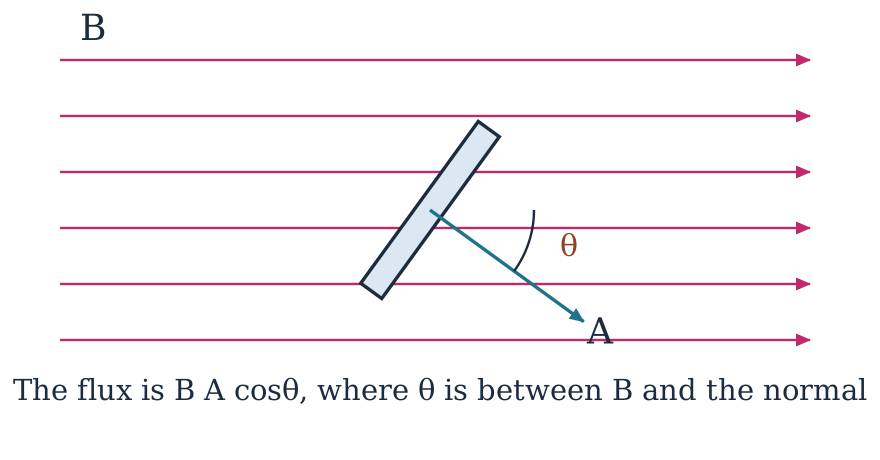
If the normal to the surface makes an angle $\theta$ with $B$, only the component $B\cos\theta$ along the vector area contributes.
Magnetic flux through an area whose normal makes an angle θ with B
$$\phi_B=BA\cos\theta$$

In Vector Form

$$\phi_B=\mathbf{B}\cdot\mathbf{A}$$

A Scalar

The flux is a dot product of two vectors, so it is a scalar quantity.

Definition

The magnetic flux through a plane element of area $A$ in a uniform magnetic field $B$ is given by the dot product of $B$ and $A$.

The Vector Area

Here $A$ is a vector whose magnitude is the area of the element and whose direction is along the normal to the surface, and $\theta$ is the angle between $B$ and $A$.

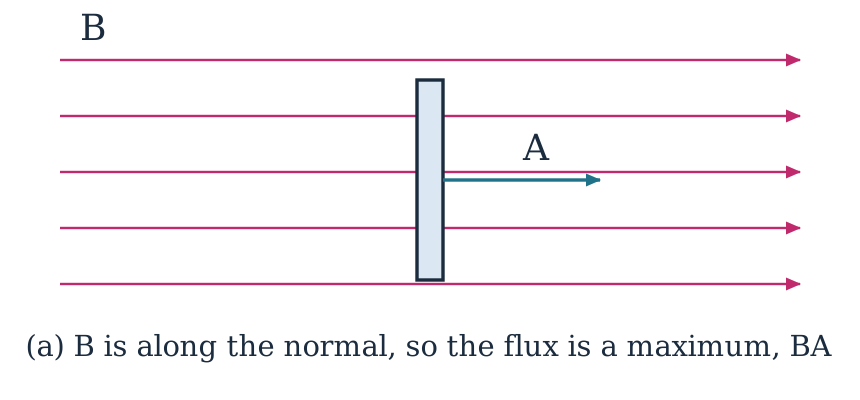
Maximum Flux

When the field is directed along the normal to the area the angle is zero, so the flux is a maximum.
The field is along the normal to the area, so the flux is a maximum
$$\theta=0^{\circ}$$
$$\phi_B=BA$$

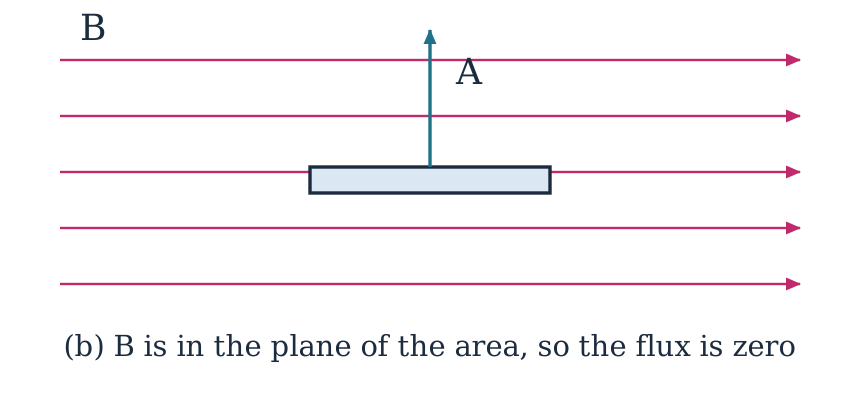
Zero Flux

When the field is parallel to the plane of the area, the angle between the field and the normal is a right angle, so the flux is zero.
The field is parallel to the plane of the area, so the flux is zero
$$\theta=90^{\circ}$$
$$\phi_B=0$$

A Curved Surface

A curved surface placed in a uniform field is divided into a number of small surface elements, each assumed plane, and the flux through the whole surface is the sum of the contributions of all the elements.

Unit of Flux

From the definition of the tesla, the unit of magnetic flux is the weber.
$$1\,\mathrm{Wb}=1\,\mathrm{N\,m\,A^{-1}}$$

Flux Density

The magnetic induction $B$ is the flux per unit area of a surface perpendicular to $B$, so it is also called the magnetic flux density.
$$B=\frac{\phi_B}{A}$$

Unit of Flux Density

$$1\,\mathrm{Wb\,m^{-2}}=1\,\mathrm{N\,A^{-1}\,m^{-1}}=1\,\mathrm{T}$$
LQ 1ends here

Book Examples

Example 10.2.1

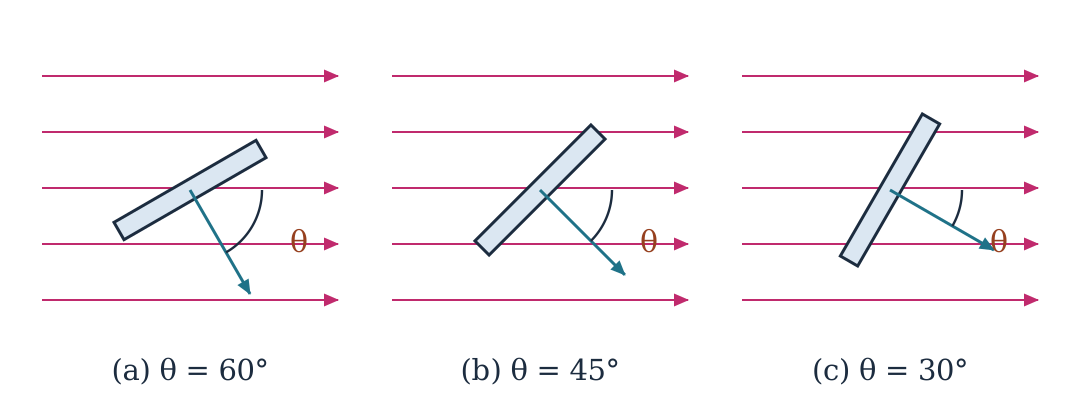
A rectangular loop of wire is placed in a uniform magnetic field of magnitude 1.2 T. If the loop is 25 cm long and 20 cm wide, determine the magnetic flux through the loop when the angle between B and the area vector is (a) $60^{\circ}$ (b) $45^{\circ}$ (c) $30^{\circ}$.

Given Data

$$B=1.2\,\mathrm{T}$$
$$A=0.25\times0.20=5\times10^{-2}\,\mathrm{m^2}$$

Diagram

A rectangular loop set at three orientations in a uniform magnetic field

To Find

The flux in each orientation

Formula

$$\phi_B=BA\cos\theta$$

Solution

For the first orientation
$$\begin{aligned}\phi_1&=1.2\times5\times10^{-2}\times\cos60^{\circ} \\ &=3\times10^{-2}\,\mathrm{Wb}\end{aligned}$$
For the second orientation
$$\begin{aligned}\phi_2&=1.2\times5\times10^{-2}\times0.707 \\ &=4.2\times10^{-2}\,\mathrm{Wb}\end{aligned}$$
For the third orientation
$$\begin{aligned}\phi_3&=1.2\times5\times10^{-2}\times0.866 \\ &=5.2\times10^{-2}\,\mathrm{Wb}\end{aligned}$$

Result

$$\phi_1=3\times10^{-2}\,\mathrm{Wb}$$
$$\phi_2=4.2\times10^{-2}\,\mathrm{Wb}$$
$$\phi_3=5.2\times10^{-2}\,\mathrm{Wb}$$

Short Questions

SQ 10.2.1

Distinguish between magnetic flux and magnetic flux density.

Magnetic FluxMagnetic Flux Density
It is the number of lines passing through an area.It is the flux per unit area held normal to the field.
It is a scalar.It is a vector.
Its unit is the weber.Its unit is the tesla, or Wb m$^{-2}$
$\phi_B=BA\cos\theta$$B=\phi_B/A$
SQ 10.2.2

Why is magnetic flux a scalar even though B and A are both vectors?

Reason

It is the dot product of the two vectors, and a dot product has magnitude only.
$$\phi_B=\mathbf{B}\cdot\mathbf{A}$$
SQ 10.2.3

How is the flux through a curved surface found?

By Dividing It Up

The curved surface is divided into many small elements, each of which may be taken as plane. The flux through each is found, and the flux through the whole surface is their sum.
SQ 10.2.4

Show that the weber per square metre is the same as the tesla.

Working

$$1\,\mathrm{Wb}=1\,\mathrm{N\,m\,A^{-1}}$$
$$1\,\mathrm{Wb\,m^{-2}}=1\,\mathrm{N\,A^{-1}\,m^{-1}}=1\,\mathrm{T}$$
SQ 10.2.5

A field of 0.4 T passes through an area of 0.2 m$^2$ whose normal is at $60^{\circ}$ to the field. Find the flux.

Working

$$\phi_B=BA\cos\theta$$
$$\phi_B=0.4\times0.2\times0.5=0.04\,\mathrm{Wb}$$
MCQ 10.2.1

The magnetic flux through an area is a maximum when the field is:

Ain the plane of the areaBat $45^{\circ}$ to the normal
Calong the normal to the areaDzero
Solution:The cosine is then one.
MCQ 10.2.2

The SI unit of magnetic flux is the:

AteslaBweber
CnewtonDhenry
Solution:One weber is one newton metre per ampere.
MCQ 10.2.3

Magnetic flux is:

Aa vectorBsometimes a vector
Ca scalarDa unit vector
Solution:It is a dot product of two vectors.
MCQ 10.2.4

A field of 0.5 T passes normally through an area of 0.4 m$^2$. The flux is:

A0.2 WbB0.8 Wb
C1.25 WbD2 Wb
Solution:$\phi_B=BA=0.5\times0.4$.
MCQ 10.2.5

Magnetic induction is also called:

Amagnetic fluxBmagnetic potential
Cmagnetic momentDmagnetic flux density
Solution:It is the flux per unit area held normal to the field.
Topic 10.3

Magnetic Flux Linkage

Flux Linkage

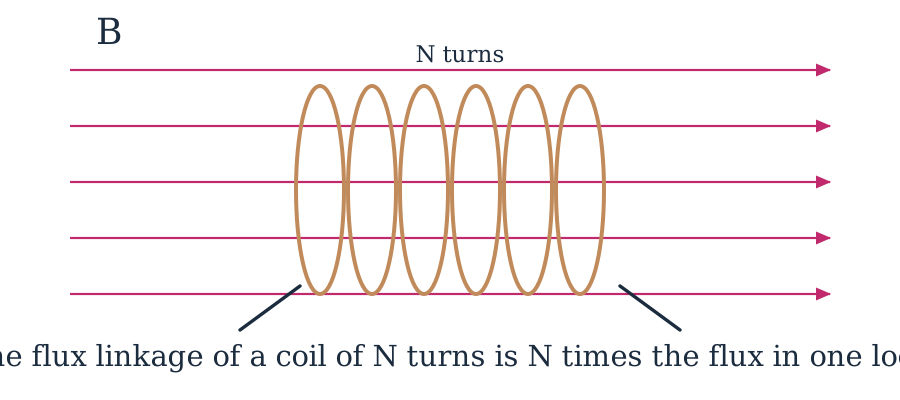
Magnetic flux linkage is the product of the magnetic flux through a coil and the number of turns in the coil.

What It Measures

It measures how much magnetic flux is linked with the coil due to its multiple turns, and it is an important factor in understanding how coils and inductors operate in electrical circuits.

Formula

$$\phi=N\phi_B$$
Here $\phi_B$ is the magnetic flux through a single loop of area $A$ and $N$ is the total number of turns of the coil.

Diagram

Magnetic flux linkage through a coil of N turns

Where It Matters

Flux linkage plays a crucial role in the design and operation of transformers, electric motors, generators and inductors, and it is particularly important in Faraday’s law of electromagnetic induction.

Short Questions

SQ 10.3.1

Define magnetic flux linkage.

Definition

The product of the magnetic flux through a coil and the number of turns in the coil.
$$\phi=N\phi_B$$
SQ 10.3.2

Where does flux linkage matter in practice?

Devices

In transformers, electric motors, generators and inductors, and above all in Faraday’s law of electromagnetic induction.
SQ 10.3.3

A coil of 200 turns and area 0.01 m$^2$ lies with its plane normal to a 0.3 T field. Find its flux linkage.

Working

$$\phi_B=BA=0.3\times0.01=3\times10^{-3}\,\mathrm{Wb}$$
$$\phi=200\times3\times10^{-3}=0.6\,\mathrm{Wb}$$
MCQ 10.3.1

Magnetic flux linkage is the product of the flux and the:

Aarea of the coilBnumber of turns of the coil
Ccurrent in the coilDresistance of the coil
Solution:It measures how much flux is linked with the whole coil.
MCQ 10.3.2

A coil of 100 turns has a flux of $2\times10^{-3}$ Wb through each turn. Its flux linkage is:

A$2\times10^{-5}$ WbB0.2 Wb
C200 WbD$2\times10^{-3}$ Wb
Solution:$\phi=N\phi_B$.
MCQ 10.3.3

Flux linkage is most important in the study of:

AelectrostaticsBoptics
CthermodynamicsDelectromagnetic induction
Solution:It appears directly in Faraday’s law.
Topic 10.4

Motion of a Charged Particle in a Magnetic Field

LQ 4starts here — Determine the force acting on a charged particle moving through a uniform magnetic field.

The Question

A current-carrying conductor placed perpendicularly in a uniform magnetic field experiences a force. Since a current is the flow of electric charges, do individual charges moving through a magnetic field also experience a force?

The Answer

Yes. Experiments show that a charged particle does experience a force when it moves across a magnetic field.

From the Conductor to the Particle

Consider a conductor of length $L$ through which $N$ charged particles, each with charge $q$, pass in time $t$. The current produced is
$$I=\frac{Q}{t}=\frac{Nq}{t}$$

The Time of Transit

The particles take a time $t$ to move across the conductor of length $L$ with velocity $v$
$$t=\frac{L}{v}$$
$$I=\frac{Nqv}{L}$$

Substituting in the Force

The force on a conductor is
$$\mathbf{F}=I(\mathbf{L}\times\mathbf{B})$$
and the vector $\mathbf{L}$ has magnitude $L$ along the current.
$$\mathbf{F}=\frac{Nqv}{L}(\mathbf{L}\times\mathbf{B})$$
$$\mathbf{F}=Nq(\mathbf{v}\times\mathbf{B})$$

Force on One Particle

$$\mathbf{F}=q(\mathbf{v}\times\mathbf{B})$$

Magnitude

If $\theta$ is the angle between $B$ and $v$
$$F=qvB\sin\theta$$

Maximum and Zero

The force is a maximum when $B$ is perpendicular to $v$ and zero when $B$ is along $v$
$$\theta=90^{\circ}$$
$$F=qvB$$
$$\theta=0^{\circ}$$
$$F=0$$

Direction

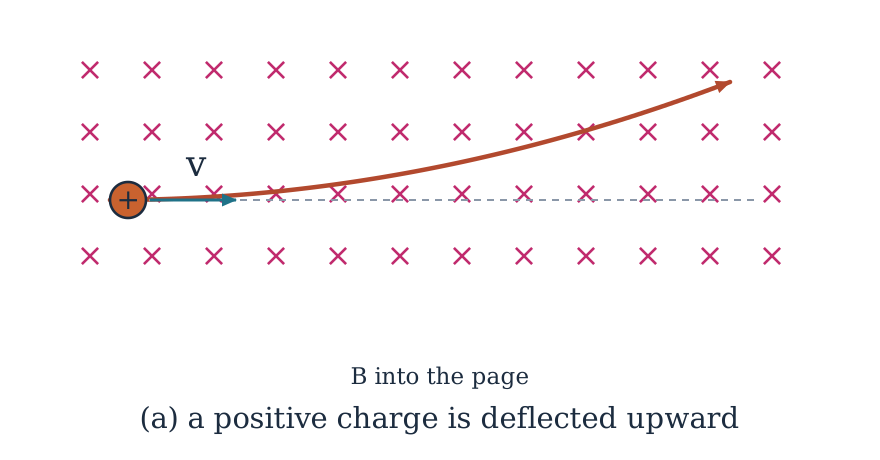
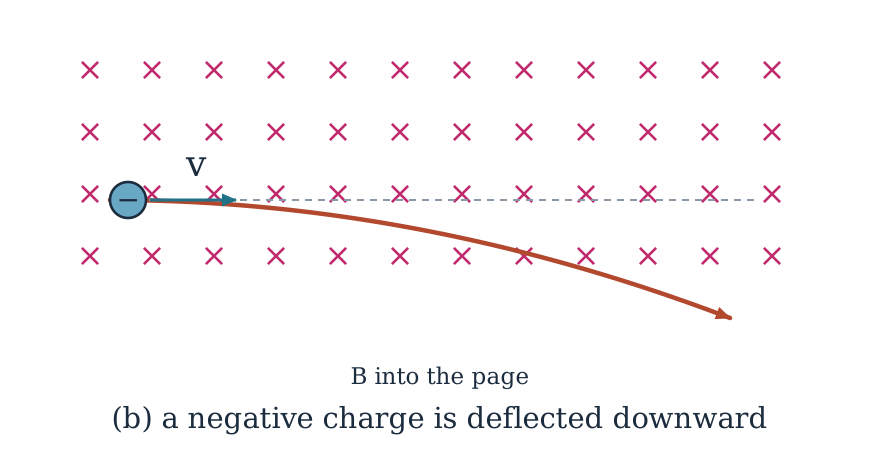
The direction of the force is found by applying Fleming’s left-hand rule, or the right-hand rule for a vector product.

A Positive Charge

A positively charged particle entering the field along the dotted line experiences a force in the upward direction and is deflected along a curved path.
A positive charge moving across a magnetic field is deflected upward

A Negative Charge

A negatively charged particle is deflected downward by the force acting on it.
A negative charge moving across a magnetic field is deflected downward

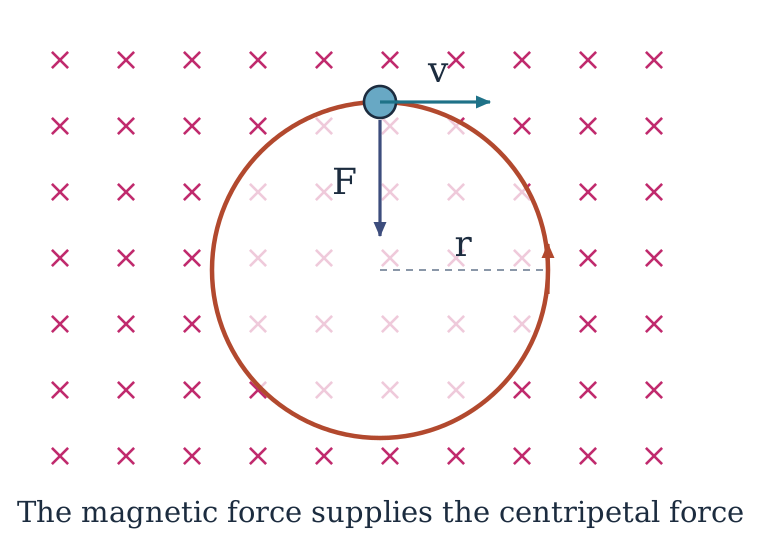
A Circular Path

When the velocity is perpendicular to the field, the force is always perpendicular to the velocity, so it supplies the centripetal force and the particle moves in a circle.
A charged particle moving at right angles to a uniform field travels in a circle

Radius of the Path

$$qvB=\frac{mv^2}{r}$$
$$r=\frac{mv}{qB}$$

Meaning

The radius is directly proportional to the momentum of the particle and inversely proportional to the flux density.
LQ 4ends here

Book Examples

Example 10.4.1

An electron enters a uniform magnetic field perpendicularly with a speed of $10^{7}$ m s$^{-1}$. Along what path will the electron move inside the field? ($B=2.5$ Wb m$^{-2}$, $m=9.11\times10^{-31}$ kg, $e=1.6\times10^{-19}$ C)

Given Data

$$v=10^{7}\,\mathrm{m\,s^{-1}}$$
$$B=2.5\,\mathrm{Wb\,m^{-2}}$$
$$m=9.11\times10^{-31}\,\mathrm{kg}$$
$$e=1.6\times10^{-19}\,\mathrm{C}$$

To Find

The path of the electron

Formula

The velocity is perpendicular to the field, so the angle is a right angle.
$$F=evB\sin90^{\circ}=evB$$
The force is perpendicular to the velocity, so it supplies the centripetal force.
$$evB=\frac{mv^2}{r}$$
$$r=\frac{mv}{eB}$$

Solution

Putting the values
$$\begin{aligned}r&=\frac{9.11\times10^{-31}\times10^{7}}{1.6\times10^{-19}\times2.5} \\ &=2.3\times10^{-5}\,\mathrm{m}\end{aligned}$$

Result

The path of the electron is a circle of radius
$$r=2.3\times10^{-5}\,\mathrm{m}$$

Short Questions

SQ 10.4.1

Write the expression for the force on a charge moving in a magnetic field and say when it is zero.

Formula

$$F=qvB\sin\theta$$

Zero

When the velocity is along the field, so that the angle is zero or $180^{\circ}$.
SQ 10.4.2

Why does a charged particle entering a field at right angles travel in a circle?

Reason

The force is always perpendicular to the velocity, so it changes only the direction of the motion and not the speed. A constant force always at right angles to the motion is a centripetal force.
SQ 10.4.3

Derive the radius of the circular path of a charged particle in a magnetic field.

Working

The magnetic force supplies the centripetal force.
$$qvB=\frac{mv^2}{r}$$
$$r=\frac{mv}{qB}$$
SQ 10.4.4

Two protons enter the same field at right angles, one twice as fast as the other. Compare the radii of their paths.

Twice as Large

The radius is proportional to the speed.
$$r=\frac{mv}{qB}$$
So the faster proton follows a circle of twice the radius.
SQ 10.4.5

An electron moves in a circle of radius 2 mm in a 0.4 T field. Find its momentum.

Working

$$r=\frac{mv}{qB}$$
$$mv=qBr$$
$$mv=1.6\times10^{-19}\times0.4\times2\times10^{-3}=1.28\times10^{-22}\,\mathrm{kg\,m\,s^{-1}}$$
MCQ 10.4.1

The force on a charge moving through a magnetic field is:

A$qvB\cos\theta$B$qvB\tan\theta$
C$qvB\sin\theta$D$qv/B$
Solution:It is the magnitude of the vector product $q(\mathbf{v}\times\mathbf{B})$.
MCQ 10.4.2

A charged particle moving parallel to a magnetic field experiences a force of:

AzeroB$qvB$
C$qvB/2$D$2qvB$
Solution:The angle between $v$ and $B$ is zero.
MCQ 10.4.3

The radius of the circular path of a charged particle in a magnetic field is:

A$qB/mv$B$mvB/q$
C$mv/qB$D$qvB/m$
Solution:It follows from equating the magnetic and the centripetal force.
MCQ 10.4.4

A magnetic field does no work on a moving charge because the force is:

Aparallel to the velocityBzero
CconstantDperpendicular to the velocity
Solution:A perpendicular force changes direction but not speed.
MCQ 10.4.5

A particle of twice the momentum enters the same field at right angles. Its radius becomes:

Ahalf as largeBtwice as large
Cfour times as largeDunchanged
Solution:The radius is proportional to the momentum.
Topic 10.5

Velocity Selector

LQ 5starts here — What is a velocity selector? Explain its working.

Velocity Selector

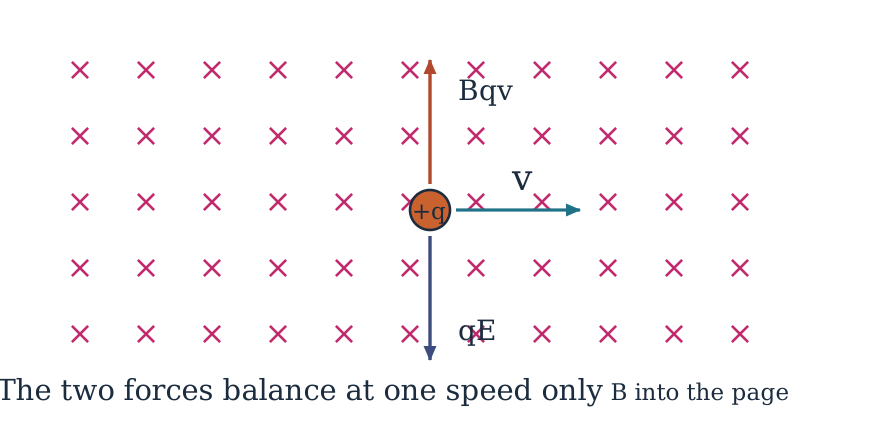
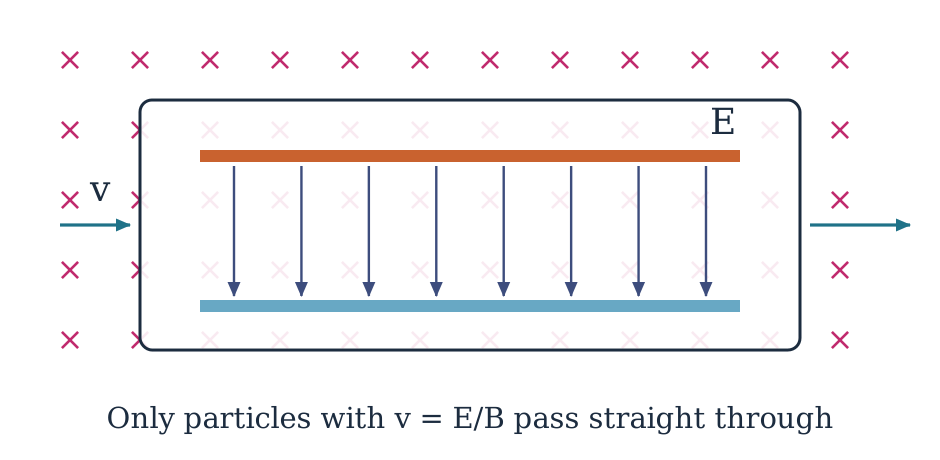
A velocity selector is a device used to determine the velocity of a charged particle. Electric and magnetic forces are applied to the moving particle in such a way that they balance each other for only one value of velocity.

The Set Up

Consider a particle with a positive charge $+q$ that enters a uniform magnetic field $B$ at right angles to it, with velocity $v$. The magnetic force acts on the particle in the upward direction, so to balance it an electric force must act downward.

Diagram

The magnetic and the electric force on a charge in a velocity selector

Construction

A velocity selector consists of a cylindrical tube located within a magnetic field $B$. Inside the tube is a parallel plate capacitor that creates a uniform electric field $E$, oriented perpendicular to the magnetic field.

Diagram

A velocity selector
A velocity selector

Working

When the charged particle enters the left end of the tube, the magnetic force acts upward while the electric force acts downward. If the strengths of the two fields are adjusted appropriately, these forces cancel each other out.

Newton’s First Law

With no net force acting on the particle, its velocity remains constant, so the particle moves in a straight line at a constant velocity and exits the right end of the tube.

Other Particles

Particles with velocities different from $v$ are deflected and do not exit at the right end of the tube.

The Selected Speed

The velocity is perpendicular to both $B$ and $E$, so the two forces are
$$F_{magnetic}=Bqv$$
$$F_{electric}=qE$$
For no deflection of the particle
$$Bqv=qE$$
$$v=\frac{E}{B}$$
LQ 5ends here

Book Examples

Example 10.5.1

Alpha particles ranging in speed from 1000 m s$^{-1}$ to 2000 m s$^{-1}$ enter a velocity selector where the electric intensity is 300 V m$^{-1}$ and the magnetic induction is 0.20 T. Which particle will move undeviated through the field?

Given Data

$$E=300\,\mathrm{V\,m^{-1}}=300\,\mathrm{N\,C^{-1}}$$
$$B=0.20\,\mathrm{T}$$

To Find

The selected speed $v=?$

Formula

A particle passes undeviated when the electric force balances the magnetic force.
$$qE=Bqv$$
$$v=\frac{E}{B}$$

Solution

Putting the values
$$v=\frac{300}{0.20}=1500\,\mathrm{m\,s^{-1}}$$

Result

The alpha particles having a speed of 1500 m s$^{-1}$ will move undeviated through the field.
Example 10.5.2

A charged particle moves through a velocity selector at a constant velocity in a straight line. The electric field of the velocity selector is $4.8\times10^{5}$ N C$^{-1}$ and the magnetic field is 0.20 T. When the electric field is turned off, the charged particle travels on a circular path of radius 3.0 cm. Find the charge to mass ratio of the particle.

Given Data

$$E=4.8\times10^{5}\,\mathrm{N\,C^{-1}}$$
$$B=0.20\,\mathrm{T}$$
$$r=3.0\,\mathrm{cm}=3\times10^{-2}\,\mathrm{m}$$

To Find

The ratio $q/m=?$

Formula

While both fields act, the particle passes undeviated.
$$qE=Bqv$$
$$v=\frac{E}{B}$$
With the electric field off, the magnetic force supplies the centripetal force.
$$Bqv=\frac{mv^2}{r}$$
$$\frac{q}{m}=\frac{v}{Br}$$

Solution

Putting the selected speed into the ratio
$$\frac{q}{m}=\frac{E}{B^2r}$$
Putting the values
$$\begin{aligned}\frac{q}{m}&=\frac{4.8\times10^{5}}{(0.20)^2\times3\times10^{-2}} \\ &=4\times10^{8}\,\mathrm{C\,kg^{-1}}\end{aligned}$$

Result

$$\frac{q}{m}=4\times10^{8}\,\mathrm{C\,kg^{-1}}$$

Short Questions

SQ 10.5.1

What is a velocity selector used for?

Purpose

To pick out charged particles of one particular velocity from a beam whose particles have many different speeds.
SQ 10.5.2

Derive the speed selected by a velocity selector.

Working

The two forces balance for the selected particle.
$$Bqv=qE$$
$$v=\frac{E}{B}$$
SQ 10.5.3

Why must the electric and magnetic fields of a velocity selector be perpendicular to each other?

Reason

The magnetic force is perpendicular to both $v$ and $B$. Only if $E$ lies along that same line can the electric force be antiparallel to it and cancel it exactly.
SQ 10.5.4

What happens to particles that are faster than the selected speed?

They Are Deflected

The magnetic force $Bqv$ grows with the speed while the electric force $qE$ does not, so the magnetic force wins and the particle is deflected out of the straight path.
MCQ 10.5.1

The speed selected by a velocity selector is:

A$E/B$B$B/E$
C$EB$D$E/B^2$
Solution:The electric and the magnetic force balance at this speed.
MCQ 10.5.2

In a velocity selector, E and B must be:

Aparallel to each otherBantiparallel
Cperpendicular to each otherDat $45^{\circ}$
Solution:Only then can the two forces be antiparallel.
MCQ 10.5.3

A velocity selector has $E=400$ N C$^{-1}$ and $B=0.5$ T. The selected speed is:

A200 m s$^{-1}$B800 m s$^{-1}$
C0.00125 m s$^{-1}$D80 m s$^{-1}$
Solution:$v=E/B=400/0.5$.
MCQ 10.5.4

A particle slower than the selected speed inside a velocity selector is deflected by the:

Aelectric forceBmagnetic force
Cgravitational forceDno force
Solution:The magnetic force $Bqv$ shrinks with the speed, so the electric force wins.
Topic 10.6

Induced emf and Faraday’s Law

LQ 3starts here — State and explain Faraday’s law and Lenz’s law. Also describe the factors affecting the induced emf.

The Observation

It has been observed experimentally that when a conductor moves across a magnetic field, an electromotive force is induced between its ends. If the ends of the conductor are connected by a wire to form a closed circuit, a current will flow through it.

Motional emf

The emf induced by the motion of a conductor across a magnetic field is called motional emf.

The Experiment

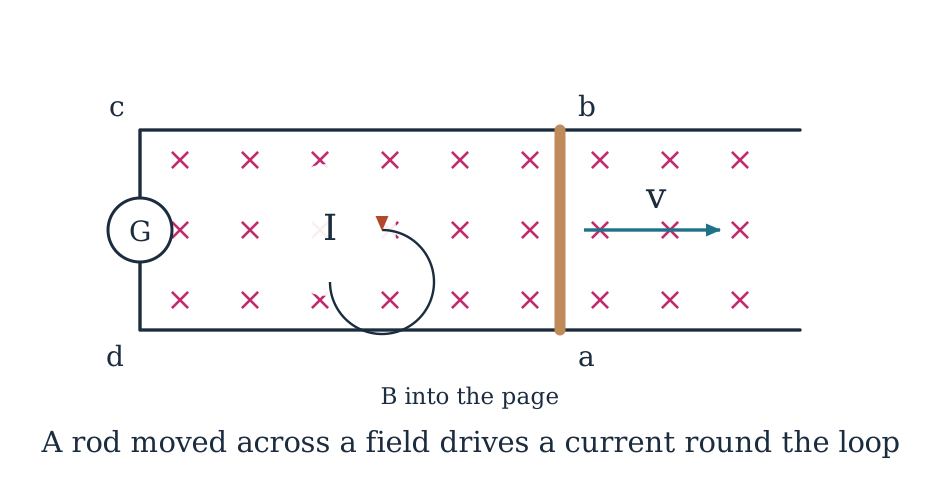
A conducting rod of length $L$ is placed on two parallel metal rails, and a galvanometer is connected between the ends of the rails, forming the closed loop $abcda$. A uniform magnetic field $B$ is directed into the page.

Diagram

A conducting rod moved along two rails across a magnetic field

What Is Seen

When the rod is stationary the galvanometer indicates no current. If the rod is pulled to the right with constant velocity $v$, the galvanometer indicates a current flowing through the loop.

Why

When the rod moves, a charge $q$ within it moves with the same velocity $v$ in the field $B$ and experiences a force.
$$F=qvB\sin\theta$$
The angle between $v$ and $B$ is a right angle, so
$$F=qvB$$

Charge Separation

Applying the right-hand rule, the force on the charge is directed from $a$ to $b$ along the rod, so charges migrate to the top end. A concentration of charge builds up at $b$ and a deficiency at $a$.

The Electrostatic Field

This redistribution creates an electrostatic field $E$ directed from $b$ to $a$, and the electrostatic force $qE$ opposes the magnetic force. The system quickly reaches equilibrium.
$$qE=qvB$$
$$E=vB$$

The Potential Difference

The motional emf equals the potential difference between the two ends of the rod in this state. The electric intensity is the negative of the potential gradient.
$$E=-\frac{\Delta V}{L}$$
$$\Delta V=-EL=-vBL$$

Motional emf

$$\varepsilon=-vBL$$

At an Angle

If the angle between $v$ and $B$ is $\theta$
$$\varepsilon=-vBL\sin\theta$$

Direction of the Current

Due to the induced emf, positive charges flow along the path $abcda$, so the induced current is anticlockwise in the diagram.

Why the Current Continues

As the current flows, the charge at the ends decreases, which reduces the electric field while the magnetic force stays the same. The magnetic force then carries the charges back to the top end, and the current continues to flow.

Faraday’s Law

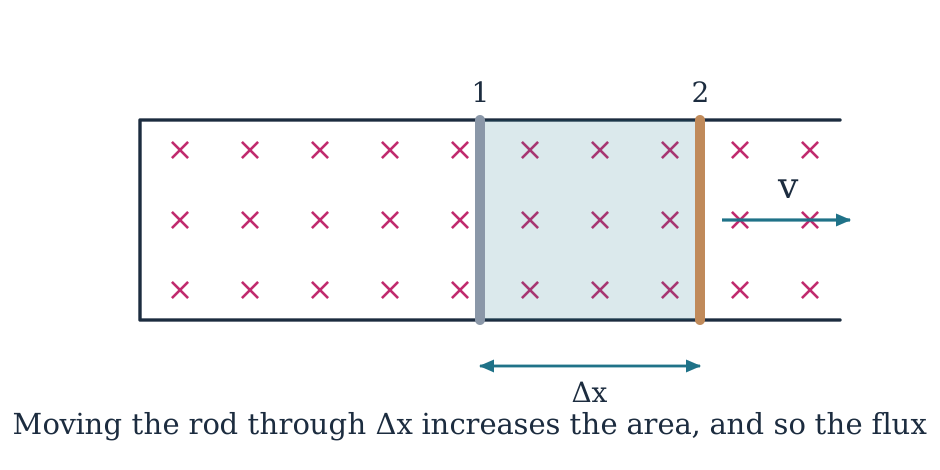
The motional emf can also be described in terms of magnetic flux. Let the rod move from position 1 to position 2 in a small interval of time $\Delta t$, covering a distance $\Delta x$.

Diagram

The rod moving from position 1 to position 2 increases the flux through the loop

The Velocity

$$v=\frac{\Delta x}{\Delta t}$$
$$\varepsilon=-\frac{\Delta x}{\Delta t}BL$$

The Change of Area

As the rod moves through $\Delta x$, the area of the loop increases by
$$\Delta A=\Delta x\,L$$

The Change of Flux

$$\Delta\phi_B=B\,\Delta A$$
$$\varepsilon=-\frac{\Delta\phi_B}{\Delta t}$$

Meaning

If the magnetic flux through a single loop of a conducting coil is changing, then the negative of the rate of change of the flux is equal to the emf induced in the loop.

For a Coil of N Turns

$$\varepsilon=-N\frac{\Delta\phi_B}{\Delta t}$$

Statement

The average emf induced in a conducting coil of $N$ loops is equal to the negative of the time rate at which the magnetic flux through the coil is changing with time.

The Minus Sign

The minus sign indicates that the direction of the induced emf is such that it opposes the change in flux.

Book Examples

Example 10.6.1

A rod of length 25 cm is moving at a speed of 0.5 m s$^{-1}$ in a direction perpendicular to a 0.25 T magnetic field. Find the emf produced in the rod.

Given Data

$$L=25\,\mathrm{cm}=0.25\,\mathrm{m}$$
$$v=0.5\,\mathrm{m\,s^{-1}}$$
$$B=0.25\,\mathrm{T}=0.25\,\mathrm{N\,A^{-1}\,m^{-1}}$$

To Find

Induced emf $\varepsilon=?$

Formula

$$\varepsilon=vBL$$

Solution

Putting the values
$$\varepsilon=0.5\times0.25\times0.25=3.13\times10^{-2}\,\mathrm{V}$$

Result

$$\varepsilon=3.13\times10^{-2}\,\mathrm{V}$$
Example 10.6.2

A loop of wire is placed in a uniform magnetic field that is perpendicular to the plane of the loop. The strength of the magnetic field is 0.6 T. The area of the loop begins to shrink at a constant rate of $\Delta A/\Delta t=0.8\ \mathrm{m^2\,s^{-1}}$. What is the magnitude of the emf induced in the loop while it is shrinking?

Given Data

$$\frac{\Delta A}{\Delta t}=0.8\,\mathrm{m^2\,s^{-1}}$$
$$B=0.6\,\mathrm{T}$$
$$N=1$$

To Find

Induced emf $\varepsilon=?$

Formula

The field is along the normal to the loop, so the angle is zero.
$$\begin{aligned}\frac{\Delta\phi_B}{\Delta t}&=B\frac{\Delta A}{\Delta t}\cos0^{\circ} \\ &=B\frac{\Delta A}{\Delta t}\end{aligned}$$
By Faraday’s law the magnitude of the induced emf is
$$\varepsilon=N\frac{\Delta\phi_B}{\Delta t}$$

Solution

Putting the values
$$\varepsilon=1\times0.6\times0.8=0.48\,\mathrm{V}$$

Result

$$\varepsilon=0.48\,\mathrm{V}$$

Short Questions

SQ 10.6.1

What is motional emf?

Definition

The emf induced by the motion of a conductor across a magnetic field.
$$\varepsilon=-vBL$$
SQ 10.6.2

In the rod-and-rails experiment, why do charges pile up at one end of the rod?

Reason

Each charge in the moving rod feels a magnetic force $qvB$ directed along the rod, so charge migrates to one end. A deficiency is left at the other end and an electrostatic field builds up.
SQ 10.6.3

State Faraday’s law of electromagnetic induction.

Statement

The average emf induced in a coil of $N$ turns is equal to the negative of the rate at which the magnetic flux through the coil changes.
$$\varepsilon=-N\frac{\Delta\phi_B}{\Delta t}$$
SQ 10.6.4

Why does the current in the rod-and-rails experiment keep flowing rather than stopping once equilibrium is reached?

Reason

As the current drains the charge from the ends, the electrostatic field weakens while the magnetic force stays the same. The unbalanced magnetic force carries fresh charge to the top end, so the current continues.
SQ 10.6.5

What does the minus sign in Faraday’s law mean?

Meaning

It shows that the induced emf is in the direction that opposes the change of flux producing it, which is Lenz’s law.
MCQ 10.6.1

The emf induced by the motion of a conductor across a field is called:

Aback emfBthermal emf
Ccontact emfDmotional emf
Solution:Its magnitude is $vBL$.
MCQ 10.6.2

Faraday’s law for a coil of N turns is:

A$\varepsilon=-\Delta\phi/N\Delta t$B$\varepsilon=N\phi\Delta t$
C$\varepsilon=-N\phi/\Delta t^2$D$\varepsilon=-N\Delta\phi/\Delta t$
Solution:The emf is the negative rate of change of the flux linkage.
MCQ 10.6.3

A rod 0.4 m long moves at 3 m s$^{-1}$ at right angles to a 0.5 T field. The emf induced is:

A6 VB0.6 V
C0.06 VD1.2 V
Solution:$\varepsilon=vBL=3\times0.5\times0.4$.
MCQ 10.6.4

No emf is induced in a loop moving through a uniform field because:

Athe flux through it does not changeBthe field is too weak
Cthe loop has no resistanceDthe loop is closed
Solution:An emf needs a changing flux, not merely a field.
MCQ 10.6.5

In the rod-and-rails experiment, the induced current flows:

Aclockwise round the loopBonly while the rod is at rest
Canticlockwise round the loopDfrom the galvanometer into the rails only
Solution:The positive charges flow along the path abcda.
Topic 10.7

Lenz’s Law and Direction of Induced emf

Why the Minus Sign Matters

The minus sign in Faraday’s law relates to the direction of the induced emf. To determine that direction we use a principle discovered by the Russian physicist Heinrich Lenz in 1834.

Statement

The direction of the induced current is always such that it opposes the change that causes the current.

Currents, Not emfs

Lenz’s law applies specifically to induced currents and not directly to induced emf, so it is applied to closed conducting loops or coils. If the loop is not closed, we imagine it as closed to find the direction of the current, and from that infer the direction of the emf.

A Magnet and a Coil

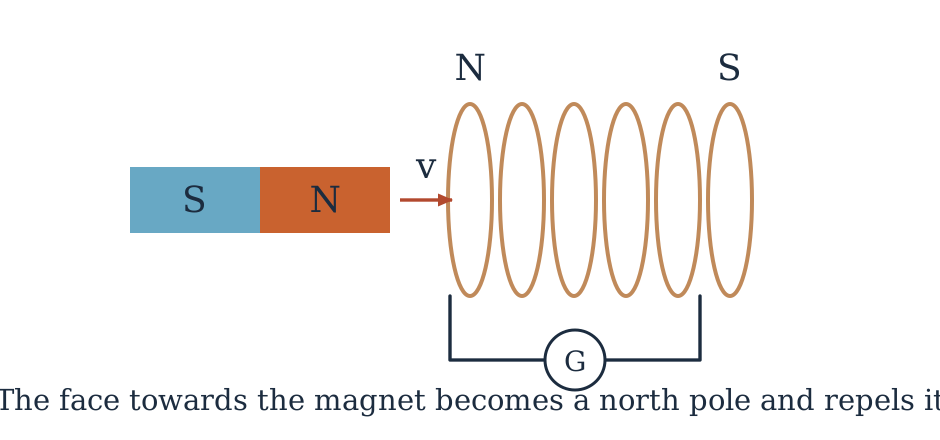
A current-carrying coil generates a magnetic field similar to that of a bar magnet, with one face of the coil acting as the north pole and the other as the south pole.

Pushing the Magnet In

To oppose the motion of the bar magnet, the face of the coil towards the magnet must become a north pole, so that the two north poles repel each other.

Diagram

A bar magnet pushed towards a coil induces a current that opposes the push

Direction of the Current

According to the right-hand rule, the induced current in the coil must flow anticlockwise when viewed from the side of the bar magnet.

Pulling the Magnet Away

If we pull the magnet away from the coil, the induced current will oppose the pull by creating a south pole on the face of the coil towards the bar magnet.

Conservation of Energy

Lenz’s law is also a manifestation of the law of conservation of energy.

The Moving Rod Again

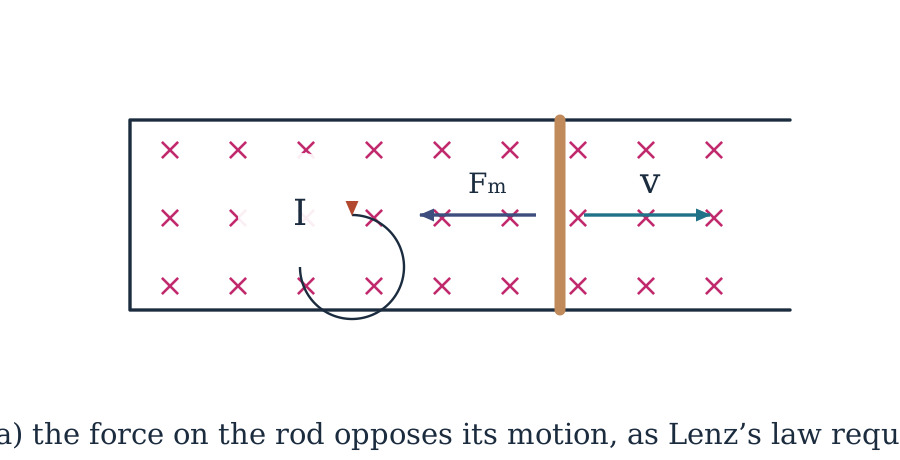
When the rod moves to the right, an emf is induced and a current flows anticlockwise round the loop. Because the current-carrying rod is moving within the magnetic field, it experiences a magnetic force.
$$F_m=BIL\sin90^{\circ}=BIL$$

Direction of That Force

By the right-hand rule, the direction of $F_m$ is opposite to that of the velocity, so it tends to stop the rod.
The induced current sets up a force that opposes the motion of the rod

Where the Energy Comes From

To keep the rod moving with a constant velocity an external force equal in magnitude to $F_m$ but opposite in direction must be applied. This external force provides the energy necessary for the induced current to flow.

The Forbidden Case

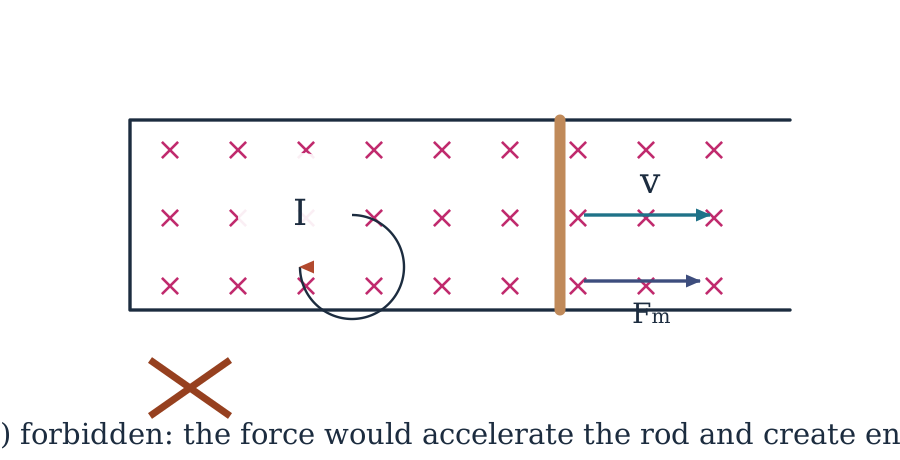
Lenz’s law forbids a clockwise induced current here, because the force would then be in the direction of $v$ and would accelerate the rod.
A clockwise current is forbidden: the force would accelerate the rod

Why It Is Forbidden

A faster rod would induce a stronger current, a larger magnetic force and a still faster rod. Starting with a minute quantity of energy we would obtain an ever-increasing kinetic energy from nowhere, which is against the law of conservation of energy.

Short Questions

SQ 10.7.1

State Lenz’s law.

Statement

The direction of the induced current is always such that it opposes the change that causes the current.
SQ 10.7.2

A north pole is pulled away from a coil. What pole appears on the near face of the coil, and why?

A South Pole

The induced current opposes the pull, so the near face becomes a south pole and attracts the receding north pole.
SQ 10.7.3

How does Lenz’s law follow from the conservation of energy?

Reason

If the induced current helped the motion instead of opposing it, the motion would speed up, the current would grow and the kinetic energy would increase without any source. That is impossible, so the current must oppose the change.
SQ 10.7.4

What supplies the electrical energy in the rod-and-rails experiment?

The External Force

The induced current makes the field push back on the rod, so an external force must be applied to keep it moving. The work done by that force is the source of the electrical energy.
MCQ 10.7.1

Lenz’s law is a consequence of the conservation of:

AchargeBmomentum
CenergyDmass
Solution:A current that helped the motion would create energy from nothing.
MCQ 10.7.2

When a north pole is pushed towards a coil, the near face of the coil becomes a:

Anorth poleBsouth pole
Cneutral faceDpole that depends on the speed
Solution:Two north poles repel, which opposes the push.
MCQ 10.7.3

Lenz’s law applies directly to:

Ainduced emfsBmagnetic flux
Cflux linkageDinduced currents
Solution:For an open loop we imagine it closed to find the direction.
MCQ 10.7.4

The magnetic force on the rod in the rod-and-rails experiment is directed:

Aalong the velocity of the rodBopposite to the velocity of the rod
Cinto the pageDout of the page
Solution:It is what has to be overcome to keep the rod moving.
Topic 10.8

Factors Affecting the Induced emf

Rate of Change of Magnetic Flux

Faraday’s law shows that faster changes in magnetic flux result in a greater induced emf.
$$\varepsilon=-N\frac{\Delta\phi_B}{\Delta t}$$

Number of Turns of the Coil

The induced emf is also proportional to the number of turns of the coil, so more turns give a greater induced emf.

Relative Speed

The speed of the coil, or of the conductor, through the magnetic field affects the magnitude of the induced emf. A faster speed increases the rate of change of flux and so increases the induced emf.
LQ 3ends here

Short Questions

SQ 10.8.1

Name the three factors that decide the magnitude of an induced emf.

Factors

The rate of change of the magnetic flux.
The number of turns of the coil.
The relative speed of the coil or conductor through the field.
SQ 10.8.2

Two identical coils, one of 50 turns and one of 200 turns, meet the same rate of change of flux. Compare their induced emfs.

Four Times

The emf is proportional to the number of turns.
$$\varepsilon=-N\frac{\Delta\phi_B}{\Delta t}$$
The 200-turn coil gives four times the emf.
SQ 10.8.3

Why does moving a magnet faster into a coil give a larger reading?

Reason

The same change of flux occurs in a shorter time, so the rate of change of flux is greater and the induced emf is larger.
MCQ 10.8.1

The induced emf does not depend on the:

Aresistance of the coilBnumber of turns
Crate of change of fluxDrelative speed
Solution:The resistance settles the current, not the emf.
MCQ 10.8.2

Doubling the number of turns of a coil at the same rate of change of flux:

Ahalves the induced emfBleaves it unchanged
Cdoubles the induced emfDquadruples it
Solution:The emf is proportional to N.
MCQ 10.8.3

A magnet pushed into a coil twice as fast induces an emf that is:

Ahalf as largeBtwice as large
CunchangedDfour times as large
Solution:The same change of flux happens in half the time.
Topic 10.9

Ferrofluids

LQ 6starts here — Explain how ferrofluids work.

Ferrofluid

A ferrofluid is a unique material that exhibits both liquid and magnetic properties. It operates through a combination of magnetic and fluid dynamics principles.

What It Is

A ferrofluid is a colloidal suspension of magnetic particles in a carrier fluid such as oil or water.

The Particles

Typically the magnetic particles are iron oxide, ground to the nano-scale and approximately 10 nanometres in size.

The Surfactant

The particles are coated with a surfactant, a substance that reduces surface tension. This coating prevents the particles from clumping together, so they remain evenly dispersed in the fluid.

Why They Do Not Settle

The viscosity of the fluid, the nanometre size of the particles and their constant movement prevent the particles from settling down.

With No Magnet

A ferrofluid acts like an ordinary liquid.

With a Magnet Nearby

The particles are temporarily magnetized and the fluid becomes a magnet. They form structures within the fluid, causing the ferrofluid to act more like a solid. When the magnet is removed the particles are demagnetized and the ferrofluid acts like a liquid again.

The Competition of Forces

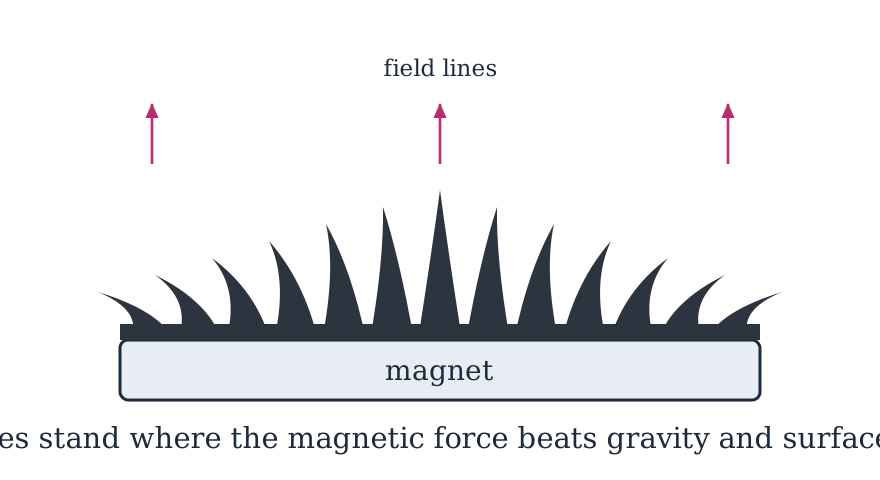
The phenomenon is due to the competition between magnetic forces, surface tension and gravity.

Spikes

In a strong magnetic field, chain-like structures form as the magnetic forces pull the fluid upwards while gravity and surface tension pull it back down. These chains align along the field lines and increase the viscosity, making the fluid behave like a solid bulging in certain directions. These are commonly known as spikes, and they form where the magnetic forces overcome the other forces.

Diagram

Spikes formed by a ferrofluid in the field of a magnet

Experiment

You need some laser printer toner, cooking oil, a test tube, a glass bottle, a small stick and a magnet.

Procedure

Pour some toner into the test tube. Laser printer toner contains 40% iron oxide in nanometre particle size.
Add some cooking oil and mix it well with the stick to form the ferrofluid.
Put this fluid in the bottle. It will act like a liquid on shaking the bottle.
Bring the magnet near the fluid, outside the bottle.

Observation

The fluid jumps towards the magnet, because it has itself become a magnet. Holding the magnet at the side of the bottle produces a structure with spikes.
LQ 6ends here

Applications in Electronics

Ferrofluids are used in rotary seals for computer hard drives and other rotating shaft motors. In loudspeakers they cool the voice coil, which heats up during operation: the magnetic field holds the fluid in place around the coil so it can absorb and dissipate heat more effectively. They also dampen vibrations and improve sound quality.

Medical Applications

Ferrofluids can be directed to specific areas in the body using external magnets, allowing targeted drug delivery. The magnetic particles can carry drugs directly to a tumour, reducing side effects and improving treatment efficiency. They are also used as contrast agents in magnetic resonance imaging.

Other Uses

Damping, and precisely controlling the flow of liquids by manipulating the magnetic field.

Short Questions

SQ 10.9.1

What is a ferrofluid made of?

Composition

A colloidal suspension of iron oxide particles about 10 nanometres across in a carrier fluid such as oil or water, each particle coated with a surfactant.
SQ 10.9.2

What is the purpose of the surfactant coating?

Purpose

It reduces the surface tension and prevents the particles from clumping together, so they remain evenly dispersed through the fluid.
SQ 10.9.3

Why do spikes form on a ferrofluid near a magnet?

Competition of Forces

The magnetic force pulls the fluid upward along the field lines while gravity and surface tension pull it back down. Spikes stand where the magnetic force wins.
SQ 10.9.4

Give one use of a ferrofluid in electronics and one in medicine.

Electronics

Cooling the voice coil of a loudspeaker, where the magnetic field holds the fluid around the coil.

Medicine

Targeted drug delivery, where external magnets steer the particles carrying the drug to a tumour.
MCQ 10.9.1

The magnetic particles in a ferrofluid are typically about:

A10 micrometres acrossB10 millimetres across
C1 metre acrossD10 nanometres across
Solution:They are iron oxide ground to the nano-scale.
MCQ 10.9.2

The surfactant in a ferrofluid prevents the particles from:

Abecoming magnetizedBconducting electricity
Cclumping togetherDdissolving
Solution:It keeps them evenly dispersed in the carrier fluid.
MCQ 10.9.3

With no magnet nearby a ferrofluid behaves like:

Aa solidBa gas
Ca magnetDa liquid
Solution:The particles are demagnetized and move freely.
MCQ 10.9.4

In a loudspeaker a ferrofluid is used to:

Acool the voice coilBamplify the signal
Cmagnetize the coneDinsulate the wires
Solution:It also damps vibration and improves the sound quality.
MCQ 10.9.5

A ferrofluid in a medical scan can be used as:

Aan X-ray sourceBa contrast agent in MRI
Can ultrasound gelDa radioactive tracer
Solution:It is also used for targeted drug delivery.
Topic 10.10

A Seismometer

Seismometer

A seismometer is an instrument that responds to any movement of the rocks under the ground, or to vibration caused by earthquakes, volcanic eruptions and explosions.

How It Works

A seismometer detects earthquakes by using electromagnetic induction to convert ground motion into electrical signals.

Construction

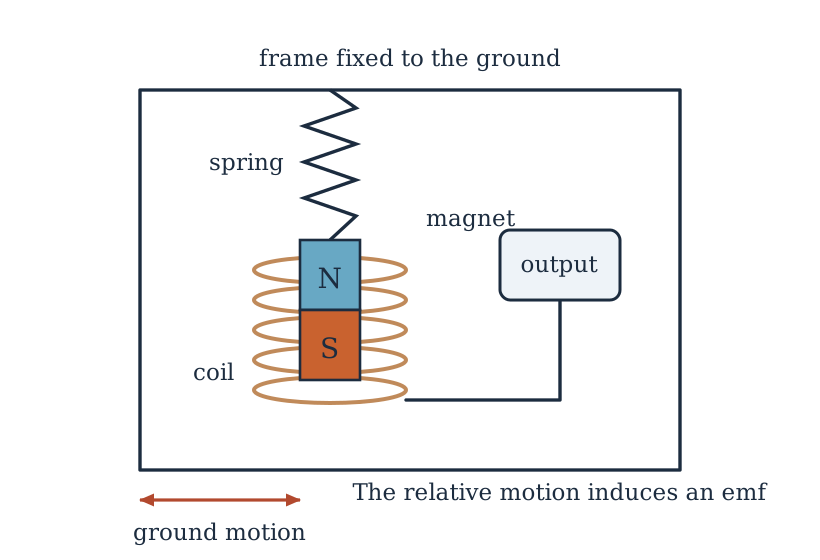
It includes a weight suspended by a spring. The weight is often attached to a magnet which moves inside a coil of wire.

Diagram

A seismometer: the magnet stays still while the frame and the coil move with the ground

Inertia

When an earthquake occurs, the ground moves but the weight tends to stay stationary due to inertia. This results in relative motion between the weight and the frame of the seismometer, which is attached to the ground.

Faraday’s Law

The changing magnetic flux through the coil induces an emf in the coil, which gives rise to an induced electric current.

The Signal

The induced current is proportional to the velocity of the ground motion. The electrical signals generated are then amplified and recorded.

What Is Recorded

The data provides the amplitude, the frequency and the duration of the earthquake waves, from which the location, magnitude and depth of the earthquake are determined.

The Vault

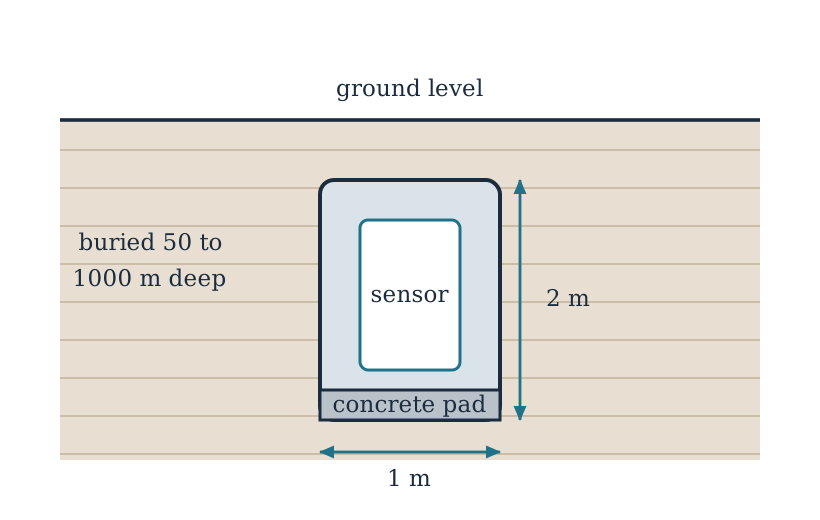
A seismometer is usually buried under the ground at a depth of 50 to 1000 metres, and it is placed in a protective case called a vault. This is a cylindrical steel tank approximately 1 metre wide and 2 metres deep with a concrete pad at the bottom.

Diagram

A seismometer buried in its protective vault

Seismic Waves

P-waves are primary waves and are longitudinal, while S-waves are secondary waves and are transverse in nature.

Depth of Earthquakes

Most earthquakes are caused by plate tectonics and occur at a depth of 60 km. These are categorized as shallow. Intermediate earthquakes can be as deep as 280 km beneath the crust, while deep earthquakes can reach depths past 280 km.

Short Questions

SQ 10.10.1

What does a seismometer do, and on what principle?

Purpose

It responds to any movement of the rocks under the ground.

Principle

It uses electromagnetic induction to turn ground motion into an electrical signal.
SQ 10.10.2

Why does the suspended weight of a seismometer stay still while the ground moves?

Inertia

The weight hangs on a spring, so the ground and the frame can move while the weight tends to stay where it is because of its inertia. That gives the relative motion between the magnet and the coil.
SQ 10.10.3

What quantity is the induced current in a seismometer proportional to?

The Ground Velocity

The induced current is proportional to the velocity of the ground motion, and the signal is then amplified and recorded.
SQ 10.10.4

Why is a seismometer buried in a vault?

Reason

Burying it 50 to 1000 metres down in a sealed steel vault keeps it away from surface noise such as traffic, wind and temperature swings, so only real ground motion is recorded.
MCQ 10.10.1

A seismometer converts ground motion into an electrical signal by:

Aelectromagnetic inductionBthe photoelectric effect
Cthe piezoelectric effectDthermal expansion
Solution:The relative motion of a magnet and a coil induces an emf.
MCQ 10.10.2

In a seismometer the suspended weight stays nearly still because of its:

AchargeBmagnetism
Cweight aloneDinertia
Solution:It hangs on a spring while the frame moves with the ground.
MCQ 10.10.3

The current induced in a seismometer coil is proportional to the:

Adepth of the earthquakeBvelocity of the ground motion
Cmass of the magnetDresistance of the coil
Solution:That is what makes the record a measure of the wave.
MCQ 10.10.4

A seismometer vault is typically:

A10 m wide and 20 m deepB10 cm wide and 20 cm deep
C1 m wide and 2 m deepD1 km wide
Solution:It is a cylindrical steel tank with a concrete pad at the bottom.
MCQ 10.10.5

Longitudinal seismic waves are called:

AP-wavesBS-waves
Csurface wavesDshear waves
Solution:S-waves, the secondary waves, are transverse.

Chapter Exercise

SQ 10.1

It is said that Lenz’s law specifically applies to induced currents and not directly to induced emf. Explain briefly.

Reason

The law fixes the direction of the induced current, because it is the current that produces the opposing magnetic field.

An Open Loop

If the loop is not closed, no current flows. We then imagine the loop closed, find the direction the current would take, and from that infer the direction of the emf.
SQ 10.2

A square loop of wire is moving through a uniform magnetic field. The normal to the loop is oriented parallel to the magnetic field. Is an emf induced in the loop?

No

The field is uniform and the orientation does not change, so the flux through the loop stays constant.
$$\phi_B=BA\cos0^{\circ}=BA$$
Since the flux does not change, the rate of change is zero and no emf is induced.
SQ 10.3

Does the induced emf always act to decrease the magnetic flux through a circuit?

No

It always acts to oppose the change, not to decrease the flux.

Increasing Flux

The induced current opposes the increase, so it acts to decrease the flux.

Decreasing Flux

The induced current now acts to maintain the flux, that is, to increase it.
SQ 10.4

When a magnet is pushed into a solenoid, the galvanometer indicates a small current. Why is the current produced? What magnetic pole is produced at the left end of the solenoid?

Why the Current Flows

The motion of the magnet changes the magnetic flux through the solenoid, and a changing flux induces an emf which drives a current.

The Pole

The face of the solenoid towards the approaching north pole becomes a north pole, so that it repels the magnet and opposes the push.
SQ 10.5

A bar magnet falls through a fixed metal ring. Will the magnet fall with the acceleration of a freely falling body?

No

The falling magnet changes the flux through the ring, so a current is induced in it.

Why It Slows

By Lenz’s law that current opposes the motion, so it exerts an upward force on the magnet. The magnet therefore falls with an acceleration less than $g$.
SQ 10.6

Which of two charged particles of the same mass will be deflected most in a magnetic field: (a) fast moving (b) slow moving?

The Slow One

The radius of the circular path is
$$r=\frac{mv}{qB}$$
A smaller speed gives a smaller radius, which is a sharper bend, so the slow particle is deflected more.
SQ 10.7

An electron and a proton are projected into a magnetic field at right angles to it with a certain velocity. Which particle will suffer greater deflection? Why?

The Electron

Both carry the same magnitude of charge and enter at the same speed, so they feel the same force.
$$r=\frac{mv}{qB}$$

Reason

The electron has a far smaller mass, so its radius is much smaller and it is deflected far more.
SQ 10.8

Can a single moving proton produce a magnetic field?

Yes

A moving charge is a current, and every current produces a magnetic field around it.

Note

A moving charged particle is surrounded by both an electric and a magnetic field; a stationary one has only an electric field.
SQ 10.9

A magnetic field is necessary if there is to be a magnetic flux through a coil of wire. Yet just because there is a magnetic field does not mean that a flux will pass through a coil. Account for this.

Reason

The flux depends on the orientation as well as on the field.
$$\phi_B=BA\cos\theta$$

Zero Flux

If the plane of the coil contains the field, the normal is at right angles to it and the flux is zero, however strong the field.
$$\theta=90^{\circ}$$
$$\phi_B=0$$
CRQ 10.1

A charge is lying stationary between the opposite poles of two magnets. Is a magnetic force exerted on it? Why?

No

The magnetic force on a charge is
$$F=qvB\sin\theta$$

Reason

The charge is stationary, so its velocity is zero and the force is zero. A magnetic field acts only on a moving charge.
CRQ 10.2

When the switch in the circuit is closed, a current is established in the coil and the metal ring jumps upward. Why? What would happen if the battery polarity were reversed?

Why It Jumps

Closing the switch makes the flux through the ring rise sharply, so a current is induced in the ring. By Lenz’s law it opposes the increase, so the ring and the coil repel each other and the ring is thrown upward.

Reversed Polarity

The field is reversed but it still grows from zero, so the induced current is also reversed and the ring is still repelled. It jumps upward again.
CRQ 10.3

A coil of wire lies in the x–y plane with a magnetic field directed along the y-axis. About which of the three coordinate axes should the coil be rotated in order to generate an emf and a current in the coil?

About the x-axis

The normal to the coil is along the z-axis, which is at right angles to the field, so the flux is zero to begin with.

Why the x-axis

Rotating about the x-axis tilts the normal towards the y-axis and changes the flux, so an emf is induced.

Why Not the Others

Rotating about the y-axis or the z-axis keeps the normal perpendicular to the field, so the flux stays zero.
CRQ 10.4

Is it possible to change both the area of a loop and the magnetic field passing through it and still not have an induced emf in the loop?

Yes

The emf depends on the change of the flux, not of the field or the area separately.
$$\phi_B=BA$$

Condition

If one is increased in the same proportion as the other is decreased, the product stays constant, the flux does not change and no emf is induced.
CRQ 10.5

Does the application of a uniform magnetic field to a moving charged particle result in a change in the kinetic energy of the particle?

No

The magnetic force is always perpendicular to the velocity, so it does no work on the particle.

Result

The speed, and therefore the kinetic energy, stays the same; only the direction of the velocity changes.
CRQ 10.6

A uniform electric field and a magnetic field act in the same direction. A proton is projected into the space with a uniform velocity in the opposite direction. What will happen to the proton?

No Magnetic Force

The velocity is antiparallel to the field, so the angle is $180^{\circ}$ and the magnetic force is zero.
$$F=qvB\sin180^{\circ}=0$$

Electric Force Only

The electric force acts along the field, opposite to the motion, so the proton is retarded along a straight line. It slows, stops and then returns along the same line.
CRQ 10.7

A conductor moves in a magnetic field when a current is passed through it. Would you expect the reverse effect to occur, that is, would a current be produced if a conductor is moved across a magnetic field?

Yes

This is exactly electromagnetic induction.

Why

Moving the conductor across the field changes the flux through the circuit, so an emf is induced.
$$\varepsilon=-\frac{\Delta\phi_B}{\Delta t}$$
If the circuit is closed, an induced current flows.
CRQ 10.8

A rod moves to the right on rails in a magnetic field. The induced emf gives rise to a current and the bulb lights up. Where does the electrical energy consumed by the bulb come from?

From the External Agent

The induced current in the rod feels a magnetic force that opposes its motion.

The Balance

To keep the rod moving at a constant velocity, an external force must be applied against that magnetic force, and the work it does is the source of the energy.

Conclusion

The electrical energy in the bulb comes from the mechanical work done in pulling the rod, so energy is conserved.
CRQ 10.9

What will you do if you want to save a sensitive instrument from stray magnetic fields?

Magnetic Shielding

Enclose the instrument in a case of a soft ferromagnetic material, such as soft iron or mu-metal.

How It Works

The lines of the stray field prefer the easy path through the high-permeability shell, so they are guided round the enclosure and very few pass into the space inside.
MCQ 10.1

A current is flowing towards north along a power line. The direction of the magnetic field over the wire is directed towards:

AnorthBsouth
CeastDwest
Solution:Correct answer: (c) east.
MCQ 10.2

The radius of curvature of the path of a charged particle in a uniform magnetic field is directly proportional to:

Athe particle’s chargeBthe particle’s momentum
Cthe particle’s energyDthe flux density of the field
Solution:Correct answer: (b) the particle’s momentum.
MCQ 10.3

A beam of electrons travelling to the right enters a magnetic field whose lines lie in the plane of the page and point towards the bottom of the page. What is the effect of the magnetic field on the electrons?

AThey are deflected into the plane of the diagram.BThey are deflected out of the plane of the diagram.
CThey are deflected towards the bottom of the diagram.DThey are deflected towards the top of the diagram.
Solution:Correct answer: (b) They are deflected out of the plane of the diagram..
MCQ 10.4

The force exerted on a wire of 1 metre length carrying 1 ampere current placed at right angles to the magnetic field is called:

Amagnetic field intensityBmagnetic flux
Cmagnetic inductionDnone of these
Solution:Correct answer: (c) magnetic induction.
MCQ 10.5

The unit of flux density is:

AN A$^{-1}$ m$^{-1}$BN A m$^{-1}$
CN m A$^{-1}$DN m A
Solution:Correct answer: (a) N A$^{-1}$ m$^{-1}$.
MCQ 10.6

A moving charged particle is surrounded by:

Aelectric field onlyBmagnetic field only
Cboth electric and magnetic fieldDno field
Solution:Correct answer: (c) both electric and magnetic field.
MCQ 10.7

The magnetic force on a charge $q$ moving parallel to a magnetic field with velocity $v$ is:

A$qvB\sin\theta$B$qvB$
CzeroD$ILB$
Solution:Correct answer: (c) zero.
MCQ 10.8

The unit N A$^{-1}$ m$^{-1}$ is called:

AweberBtesla
CcoulombDnone of these
Solution:Correct answer: (b) tesla.
MCQ 10.9

Electrons moving perpendicularly through a uniform magnetic field are:

Adeflected towards the north poleBdeflected towards the south pole
Cdeflected along a circular pathDnot deflected at all
Solution:Correct answer: (c) deflected along a circular path.
MCQ 10.10

A magnet is suspended from a spring. The magnet oscillates and moves in and out of a coil connected to a galvanometer. When the magnet oscillates, the galvanometer shows:

Adeflection to the left and to the right with constant amplitudeBdeflection on one side
Cno deflectionDdeflection to the left and right, but the amplitude steadily decreases
Solution:Correct answer: (d) deflection to the left and right, but the amplitude steadily decreases.
Numerical 10.1

A positively charged particle is projected perpendicularly into a magnetic field at a speed of 1500 m s$^{-1}$. It experiences a force of magnitude $F$. At what angle $\theta$ with the field should the particle be projected at a speed of 2000 m s$^{-1}$ so that it experiences the same magnitude of force? (Ans: $\theta=49^{\circ}$)

Given Data

$$v_1=1500\,\mathrm{m\,s^{-1}}$$
$$\theta_1=90^{\circ}$$
$$v_2=2000\,\mathrm{m\,s^{-1}}$$

To Find

The angle $\theta=?$

Formula

$$F=qvB\sin\theta$$

Solution

The charge and the field are the same in both cases, so the force is the same when
$$v_1\sin90^{\circ}=v_2\sin\theta$$
Putting the values
$$\sin\theta=\frac{1500}{2000}=0.75$$
$$\theta=\sin^{-1}(0.75)=49^{\circ}$$

Result

$$\theta=49^{\circ}$$
Numerical 10.2

Electrons are accelerated from rest through a potential difference of 15 kV in an oscilloscope. The electrons then pass through a 0.35 T magnetic field that deflects them to the desired position on the screen. Find the magnitude of the maximum force that an electron can experience. (Ans: $4.1\times10^{-12}$ N)

Given Data

$$V=15\,\mathrm{kV}=1.5\times10^{4}\,\mathrm{V}$$
$$B=0.35\,\mathrm{T}$$
$$e=1.6\times10^{-19}\,\mathrm{C}$$
$$m=9.1\times10^{-31}\,\mathrm{kg}$$

To Find

The maximum force $F=?$

Formula

The whole energy gained appears as kinetic energy.
$$eV=\frac{1}{2}mv^2$$
$$v=\sqrt{\frac{2eV}{m}}$$
The force is a maximum when the velocity is perpendicular to the field.
$$F=evB$$

Solution

The speed of the electrons is
$$\begin{aligned}v&=\sqrt{\frac{2\times1.6\times10^{-19}\times1.5\times10^{4}}{9.1\times10^{-31}}} \\ &=7.26\times10^{7}\,\mathrm{m\,s^{-1}}\end{aligned}$$
So the maximum force is
$$\begin{aligned}F&=1.6\times10^{-19}\times7.26\times10^{7}\times0.35 \\ &=4.1\times10^{-12}\,\mathrm{N}\end{aligned}$$

Result

$$F=4.1\times10^{-12}\,\mathrm{N}$$
Numerical 10.3

A square coil of side 15 cm consists of 60 turns. Initially it is located in a uniform magnetic field of magnitude 0.8 T such that the plane of the coil is perpendicular to the field. The coil is then turned through an angle of $\theta=30^{\circ}$ in a time of 2 s. Determine the average induced emf. (Ans: 0.07 V)

Given Data

$$L=15\,\mathrm{cm}=0.15\,\mathrm{m}$$
$$N=60$$
$$B=0.8\,\mathrm{T}$$
$$\theta=30^{\circ}$$
$$\Delta t=2\,\mathrm{s}$$

To Find

Average induced emf $\varepsilon=?$

Formula

$$A=L^2$$
$$\varepsilon=-N\frac{\Delta\phi_B}{\Delta t}$$

Solution

The area of the coil is
$$A=(0.15)^2=2.25\times10^{-2}\,\mathrm{m^2}$$
The plane starts perpendicular to the field, so the normal starts along it and the change of flux is
$$\Delta\phi_B=BA(\cos0^{\circ}-\cos30^{\circ})$$
$$\begin{aligned}\Delta\phi_B&=0.8\times2.25\times10^{-2}\times(1-0.866) \\ &=2.41\times10^{-3}\,\mathrm{Wb}\end{aligned}$$
So the average induced emf is
$$\varepsilon=60\times\frac{2.41\times10^{-3}}{2}=0.07\,\mathrm{V}$$

Result

$$\varepsilon=0.07\,\mathrm{V}$$
Numerical 10.4

A metallic rod is moving through a uniform magnetic field of 0.2 T. The emf induced across its ends is found to be 0.8 V. It is required to induce an emf of 2.4 V across its ends. How much field strength is needed for this? (Ans: 0.6 T)

Given Data

$$B_1=0.2\,\mathrm{T}$$
$$\varepsilon_1=0.8\,\mathrm{V}$$
$$\varepsilon_2=2.4\,\mathrm{V}$$

To Find

The field strength $B_2=?$

Formula

The length and the speed do not change, so
$$\varepsilon=vBL$$
$$\frac{\varepsilon}{B}=\text{constant}$$
$$\varepsilon\propto B$$

Solution

Taking the ratio of the two cases
$$\begin{aligned}B_2&=B_1\times\frac{\varepsilon_2}{\varepsilon_1}=0.2\times\frac{2.4}{0.8} \\ &=0.6\,\mathrm{T}\end{aligned}$$

Result

$$B_2=0.6\,\mathrm{T}$$
Numerical 10.5

A copper ring has a radius of 4.0 cm and a resistance of 1.0 m$\Omega$. A magnetic field is applied over the ring, perpendicular to its plane. If the magnetic field increases from 0.2 T to 0.4 T in a time interval of $5\times10^{-3}$ s, what is the current in the ring during this interval? (Ans: 201 A)

Given Data

$$r=4.0\,\mathrm{cm}=0.04\,\mathrm{m}$$
$$R=1.0\,\mathrm{m}\Omega=1\times10^{-3}\,\Omega$$
$$\Delta B=0.4-0.2=0.2\,\mathrm{T}$$
$$\Delta t=5\times10^{-3}\,\mathrm{s}$$

To Find

The induced current $I=?$

Formula

$$A=\pi r^2$$
$$\varepsilon=\frac{\Delta B\,A}{\Delta t}$$
$$I=\frac{\varepsilon}{R}$$

Solution

The area of the ring is
$$A=\pi(0.04)^2=5.03\times10^{-3}\,\mathrm{m^2}$$
So the induced emf is
$$\begin{aligned}\varepsilon&=\frac{0.2\times5.03\times10^{-3}}{5\times10^{-3}} \\ &=0.201\,\mathrm{V}\end{aligned}$$
And the current in the ring is
$$I=\frac{0.201}{1\times10^{-3}}=201\,\mathrm{A}$$

Result

$$I=201\,\mathrm{A}$$
Numerical 10.6

A coil of 10 turns and 35 cm$^2$ area is in a perpendicular magnetic field of 0.5 T. The coil is pulled out of the field in 1.0 s. Find the induced emf in the coil as it is pulled out of the field. (Ans: $1.75\times10^{-2}$ V)

Given Data

$$N=10$$
$$A=35\,\mathrm{cm^2}=35\times10^{-4}\,\mathrm{m^2}$$
$$B=0.5\,\mathrm{T}$$
$$\Delta t=1.0\,\mathrm{s}$$

To Find

Induced emf $\varepsilon=?$

Formula

The flux falls from $BA$ to zero.
$$\varepsilon=N\frac{BA}{\Delta t}$$

Solution

Putting the values
$$\begin{aligned}\varepsilon&=10\times\frac{0.5\times35\times10^{-4}}{1.0} \\ &=1.75\times10^{-2}\,\mathrm{V}\end{aligned}$$

Result

$$\varepsilon=1.75\times10^{-2}\,\mathrm{V}$$
Numerical 10.7

A proton is accelerated by a potential difference of $6\times10^{5}$ volts. It then enters perpendicularly a uniform magnetic field $B=1.0$ weber m$^{-2}$. Find the radius of curvature of the path of the proton. ($m=1.67\times10^{-27}$ kg, $e=1.6\times10^{-19}$ C) (Ans: 11.2 cm)

Given Data

$$V=6\times10^{5}\,\mathrm{V}$$
$$B=1.0\,\mathrm{Wb\,m^{-2}}$$
$$m=1.67\times10^{-27}\,\mathrm{kg}$$
$$e=1.6\times10^{-19}\,\mathrm{C}$$

To Find

The radius $r=?$

Formula

$$eV=\frac{1}{2}mv^2$$
$$v=\sqrt{\frac{2eV}{m}}$$
$$r=\frac{mv}{eB}$$

Solution

The speed of the proton is
$$\begin{aligned}v&=\sqrt{\frac{2\times1.6\times10^{-19}\times6\times10^{5}}{1.67\times10^{-27}}} \\ &=1.07\times10^{7}\,\mathrm{m\,s^{-1}}\end{aligned}$$
So the radius of the path is
$$\begin{aligned}r&=\frac{1.67\times10^{-27}\times1.07\times10^{7}}{1.6\times10^{-19}\times1.0} \\ &=0.112\,\mathrm{m}\end{aligned}$$

Result

$$r=11.2\,\mathrm{cm}$$
Numerical 10.8

A proton enters a uniform magnetic field $B=0.3$ weber m$^{-2}$ in a direction making an angle of $45^{\circ}$ with the magnetic field. What will be the radius of the circular path if the velocity of the proton is $10^{4}$ m s$^{-1}$? (Ans: $2.46\times10^{-4}$ m)

Given Data

$$B=0.3\,\mathrm{Wb\,m^{-2}}$$
$$\theta=45^{\circ}$$
$$v=10^{4}\,\mathrm{m\,s^{-1}}$$
$$m=1.67\times10^{-27}\,\mathrm{kg}$$
$$e=1.6\times10^{-19}\,\mathrm{C}$$

To Find

The radius $r=?$

Formula

Only the component of the velocity across the field bends the path.
$$r=\frac{mv\sin\theta}{eB}$$

Solution

Putting the values
$$\begin{aligned}r \\ &=\frac{1.67\times10^{-27}\times10^{4}\times0.707}{1.6\times10^{-19}\times0.3}\end{aligned}$$
$$\begin{aligned}r&=\frac{1.18\times10^{-23}}{4.8\times10^{-20}} \\ &=2.46\times10^{-4}\,\mathrm{m}\end{aligned}$$

Result

$$r=2.46\times10^{-4}\,\mathrm{m}$$
Numerical 10.9

Three identical conducting rods $L_1$, $L_2$ and $L_3$ are moving in different planes with the same speed 2.5 m s$^{-1}$. The length of each rod is 60 cm and a constant magnetic field of magnitude $B=0.5$ T is directed along the z-axis. Find the magnitude of the emf induced in each rod. [Ans: rod $L_1$ 0.75 V with end a positive, rod $L_2$ zero, rod $L_3$ zero]

Given Data

$$v=2.5\,\mathrm{m\,s^{-1}}$$
$$L=60\,\mathrm{cm}=0.60\,\mathrm{m}$$
$$B=0.5\,\mathrm{T}$$

To Find

The emf induced in each rod

Formula

The emf is induced only by the component of the motion that cuts the field lines.
$$\varepsilon=vBL$$

Solution

The rod $L_1$ moves at right angles to the field and its length is at right angles to both, so it cuts the lines.
$$\varepsilon_1=2.5\times0.5\times0.60=0.75\,\mathrm{V}$$
Its end a is the positive end.
The rod $L_2$ moves along the field, so no lines are cut.
$$\varepsilon_2=0$$
The rod $L_3$ moves in a plane containing the field so that its velocity and its length lie along the field, so no lines are cut.
$$\varepsilon_3=0$$

Result

$$\varepsilon_1=0.75\,\mathrm{V}$$
$$\varepsilon_2=0$$
$$\varepsilon_3=0$$
Numerical 10.10

An emf of 0.5 V is induced across the ends of a metal rod moving through a magnetic field of 0.4 T. If an emf of 1.5 V has to be induced, what field strength would be needed for that? Assume that all other factors remain the same. (Ans: 1.2 T)

Given Data

$$\varepsilon_1=0.5\,\mathrm{V}$$
$$B_1=0.4\,\mathrm{T}$$
$$\varepsilon_2=1.5\,\mathrm{V}$$

To Find

The field strength $B_2=?$

Formula

The speed and the length are unchanged, so
$$\frac{\varepsilon}{B}=\text{constant}$$
$$\varepsilon\propto B$$

Solution

Taking the ratio of the two cases
$$B_2=0.4\times\frac{1.5}{0.5}=1.2\,\mathrm{T}$$

Result

$$B_2=1.2\,\mathrm{T}$$
Numerical 10.11

A charged particle moves through a velocity selector at a constant velocity of $4.96\times10^{4}$ m s$^{-1}$ in a direction perpendicular to both E and B. If the magnetic field strength is 0.114 T, what should be the magnitude of the electric field intensity so that the particle moves undeflected? (Ans: $5.65\times10^{3}$ N C$^{-1}$)

Given Data

$$v=4.96\times10^{4}\,\mathrm{m\,s^{-1}}$$
$$B=0.114\,\mathrm{T}$$

To Find

The electric intensity $E=?$

Formula

For no deflection the electric force balances the magnetic force.
$$qE=Bqv$$
$$E=vB$$

Solution

Putting the values
$$E=4.96\times10^{4}\times0.114=5.65\times10^{3}\,\mathrm{N\,C^{-1}}$$

Result

$$E=5.65\times10^{3}\,\mathrm{N\,C^{-1}}$$
Numerical 10.12

A current-carrying conductor PQ of length 2 m is placed perpendicularly to a magnetic field of flux density 0.5 T. The resulting force on the conductor is 1 N acting into the plane of the paper. What is the magnitude and direction of the current? (Ans: 1 A, Q to P)

Given Data

$$L=2\,\mathrm{m}$$
$$B=0.5\,\mathrm{T}$$
$$F=1\,\mathrm{N}$$
$$\theta=90^{\circ}$$

To Find

The current $I=?$ and its direction

Formula

$$F=BIL\sin\theta$$
$$I=\frac{F}{BL}$$

Solution

Putting the values
$$I=\frac{1}{0.5\times2}=1\,\mathrm{A}$$

Direction

The field points to the right and the force is into the page. By Fleming’s left-hand rule the current must run from Q to P.

Result

$$I=1\,\mathrm{A}\ \text{from Q to P}$$

Self Test

Seventeen questions across the whole chapter. Work through them without the notes, then check the answers keyed at the foot of the page.

Q 1

The force on a current-carrying conductor in a magnetic field is a maximum when the conductor is:

Aalong the fieldBperpendicular to the field
Cat $30^{\circ}$ to the fieldDat $45^{\circ}$ to the field
Q 2

In Fleming’s left-hand rule the second finger points along the:

AforceBmagnetic field
CcurrentDinduced emf
Q 3

One tesla is the same as:

A1 N A$^{-1}$ m$^{-1}$B1 N A m
C1 N m A$^{-1}$D1 N m A
Q 4

A 0.5 m wire carrying 6 A lies at right angles to a 0.4 T field. The force on it is:

A0.3 NB3 N
C1.2 ND12 N
Q 5

The magnetic flux through a plane area is given by:

A$BA\tan\theta$B$BA\sin\theta$
C$B/A$D$BA\cos\theta$
Q 6

The SI unit of magnetic flux is the:

AteslaBweber
ChenryDnewton
Q 7

Magnetic flux linkage is the product of the flux and the:

Aarea of the coilBcurrent in the coil
Cnumber of turnsDresistance of the coil
Q 8

A charged particle moving along a magnetic field experiences a force of:

A$qvB$B$qvB/2$
C$2qvB$Dzero
Q 9

The radius of the circular path of a charged particle in a magnetic field is:

A$mv/qB$B$qB/mv$
C$qvB/m$D$mvB/q$
Q 10

A magnetic field does no work on a moving charge because the force is:

AzeroBconstant
Cperpendicular to the velocityDparallel to the velocity
Q 11

The speed selected by a velocity selector is:

A$EB$B$B/E$
C$E/B^2$D$E/B$
Q 12

A rod 0.5 m long moves at 4 m s$^{-1}$ at right angles to a 0.2 T field. The emf induced is:

A0.4 VB4 V
C0.04 VD2 V
Q 13

Faraday’s law for a coil of N turns is:

A$\varepsilon=N\phi\Delta t$B$\varepsilon=-N\Delta\phi/\Delta t$
C$\varepsilon=-\Delta\phi/N\Delta t$D$\varepsilon=N/\phi\Delta t$
Q 14

Lenz’s law is a consequence of the conservation of:

AchargeBmomentum
CenergyDmass
Q 15

When a north pole is pushed towards a coil, the face of the coil nearest the magnet becomes a:

Asouth poleBnorth pole
Cneutral faceDpole that depends on the speed
Q 16

A ferrofluid behaves like a solid when:

Ait is heatedBthe surfactant is removed
Cit is shakenDa magnet is brought near it
Q 17

The current induced in the coil of a seismometer is proportional to the:

Adepth of the earthquakeBmass of the magnet
Cvelocity of the ground motionDresistance of the coil

Answers 1 (b)2 (c)3 (a)4 (c)5 (d)6 (b)7 (c)8 (d)9 (a)10 (c)11 (d)12 (a)13 (b)14 (c)15 (b)16 (d)17 (c)