Electric Potential Difference
Electrostatics | |
DefinitionElectrostatics or static electricity refers to the phenomena arising from stationary electric charges. These include the forces exerted by charges on each other, the electric field and electric potential produced by them, and the electrical energy stored in space and in various devices. | |
Coulomb’s LawA charge placed in the electric field of another charge experiences a force. Its direction depends on whether the charges are positive or negative. $$F_e=\frac{1}{4\pi\varepsilon_o}\frac{q_1q_2}{r^2}$$ | |
Electric Potential Difference | |
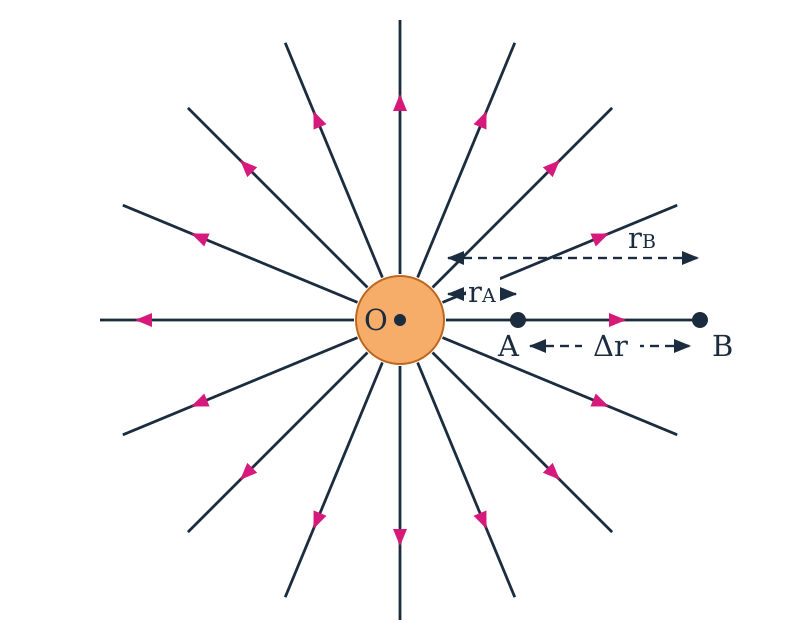
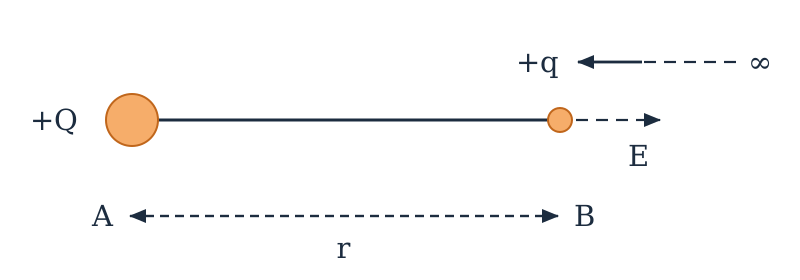
DefinitionThe electric potential difference is the work done per unit charge in moving it between two points against the electric field. 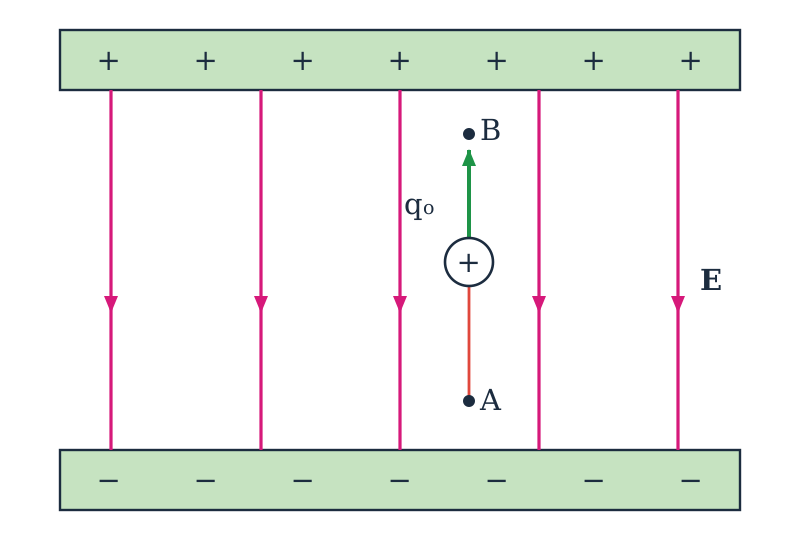 $$\Delta V=V_B-V_A=\frac{W_{AB}}{q_o}=\frac{\Delta U}{q_o}$$ | |
UnitIts SI unit is the volt. It can be converted into other units such as kilovolts (kV) or millivolts (mV). $$1\,\mathrm{V}=\frac{1\,\mathrm{J}}{1\,\mathrm{C}}$$ | |
Potential GradientThe electric field represents the rate of change of potential with distance, called the gradient of potential. $$\Delta V=-\mathbf{E}\cdot\Delta\mathbf{d}$$ $$E=-\frac{\Delta V}{\Delta d}$$ The negative sign indicates that the field points from higher to lower potential. | |
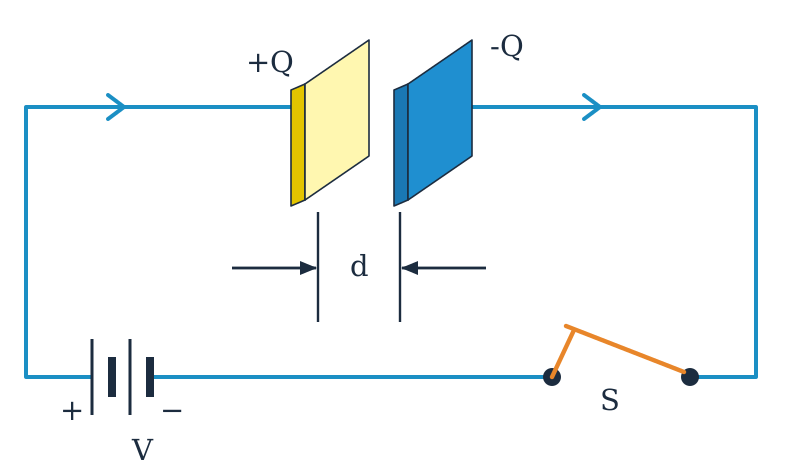
Uniform FieldIn a uniform electric field the relation simplifies to $$E=\frac{V}{d}$$ The potential difference between two points is directly proportional to the electric field strength and the distance between them. A stronger electric field causes a more rapid decrease in potential, a clear physical link between field intensity and voltage variation in space. | |
For Your InformationAlthough the points at infinity are assumed to be at zero potential, the Earth is taken to be at zero potential practically. The absolute value of the electric potential at a point is therefore measured with respect to the Earth. |
Book Examples
|
Example 16.1.1
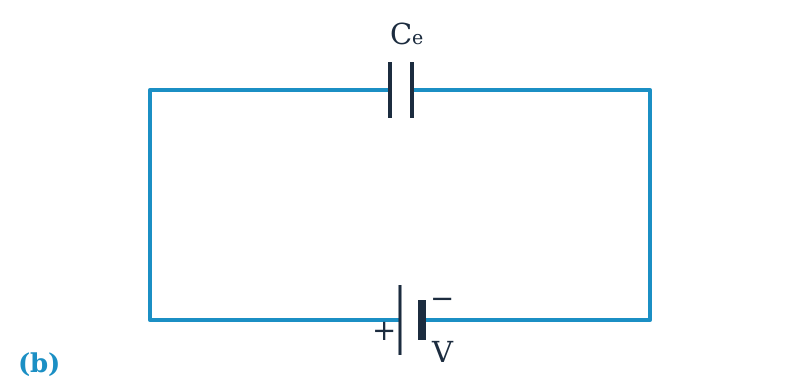
A 6 volts battery is connected to two parallel copper plates separated by a distance of 0.3 cm. Find the electric field intensity between them. |
|||||||||||||||||
|
|||||||||||||||||
Short Questions
|
SQ 16.1.1
Define electric potential difference and give its SI unit. |
|||||||||
|
|||||||||
|
SQ 16.1.2
What is meant by the gradient of potential? |
|||||||||
|
|||||||||
|
SQ 16.1.3
Show that volt per metre is the same as newton per coulomb. |
|||||||||
|
|||||||||
|
MCQ 16.1.1
The SI unit of electric potential difference is the: |
|||||||
| A | coulomb | B | farad | ||||
| C | volt | D | joule | ||||
| Solution:One volt is one joule per coulomb. | |||||||
|
MCQ 16.1.2
A 12 V battery is connected to two parallel plates 0.4 cm apart. The field between them is: |
|||||||
| A | 3000 V m$^{-1}$ | B | 30 V m$^{-1}$ | ||||
| C | 48 V m$^{-1}$ | D | 300 V m$^{-1}$ | ||||
| Solution:E = V/d = 12 V / 0.004 m = 3000 V m⁻¹. | |||||||
|
MCQ 16.1.3
One volt is equal to: |
|||||||
| A | 1 C J$^{-1}$ | B | 1 J C$^{-1}$ | ||||
| C | 1 J s$^{-1}$ | D | 1 N C$^{-1}$ | ||||
| Solution:Potential difference is work per unit charge. | |||||||
|
MCQ 16.1.4
If the separation of two plates is doubled at the same potential difference, the uniform field between them becomes: |
|||||||
| A | double | B | four times | ||||
| C | unchanged | D | half | ||||
| Solution:E = V/d, so E halves when d doubles. | |||||||