Mass Defect and Binding Energy
The Nucleus | |
DefinitionThe nucleus is the dense, positively charged central part of an atom, of very small size, made of protons and neutrons and surrounded by electrons. | |
DiscoveryErnest Rutherford’s experiments in 1911 indicated the existence of a dense, positively charged central part of the atom, the nucleus, of very small size and surrounded by electrons. In 1920 Rutherford suggested that the positive charge is due to protons inside the nucleus, and predicted another particle having no charge. The prediction came true when the neutron was discovered in 1932. | |
Do You Know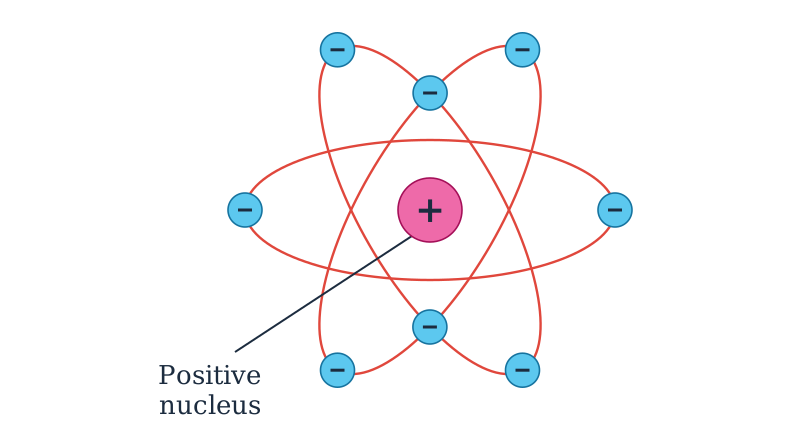 From alpha-particle scattering experiments, Lord Rutherford concluded that most of the atom is empty and that its mass is concentrated in a very small region called the nucleus. | |
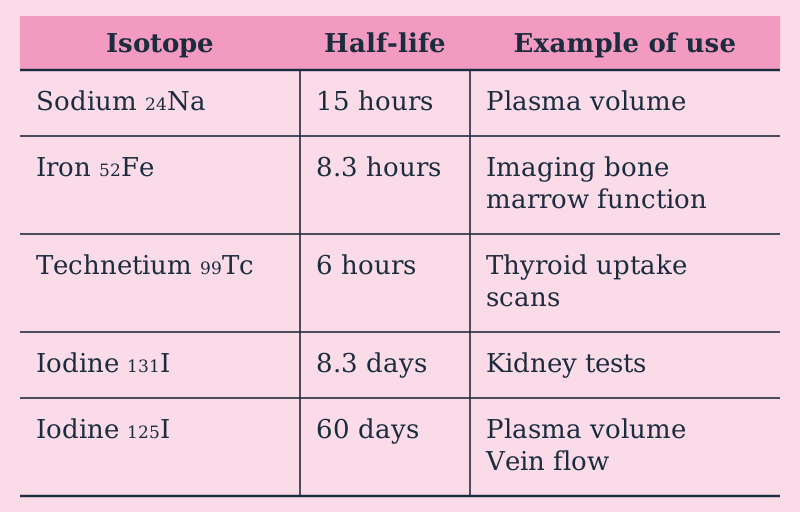
Nuclear PhysicsNuclear physics is the study of the various aspects of atomic nuclei and sub-atomic particles: unstable nuclei giving off radiations, their decay, and nuclear reactions such as fission and fusion, which release huge amounts of energy. Radioactive isotopes are used as tracers in medical diagnostics and treatment, agriculture, scientific research and industry. | |
NuclideAn atomic nucleus, often called a nuclide, is represented by the symbol ${}^{A}_{Z}X$. | |
Symbols$X$ is the chemical symbol of the element. $Z$ is the atomic or charge number, the number of protons in the nucleus. $A$ is the mass number, the total number of nucleons (protons and neutrons). | |
Number of Neutrons$$N=A-Z$$ | |
ExamplesHydrogen, carbon and uranium are written as $${}^{1}_{1}\mathrm{H}\qquad{}^{12}_{6}\mathrm{C}\qquad{}^{235}_{92}\mathrm{U}$$ | |
SizeThe nucleus is very dense, with a radius of the order of $10^{-14}$ m, surrounded by a cloud of electrons that gives the atom a radius of the order of $10^{-10}$ m. LQ 1starts here — mass defect, binding energy, and the information given by the curve of binding energy per nucleon against nucleon number | |
Mass Defect | |
DefinitionThe mass of a nucleus is always less than the total mass of the protons and neutrons that make it up. The lost or missing mass is called the mass defect $\Delta m$ $$\Delta m=[Zm_p+(A-Z)m_n]-m_{nucleus}$$ | |
Symbols$m_p$ is the mass of a proton. $m_n$ is the mass of a neutron. $m_{nucleus}$ is the mass of the entire nucleus. | |
Binding Energy | |
DefinitionThe energy required to break the nucleus into its constituents (neutrons and protons) is called binding energy. It is the potential energy of the nucleus, written B.E. | |
Mass into EnergyThe missing mass is converted to energy, used in the formation of the nucleus. It is calculated from Einstein’s mass-energy relation. $$\Delta E=(\Delta m)c^2$$ | |
Negative ValueBinding energy is considered to have a negative value, just as the absolute gravitational potential is taken as zero on the surface of the Earth. | |
For Your Information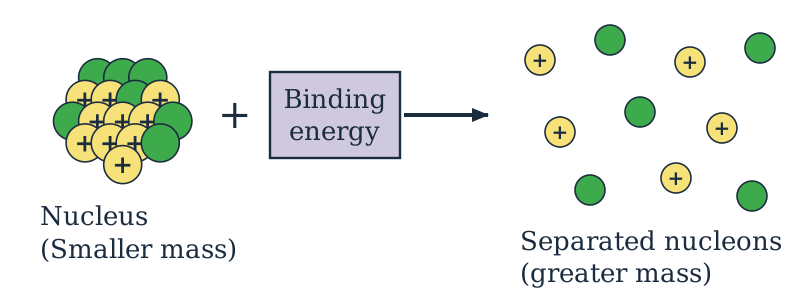 Energy must be supplied to break the nucleus apart into its constituent protons and neutrons. | |
Binding Energy per NucleonA better measure is the binding energy per nucleon. It can be considered as the average energy needed to separate a nucleus into its individual nucleons. | |
Atomic Mass UnitThe masses of sub-atomic particles are usually given in atomic mass units (amu or u). One atomic mass unit is $\frac{1}{12}$th of the mass of an unbound neutral atom of ${}^{12}_{6}\mathrm{C}$ $$1\,\mathrm{u}=1.66\times10^{-24}\,\mathrm{g}=1.66\times10^{-27}\,\mathrm{kg}$$ | |
Some Atomic Masses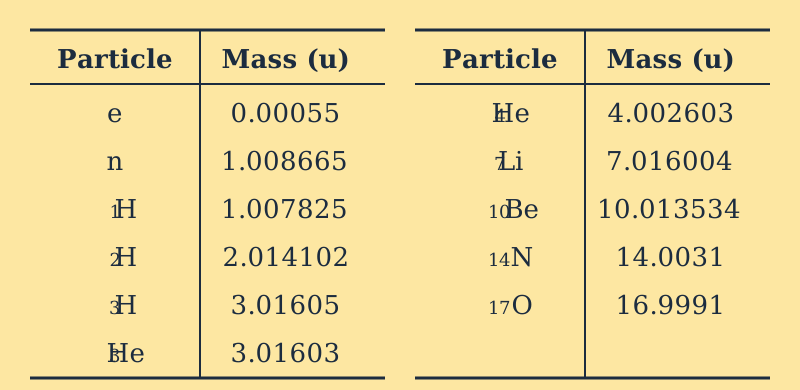 | |
Binding Energy Curve | |
DefinitionThe binding energy curve is the graph of the binding energy per nucleon against the mass number $A$. | |
UseA curve of binding energy per nucleon against the mass number $A$ is useful. The position of a nucleus on this curve tells how stable it is and whether energy can be obtained from it by fission or by fusion. 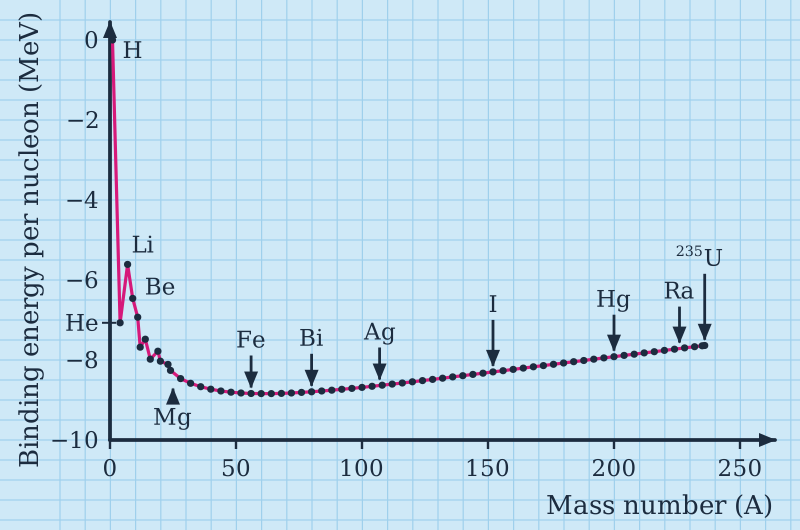 | |
From Hydrogen to HeliumThe hydrogen nucleus, with just one proton, has zero binding energy. The fall from hydrogen to helium is large, which suggests a large energy release when hydrogen is converted to helium. | |
Most Stable NuclideThe curve reaches a maximum binding energy per nucleon of about 8.7 MeV for iron ${}^{56}_{26}\mathrm{Fe}$, the most stable nuclide. The region of most stable nuclei lies between mass numbers 50 and 80. After it the binding energy per nucleon decreases steadily to the end of the curve. LQ 1ends here LQ 4starts here — why very light and very heavy nuclei are unstable, and how they are useful as a source of a huge amount of energy | |
Light and Heavy Nuclei | |
Less Tightly BoundThe binding energy per nucleon is less for very light and very heavy nuclei, so their nucleons are not so tightly bound as those of the middle elements. | |
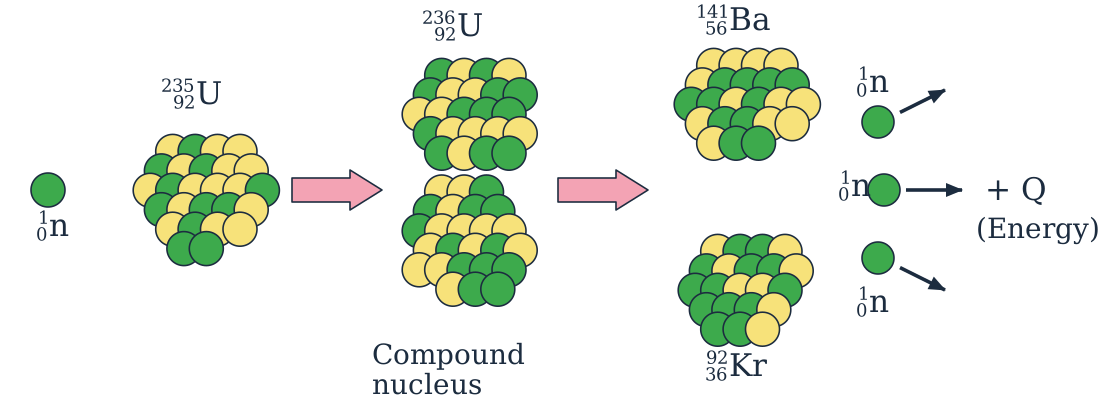
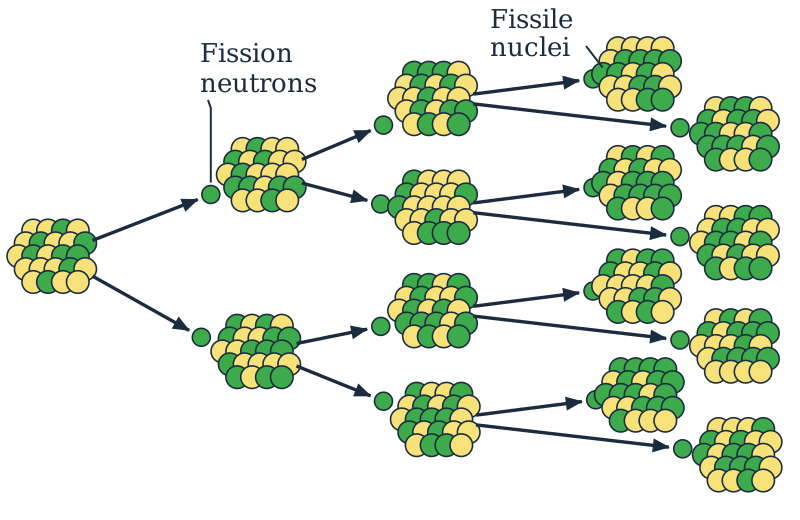
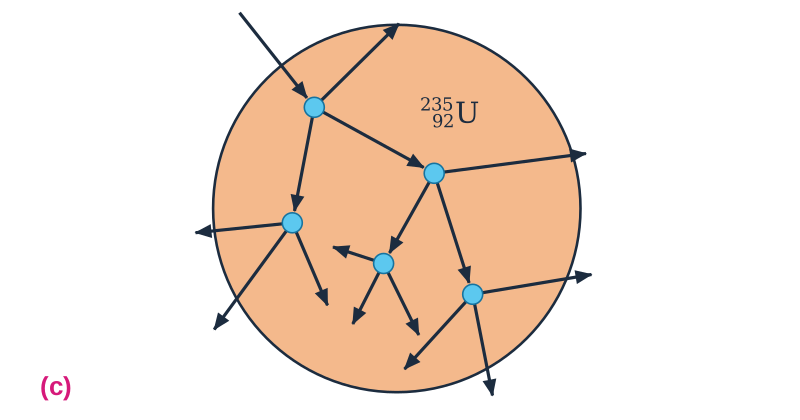
FissionIf a heavy nucleus is split into two nuclei lying near the lowest part of the curve, these are more tightly bound and stable. This process is called nuclear fission, and mankind already benefits from it in the production of huge amounts of power. | |
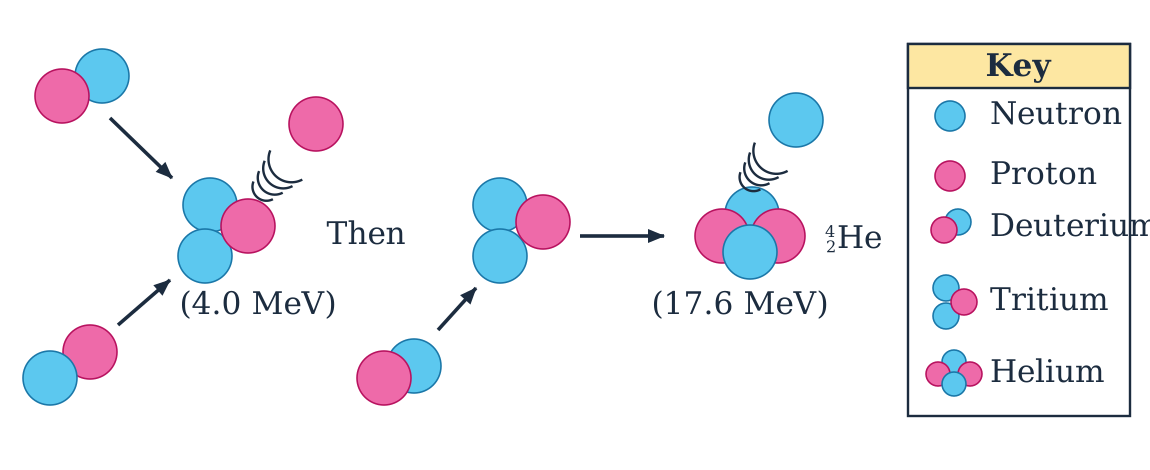
FusionThe nucleons of any pair of neighbouring nuclei on the lighter side of the curve would be more tightly bound if the pair combined into a single nucleus. If deuterium and tritium fuse to form a more stable helium nucleus, a huge amount of energy is released. Such a process is not easy to initiate and needs extremely high temperature, such as occurs naturally in our Sun and the other stars. | |
Energy from Nuclear ReactionsEnergy is obtained from any nuclear reaction in which the binding energy per nucleon of the products increases. LQ 4ends here |
Book Examples
|
Example 19.1.1
Find the mass defect and binding energy of the helium nucleus, given that the mass of a proton is 1.672623$\times10^{-27}$ kg, the mass of a neutron is 1.674929$\times10^{-27}$ kg and the mass of the nucleus of ${}^{4}_{2}\mathrm{He}$ is 6.646786$\times10^{-27}$ kg. |
|||||||||||||||||
|
|||||||||||||||||
Short Questions
|
SQ 19.1.1
What is a nuclide? How is the number of neutrons found from its symbol? |
|||||||||||
|
|||||||||||
|
SQ 19.1.2
Define the atomic mass unit and give its value in kilograms. |
|||||||||||
|
|||||||||||
|
SQ 19.1.3
Why is binding energy considered to have a negative value? |
|||||||||||
|
|||||||||||
|
SQ 19.1.4
Why is binding energy per nucleon a better measure of the stability of a nucleus than its total binding energy? |
|||||||||||
|
|||||||||||
|
SQ 19.1.5
Which is the most stable nuclide? Give the reason. |
|||||||||||
|
|||||||||||
|
SQ 19.1.6
What does the large fall of the binding energy curve from hydrogen to helium suggest? |
|||||||||||
|
|||||||||||
|
MCQ 19.1.1
The number of neutrons in ${}^{235}_{92}\mathrm{U}$ is: |
|||||||
| A | 143 | B | 92 | ||||
| C | 235 | D | 327 | ||||
| Solution:N = A - Z = 235 - 92 = 143. | |||||||
|
MCQ 19.1.2
The radius of a nucleus is of the order of: |
|||||||
| A | $10^{-10}$ m | B | $10^{-8}$ m | ||||
| C | $10^{-14}$ m | D | $10^{-18}$ m | ||||
| Solution:The atom, with its electron cloud, is of the order of $10^{-10}$ m. | |||||||
|
MCQ 19.1.3
One atomic mass unit is equal to: |
|||||||
| A | $1.66\times10^{-24}$ kg | B | $1.66\times10^{-27}$ kg | ||||
| C | $1.67\times10^{-31}$ kg | D | $9.1\times10^{-31}$ kg | ||||
| Solution:It is 1/12th of the mass of a carbon-12 atom, $1.66\times10^{-24}$ g. | |||||||
|
MCQ 19.1.4
The mass defect of a nucleus is: |
|||||||
| A | $m_{nucleus}-Zm_p$ | B | $Zm_p+Am_n$ | ||||
| C | $m_{nucleus}-[Zm_p+(A-Z)m_n]$ | D | $[Zm_p+(A-Z)m_n]-m_{nucleus}$ | ||||
| Solution:The nucleus is lighter than its separate protons and neutrons. | |||||||
|
MCQ 19.1.5
A mass defect of $2.0\times10^{-30}$ kg is equivalent to an energy of: |
|||||||
| A | $6.0\times10^{-22}$ J | B | $1.8\times10^{-15}$ J | ||||
| C | $1.8\times10^{-13}$ J | D | $3.6\times10^{-13}$ J | ||||
| Solution:E = mc^2 = 2.0e-30 x 9e16 = 1.8e-13 J. | |||||||
|
MCQ 19.1.6
The binding energy per nucleon is maximum for: |
|||||||
| A | helium | B | iron | ||||
| C | uranium | D | hydrogen | ||||
| Solution:Iron-56 has about 8.7 MeV per nucleon. | |||||||
|
MCQ 19.1.7
The region of the most stable nuclei lies between mass numbers: |
|||||||
| A | 1 and 20 | B | 100 and 150 | ||||
| C | 200 and 250 | D | 50 and 80 | ||||
| Solution:The curve is lowest, most tightly bound, between A = 50 and 80. | |||||||
|
MCQ 19.1.8
The binding energy of the hydrogen nucleus ${}^{1}_{1}\mathrm{H}$ is: |
|||||||
| A | zero | B | 2.2 MeV | ||||
| C | 7.1 MeV | D | 8.7 MeV | ||||
| Solution:It has just one proton and nothing to bind. | |||||||
|
MCQ 19.1.9
Energy is obtained from a nuclear reaction in which the binding energy per nucleon of the products: |
|||||||
| A | decreases | B | increases | ||||
| C | remains the same | D | becomes zero | ||||
| Solution:The products are more tightly bound than the reactants. | |||||||