Work Done by a Constant Force
LQ 2starts here — How is work done by a (i) constant force (ii) variable force? | |
Work in PhysicsIn everyday speech work is thought of as physical or mental effort. In physics the term involves two things, a force and a displacement, and no work is done unless both are present. | |
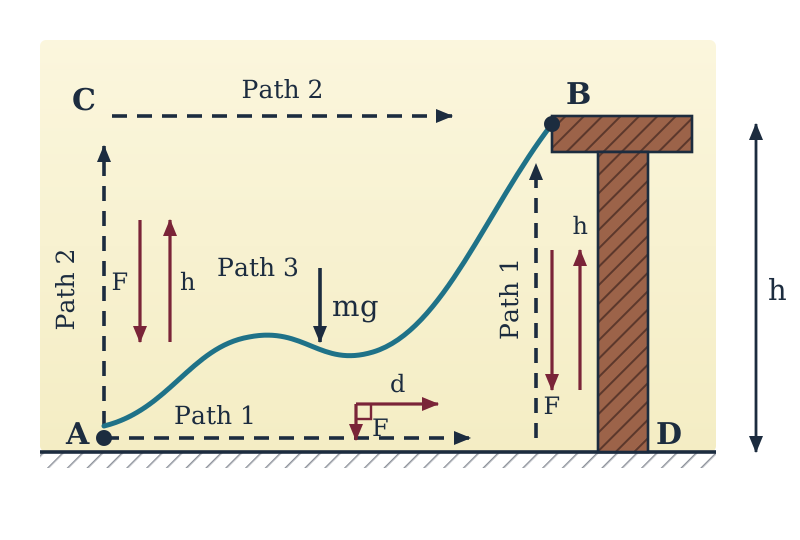
Work Done by a Constant ForceConsider an object being pulled by a constant force $F$ which displaces it through a displacement $d$ in the direction of the force. The work $W$ is defined as the product of the magnitude of the force and the magnitude of the displacement. | |
Mathematically$$W=Fd$$ | |
Zero DisplacementIf the displacement is zero, no work is done however large the force applied. Pushing on a wall may tire the muscles, but the work done is zero. | |
Figure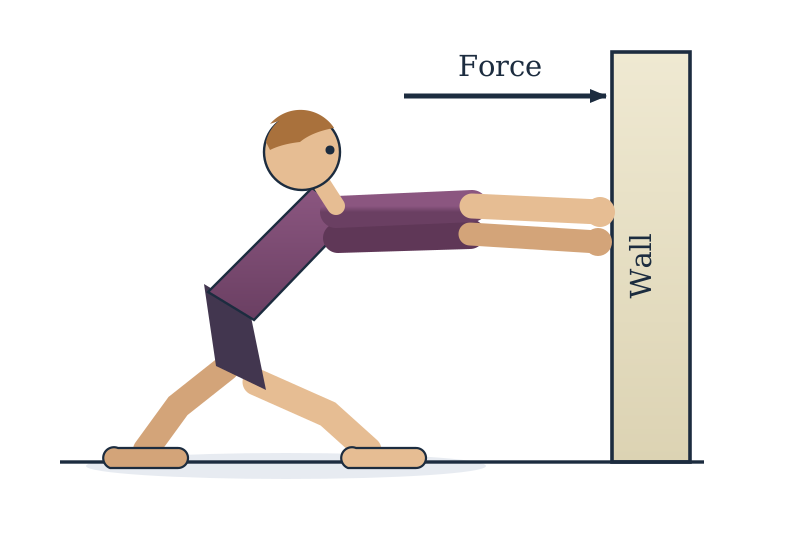 | |
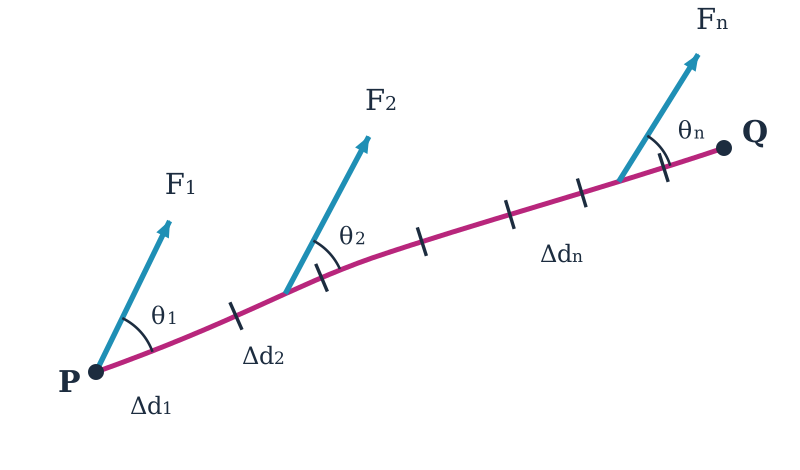
Force at an Angle to the DisplacementThe force applied on a body is not always along the displacement. If the force $F$ makes an angle $\theta$ with the displacement $d$, the work done is the product of the component of the force along the displacement and the magnitude of the displacement. | |
Figure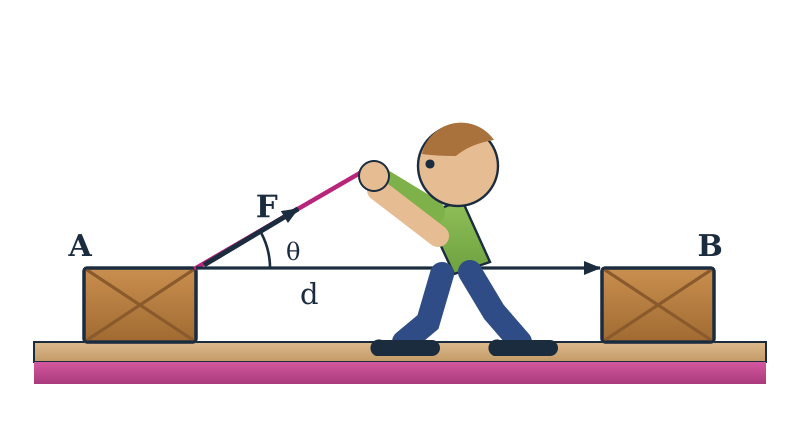 | |
Component Along the DisplacementThe component of the force along the displacement is $F\cos\theta$, and the work done is that component multiplied by the displacement. $$W=(F\cos\theta)\,d=Fd\cos\theta$$ | |
Figure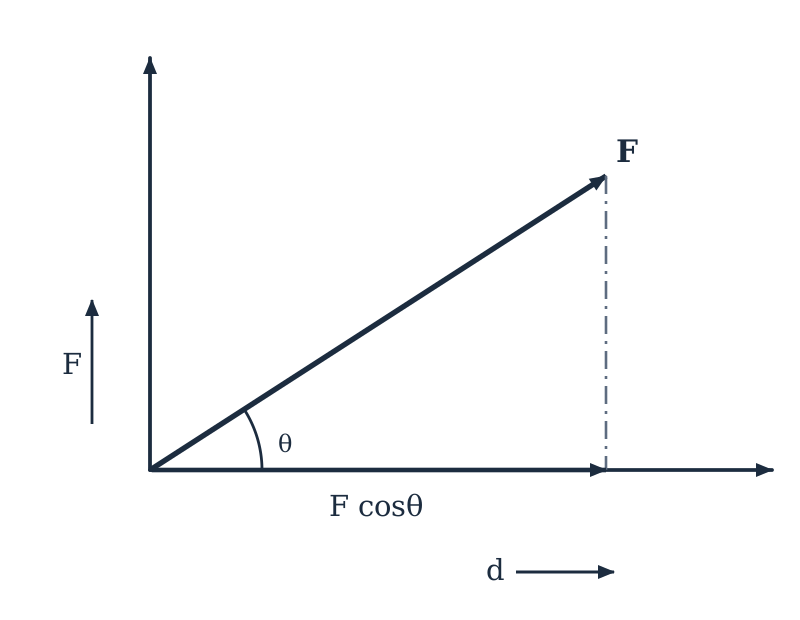 | |
General Form$$W=\vec{F}\cdot\vec{d}=Fd\cos\theta$$ | |
Scalar QuantityThe work done is the scalar product of the force and the displacement, so work itself is a scalar quantity. It has magnitude only and no direction. | |
Unit of WorkThe SI unit of work is the newton metre, which is given the name joule. $$W=Fd$$ $$1\,\mathrm{J}=1\,\mathrm{N}\times1\,\mathrm{m}=1\,\mathrm{N\,m}$$ | |
Definition of a JouleOne joule is the work done when a force of one newton displaces a body through one metre in the direction of the force. | |
Sign of the Work DoneThe angle between the force and the displacement decides the sign of the work. If the angle is less than $90^{\circ}$, the work done is positive. If the angle is a right angle, no work is done, because the cosine of a right angle is zero. If the angle is greater than $90^{\circ}$, the work done is negative. | |
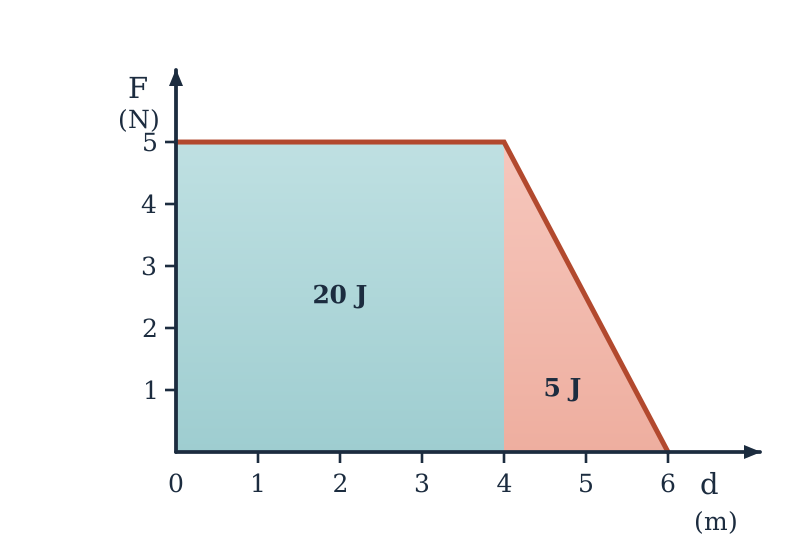
Work from a Force-Displacement GraphWhen a constant force acts through a distance $d$, the event can be plotted on a graph with the distance along the x-axis and the force along the y-axis. | |
Shape of the GraphThe force does not vary, so the graph is a horizontal straight line. | |
Area Under the GraphIf the constant force $F$ and the displacement $d$ are in the same direction, the work done is $Fd$, and the shaded rectangle under the line has exactly that area. $$W=\text{area under the graph}$$ | |
Graph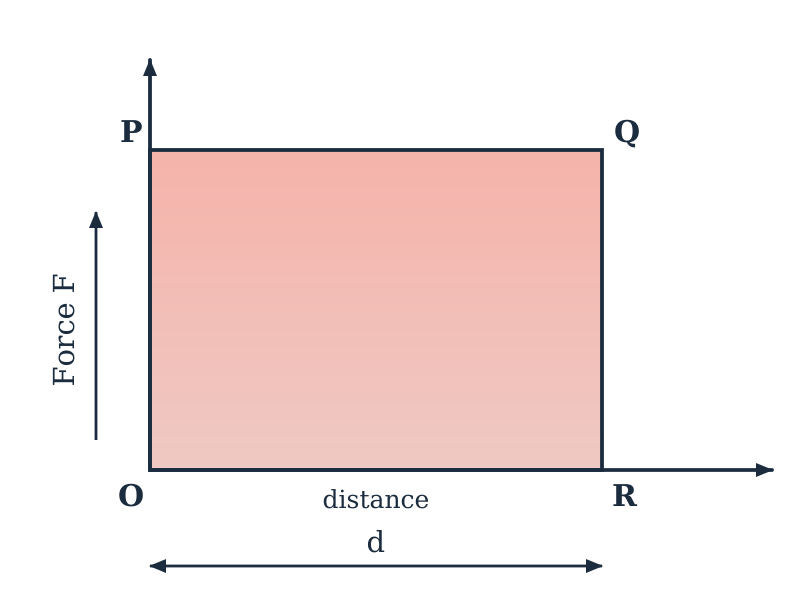 | |
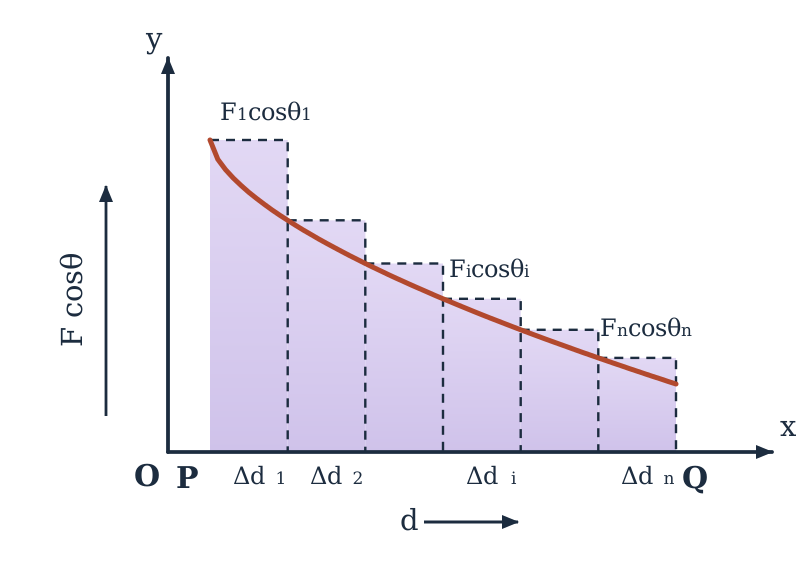
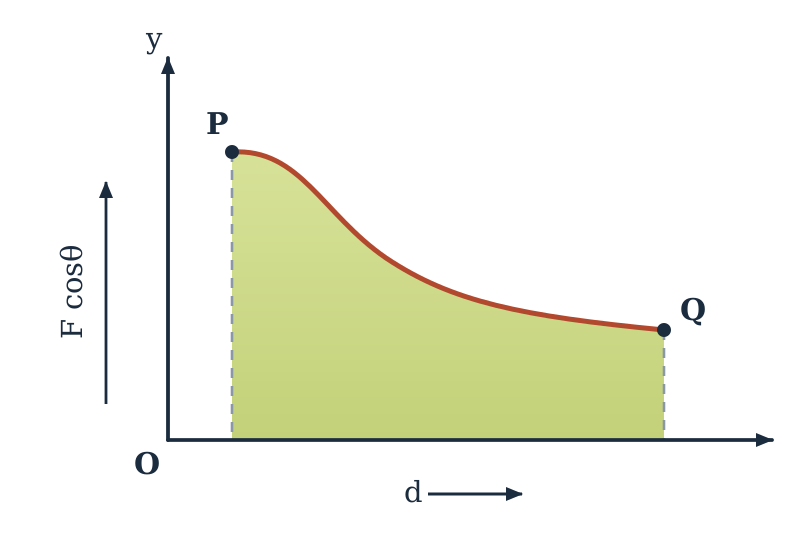
ConclusionThe area under a force-displacement curve represents the work done by the force. When the force is not along the displacement, the graph is plotted between $F\cos\theta$ and $d$ instead. |
Short Questions
|
SQ 4.1.1
A man pushes hard against a wall but the wall does not move. Is any work done? Explain. |
|||||||||||||||
|
|||||||||||||||
|
SQ 4.1.2
Under what condition is the work done by a force zero even though both the force and the displacement are not zero? |
|||||||||||||||
|
|||||||||||||||
|
SQ 4.1.3
Show that work is a scalar quantity although force and displacement are both vectors. |
|||||||||||||||
|
|||||||||||||||
|
SQ 4.1.4
A force of $10\,\mathrm{N}$ moves a body through $5\,\mathrm{m}$, acting at $60^{\circ}$ to the displacement. Find the work done. |
|||||||||||||||
|
|||||||||||||||
|
SQ 4.1.5
When is the work done by a force said to be negative? Give one example. |
|||||||||||||||
|
|||||||||||||||
|
SQ 4.1.6
How is the work done by a constant force found from a force-displacement graph? |
|||||||||||||||
|
|||||||||||||||
|
MCQ 4.1.1
Work done by a constant force is the: |
|||||||
| A | vector product of force and displacement | B | scalar product of force and displacement | ||||
| C | ratio of force to displacement | D | sum of force and displacement | ||||
| Solution:Work is defined as $\vec{F}\cdot\vec{d}$, and the scalar product of two vectors is a scalar. | |||||||
|
MCQ 4.1.2
If the angle between the force and the displacement is $90^{\circ}$, the work done is: |
|||||||
| A | maximum | B | negative | ||||
| C | zero | D | equal to $Fd$ | ||||
| Solution:$W=Fd\cos90^{\circ}$ and the cosine of a right angle is zero. | |||||||
|
MCQ 4.1.3
The SI unit of work is equivalent to: |
|||||||
| A | newton metre | B | newton per metre | ||||
| C | newton second | D | newton per second | ||||
| Solution:$W=Fd$, so the unit of work is $\mathrm{N\,m}$, which is given the name joule. | |||||||
|
MCQ 4.1.4
A force of $5\,\mathrm{N}$ moves a body through $4\,\mathrm{m}$ at $60^{\circ}$ to the displacement. The work done is: |
|||||||
| A | 20 J | B | 10 J | ||||
| C | 17.3 J | D | zero | ||||
| Solution:$W=5\times4\times\cos60^{\circ}=20\times0.5=10\,\mathrm{J}$ | |||||||
|
MCQ 4.1.5
However large the applied force, no work is done if the: |
|||||||
| A | force is small | B | body is heavy | ||||
| C | displacement is zero | D | surface is rough | ||||
| Solution:$W=Fd$, so a zero displacement makes the work zero whatever the force. | |||||||
|
MCQ 4.1.6
The work done by a force is negative when the angle between the force and the displacement is: |
|||||||
| A | zero | B | less than $90^{\circ}$ | ||||
| C | equal to $90^{\circ}$ | D | greater than $90^{\circ}$ | ||||
| Solution:The cosine of an angle greater than a right angle is negative, so $Fd\cos\theta$ is negative. | |||||||
|
MCQ 4.1.7
The area under a force-displacement graph gives the: |
|||||||
| A | power | B | work done | ||||
| C | momentum | D | acceleration | ||||
| Solution:For a constant force the area of the rectangle under the line is $Fd$, which is the work done. | |||||||